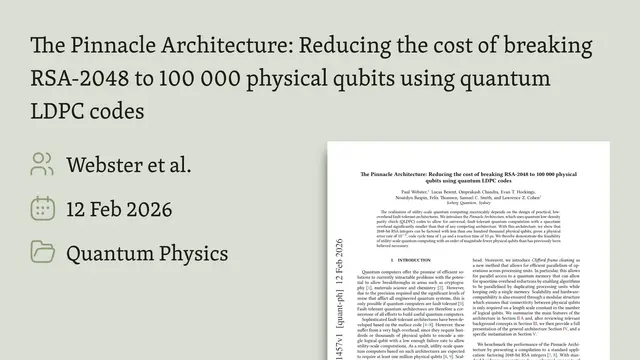
Shor's Algorithm with Just 10,000 Atomic Qubits
This presentation reveals a groundbreaking architecture that shrinks the hardware requirements for breaking RSA and ECC encryption by orders of magnitude. By combining high-rate quantum error-correcting codes with reconfigurable neutral-atom processors, researchers demonstrate that Shor's algorithm—long thought to require millions of physical qubits—can run on as few as 10,000. We explore the technical innovations that make this possible, examine concrete resource estimates for cryptographically relevant problems, and consider the urgent implications for both quantum hardware development and post-quantum cryptography standards.Script
Breaking RSA encryption has always seemed impossibly distant—requiring millions of physical qubits and decades of engineering. But this paper collapses that timeline. Researchers show that Shor's algorithm, the quantum threat to modern cryptography, can run on neutral-atom processors with as few as 10,000 qubits.
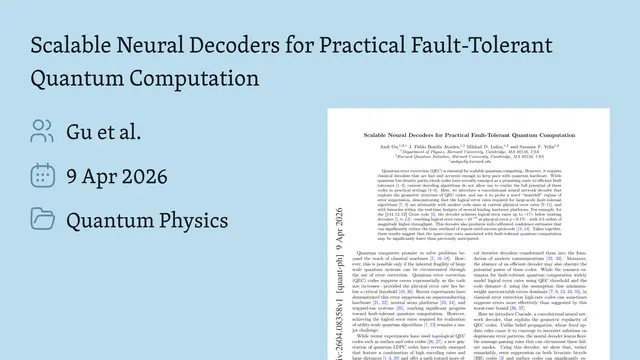
The key innovation is high-rate quantum error-correcting codes—specifically lifted-product and bivariate bicycle constructions. These codes pack far more logical information into each physical qubit than traditional surface codes. Where earlier architectures demanded millions of qubits, this approach achieves comparable fault tolerance with just tens of thousands, all on hardware that's already being demonstrated in labs with 6,000-qubit arrays.
So what can you actually break with 10,000 qubits?
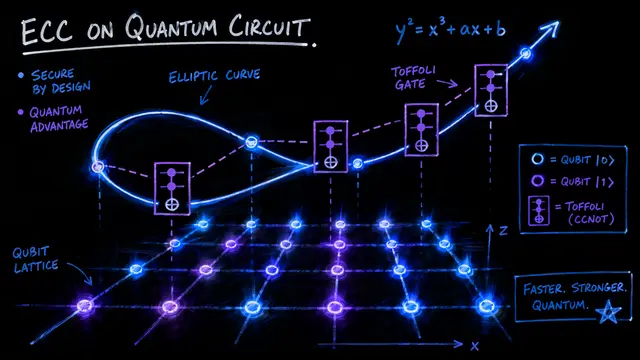
The analysis targets two cryptographic standards. RSA 2048, still widely deployed, requires about 102,000 qubits and 97 days in a fully parallel architecture. But elliptic curve cryptography—ECC 256, the foundation of modern TLS—falls with just 26,000 qubits and 10 days. The discrete logarithm problem on elliptic curves has inherently lower quantum complexity, making it the more immediate vulnerability.
The architecture itself is surgical in its efficiency. Logical operations happen through code surgery—reconfigurable measurements that knit and split encoded quantum information across functional zones. Qubits teleport between memory and processor blocks as algorithms unfold. And magic states, the fuel for non-Clifford gates, distill in parallel factories with error rates so low they no longer bottleneck computation.
This isn't just a theoretical exercise—it redefines the quantum threat model. The gap between laboratory demonstrations and cryptographically dangerous machines has narrowed from impossible to plausible within a decade. Post-quantum standards, already in deployment, now face real urgency. And the frontier hasn't closed: higher-rate codes, faster measurements, and space-time compiler optimizations promise to shrink both the qubit count and the clock time even further.
Shor's algorithm just became an engineering problem, not a distant dream. Visit EmergentMind.com to explore more cutting-edge research and create your own videos.