RSI-Anything: Unlocking Recursive Self-Improvement with World Models
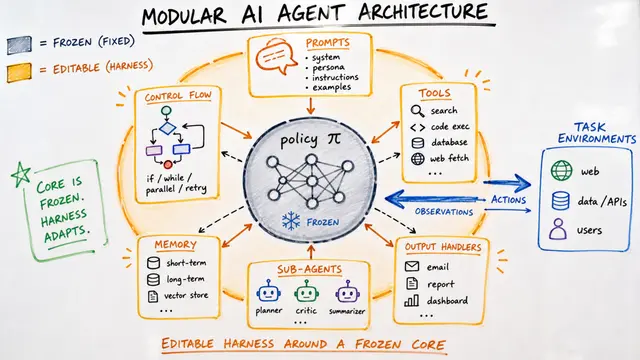
This presentation introduces RSI-Anything, a framework that treats policy and predictive world model as a coupled, persistent system for recursive self-improvement. Rather than updating policies alone, RSI-Anything uses world-model predictions to guide which candidates receive costly external evaluation, adapts the predictor when reliability degrades, and retains policy–model pairs only when they pass component-level and compatibility checks. Across code repair, GUI interaction, laboratory planning, reaction optimization, and immune-science workflows, the framework demonstrates improved feedback allocation and successive gains under constrained interaction budgets.Script
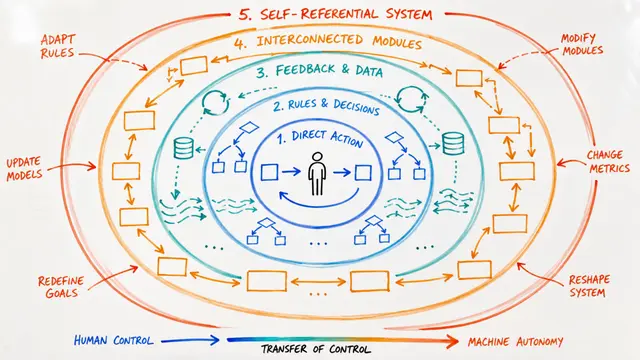
Most recursive learning systems update policies through trial and error, but their predictions become unreliable the moment the policy changes. RSI-Anything solves this by treating the policy and its world model as a coupled system, where both must pass compatibility checks before the next cycle begins.
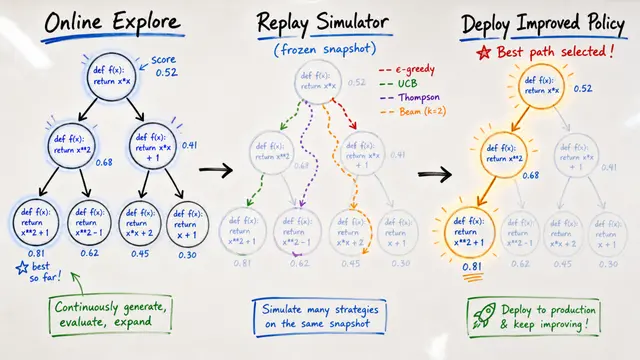
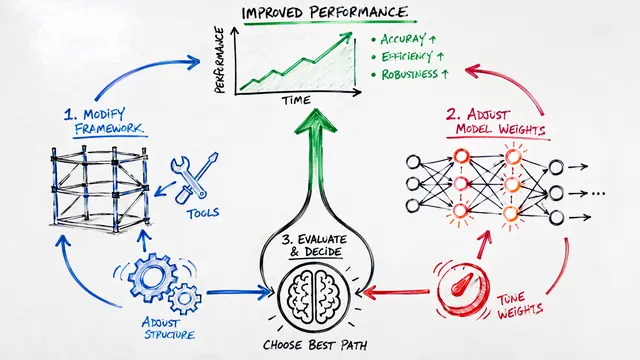
The framework operates in three stages: the policy proposes candidates, the world model predicts their outcomes and a verifier removes invalid options, then only high-utility candidates receive costly external evaluation. Those observations then drive policy revision and, when reliability drops, trigger world-model adaptation.
In controlled code-repair experiments, the researchers held the coder fixed and varied only the selection mechanism. Predictive selection improved hidden-test success from 26.3 percent to 29.2 percent, then adapting the world model pushed it to 31.2 percent, all without increasing online test usage.
The GUI interaction results reveal something deeper than task completion. Success rose from 51 percent to 99 percent, but actions per episode dropped by 39 percent, repeated clicks fell to zero, and incorrect submissions nearly vanished. The retained policy–model pair optimized for reliability, not just efficiency.
Laboratory planning tasks show persistent improvement across five successive policy versions. The final score climbed monotonically from 21.8 percent to 46.0 percent, exceeding the reference system by 0.69 percentage points. Each retained version outperformed the last, demonstrating accumulation rather than one-shot selection.
The framework ultimately asks whether we can make recursive learning reliable when feedback is expensive and policies keep shifting the ground beneath our predictors. Visit EmergentMind.com to explore the full results and create your own videos on the latest research.