The Last AI Built by Humans: Toward Genuine Recursive Self-Improvement
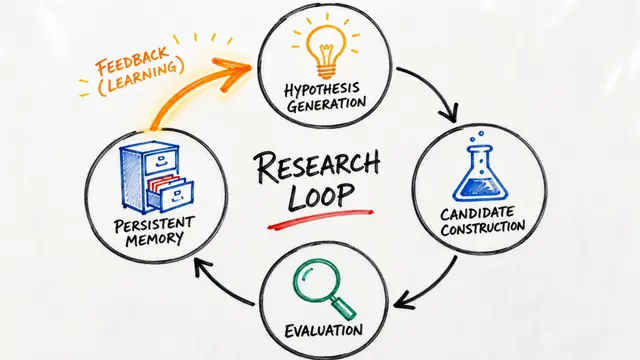
This presentation examines a framework for analyzing recursive self-improvement in AI systems through five autonomy levels, from executing prescribed updates to modifying the mechanisms that govern subsequent improvement. Drawing on recent evidence from prompt optimization, autonomous training pipelines, deployment adaptation, and preliminary industrial systems, the talk clarifies why persistent memory, automated experimentation, and stronger benchmark performance are not interchangeable forms of RSI—and why the most consequential question is not whether AI can generate better artifacts, but whether inherited changes can reliably improve the process that generates, verifies, and inherits later improvements.Script
Foundation model development now consumes approximately 9,240 expert-hours to validate 1,320 professional tasks, or 70,000 submission attempts to produce a single 3,000-question benchmark. The marginal cost of generating candidate improvements increasingly exceeds the cost of executing them, and that inversion is driving interest in recursive self-improvement.
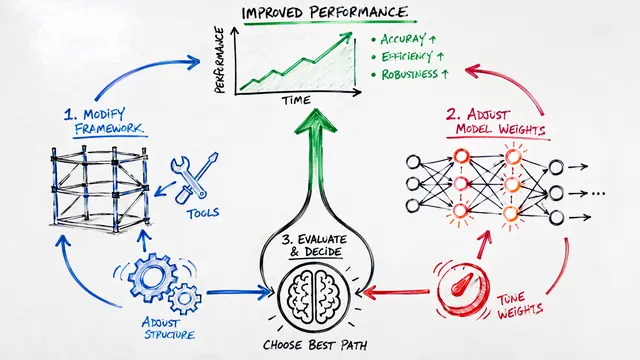
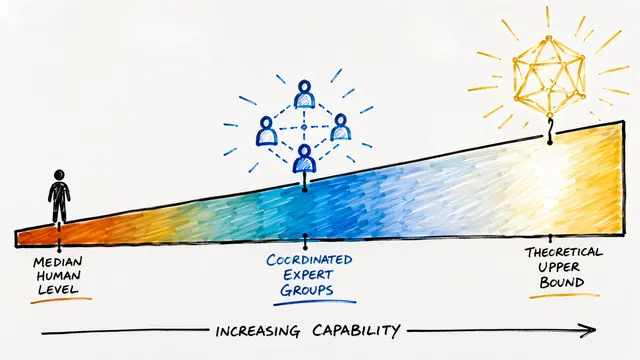
The authors propose five autonomy levels organized around the improvement loop, not the model architecture. Level 1 executes prescribed updates. Level 2 selects interventions. Level 3 controls future learning experience. Level 4 adapts from deployment. Level 5 improves the improvement mechanism itself.
Advanced mathematics and graduate science have reached headroom-closed index values above 85, but software engineering stands at 52.6, search and terminal agents at 56.8, and tool agents at just 39.9. The domains with the largest remaining headroom are precisely those that require state tracking, planning, tool selection, and recovery from cascading errors.
Operational automation of data pipelines is distinct from learner-conditioned experience autonomy. The decisive evidence is that learner feedback changes what experience is selected or generated next, and that persistent learning changes later acquisition decisions. Search Self-Play and Absolute Zero exemplify this closed dependence.
In a pilot involving eight model–harness configurations, clean workspaces improved pass rates by 21.7 to 51.6 percentage points over noisy workspaces. Later, reconstructed environments improved rubric scores by 18.65 to 39.67 percentage points across fixed model pairings, demonstrating that environment state can impose a performance bottleneck independent of the underlying model.
The strongest unresolved issue is not whether AI systems can generate better artifacts, but whether inherited changes can reliably improve the process that generates, verifies, and inherits later improvements. STOP's fourth-generation improver outperformed the seed on five transfer tasks, but 14 of 100 trials in another system ended below initial performance, demonstrating that self-modification can be persistent and recursive while remaining unstable. Visit EmergentMind.com to explore the full framework and create your own videos on recursive self-improvement research.