Counting Corners to Classify Knotted Tori in Five Dimensions
This lightning talk introduces a new combinatorial framework for computing the rotation class of Legendrian tori embedded in five-dimensional contact space. By developing Lagrangian hypercube diagrams that generalize classical grid diagrams from knot theory, the authors reduce a sophisticated topological invariant to simple corner-counting formulas on two-dimensional projections, prove that every integer pair can be realized as a rotation class, and open algorithmic pathways for computing contact homology in higher dimensions.Script
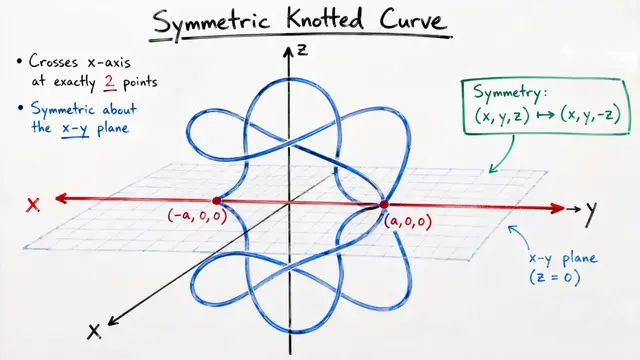
In three dimensions, we classify knotted loops by counting twists. In five dimensions, knotted tori demand an entirely new invariant: the rotation class, a pair of integers that has resisted simple computation until now.
The authors discovered that rotation information hides in the corners of grid diagrams. By counting counterclockwise corners minus clockwise corners and dividing by four, they extract the rotation number directly from the diagram, no calculus required.
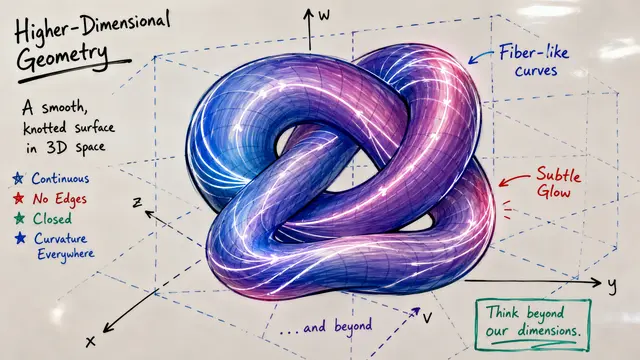
To handle tori in five dimensions, the paper introduces Lagrangian hypercube diagrams, living in a four-dimensional cube with one axis per coordinate pair. Each hypercube projects down to two grid diagrams, one for each generator of the torus, encoding the full rotation class as a pair of winding numbers.
The central theorem states that the rotation class is simply the pair formed by the winding numbers of the two projections. This reduces a homotopy-theoretic invariant to integer arithmetic, and the authors prove every integer pair can be realized by explicit construction.
The framework goes further, computing the Maslov index for any homology class as twice the dot product of the class coefficients with the rotation class. The Maslov number, the smallest positive index, equals twice the greatest common divisor of the two winding numbers.
By building Lagrangian unknots with arbitrary rotation numbers and combining them through the hypercube construction, the authors achieve universality: every rotation class is realized. This combinatorial toolkit paves the way for algorithmic contact homology and may illuminate singular geometries in string theory. Visit EmergentMind.com to explore more cutting-edge research and create your own explainer videos.