Teaching Geometry Through Computation
This tutorial paper reimagines how physics students learn topology, differential geometry, and general relativity by integrating formal mathematical exposition with executable Mathematica notebooks. Rather than treating these subjects as purely abstract theories, the authors translate definitions, tensor operations, and physical applications into runnable calculations and visualizations, creating a computational companion that makes geometric concepts tangible through direct symbolic manipulation and graphical verification.Script
Most physics students encounter differential geometry through pages of abstract definitions and index gymnastics. This tutorial takes a radically different approach: every topological space, every tangent vector, every curvature tensor is paired with executable Mathematica code that lets you see the structure, manipulate it, and verify the formulas yourself.
The power of this method becomes clear in the homotopy chapter. A loop on a punctured plane cannot contract to a point because the hole creates a topological obstruction. The notebook visualizes the entire deformation, showing exactly why the fundamental group of the circle is the integers while a disk without holes has trivial fundamental group.
When the authors compute Berry curvature for a two-level quantum system, the result is a monopole-like field on the sphere. The integral of this curvature gives the first Chern number, which equals 1. The computational verification shows that while the Berry connection depends on gauge choice, the curvature and its topological invariant do not.
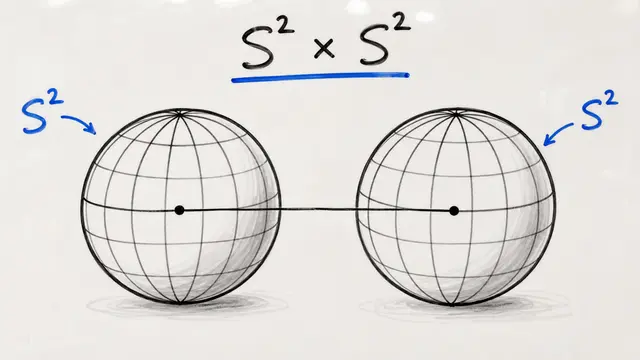
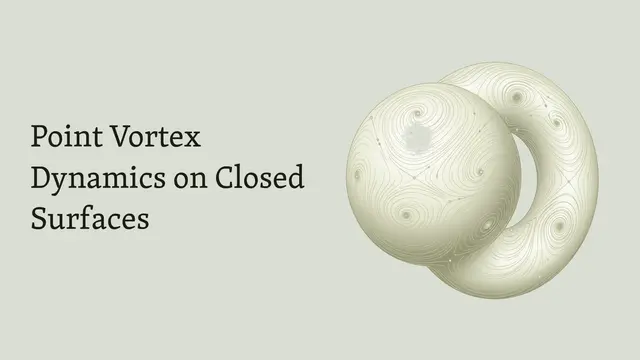
Tangent vectors are introduced through equivalence classes of curves and as derivations on smooth functions. The notebooks construct coordinate bases, visualize tangent vectors on spheres and tori, and verify transformation laws under chart changes. This makes the abstract definition concrete: you see that tangent vectors are intrinsic objects even though their components depend on coordinates.
The Maxwell chapter exemplifies the method's strength. Electric and magnetic fields combine into a two-form, the homogeneous equations become exterior derivative of F equals zero, and the action is a compact wedge-product integral. The notebook recovers the familiar energy density in flat spacetime, then shows how the formulation naturally extends to curved backgrounds by separating metric-independent structure from Hodge-operator dependence.
The tutorial's scope is deliberately broad rather than proof-complete, covering bundles, Lie groups, and general relativity through calculation rather than theorem. Its value lies in making geometry operational: definitions become verifiable, abstract objects become manipulable, and the gap between formalism and physical intuition narrows. To explore more research brought to life through video, visit EmergentMind.com and create your own.