Vector Balancing via Directional Total Variation
This presentation explains a breakthrough resolution of the Komlós conjecture, establishing an explicit dimension-free bound for vector signing problems. The paper introduces directional total variation as a stable invariant under iterative transformations, proving that any collection of unit vectors can be signed so their sum stays bounded by approximately 7.52 in every coordinate. The approach yields the long-conjectured square-root dependence in the Beck-Fiala discrepancy problem without dimension or sparsity restrictions, though the construction remains existential rather than algorithmic.Script
Can you take any collection of vectors in high-dimensional space and assign plus or minus signs so that their sum never gets too large in any direction? The Komlós conjecture said yes, with a universal constant, and this paper proves it with the explicit bound 3 times the square root of 2 pi.
The problem is beautifully simple. Given vectors of Euclidean norm at most 1, the authors prove you can choose signs so the sum has infinity norm less than 7.52, independent of dimension or how many vectors you have.
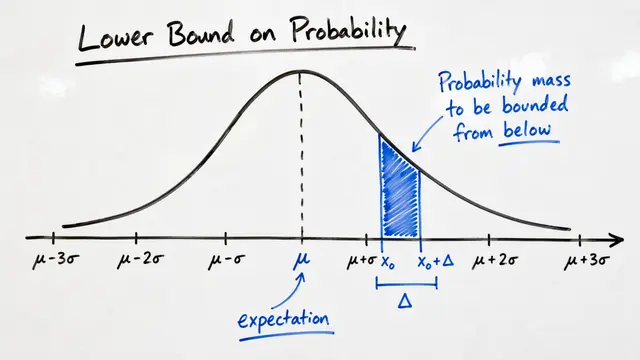
The key innovation is tracking something called directional total variation. Instead of controlling Gaussian measure like classical approaches, the authors control how much a probability density can change when you nudge it in any direction, creating an invariant that survives iterative transformations.
Here's how it works. You lift each convex body into one higher dimension, rearrange the vertical slices symmetrically, and extract a new density from a prescribed horizontal section. As long as the variation parameter times the vector norm stays below one third, the new density inherits the same directional bounds.
For discrepancy theory, the payoff is immediate. The Beck-Fiala conjecture asked whether discrepancy grows like the square root of column sparsity. This result confirms it for every positive integer, with no dimension or sparsity conditions, though the proof remains existential and doesn't yield an efficient algorithm.
The argument starts with a cosine-squared density on a cube of radius 3 root 2 pi and iterates the transform for each vector. The constant isn't proven optimal, the construction isn't algorithmic, and it doesn't control prefixes or give concentration bounds. But it closes a decades-old problem with an explicit universal constant, and you can explore the full technical details at EmergentMind.com, where you can also create videos like this one for any paper you're studying.