Self-Teaching AI: Dense Credit Assignment Through Retrospective Learning
This presentation explores a breakthrough in reinforcement learning for large language models that transforms sparse scalar rewards into dense token-level learning signals. By using the model as its own teacher after receiving feedback, Self-Distillation Policy Optimization (SDPO) achieves superior sample efficiency and performance across coding and reasoning tasks, demonstrating how AI systems can learn more effectively from their own mistakes when given rich textual feedback.Script
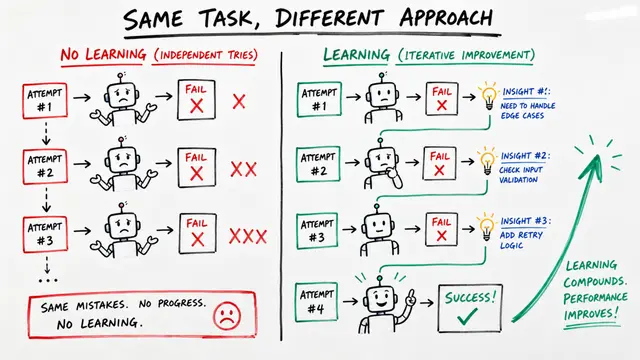
What if an AI could become its own teacher, learning from detailed feedback about its mistakes instead of just being told right or wrong? Most reinforcement learning for language models relies on sparse scalar rewards that offer little guidance about which specific choices led to failure, creating a massive credit assignment bottleneck that slows learning.
Building on this challenge, traditional reinforcement learning from verifiable rewards typically wastes valuable information. When a coding attempt fails, the environment provides detailed error messages and test failures, but standard methods like GRPO only use a binary success signal, ignoring all that rich diagnostic feedback.
The key insight is to harness the model's own capacity for retrospective reasoning.
This comparison reveals the fundamental difference in approach. While traditional methods treat all tokens equally regardless of their contribution to failure, SDPO uses the model twice: first as a student making an attempt, then as a self-teacher that retrospectively evaluates the same attempt after seeing what went wrong.
The elegance lies in its simplicity: the same model parameters serve dual roles. When the self-teacher sees feedback about runtime errors or failed tests, it can retrospectively assign higher probability to better token choices, creating dense learning signals at every position in the sequence.
Now let's examine how this translates into a concrete learning algorithm.
Mathematically, SDPO minimizes the KL divergence between the student's token predictions and the self-teacher's feedback-informed predictions. This creates advantages that are positive where the teacher increases probability and negative where it decreases probability, providing granular guidance for every token choice.
Practically, SDPO adds minimal computational overhead compared to standard policy gradient methods. The extra forward pass for teacher probabilities can run in parallel with other computations, and clever implementation techniques like top-K distillation keep memory usage manageable.
This visualization perfectly captures the core mechanism in action. You can see how the self-teacher model, after processing the feedback about what went wrong, assigns different probabilities to each token in the original attempt. The green areas show where the teacher would increase probability for better choices, while red areas indicate tokens that should be discouraged, creating a detailed learning map across the entire response.
The proof comes in the empirical results across multiple challenging domains.
The coding results are particularly compelling because they showcase SDPO in its ideal environment. With detailed compiler errors and test case failures as feedback, the method achieves both higher final performance and dramatically improved sample efficiency, reaching the baseline's best results in a quarter of the training time.
Even more impressive is SDPO's performance on tasks without explicit rich feedback. By using successful rollouts from the same batch as implicit feedback for failed attempts, the method still achieves meaningful improvements while learning to be much more concise in its responses.
Perhaps most remarkably, SDPO can even improve at test time on individual hard problems. Through iterative self-teaching with feedback, it learns to find solutions more efficiently than brute force sampling approaches, even starting from scenarios where the model almost never succeeds on the first try.
These results reveal several important principles about learning from feedback.
The success factors reveal why SDPO works: it fundamentally relies on the model's ability to learn from context. Larger models with stronger in-context learning capabilities make better self-teachers, and the quality of environmental feedback directly translates into learning signal quality.
The method's strengths and limitations are closely tied to its fundamental design. While it eliminates the need for external teachers and integrates seamlessly into existing workflows, it does require models sophisticated enough for effective retrospective reasoning and high-quality environmental feedback to reach its full potential.
The implications extend far beyond the specific tasks tested in this work.
This work represents a significant step toward more efficient and accessible AI training. By showing how models can effectively teach themselves from environmental feedback, it opens up new possibilities for learning in domains where traditional reward signals are sparse but diagnostic information is abundant.
The authors outline several promising research directions that could amplify these benefits. Extending to long-horizon agentic tasks, scaling to multi-task scenarios, and exploring how self-teaching works with more subjective feedback could significantly expand the method's applicability and impact.
Self-Distillation Policy Optimization demonstrates that the key to better AI learning might already exist within the models themselves, waiting to be unlocked through clever use of environmental feedback. This elegant approach to dense credit assignment could fundamentally change how we train AI systems in any domain rich with diagnostic information. To dive deeper into this fascinating intersection of self-supervision and reinforcement learning, visit EmergentMind.com to explore the full paper and related research.