Qwen-VLA: One Model to Control Them All
This presentation explores Qwen-VLA, a unified vision-language-action model that generalizes across manipulation, navigation, and trajectory-centric tasks on diverse robot platforms. We examine its architectural innovations, staged training curriculum spanning text-to-action pretraining through reinforcement learning, and empirical results showing that a single generalist model can match or exceed specialist performance while dramatically improving out-of-distribution generalization on real robots.Script
Training a separate AI model for every robot, every task, and every environment creates an unsustainable explosion of specialist systems. Qwen-VLA takes a radically different approach, unifying manipulation, navigation, and trajectory control into a single model that adapts across platforms through simple text prompts.
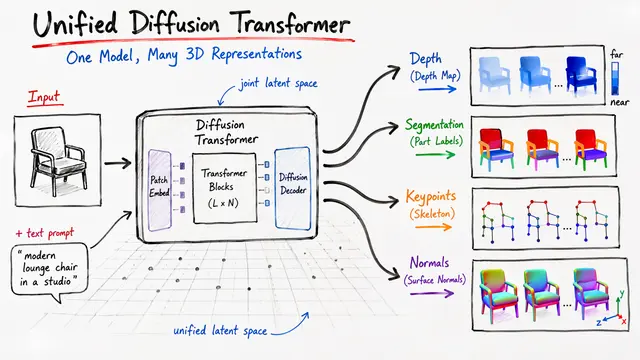
The architecture treats all embodied tasks as conditional prediction in a shared action and trajectory space. A multimodal backbone processes vision, language, and embodiment descriptions, while a diffusion transformer policy head generates action sequences masked and padded to fit any robot's control dimensions.
Training follows a carefully staged curriculum. First, the action decoder learns a language-indexed action prior from text alone, decoupling semantics from vision. Then vision is introduced to ground that prior, followed by supervised fine-tuning on high-quality demonstrations, and finally reinforcement learning to optimize closed-loop task success.
The results are striking. Qwen-VLA achieves 97.9 percent on single-arm manipulation benchmarks, 86.1 percent on bimanual tasks, and state-of-the-art navigation performance, matching or exceeding most specialist models despite training on a unified architecture.
Real-world out-of-distribution tests on the ALOHA dual-arm platform reveal the power of unified pretraining. Without it, success on novel colors, objects, and backgrounds drops to 36 percent. With pretraining across diverse embodiments and tasks, that jumps to 77 percent.
Qwen-VLA demonstrates that a single unified model can achieve robust, generalizable control across tasks, environments, and embodiments through prompt-conditioned adaptation. To dive deeper into this work and generate your own video explanations of cutting-edge research, visit EmergentMind.com.