Generated Reality: Human-centric World Simulation via Interactive Video with Hand/Camera Control
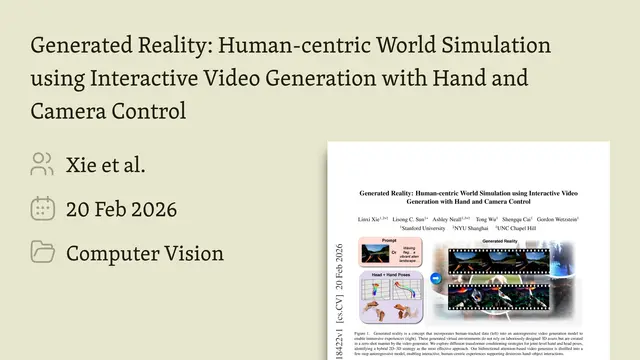
This presentation explores a breakthrough in extended reality content generation that eliminates the need for traditional 3D asset creation. The authors demonstrate a video diffusion system that generates photorealistic, interactive virtual environments in real-time by conditioning on both head and hand poses tracked from VR headsets. Through hybrid hand-pose conditioning strategies and distillation for speed, the system achieves task completion rates of 71% in user studies, proving that embodied AI can create immersive, responsive worlds driven directly by natural human movement.Script
Creating photorealistic virtual reality content today requires expensive 3D modeling expertise and massive computational resources. But what if you could generate entire interactive worlds in real-time, simply by moving your hands and head naturally? This paper demonstrates exactly that breakthrough.
The authors identified a critical limitation in world models: while recent video diffusion systems can generate stunning visuals, they respond only to coarse signals like text prompts or camera position. The nuanced, articulated movements of human hands—essential for believable interaction—were completely missing from the control vocabulary.
The solution required rethinking how hand information enters the generative model.
Through rigorous ablation across four conditioning architectures, they discovered that neither 2D skeletons nor 3D pose parameters alone were sufficient. The hybrid approach combines spatially aligned skeleton overlays with articulated 3D hand parameters, achieving anatomically accurate generation even when fingers occlude each other or grasp complex objects.
The complete pipeline integrates commercial VR headset tracking with a transformer-based video diffusion model. Camera pose is encoded via Plücker-ray embeddings, while hand pose flows through both a 2D skeleton encoder and a 3D parameter network. These modalities fuse via element-wise addition before entering the diffusion transformer blocks, enabling joint, coherent control over both viewpoint and manipulation.
To move from research prototype to interactive system, the authors applied distillation techniques that convert slow bidirectional models into fast autoregressive generators. The result is a system running at 11 frames per second with under 1.5 seconds of latency, making genuine real-time VR interaction feasible for the first time with generative video.
The system's generalization is remarkable. Trained on controlled hand-object interaction datasets, it produces coherent egocentric video across wildly different environments—alien terrain, forest paths, dungeon corridors—all with physically plausible hand movements. This zero-shot transfer suggests the model has learned fundamental principles of embodied interaction rather than memorizing specific scenarios.
But does explicit hand control actually improve the user experience?
The user study provides the definitive answer. Participants performed three manipulation tasks: pushing a button, opening a jar, and turning a steering wheel. With hand and head tracking enabled, task completion soared from 3% to 71%. Even more striking, perceived control jumped from 1.74 to 4.21 on a 7-point scale. Users weren't just completing tasks—they felt genuinely in command of the generated world.
This work proves that asset-free, embodied VR is no longer theoretical. By conditioning video diffusion on the precise language of human movement—joint angles, camera trajectories, hand articulation—the authors have opened a path toward virtual worlds that respond to us as naturally as the physical one does. To explore the full technical details and see more examples, visit EmergentMind.com.