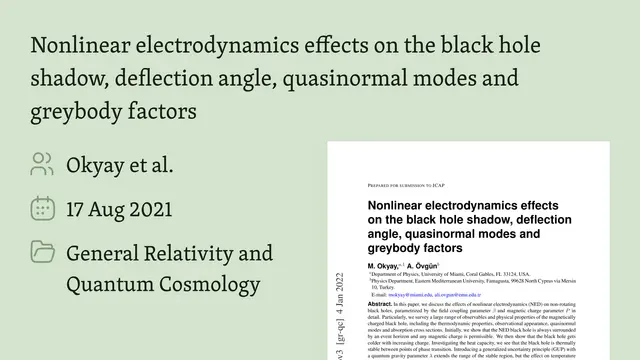
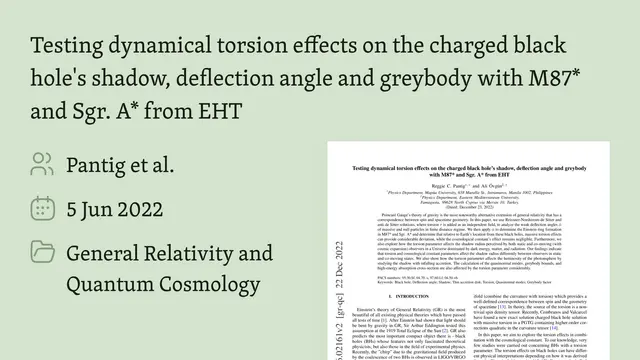
When Black Holes Break the Rules: Testing Einstein with M87* and Sgr A*
This presentation explores how nonlinear electrodynamics modifies black hole physics in ways we can actually observe. Using data from the Event Horizon Telescope's groundbreaking images of M87* and Sgr A*, the research investigates how electromagnetic fields in extreme environments create measurable differences in black hole shadows, accretion disk emissions, and light deflection—offering a direct test of general relativity's limits at the edge of these cosmic giants.Script
The Event Horizon Telescope gave us the first images of black holes M87* and Sgr A*, but what if those shadows are hiding secrets about physics beyond Einstein's equations? This research probes whether nonlinear electrodynamics—where electromagnetic fields behave unexpectedly in extreme environments—leaves observable fingerprints on black hole shadows, accretion disks, and the paths light takes around these cosmic monsters.
In the intense gravitational fields near black holes, quantum effects cause electromagnetic fields to polarize the vacuum itself, creating nonlinear behavior that standard physics doesn't predict. The authors introduce parameters beta and C that quantify how much this nonlinear electrodynamics warps spacetime differently than Einstein's equations alone would suggest, and crucially, these parameters change observable features we can measure with telescopes.
So how do these theoretical modifications show up in real telescope data?
The research identifies three observable channels where nonlinear electrodynamics leaves its mark. Black hole shadows expand or contract depending on the NLE parameters, with the photon sphere—the boundary where light orbits—shifting measurably. Meanwhile, the accretion disk's energy flux, temperature, and luminosity all deviate from standard predictions in ways that depend directly on beta and C, creating a diagnostic fingerprint.
Here's where theory meets reality. By comparing their NLE black hole model predictions to the actual Event Horizon Telescope measurements of M87* and Sgr A*, the authors derive concrete constraints on the beta parameter. Using the Gauss-Bonnet theorem to calculate how much light bends around these black holes, they identify specific parameter ranges where nonlinear electrodynamics could explain the observations without contradicting what we see.
This work transforms an abstract quantum field theory question into something telescopes can actually test. The constraints remain loose because current observations have limited precision, but the framework is now in place. As the Event Horizon Telescope improves and new observations accumulate, we'll either confirm that Einstein's equations hold perfectly even at the event horizon, or discover that vacuum polarization is quietly reshaping spacetime in ways we're only beginning to measure.
When you stare at a black hole shadow, you might be seeing the signature of quantum fields breaking classical rules. Visit EmergentMind.com to explore more cutting-edge research and create your own video presentations.