Nonlinear Electrodynamics Effects on Black Hole Observables
This presentation explores how nonlinear electrodynamics modifies the observable properties of black holes, including their shadows, gravitational lensing effects, oscillation frequencies, and radiation spectra. The authors investigate black holes carrying magnetic charge in a framework that extends Maxwell's classical electrodynamics, revealing how electromagnetic effects in extreme gravitational fields alter predictions for observations by telescopes and gravitational wave detectors.Script
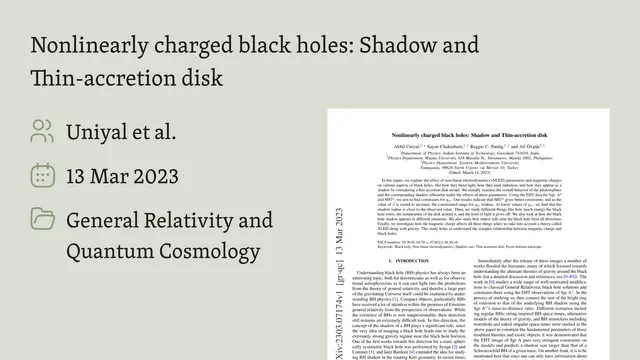
When magnetic fields reach extreme intensities near black holes, classical Maxwell electrodynamics breaks down. The authors of this paper investigate how nonlinear electromagnetic effects reshape the very fabric of what we observe around black holes, from the shadows they cast to the gravitational waves they emit.
The framework parametrizes departures from classical electrodynamics using a magnetic charge parameter and a field coupling strength. These modifications emerge naturally from quantum corrections predicted by string theory, becoming significant only where electromagnetic fields reach extraordinary intensities near the event horizon.
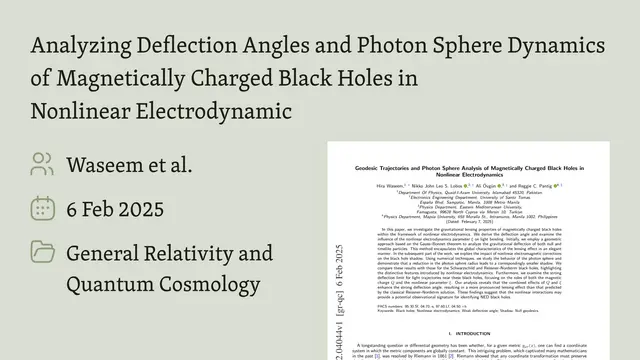
The magnetic charge creates a dual signature. Optically, it enlarges the shadow and enhances gravitational lensing as the photon sphere moves outward. Thermodynamically, it cools the black hole while maintaining the negative heat capacity that signals stability against runaway evaporation.
These geometric changes leave an imprint in the spacetime vibrations we can detect from Earth.
When perturbed, these black holes ring like bells at characteristic frequencies. The authors computed quasinormal modes using both time-domain integration and semiclassical methods, finding that magnetic charge systematically lowers the fundamental oscillation frequencies. The potential barrier surrounding the black hole also filters outgoing radiation differently, suppressing transmission at low frequencies.
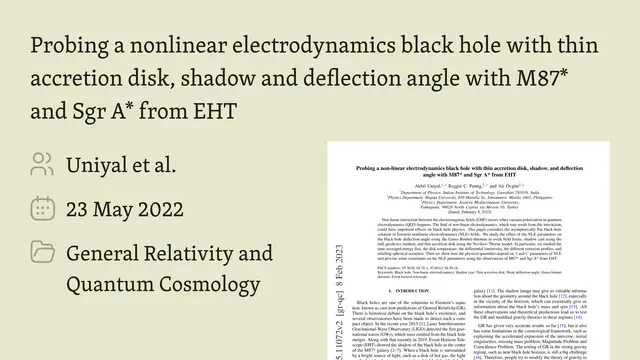
The Event Horizon Telescope's measurement of the M87* shadow radius provides the tightest constraint, limiting magnetic charge to below 0.4 solar masses. Future gravitational wave observatories could detect the frequency shifts in black hole merger ringdowns. While astrophysical black holes probably carry negligible charge, these calculations probe how gravity and electromagnetism intertwine at nature's most extreme boundary.
Nonlinear electrodynamics transforms black holes from purely gravitational objects into laboratories for testing the marriage of quantum field theory and general relativity. Visit EmergentMind.com to explore more cutting-edge research and create your own video presentations.