Physics-Constrained Deep Learning for Fluid Flow Surrogate Modeling Without Simulation Data
This presentation explores a groundbreaking approach to surrogate modeling for fluid flows that eliminates the need for expensive CFD simulation data. The authors introduce a physics-informed deep learning method that constructs structured neural networks with hard-coded boundary conditions and trains them using only the governing physics equations themselves. Through experiments on hemodynamic flows including pipe, stenotic, and aneurysmal geometries, they demonstrate that label-free learning can achieve accurate predictions across varying viscosity and geometry parameters while offering substantial computational speedups for uncertainty quantification and real-time applications.Script
Computational fluid dynamics simulations are too slow for real-time applications, and generating them at scale is prohibitively expensive. This paper presents a method that builds accurate surrogate models for fluid flows without using a single data point from traditional simulations.
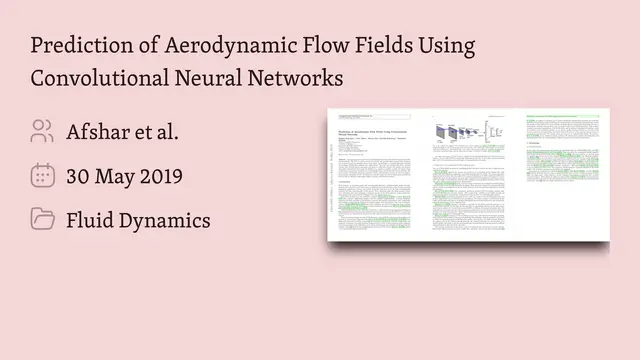
Traditional CFD faces a three-fold challenge: the Navier-Stokes equations are computationally intensive, complex geometries demand careful meshing, and applications requiring hundreds or thousands of simulations become infeasible. The authors ask whether we can bypass simulation data entirely.
Their answer lies in teaching neural networks the physics itself.
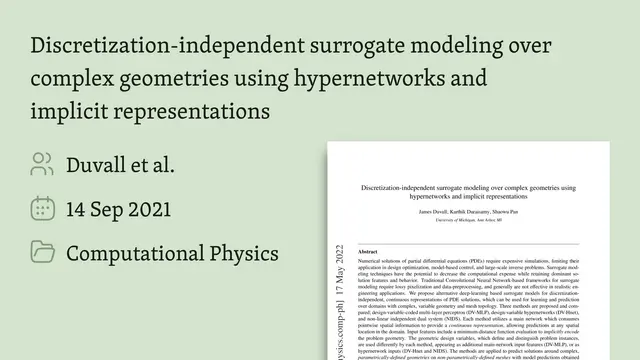
The method constructs a structured deep neural network that embeds boundary conditions directly into its design. Instead of learning from simulation outputs, the network trains by minimizing the residuals of the Navier-Stokes equations themselves, using automatic differentiation to enforce the governing physics at every step.
A crucial design choice emerges from their experiments. Treating boundary conditions as soft penalties in the loss function produces inferior results. Hard-coding these constraints into the network architecture itself ensures the model respects the physics exactly, delivering unique and accurate solutions.
The authors tested their approach on hemodynamic flows including pipes, stenoses, and aneurysms, varying both viscosity and geometry. The network learned these scenarios with remarkable accuracy, capturing non-linear fluid dynamics in geometries where traditional surrogates would struggle.
The computational gains are striking. By avoiding the expense of generating thousands of CFD simulations for training, the method achieves faster uncertainty quantification and opens the door to real-time deployment where traditional approaches would be too slow.
The method has boundaries. Current demonstrations focus on 2D hemodynamic flows, and extending to full 3D industrial-scale problems requires further work. The authors note that hybrid models blending physics constraints with partial simulation data could refine accuracy where data is accessible.
This work redefines what surrogate modeling can be. By eliminating dependence on expensive training data, it empowers engineers to explore design spaces, quantify uncertainty, and deploy models in real-time contexts where traditional CFD cannot follow. Physics itself becomes the teacher, and the network becomes the student who never forgets.
When the equations become the data, simulation becomes optional. Visit EmergentMind.com to learn more and create your own research videos.