Ontology-Grounded RAG: Structured Knowledge Meets Generation
This presentation introduces Ontology-Grounded Retrieval-Augmented Generation (OG-RAG), a paradigm that integrates domain ontologies—structured entities, relations, and constraints—into every stage of the retrieval-generation loop for large language models. Unlike standard RAG systems that rely on unstructured document retrieval, OG-RAG leverages hypergraph construction, set-cover optimization, and symbolic reasoning to deliver precise, fact-centric generation with demonstrated gains in recall, correctness, and deductive reasoning across biomedicine, industry, and cybersecurity domains.Script
Standard retrieval-augmented generation retrieves unstructured text and hopes the language model figures it out. But what if we could give the model a structured map of facts, relations, and constraints before it generates a single word? That's the promise of ontology-grounded RAG, and it's changing how we build fact-centric AI systems.
Let's examine how ontology grounding transforms the retrieval pipeline.
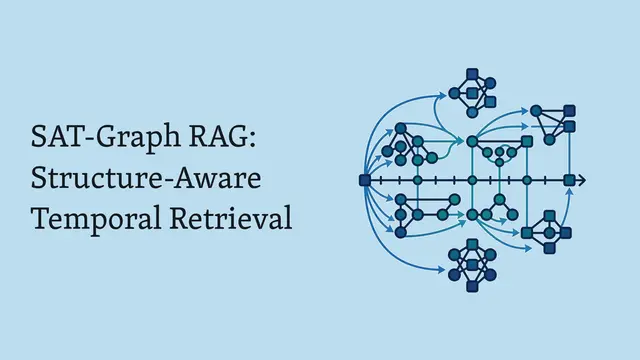
OG-RAG starts by defining a domain ontology as a set of entities, attributes, and relations. Documents are then decomposed into atomic facts represented as subject-attribute-value triples. These facts become nodes in a hypergraph, with hyperedges capturing the full relational context of multi-entity statements. When a query arrives, the system doesn't just grab the top matching chunks. Instead, it solves an optimization problem: find the minimal set of hyperedges that covers all relevant fact nodes, ensuring complete context without redundancy.
The difference is stark. Conventional RAG treats documents as opaque blocks of text, retrieving chunks based on embedding similarity. There's no guarantee the retrieved passages contain complete or non-contradictory information. OG-RAG, by contrast, retrieves structured facts grounded in a domain ontology. The set-cover optimization ensures every relevant fact is present, and the structured representation eliminates ambiguity. The result? Systems that are 30% faster to validate and substantially more correct.
The numbers tell a compelling story. On benchmark tasks, OG-RAG achieves 87% context recall compared to just 24% for standard RAG. That's not incremental—it's transformative. Answer correctness jumps from 31% to 57%, and deductive reasoning tasks that require chaining multiple facts see accuracy climb to 52%. These aren't small refinements; they represent a fundamental shift in what retrieval-augmented systems can reliably do.
OG-RAG isn't just a research curiosity. In biomedicine, it handles the chaos of evolving clinical code standards, mapping ICD equivalences without retraining the entire model. Cybersecurity educators use it to deliver validated technical explanations grounded in formal axioms, deployed to thousands of students. In agriculture and industrial workflows, ontology-backed systems provide deterministic answers that comply with regulatory and operational rules. When correctness isn't optional, ontology grounding is essential.
Ontology-grounded RAG is not without trade-offs. Ontologies can become stale, and maintaining them manually is labor-intensive. The hypergraph machinery scales less gracefully than pure vector search, creating computational bottlenecks for truly massive corpora. The path forward involves automating ontology updates with language models themselves, integrating graph neural networks for end-to-end relevance ranking, and designing interactive tools that keep human experts in the loop. These are engineering challenges, not fundamental limits, and the performance gains make them worth solving.
Ontology-grounded RAG formalizes retrieval as a structured optimization problem, transforming fact-centric generation from aspiration to reality. When precision, completeness, and interpretability matter, structure isn't overhead—it's the foundation. Visit EmergentMind.com to explore more cutting-edge AI research and create your own video presentations.