Medical Vision-Language Foundation Models
This lightning talk explores how Medical Vision-Language Foundation Models are revolutionizing healthcare by combining computer vision with natural language processing. We'll examine their architecture, clinical applications, and the challenges they face in real-world deployment. From automated report generation to diagnostic assistance, these models represent a paradigm shift toward generalizable AI systems that can understand both medical images and clinical text.Script
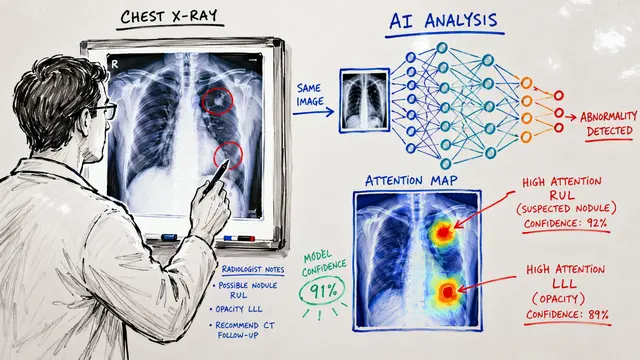
Picture a radiologist analyzing thousands of medical images, writing detailed reports, and answering complex questions about patient conditions. What if AI could seamlessly understand both the visual complexity of medical scans and the nuanced language of clinical reports?
Let's start by understanding what makes these models so revolutionary.
Building on this vision, medical vision-language foundation models represent a fundamental shift from narrow, task-specific systems. These models fuse computer vision with clinical language understanding, creating adaptable foundations for diverse healthcare applications.
The architecture typically consists of three essential modules working in harmony. Vision transformers process medical images while biomedical language models handle clinical text, with specialized fusion components bridging these modalities.
Now let's explore how these models learn to understand medical data.
These models employ sophisticated training strategies that go far beyond traditional supervised learning. Contrastive objectives align medical images with their corresponding reports, while masked modeling helps each modality develop robust internal representations.
A particularly innovative approach involves iterative semantic refinement, where models progressively learn medical terminology using clinical dictionaries. This ensures the training focuses on the most clinically relevant concepts rather than generic language patterns.
Let's examine how these models are transforming clinical practice.
These models excel across both diagnostic and generative tasks, fundamentally changing how clinicians interact with medical data. On the diagnostic side, they can classify diseases and answer complex visual questions, while generatively, they create detailed reports and guide precise image segmentation.
The versatility extends across major medical specialties, from radiology and ophthalmology to pathology and ultrasound imaging. This broad applicability demonstrates the power of foundation models to generalize across diverse medical domains.
Perhaps most remarkably, these models demonstrate few-shot and zero-shot learning capabilities. They can identify rare diseases with minimal examples and adapt to new medical domains without extensive retraining, addressing one of healthcare's biggest challenges.
However, adapting these models to medical domains presents unique challenges.
The transition from natural images to medical imaging creates significant domain shifts. Medical images have unique characteristics, annotations are often scarce, and clinical text follows specialized conventions that differ substantially from general language.
Researchers have developed sophisticated adaptation strategies to address these challenges. Parameter-efficient methods like adapter tuning reduce overfitting, while focal sampling preserves critical pathological details that might be lost at lower resolutions.
Let's examine how we measure the success of these complex systems.
Evaluation requires a multifaceted approach that goes beyond traditional machine learning metrics. Clinical accuracy, segmentation precision, language quality, and robustness across different populations all play crucial roles in assessment.
The research community has developed comprehensive benchmarks and open-source evaluation tools. These standardized resources ensure reproducible research and enable fair comparisons across different model architectures and training approaches.
Despite their promise, these models face significant limitations that must be addressed.
Perhaps the most critical challenge involves bias and fairness. These models can perpetuate or amplify existing healthcare disparities, systematically underdiagnosing certain demographic groups and encoding problematic biases from their training data.
Additionally, the black-box nature of these complex architectures poses significant challenges for clinical adoption. Healthcare professionals need to understand and trust AI recommendations, making interpretability a crucial barrier to widespread deployment.
Looking ahead, several exciting research directions are emerging.
The future hinges on expanding and diversifying medical datasets. Initiatives like MedTrinity-25M are creating massive multimodal collections, while synthetic data generation helps address the scarcity of rare disease examples.
Research is also focusing on federated learning approaches that protect patient privacy while enabling multi-institutional collaboration. Model compression and electronic health record integration aim to democratize access to these powerful tools.
Medical vision-language foundation models represent a transformative shift toward AI systems that truly understand both the visual complexity of medical imaging and the nuanced language of clinical practice. While challenges around bias, interpretability, and deployment remain, these models are already reshaping how we approach diagnostic medicine and patient care. To explore more cutting-edge research in AI and machine learning, visit EmergentMind.com.