AI Detection of COVID-19 in X-Ray Images Using RepVGG
This presentation explores a deep learning approach for automatically detecting and classifying diseases in chest X-rays, with a focus on distinguishing COVID-19, pneumonia, and normal cases. The researchers introduce RepVGG, a CNN architecture that combines the simplicity of VGG with the power of residual learning, and demonstrate how it outperforms established models like ResNet50 and DenseNet. Through visualization techniques like Grad-Cam, the system not only classifies diseases but also highlights the affected lung regions, providing interpretable diagnostic support for radiologists.Script
A radiologist examining chest X-rays for COVID-19 faces immense pressure: speed and accuracy can mean the difference between containing an outbreak and losing critical time. This paper demonstrates how RepVGG, a specialized neural network architecture, achieves breakthrough accuracy in automatically detecting COVID-19, pneumonia, and normal cases from X-ray images while highlighting exactly where the disease appears in the lungs.
The bottleneck is not just speed. Distinguishing COVID-19 from bacterial pneumonia or normal lung tissue requires detecting subtle opacity patterns and distributions that even experienced radiologists must scrutinize carefully. Automating this process could transform emergency response capacity.
The researchers turned to a novel architecture that merges two competing philosophies in deep learning.
RepVGG introduces structural re-parameterization, a technique that trains the model with multiple computational branches to capture rich features, then collapses those branches into a simple, fast architecture at inference time. The researchers trained RepVGG on 2,856 chest X-rays from Kaggle, including 1,000 COVID-19 cases, 1,000 normal images, and 856 pneumonia cases, achieving classification accuracy that surpassed every baseline model tested.
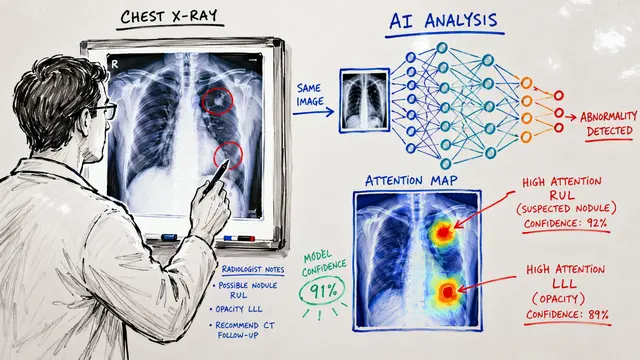
But accuracy is only half the story. The system uses Grad-Cam, a visualization technique that generates heatmaps highlighting which regions of the lung the neural network focused on when making its diagnosis. In this COVID-19 case, the heatmap reveals concentrated attention on the lower and peripheral lung zones where ground-glass opacities typically appear, giving radiologists visual confirmation of the AI's reasoning and focusing their attention on the most critical areas.
RepVGG does not replace radiologists. It gives them a second set of eyes that works at machine speed, flagging cases that need urgent attention and visually marking the exact regions that triggered the alert. In a pandemic or resource-constrained clinic, that combination of speed, accuracy, and transparency could be the difference between outbreak and containment.
When diagnostic speed determines survival rates, AI that both detects disease and explains its reasoning becomes not just a tool, but a partner in the fight for timely care. Visit EmergentMind.com to explore more research and create your own video presentations.