LoRA: Adapting Giant Language Models Without Retraining Them
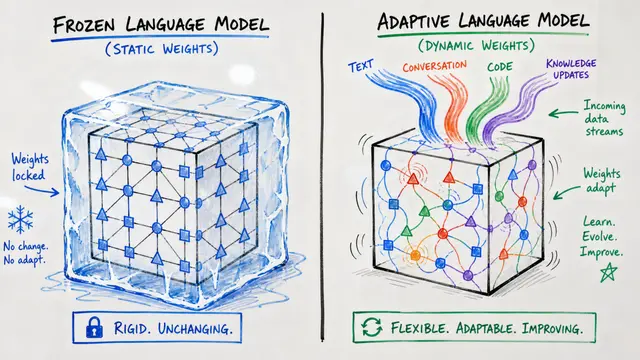
This presentation explores LoRA (Low-Rank Adaptation), a breakthrough technique that makes it practical to adapt massive language models like GPT-3 for specific tasks. By freezing the original model weights and injecting tiny trainable matrices into each layer, LoRA reduces trainable parameters by orders of magnitude while matching or exceeding the performance of full fine-tuning. We'll examine the core mechanism, empirical results showing its scalability, and the surprising discovery that task-specific adaptations live in low-dimensional subspaces.Script
Adapting GPT-3's 175 billion parameters for a specific task traditionally means retraining a model larger than most organizations can afford to touch. The authors of this paper asked a better question: what if you could freeze the giant model entirely and adapt it by training less than 1% of its parameters?
LoRA injects pairs of small matrices, called B and A, into each Transformer layer. These matrices multiply together to form a low-rank update that gets added to the frozen weights. The rank, represented by r, is tiny compared to the original dimensions, so you're training a fraction of the parameters while leaving the backbone untouched.
On GPT-3 with 175 billion parameters, LoRA achieves accuracy comparable to full fine-tuning while training only 18 million parameters. That's a reduction factor of nearly 10,000. The method scales gracefully across WikiSQL, MNLI, and other benchmarks, consistently outperforming adapter-based techniques that require more parameters and introduce inference latency.
Why does such a low-rank update work at all? The authors measured subspace similarity across multiple training runs with rank 64 and found that the column vectors of matrix A consistently capture the same directions. This reveals that task-specific knowledge concentrates in a low-dimensional subspace, not scattered across the full parameter space.
LoRA's design does introduce one constraint: you can't batch inputs from different tasks together efficiently during inference without extra machinery. However, the technique excels at task switching because you store only the tiny A and B matrices per task. Swapping tasks means loading a few megabytes instead of redistributing a 350 gigabyte model.
LoRA redefines what's possible in resource-constrained environments, proving that you don't need a supercomputer to adapt state-of-the-art models for your specific needs. To dive deeper into parameter-efficient techniques like this and create your own video explanations of cutting-edge research, visit EmergentMind.com.