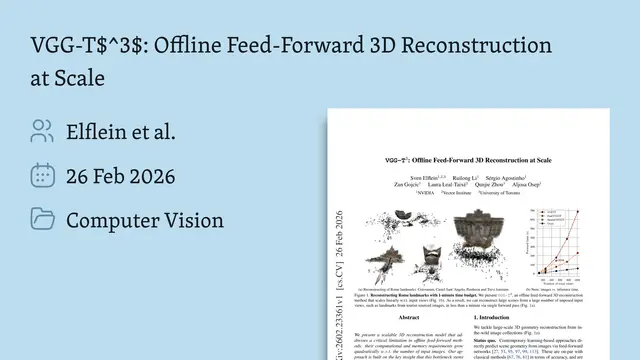
HiP3R: Hierarchical Pose Graphs for Long-Horizon 3D Reconstruction
This presentation explains how HiP3R solves the global consistency problem in long video reconstruction through a hierarchical pose graph. We examine why short-window feed-forward systems fail on extended sequences, how a two-stage similarity and Euclidean optimization reconciles conflicting chunk predictions, and the concrete evidence showing 74% trajectory error reduction across seven benchmarks without retraining the underlying models.Script
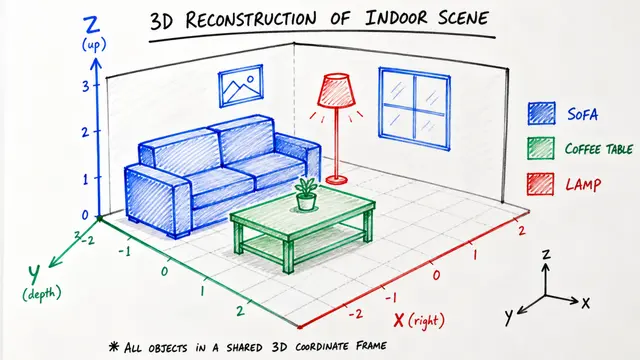
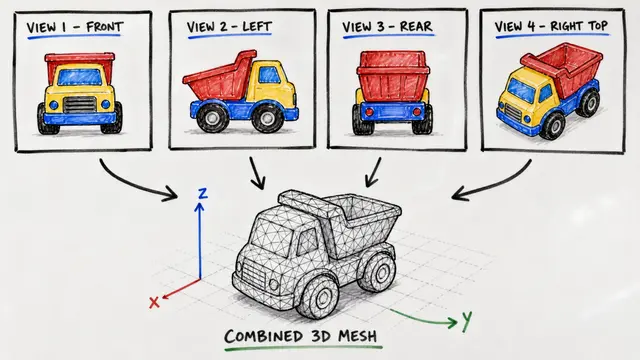
Feed-forward 3D reconstruction systems produce beautiful local geometry, but they break down catastrophically on long sequences. Each short video chunk gets its own coordinate system, creating dozens of misaligned, inconsistent fragments that disagree on scale, orientation, and even the poses of frames that appear in multiple windows.
The researchers solve this with a hierarchical pose graph that separates two fundamentally different error sources. A coarse stage optimizes similarity transformations for each chunk to fix global layout and loop closures, then a fine stage assigns exactly one shared camera pose to every physical frame.
The shared-camera formulation is crucial because overlapping frames appear in multiple chunks, each with its own prediction. Rather than averaging these conflicting estimates or picking one arbitrarily, the fine graph introduces one pose variable per physical frame and constrains it with both placement priors from every chunk and motion factors that preserve local trajectory coherence.
On KITTI, the coarse stage alone reduces trajectory error from 77 meters to 9.7 meters, an 87 percent reduction. The fine stage then improves relative motion errors while preserving that global solution. On VBR city-scale sequences averaging over 12,000 frames, the method cuts error nearly in half compared to loop-enabled chunk alignment.
The hierarchy remains computationally practical because the expensive flexible optimization happens only at the chunk level, while frame-level refinement exploits sparse analytic Jacobians. Bounded point sampling reduces graph construction time by 84 percent with negligible accuracy loss, and the method works with any feed-forward backend without retraining or test-time fine-tuning.
The method assumes that useful loop closures can be retrieved and aligned reliably. Robust weighting and progressive scheduling handle synthetic corruption well, but behavior under systematic perceptual aliasing or severe retrieval failure remains an open question. To dive deeper into hierarchical pose graphs and try generating your own research videos, visit EmergentMind.com.