UniForge3D: Shared-Space Reconstruction and Generation
This presentation explains UniForge3D, a method that jointly reconstructs and generates complete 3D assets from just four sparse, unposed images. Instead of treating reconstruction and generation as sequential steps, the system places both in a shared anchor-guided coordinate space and allows them to interact bidirectionally. The result is geometry that faithfully captures visible surfaces while completing occluded regions with learned shape priors, achieving state-of-the-art metrics on both reconstruction fidelity and generative completion.Script
Reconstructing 3D geometry from sparse images faces a tension. Reconstruction gives you fidelity to what you see, but leaves gaps. Generation fills those gaps, but can replace real structure with plausible fiction.
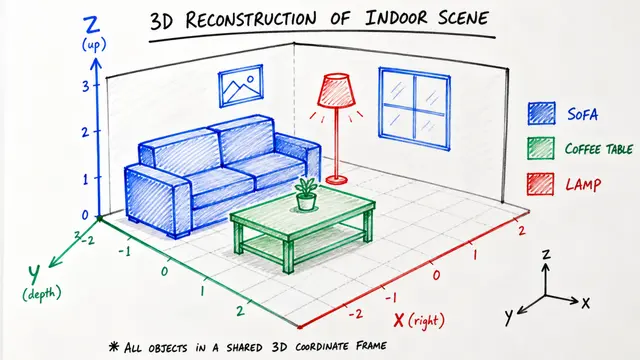
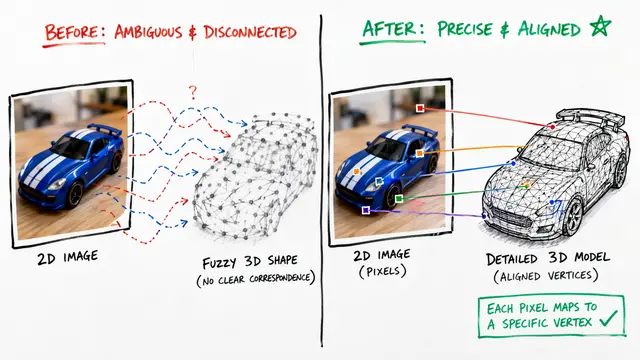
UniForge3D treats reconstruction and generation as partners, not stages. Both branches operate in the same anchor-guided coordinate space, exchanging geometric features bidirectionally so that reconstructed points inform shape priors and generated structure guides pixel-to-surface correspondence.
The method selects the most informative input view independently for every voxel. Each surface region gets conditioned on the image that actually sees it, preventing distant or occluded pixels from contaminating local feature representations.
On both Toys4K and GSO, UniForge3D achieves the best appearance and geometry scores. Chamfer distance drops to approximately 1.4 times 10 to the minus 2, and F-score reaches 0.89, outperforming Mix3R by roughly 39 percent in geometric error and 0.17 in F-score.
The training data is synthetic, so severe occlusion, strong reflections, and extreme lighting remain difficult. View selection also relies on pixel-support heuristics rather than explicit visibility or photometric uncertainty models.
UniForge3D demonstrates that shared coordinates and bidirectional interaction let reconstruction and generation correct each other rather than compound each other's errors. Explore the full paper and create your own research videos at EmergentMind.com.