Generative Recursive Reasoning: Probabilistic Pathways Through Latent Space
This presentation introduces Generative Recursive Reasoning Models (GRAM), a breakthrough framework that transforms neural reasoning from deterministic single-path computation into probabilistic multi-trajectory exploration. Unlike prior recursive models that collapse to one solution, GRAM samples multiple stochastic latent reasoning paths in parallel, enabling it to discover diverse solutions in constraint satisfaction problems, scale inference along both depth and width dimensions, and achieve state-of-the-art performance on benchmarks where even large language models fail completely.Script
On the hardest Sudoku puzzles ever designed, the best large language models score zero percent. A new architecture called GRAM achieves 97 percent by doing something fundamentally different: instead of following one reasoning path, it explores many in parallel.
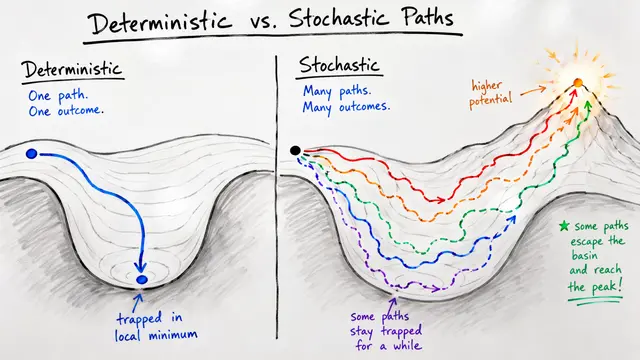
Traditional recursive reasoning models are deterministic. Given the same input, they always refine their internal state along exactly the same trajectory, collapsing every possible solution into one answer. GRAM breaks this limitation by treating recursive computation as a stochastic process, sampling diverse latent reasoning trajectories that can discover multiple valid solutions simultaneously.
The architecture operates through nested recursion. An outer loop updates a high-level latent state stochastically, adding learned Gaussian perturbations at each step to enable exploration. An inner loop refines a low-level state deterministically, allowing rapid local convergence within each stochastic trajectory.
GRAM scales inference along two independent axes. Depth means more recursive steps, as in prior models. But width is new: sampling multiple trajectories in parallel. On 8 by 8 N-Queens puzzles, deterministic models collapse as solution counts rise. GRAM maintains 99.7 percent accuracy and recovers up to 90 percent of valid solutions using just 20 samples, a capability no deterministic model can replicate.
GRAM extends beyond reasoning tasks to unconditional generation. On binarized MNIST, the model starts from noise and recursively refines samples over 256 steps, monotonically improving inception score from 1.85 to 2.04. It can even generate fully valid Sudoku boards from scratch without any constraint checker, achieving over 99 percent validity where discrete diffusion models fail.
Visualizing latent trajectories reveals why this works. Deterministic models follow one path and often get stuck in local minima. GRAM samples 50 trajectories that explore vastly more of the solution landscape, with multiple paths reaching optimal low-loss regions. This probabilistic recursion paradigm opens new directions for neural reasoning, and you can explore the full paper and create your own video explainers at emergentmind.com.