Gemma 4: Rethinking Multimodal AI from the Ground Up
Gemma 4 introduces a new generation of open-weight, natively multimodal language models that challenge conventional approaches to vision, audio, and text processing. This presentation explores how the Gemma 4 suite—spanning dense and Mixture-of-Experts architectures from 2.3B to 31B parameters—achieves state-of-the-art performance through radical architectural choices including encoder-free modality processing, thinking mode reasoning, and aggressive long-context optimization, all while maintaining deployability from edge devices to enterprise infrastructure.Script
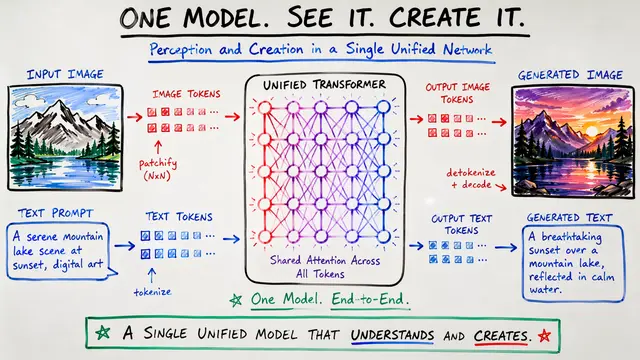
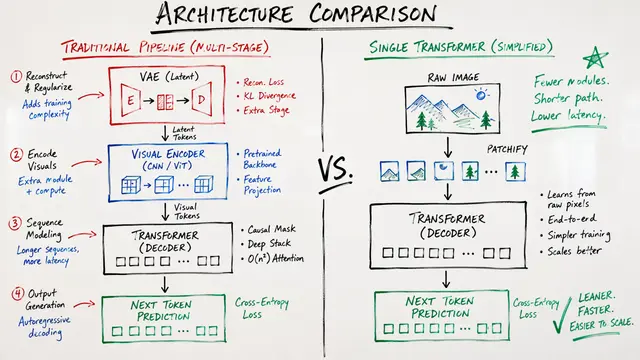
The latest generation of language models still rely on separate vision and audio encoders, adding memory overhead and deployment complexity. Gemma 4 takes a different path: its 12 billion parameter model projects raw image patches and audio segments directly into the transformer's embedding space, eliminating encoders entirely while matching or exceeding the performance of traditional architectures.
How does this encoder-free design actually work? For images, the system resizes input to variable aspect ratios, extracts patches at 16 pixel resolution, and projects them through a single matrix multiplication augmented with coordinate embeddings to preserve spatial relationships. For audio, 40 millisecond chunks of raw waveform go straight to the embedding layer, maintaining competitive transcription performance at a 78 percent reduction in encoder footprint compared to Gemma 3.
Gemma 4 introduces thinking mode, a protocol where the model generates explicit reasoning traces before producing its final answer. This approach yields measurable improvements on STEM benchmarks, coding tasks, and mathematics problems, with the 31 billion parameter model achieving the highest Elo score among dense open models in blind human evaluations, rivaling much larger Mixture-of-Experts systems.
To handle contexts up to 256,000 tokens, the authors employ a strategic 5-to-1 ratio of local to global attention, combined with key-value cache sharing and positional encoding through p-RoPE. These optimizations cut global KV cache memory by 37.5 percent, enabling efficient long-context retrieval that substantially outperforms Gemma 3 on benchmarks like RULER and GraphWalks.
The empirical results validate the architectural choices. On CoVoST translation and FLEURS transcription, Gemma 4 achieves 12 and 17 percent improvements respectively. Vision benchmarks at maximal resolution show consistent gains for the encoder-free variant, and long-context tests confirm superior retrieval across all models, with the 31 billion parameter version establishing new state-of-the-art results for dense open models.
Gemma 4 demonstrates that unified encoder-free architectures can achieve state-of-the-art multimodal performance without sacrificing deployability or efficiency. With quantization-aware training, thinking mode reasoning, and aggressive memory optimization, these open-weight models invite researchers and practitioners to explore what's possible when architectural constraints dissolve. Discover more groundbreaking AI research and create your own video presentations at EmergentMind.com.