Fisher Information Matrix: Basics & Applications
This presentation introduces the Fisher Information Matrix, a fundamental mathematical construct that quantifies how sensitive a probability model is to changes in its parameters. We explore how the FIM sets theoretical limits on estimation precision through the Cramér-Rao bound, provides the geometric structure underlying parameter spaces, and governs the asymptotic behavior of maximum likelihood estimators. The talk covers practical estimation methods, the geometric interpretation of the FIM's eigenstructure, and modern applications in deep learning and statistical inference.Script
Every statistical model hides a geometry. When you change a parameter by a tiny amount, how much does the probability distribution shift? The Fisher Information Matrix is the mathematical object that answers this question, and it sets the ultimate limits on how precisely we can ever estimate anything from data.
The Fisher Information Matrix captures how sharply peaked the likelihood surface is around the true parameter. It's computed as the expected outer product of score functions, the gradients of log probability. This matrix isn't just a statistical tool—it's the natural metric tensor that gives parameter space its geometric structure.
This geometry has profound consequences for what we can learn from data.
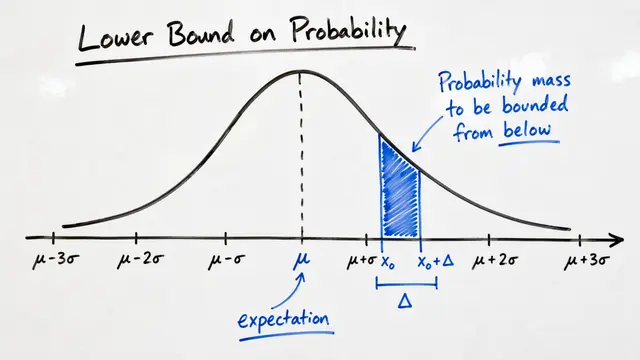
Here's the power of the FIM: it gives the tightest possible lower bound on estimation uncertainty. The Cramér-Rao inequality states that no unbiased estimator can have smaller variance than the inverse Fisher information. Maximum likelihood estimators actually reach this bound as sample size grows, and when the FIM is singular, certain parameter directions simply cannot be estimated from data at all.
Two classical approaches estimate the FIM from data. The gradient outer-product method uses squared score vectors, while the Hessian approach uses curvature of the log-likelihood. Both are consistent, but for a wide class of models, the observed Hessian estimator achieves measurably better efficiency. In modern settings with simulation-based models, clever Monte Carlo methods and variance reduction via independent perturbations push practical accuracy even further.
The FIM's eigenstructure exposes which parameter combinations matter most. In deep learning, mean-field analysis shows that as networks widen, almost all FIM eigenvalues vanish while a spike emerges, creating flat directions and sharp valleys. This geometry determines not just what we can estimate, but how quickly gradient-based algorithms can learn, making the FIM central to understanding modern optimization landscapes.
The Fisher Information Matrix bridges pure theory and practical inference, connecting the ultimate limits of what data can tell us to the concrete geometry that shapes how we learn from it. To explore more topics like this and create your own videos, visit EmergentMind.com.