Nuclear Detonation in Low Earth Orbit: Radiation Belts, Not Blast, Threaten Satellites
This presentation examines a modeling study that reveals the dominant hazard from a nuclear detonation in low Earth orbit is not the immediate radiation pulse but the formation of artificial radiation belts. Trapped beta-decay electrons from fission products can disable nearly an entire satellite fleet within days to weeks, subsequently triggering a surge in collision rates as disabled spacecraft lose maneuverability. The analysis couples prompt X-ray exposure, geomagnetic trapping, artificial radiation-belt evolution, spacecraft failure, collision generation, fragmentation, and atmospheric drag to demonstrate that burst location and geomagnetic conditions can dominate the outcome more than yield or altitude alone.Script
A one-megaton nuclear detonation at 500 kilometers altitude would destroy fewer than 3% of satellites through its initial X-ray pulse. But within seven days, trapped radioactive electrons circling Earth's magnetic field lines could disable 98% of the modeled low Earth orbit fleet.
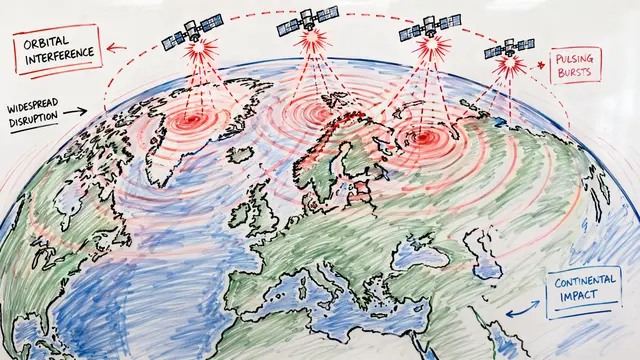
The researchers discovered that burst location, not just yield or altitude, controls the outcome. A detonation near regions of weak magnetic field can trap electrons on compact shells intersecting densely populated altitudes, producing dose rates that vary by more than two orders of magnitude across different locations.
Under the central electron-source assumption and 40 kilorad silicon threshold, half the fleet crosses the failure threshold after 1.9 days. By day seven, 97.8% is disabled. Even tripling the radiation tolerance to 120 kilorad only delays this outcome by days to weeks, not months or years.
Loss of maneuverability couples radiation failure to collision risk. The modeled global collision clock drops from 250 days to about four days within two weeks, producing an expected 20 collisions over two years compared with 12 in the control. Atmospheric drag later removes lower-altitude targets, but this reflects population depletion, not environmental recovery.
The model links prompt X-ray exposure, fission-product electron production, geomagnetic trapping, spacecraft failure, collision generation, and atmospheric drag into a single causal chain. The principal unresolved question is how realistic ion transport and spacecraft-specific radiation tolerance would modify the scale and duration of this coupled hazard.
The study demonstrates that a nuclear detonation in low Earth orbit can disable an entire satellite fleet not through blast, but through physics invisible to the unaided eye: trapped electrons, magnetic mirrors, and repeated dose accumulation. You can explore the full analysis and create your own research videos at EmergentMind.com.