Effects of a Nuclear Detonation in Low Earth Orbit
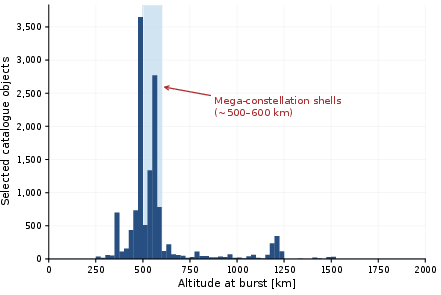
Abstract: More than 13,000 satellites operate in low Earth orbit (LEO), and concern has grown that nuclear weapons could be used in space to target them. Beyond the initial X-ray burst, electrons released by radioactive fission products can become trapped in Earth's magnetic field, repeatedly exposing satellites as an artificial radiation belt. Here we couple prompt radiation, electron trapping and belt evolution to satellite failures, collisions and atmospheric drag. For a 1-Mt detonation at 500km over the South Atlantic, repeated belt exposure disables approximately 98% of modeled satellites within one week in our central case. Tripling the assumed radiation tolerance delays widespread failure by only days: approximately 97% are still disabled within two weeks. The loss of maneuverability sharply increases collision risk, with approximately 20 collisions expected within two years. Drag removes many disabled spacecraft from lower altitudes, but replacement satellites could remain exposed to radiation and debris for years. These findings show how a single detonation could devastate orbital infrastructure and support efforts to prevent the deployment and use of nuclear weapons in space.
Paper Prompts
Sign up for free to create and run prompts on this paper.
Explain it Like I'm 14
1. What is the paper about?
This paper studies what could happen if a large nuclear weapon exploded in Low Earth Orbit (LEO), the region of space where many satellites travel.
The researchers focus on a 1-megaton nuclear explosion at about 500 kilometers above Earth. They examine not only the immediate blast, but also the longer-lasting effects:
- Radiation damaging satellites
- Satellites becoming unable to move out of the way
- More collisions between satellites and space junk
- New clouds of dangerous debris
- Atmospheric drag slowly pulling some objects back to Earth
The main message is that one nuclear explosion in space could damage much more than the satellites located near the explosion.
2. What questions did the researchers ask?
The paper tries to answer several important questions:
- How many satellites would be damaged immediately by the explosion?
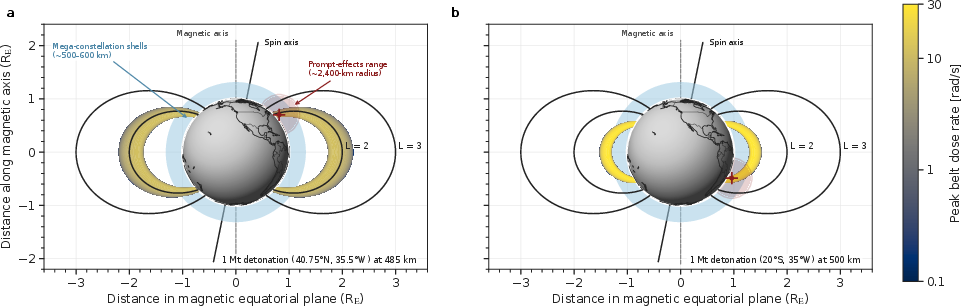
- Could the explosion create an artificial radiation belt around Earth?
- How long would that radiation continue damaging satellites?
- What would happen if many satellites suddenly lost the ability to steer?
- Would this cause more collisions and create additional space debris?
- How long might the space environment remain dangerous for replacement satellites?
The researchers also examined how the explosion’s location, size, and altitude could change the results.
3. How did the researchers study the problem?
The researchers built a large computer model. It connected several different processes together, rather like following a chain of events:
Nuclear explosion → radiation → satellite failures → collisions → debris → changes over time
Modeling the explosion
First, the model calculated the effects of the explosion’s immediate X-rays. These would damage satellites close enough to receive a strong burst of radiation.
The researchers then calculated how radioactive materials from the explosion would produce huge numbers of energetic electrons. These electrons could become trapped by Earth’s magnetic field.
Earth’s magnetic field acts somewhat like a giant invisible cage. Some electrons would bounce around inside it instead of quickly falling into the atmosphere. This could create an artificial radiation belt, similar to Earth’s natural radiation belts.
Modeling satellite damage
The researchers followed the paths of more than 13,000 satellites in a computer simulation. They assumed that each satellite had a thin layer of aluminum shielding.
They estimated how much radiation each satellite would receive as it moved through the artificial belt. If a satellite received more radiation than its electronics could handle, it was counted as disabled.
The study used two possible radiation limits:
- A lower limit of about 40 kilorad
- A higher limit of about 120 kilorad
A kilorad is a unit used to measure radiation absorbed by materials. In simple terms, it measures how much radiation damage electronics receive.
Modeling collisions and space debris
A disabled satellite might still remain in orbit, but it would no longer be able to steer. This is important because working satellites regularly move to avoid dangerous objects.
The researchers then modeled possible collisions involving:
- Working satellites
- Disabled satellites
- Rocket bodies
- Existing space debris
- New fragments created by collisions
They also included atmospheric drag. Even though space is mostly empty, the very thin upper atmosphere can slowly slow down satellites. Lower satellites lose altitude faster and eventually reenter the atmosphere.
The model covered radiation effects for about one year and collision and debris effects for up to ten years.
4. What did the researchers find?
The immediate blast would damage some satellites
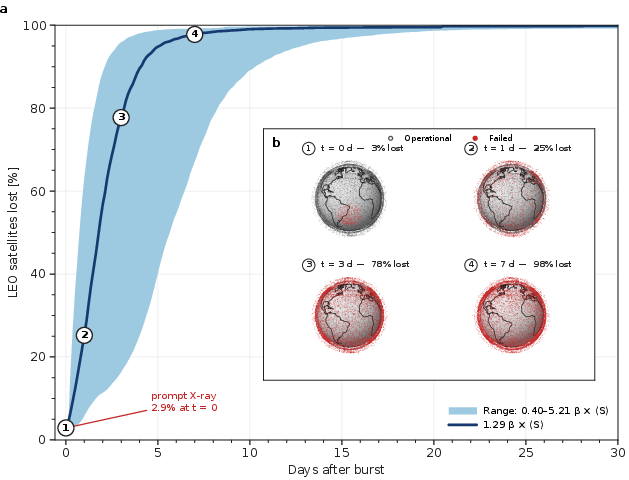
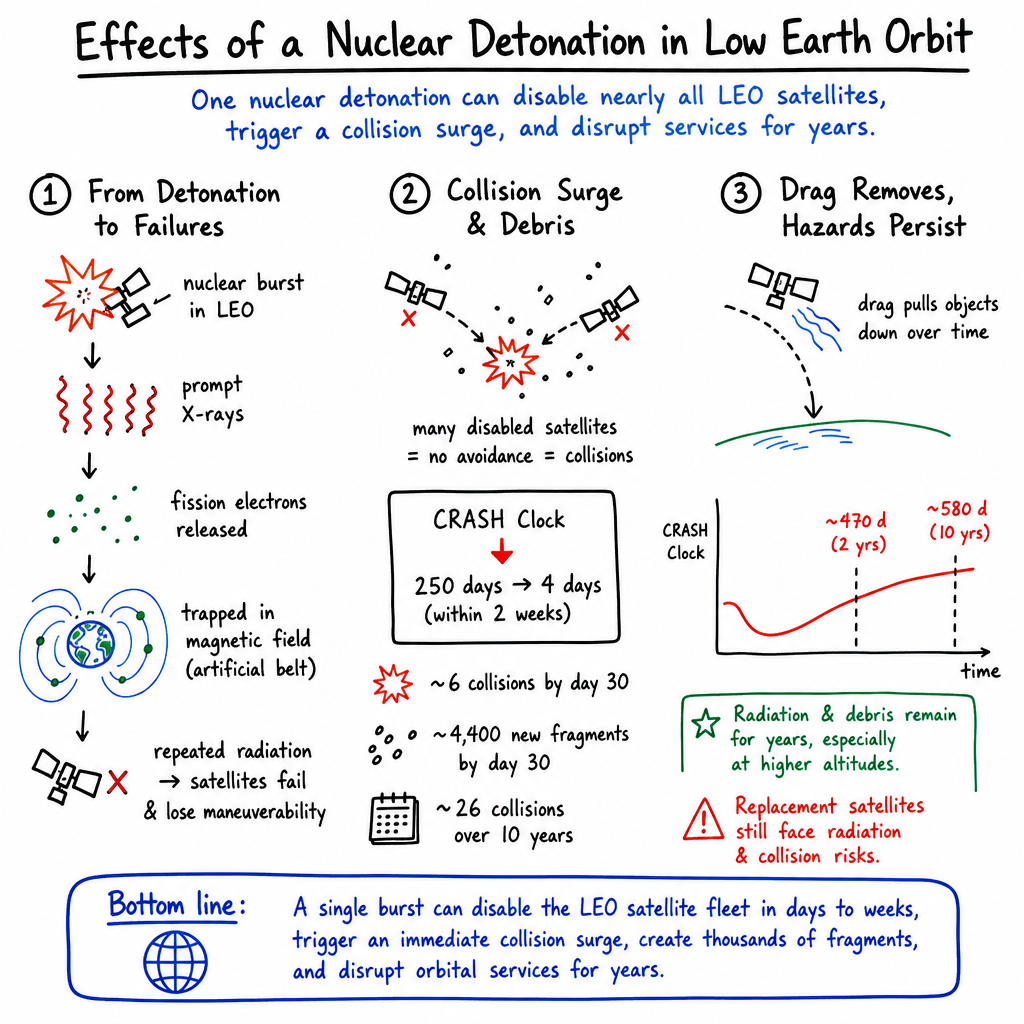
In the example explosion, the initial X-ray burst immediately disabled about 2.9% of the modeled satellites.
This was serious, but it was much smaller than the later damage caused by trapped electrons.
The artificial radiation belt could disable almost the entire satellite fleet
The trapped electrons repeatedly passed through areas where satellites were orbiting. This meant that satellites could receive radiation again and again, much like repeatedly being exposed to harmful rays.
In the main example:
- About 25% of satellites were disabled after one day
- About 78% were disabled after three days
- About 98% were disabled after one week
- More than 99% were disabled within about one month
Even when the researchers assumed that satellites were more resistant to radiation, the final result was still extremely damaging. The higher radiation limit delayed the failures, but did not stop most satellites from eventually being disabled.
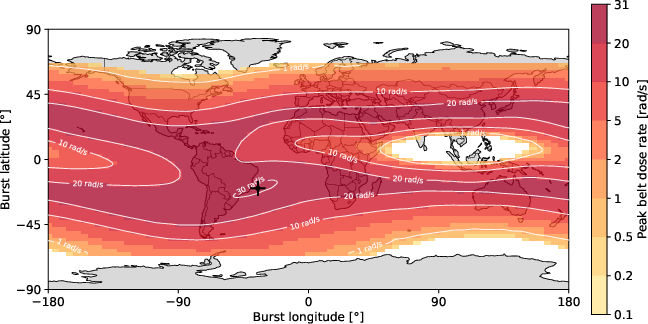
The explosion’s location mattered greatly
Not every explosion in space would create the same radiation belt.
The location affects whether the electrons:
- Escape into the atmosphere
- Remain trapped around Earth
- Become concentrated in the same region as many satellites
Some locations would create especially strong belts because of unusual features in Earth’s magnetic field. Therefore, the explosion’s position could be almost as important as its size.
Disabled satellites would create a collision surge
When satellites lose their ability to maneuver, they cannot avoid one another or dodge debris.
The study estimated that, in its main scenario:
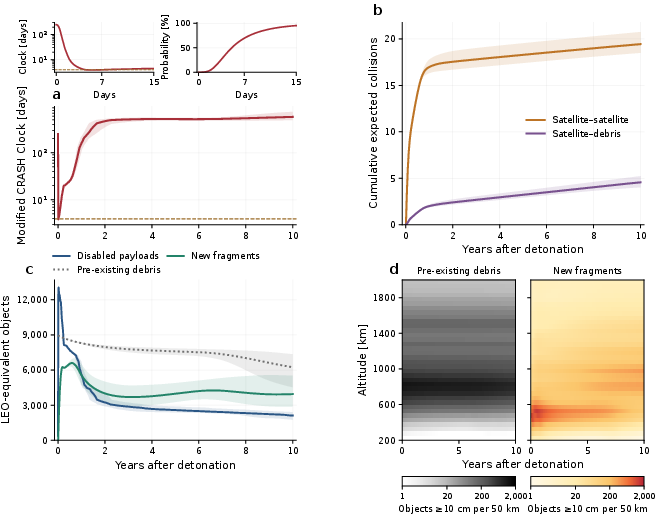
- There would be about 20 collisions within two years
- About 26 collisions within ten years
- Around 75% of the expected collisions would happen during the first year
These collisions could create thousands of new pieces of debris. Some fragments would be large enough to seriously damage or destroy other spacecraft.
The paper uses a measurement called a collision clock. This is the average time expected before a collision occurs somewhere in the modeled satellite population. The clock became much shorter after the explosion, changing from roughly 250 days to about 4 days during the first two weeks.
This does not mean that every satellite would collide after four days. It means that, across the entire population, collisions would become much more likely.
Atmospheric drag would remove some objects, but not solve the problem
Atmospheric drag would eventually pull many disabled satellites and debris pieces into the atmosphere, especially those at lower altitudes.
However, objects at higher altitudes would remain in space much longer. They could continue causing collisions and producing debris.
The fact that the collision rate eventually decreased did not mean that space had returned to normal. In many cases, the rate decreased because satellites had already fallen out of orbit—not because the environment had become safe.
Replacement satellites would also face dangers
Replacing destroyed satellites would not be easy. New satellites could still be threatened by:
- Remaining radiation belts
- Existing space debris
- Newly created collision fragments
The researchers point out that radiation from a historical nuclear test, called Starfish Prime, remained dangerous for several years. This suggests that replacement spacecraft might continue to face radiation damage long after the first explosion.
5. Why are these findings important?
The paper shows that a nuclear explosion in space could cause a chain reaction of damage:
- The explosion produces immediate radiation.
- Radioactive material creates trapped electrons.
- The electrons damage satellites over days or weeks.
- Disabled satellites cannot avoid collisions.
- Collisions create more debris.
- Debris makes space more dangerous for future satellites.
This could affect many services people use on Earth, including:
- Communication
- Weather forecasting
- Navigation
- Internet services
- Earth observation
- Military warning systems
The researchers also mention other possible effects, such as a large electromagnetic pulse affecting ground equipment and pollution from thousands of spacecraft burning up in the atmosphere.
Important limitations
The results are computer estimates, not exact predictions. The researchers had to make assumptions about:
- How many electrons the explosion would produce
- How long the electrons would remain trapped
- How resistant different satellites are to radiation
- The shapes and sizes of spacecraft
- The number and movement of small debris pieces
- Future atmospheric conditions
The model also did not include every possible effect, such as very small debris particles or the detailed design of each spacecraft.
Conclusion
The paper’s central conclusion is that a single nuclear detonation in Low Earth Orbit could disable most satellites in a short time and create a dangerous debris environment lasting for years.
The greatest danger would not come only from the initial explosion. The larger problem would be the long-lasting artificial radiation belt and the collisions caused by satellites that could no longer control their movements.
In simple terms, the research suggests that using a nuclear weapon in space could damage an entire orbital neighborhood, not just one target. This supports international efforts to prevent nuclear weapons from being placed or used in space.
Practical Applications
Immediate Applications
- Space-sector risk assessment and contingency planning — Industry / Policy. Satellite operators, insurers, launch providers, and governments can use the paper’s open end-to-end framework to run stress tests for radiation-induced spacecraft failures, loss of maneuverability, debris generation, and atmospheric drag. A practical workflow would combine current orbital catalogs with scenario parameters such as detonation altitude, yield class, satellite shielding, orbital shell, and solar activity. Potential outputs: fleet-loss timelines, collision-risk dashboards, replacement-orbit assessments, and continuity-of-service plans. Dependencies: access to accurate and current orbital data; validated radiation-tolerance specifications; improved treatment of debris smaller than 10 cm; and careful use of the results as scenario estimates rather than precise forecasts.
- Satellite fleet vulnerability screening — Aerospace manufacturing and operations. Operators can rank spacecraft by susceptibility to prompt radiation and trapped-electron exposure, identifying satellites that require greater shielding, redundant electronics, autonomous safe modes, or prioritized replacement. The modeled distinction between prompt exposure and repeated belt exposure is especially relevant for constellation design. Potential products: radiation-exposure calculators, spacecraft hardening checklists, and constellation-level survivability assessments. Dependencies: spacecraft-specific shielding geometries, component-level radiation data, orientation and attitude information, and more realistic failure criteria than the paper’s uniform 40- and 120-krad thresholds.
- Space situational awareness and collision-risk monitoring — Government and commercial tracking services. The coupled radiation–collision model can be adapted into an emergency “orbital environment stress” indicator. A CRASH-Clock-like metric could help operators decide when to increase tracking frequency, suspend launches, alter mission profiles, or reduce reliance on autonomous collision-avoidance assumptions. Potential tools: temporary orbital traffic-control protocols, emergency conjunction-prioritization systems, and risk maps by altitude band. Dependencies: rapid identification of nonmaneuverable spacecraft, reliable fragment tracking, and integration with operational conjunction-assessment systems.
- Launch and replacement-satellite planning — Launch providers and constellation operators. The paper shows that replacing disabled satellites immediately may be ineffective because radiation and debris hazards can persist after the initial failure wave. Operators can therefore incorporate post-event radiation dose and altitude-dependent collision rates into launch-window selection and replacement-orbit planning. Potential workflow: compare candidate altitudes and insertion dates against residual radiation, debris density, drag-driven clearance, and expected collision rates. Dependencies: validated long-term belt lifetimes, current solar-flux forecasts, and mission-specific maneuverability and shielding assumptions.
- Critical-infrastructure continuity planning — Telecommunications, navigation, weather, finance, and emergency services. Governments and companies can use the findings to conduct dependency analyses for services relying on LEO satellites. Continuity plans could identify terrestrial substitutes, cross-orbit redundancy, fiber and microwave fallbacks, protected timing sources, and prioritized restoration of weather, emergency communications, and navigation capabilities. Dependencies: the paper does not model service-level effects, ground-network failures, or satellite interdependencies; additional infrastructure and economic-impact modeling is required.
- National and international policy analysis — Arms control and space governance. The results provide quantitative evidence for policy assessments concerning the systemic consequences of nuclear weapons in orbit. Policymakers can use scenario ranges—not single-point predictions—to support diplomatic discussions, crisis communications, verification priorities, and norms against nuclear anti-satellite activities. Potential outputs: legislative impact assessments, treaty-supporting technical annexes, and national space-resilience strategies. Dependencies: model transparency, independent validation, access to non-public military satellite information, and separation of scientific risk analysis from operational targeting considerations.
- Open-source research and education — Academia. The framework can serve as a reproducible teaching and research platform for space-environment modeling, radiation transport, orbital mechanics, debris evolution, and risk analysis. Students and researchers could reproduce the reference case, vary assumptions, and compare results against historical events such as Starfish Prime. Potential tools: publicly documented notebooks, benchmark datasets, model-comparison challenges, and graduate-level exercises in coupled-system simulation. Dependencies: complete code and supplementary data, reproducible catalog snapshots, documentation of proprietary or unavailable inputs, and independent verification of the implementation.
- Emergency communications and public-service preparation — Daily life and civil protection. Although the paper does not directly quantify terrestrial service outages, its findings justify preparedness for prolonged disruptions to satellite communications, weather data, navigation augmentation, and timing services. Organizations can prearrange terrestrial communications, backup timing, paper procedures, and non-satellite navigation methods. Dependencies: actual consequences depend on which satellites and ground systems are affected, geographic coverage, EMP effects, and the availability of terrestrial substitutes.
Long-Term Applications
- Space-resilience digital twins — Aerospace, software, and government. The framework could evolve into a continuously updated digital twin of the LEO environment that integrates satellite telemetry, radiation environments, geomagnetic conditions, solar activity, conjunction data, fragmentation, and atmospheric drag. Such a system could evaluate a wide range of natural and hostile disturbances in near real time. Potential products: national orbital-resilience platforms, operator-facing risk APIs, and cross-operator simulation environments. Dependencies: standardized data sharing, near-real-time tracking, validated radiation and collision physics, and governance rules for sensitive satellite information.
- Mission-specific radiation-hardening optimization — Spacecraft engineering. Future versions could optimize shielding placement, component selection, fault-tolerant architectures, and orbital altitude for a specified mission lifetime and threat environment. Rather than applying a uniform spacecraft tolerance, models would calculate dose to individual electronics, sensors, power systems, and control components. Dependencies: detailed spacecraft CAD and materials data, component-level failure distributions, proton and electron transport calculations, and trade-offs involving mass, launch cost, and thermal performance.
- Autonomous post-event spacecraft operations — Robotics and satellite software. Spacecraft could be designed to detect elevated radiation, estimate remaining system lifetime, enter protective modes, preserve power and communications, and autonomously execute disposal or collision-avoidance procedures before radiation disables control systems. Potential tools: radiation-aware flight software, autonomous deorbit prioritization, and inter-satellite coordination protocols. Dependencies: reliable radiation sensors, robust autonomy under degraded communications, sufficient propulsion margin, international coordination, and assurance that autonomous maneuvers do not worsen collision risk.
- Active debris removal and orbital remediation — Robotics and space infrastructure. If a large number of spacecraft became uncontrollable, robotic servicing or debris-removal systems could target high-mass objects and collision-critical altitude bands. The paper’s altitude-dependent drag and collision outputs could help prioritize removal candidates. Dependencies: safe rendezvous with potentially damaged spacecraft, debris tracking below 10 cm, legal authority to service foreign objects, adequate launch capacity, and proof that removal missions would not introduce additional collision hazards.
- Improved artificial-radiation-belt forecasting — Space physics and space weather. Further research could replace the reduced-order belt model with particle-resolved simulations that track radioactive debris transport, pitch-angle scattering, wave–particle interactions, anisotropic injection, geomagnetic variability, and evolving atmospheric loss. This would improve estimates of the duration and spatial distribution of radiation hazards. Dependencies: specialized space-physics observations, high-performance computing, better historical calibration, and measurements from radiation-monitoring satellites.
- Long-term debris and orbital sustainability modeling — Policy and research. The study can be extended beyond ten years to examine century-scale debris evolution, possible runaway collision regimes, and the conditions under which orbital regions become impractical for sustained use. Results could inform altitude-management policies, disposal requirements, constellation-density limits, and international debris-mitigation standards. Dependencies: inclusion of launches, planned disposals, sub-10-cm debris, inclination and precession, realistic fragmentation distributions, and improved treatment of spacecraft replacement.
- Integrated assessment of ground impacts — Energy, communications, and public safety. A future multidisciplinary model could connect orbital losses with EMP effects, terrestrial power and communications infrastructure, atmospheric chemistry, aviation, weather forecasting, financial timing systems, and emergency response. This would support national-scale resilience planning rather than focusing only on satellite counts. Dependencies: detailed infrastructure inventories, regional EMP modeling, atmospheric aerosol chemistry, interdependent-network analysis, and empirical validation.
- Environmental assessment of mass reentry — Atmospheric science and environmental policy. The projected reentry of thousands of disabled spacecraft could motivate models of aluminum, lithium, copper, lead, and other materials entering the upper atmosphere. Long-term work could assess stratospheric chemistry, aerosol formation, radiative effects, and ecological consequences. Dependencies: spacecraft material inventories, ablation and fragmentation models, atmospheric transport simulations, and laboratory or observational validation.
- Resilient multi-orbit communications and sensing architectures — Telecommunications and defense. The findings support the development of diversified systems that combine LEO, medium Earth orbit, geostationary orbit, high-altitude platforms, terrestrial networks, fiber, and ground-based sensors. A multi-orbit architecture could reduce dependence on a single vulnerable LEO population. Dependencies: different orbital regimes may face distinct radiation, debris, latency, and launch constraints; resilience benefits must be evaluated against cost, interoperability, and the possibility of correlated ground-system failures.
- International orbital emergency protocols — Policy and governance. A mature version of the framework could support pre-agreed procedures for data sharing, emergency conjunction warnings, temporary launch restrictions, coordinated satellite disposal, and humanitarian prioritization of surviving space services. Dependencies: international trust, protection of commercially and militarily sensitive data, agreed definitions of orbital emergencies, and mechanisms for attributing and responding to hostile actions.
Glossary
- Adiabatic invariant: A quantity describing particle motion in a slowly varying magnetic field that remains approximately constant. “An electron emitted at position conserves its first adiabatic invariant”
- Aerodynamic area-to-mass ratio: The effective exposed area of an object divided by its mass, influencing atmospheric drag. “Starlink masses and uncontrolled area-to-mass ratios vary by generation”
- Artificial radiation belt: A persistent population of energetic charged particles trapped by a planet’s magnetic field after a nuclear detonation. “electrons released by radioactive fission products can become trapped in [ADDRESS]'s magnetic field, repeatedly exposing satellites as an artificial radiation belt.”
- Atmospheric column: The integrated mass of atmosphere along a specified path, usually expressed per unit area. “$\Sigma_{\mathrm{air}$ is the atmospheric column in g\,cm integrated along the slant path”
- Atmospheric drag: Aerodynamic resistance from the upper atmosphere that reduces an orbiting object’s energy and altitude. “Both intact objects and debris descend under atmospheric drag.”
- Beta decay: Radioactive decay in which a nucleus emits a beta particle, such as an electron. “Radioactive debris ions release electrons through beta decay”
- Blackbody spectrum: An idealized distribution of electromagnetic radiation emitted by an object at a given temperature. “with a blackbody spectrum at ~keV normalized over 0.1--50~keV.”
- Bremsstrahlung: Electromagnetic radiation produced when charged particles are accelerated or decelerated, often near atomic nuclei. “A small parameterized bremsstrahlung contribution is included.”
- Burn-up code: A computational tool for modeling the production and decay of radioactive isotopes in nuclear materials. “use an open-source burn-up code to obtain the electrons released by radioactive fission products”
- Catastrophic collision: A collision energetic enough to destroy the target and generate substantial fragmentation. “The decade includes approximately 22 catastrophic collisions and 4 cratering events.”
- CelesTrak elements: Orbital state parameters distributed through the CelesTrak satellite-tracking service. “The radiation calculation propagates the 14 January 2026 CelesTrak elements with SGP4”
- Conjugate atmosphere: The atmospheric region connected to another location by the same geomagnetic field lines. “Starfish Prime debris arriving at the southern conjugate region”
- Continuous-slowing-down range: The estimated distance an energetic charged particle travels while gradually losing energy in matter. “aluminium continuous-slowing-down ranges are taken from tabulated NIST ESTAR values”
- Cratering event: A collision that damages or erodes an object without completely destroying it. “The decade includes approximately 22 catastrophic collisions and 4 cratering events.”
- Drift loss cone: The set of particle trajectories whose magnetic drift eventually carries them into the atmosphere. “This loss along the full drift path is accounted for through the drift loss cone”
- Electromagnetic pulse (EMP): A brief, intense burst of electromagnetic energy that can disrupt or damage electronic systems. “A 1-Mt detonation at 500~km would produce an electromagnetic pulse (EMP)”
- Fission fraction: The portion of a nuclear weapon’s explosive yield produced by nuclear fission. “We assume that fission accounts for 50\% of the explosive yield”
- Fluence: The amount of radiant energy or particle energy received per unit area. “The adopted fluence threshold of 40~J\,m corresponds to an unattenuated range of approximately 2,400~km.”
- Geomagnetic field: Earth’s magnetic field, which governs the motion and confinement of charged particles in near-Earth space. “Using a realistic geomagnetic field”
- IGRF-14: The fourteenth-generation International Geomagnetic Reference Field model. “We use IGRF-14 for 14 January 2026”
- Ionizing dose: The energy deposited by ionizing radiation per unit mass of material. “This fluence criterion is applied independently of accumulated ionizing dose.”
- Isotropic emission: Emission distributed equally in all directions. “For isotropic emission, the locally retained fraction is”
- L-shell: A parameter labeling geomagnetic field shells according to their magnetic-field strength and radial extent. “The magnetic shells onto which electrons are released”
- Magnetic latitude: Latitude measured relative to a planet’s magnetic, rather than geographic, equator. “These shells cross the 500--600-km constellation altitudes at magnetic latitudes of about --”
- Magnetic mirror point: The location along a magnetic field line where a charged particle reverses direction because of increasing magnetic-field strength. “An electron can be reflected above the atmosphere near its injection point”
- Magnetic shell: A surface or family of field lines on which charged particles can circulate while remaining magnetically confined. “The burst chosen to maximize prompt effects populates magnetic shells --2.19”
- Mass attenuation coefficient: A material-specific measure of how strongly radiation is attenuated per unit mass thickness. “$\mu_{\mathrm{air}$ is the mass attenuation coefficient of air”
- Nonhomogeneous Poisson process: A stochastic process whose event rate varies with time. “The probability diagnostic assumes a nonhomogeneous Poisson process”
- Omnidirectional flux: Particle flux integrated over all directions of travel. “The shell-average omnidirectional electron flux is .”
- Orbit-averaged drag: A method that represents atmospheric drag through its average effect over an entire orbit. “Both debris populations move between altitudes under orbit-averaged drag”
- Orbital precession: The gradual rotation of an orbit’s orientation in space due to gravitational and other perturbations. “the model does not resolve inclination or orbital precession.”
- Pitch-angle scattering: The alteration of a charged particle’s direction relative to the magnetic field, often caused by waves or turbulence. “wave-driven pitch-angle scattering during injection is not explicitly calculated.”
- Prompt radiation: Radiation emitted immediately during or shortly after a nuclear detonation. “We calculate prompt X-ray exposure”
- Radiation hardness assurance: The design and testing process used to ensure that electronic components tolerate specified radiation levels. “The military values correspond to component-level radiation-hardness assurance levels F and H”
- Radial diffusion: The gradual transport of trapped charged particles across magnetic shells. “The trapped population evolves by radial diffusion and parameterized electron losses”
- Residual-risk factor: A multiplicative factor representing the remaining probability of an event after mitigation or avoidance. “The residual-risk factor is when either partner is operational and one otherwise”
- SGP4: The Simplified General Perturbations 4 orbital-propagation algorithm used with two-line element data. “The radiation calculation propagates the 14 January 2026 CelesTrak elements with SGP4”
- Slant range: The direct distance between a radiation source and a target along a non-vertical line of sight. “The attenuated fluence at slant range is”
- Solar-cycle forcing: Time-varying atmospheric forcing associated with changes in solar activity. “The main collision response persists across the tested solar-cycle and Starlink drag assumptions”
- Stopping power: The rate at which a charged particle loses energy as it passes through matter. “collision stopping powers and aluminium continuous-slowing-down ranges are taken from tabulated NIST ESTAR values”
- Trapping efficiency: The fraction of emitted charged particles that remain confined by the geomagnetic field. “The total trapping efficiency and shell injection weights satisfy”
- Two-line element (TLE): A standardized data format containing orbital parameters used to propagate artificial satellites. “The radiation calculation propagates the 14 January 2026 CelesTrak elements with SGP4”
- Velocity kick: A change in orbital velocity imparted to a fragment during a collision or breakup. “New fragments receive isotropic velocity kicks”
- Zero-flux boundary: A numerical boundary condition specifying that no particles cross the boundary. “We use the Brautigam--Albert diffusion coefficient at fixed , zero-flux boundaries and three-hour timesteps.”