Measuring What We Mean: A New Entropy Metric for Conceptual Diversity
This presentation introduces a novel entropy-based metric for quantifying the conceptual diversity of texts—measuring whether a text is conceptually broad or narrowly focused. By identifying noun concepts and expanding them through ontological trees like WordNet, the authors create a standardized, length-independent measure of semantic richness that has never been quantitatively evaluated before. The metric has practical applications for improving language model datasets, enhancing question-answering systems, and evaluating the conceptual scope of any written text.Script
How do you measure whether a text is conceptually broad or laser-focused on a single idea? Semantic richness has eluded quantitative evaluation, until now.
Natural Language Processing has powerful tools for syntax and word frequency, but it lacks a way to answer a fundamental question: is this text sweeping across many ideas, or drilling deep into one? The researchers identified this gap and set out to fill it.
Their solution comes from an unexpected place: the mathematics of disorder.
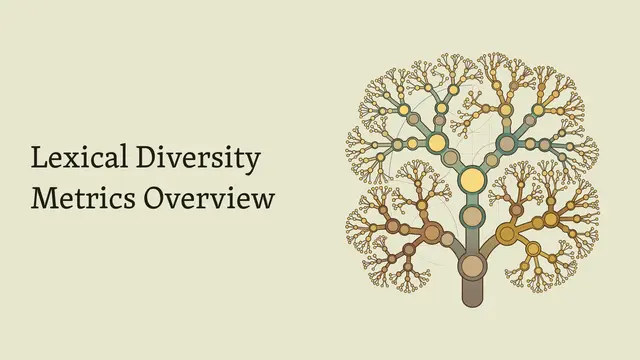
The method works in two stages. First, extract noun concepts from the text and expand them using an ontological tree like WordNet, revealing both explicit terms and hidden sub-concepts beneath them. Then, calculate how these concepts are distributed and apply entropy formulas to measure the spread. A text about many unrelated topics scores high, while a text drilling into one concept scores low, regardless of word count.
The metric produces a standardized score with clear extremes. Maximum diversity means the text spans the widest possible range of concepts, while minimum diversity indicates unwavering focus on a single idea. Crucially, this score doesn't confuse length with richness—a short text can be conceptually diverse, and a long one can be monotonous.
The applications are immediate. Language model training can now select datasets with controlled conceptual diversity, avoiding narrow or scattered content. Question-answering systems can adapt their responses based on whether a query demands breadth or depth. The authors also envision tracking how conceptual diversity evolves over time within texts, opening new research directions.
For the first time, we can measure not just what words appear, but how wide or narrow the conceptual world of a text truly is. Visit EmergentMind.com to explore more research and create your own video presentations.