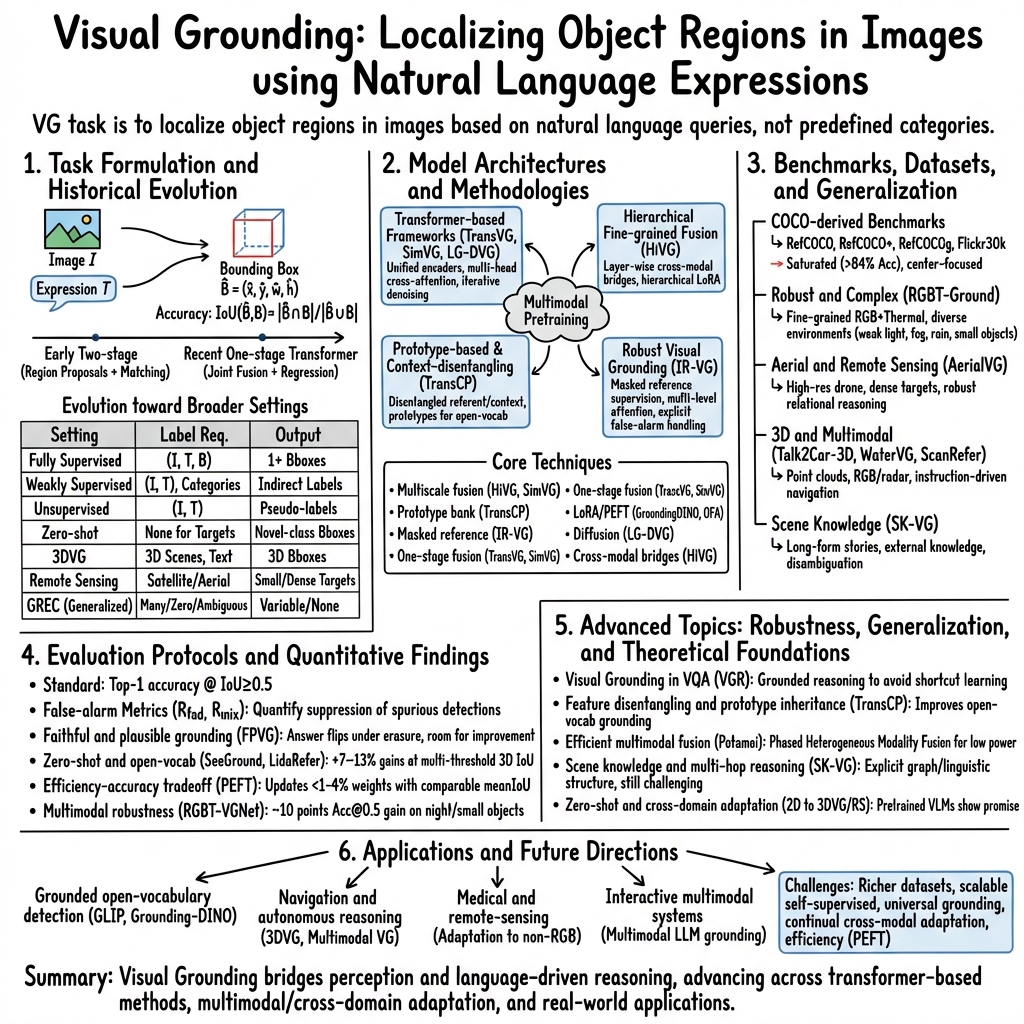
Visual Grounding Overview
- Visual Grounding is the task of pinpointing image regions defined by flexible natural language queries using multimodal fusion techniques.
- Recent advancements employ transformer-based, prototype-based, and diffusion methods to enhance precision, latency, and robustness.
- The field now spans supervised, unsupervised, zero-shot, and 3D settings, expanding its applications from detection to autonomous navigation.
Visual Grounding (VG) is the task of precisely localizing object regions in images (or other sensory data) in response to natural language expressions. Unlike classical object detection, VG does not assume a predefined category set; rather, a model receives an image and a flexible query (e.g., "the elderly man with the blue umbrella near the corner") and must return the most relevant region. Recent advances in VG research encompass supervised, weakly supervised, unsupervised, and zero-shot paradigms, with increasingly diverse multimodal inputs extending beyond RGB images to thermal, radar, and spatiotemporal data. The domain now includes generalized visual grounding (GREC), 3D visual grounding (3DVG), remote sensing visual grounding, and applications in robust, real-world environments.
1. Task Formulation and Historical Evolution
The canonical VG task is: Given image and expression , output bounding box for the region that best matches , with accuracy typically measured by (Xiao et al., 2024). Early VG research was dominated by two-stage models that first produced region proposals and then matched them to the expression via cross-modal fusion and ranking (Deng et al., 2019). Recent work focuses on one-stage transformer-based architectures, which jointly fuse visual and linguistic features for direct regression, reducing latency and improving accuracy.
Over time, the field has shifted toward broader settings:
| Setting | Label Requirement | Output |
|---|---|---|
| Fully supervised VG | (I, T, B) | 1+ bounding boxes |
| Weakly supervised VG | (I, T), categories | Indirect region labels |
| Unsupervised VG | (I, T) | Pseudo-label induction |
| Zero-shot VG | none for targets | Novel-class boxes |
| 3DVG | 3D scenes, text | 3D bounding boxes |
| Remote sensing VG | Satellite/aerial | Small/dense targets |
Generalized VG further extends to many, zero, or ambiguous referents per expression (GREC), requiring models to output variable numbers of boxes or even "no object" with high confidence (Xiao et al., 2024).
2. Model Architectures and Methodologies
Cutting-edge VG models leverage hierarchical fusion mechanisms and multimodal pretraining:
- Transformer-based frameworks (e.g., TransVG, SimVG, LG-DVG) utilize unified encoders and multi-head cross-attention to merge image and language streams (Dai et al., 2024, Chen et al., 2023). Techniques like iterative reasoning via denoising diffusion chains enable progressive box refinement under language guidance (Chen et al., 2023).
- Hierarchical fine-grained fusion (HiVG) employs layer-wise cross-modal bridges and hierarchical LoRA adaptation for modulating pretrained multimodal backbones (CLIP) (Xiao et al., 2024). This resolves global-to-local alignment bias and prevents error accumulation across the visual hierarchy.
- Prototype-based and context-disentangling approaches (TransCP) handle context ambiguity and enable open-vocabulary generalization by learning disentangled referent/context features and inheriting robust prototypes for unseen categories (Tang et al., 2023).
- Robust visual grounding (IR-VG) integrates multi-level masked reference supervision and explicit false-alarm handling—augmenting queries by masking low-impact tokens and supervising response via centerpoint attention heatmaps and a multi-stage decoder with "negative" embeddings (Li et al., 2023).
- Efficient adaptation in domain-shift settings (remote sensing, multimodal) is achieved through Parameter-Efficient Fine-Tuning (PEFT): LoRA and adapters freeze >95% of model weights, updating only small low-rank or bottleneck modules with negligible accuracy loss and massive efficiency gains (Moughnieh et al., 29 Mar 2025).
- 3D Visual Grounding (SeeGround, LidaRefer) bridges 3D point cloud scenes and 2D vision-LLMs via hybrid renderings and spatially enriched text, query-aligned perspective selection, and cross-modal fusion adapted for sparse outdoor environments (Li et al., 28 May 2025, Baek et al., 2024).
A summary table of core techniques:
| Technique | Principle | Representative Models/Papers |
|---|---|---|
| Multiscale fusion | Cross-modal at multiple encoder layers | HiVG (Xiao et al., 2024), SimVG (Dai et al., 2024) |
| Prototype bank | Clustered context for open-vocab | TransCP (Tang et al., 2023) |
| Masked reference | Text variant masking + centerpoint | IR-VG (Li et al., 2023) |
| One-stage fusion | Joint detection & matching | TransVG (Xiao et al., 2024), SimVG (Dai et al., 2024) |
| LoRA/PEFT | Low-rank fine-tuning for adaptation | GroundingDINO, OFA (Moughnieh et al., 29 Mar 2025) |
| Diffusion | Iterative denoising for box generation | LG-DVG (Chen et al., 2023) |
| Cross-modal bridges | Layer-wise bridges for deep alignment | HiVG (Xiao et al., 2024) |
3. Benchmarks, Datasets, and Generalization
VG benchmarking now covers a spectrum of conditions:
- COCO-derived benchmarks (RefCOCO, RefCOCO+, RefCOCOg, Flickr30k, ReferItGame) provide standard, well-lit, center-focused images but are saturated (>84% accuracy by SOTA) (Xiao et al., 2024, Xiao et al., 2024).
- Robust and complex scenario datasets: RGBT-Ground introduces fine-grained RGB+Thermal imagery, with diverse environments and occlusions (weak light, fog, rain, small objects), advancing evaluation for safety-critical applications (Zhao et al., 31 Dec 2025). Multi-modal fusion (RGB+TIR) yields substantial accuracy gains, especially on nighttime and long-range splits.
- Aerial and remote sensing datasets: AerialVG includes high-resolution drone imagery, rich spatial relations, and densely packed targets—necessitating models for robust relational reasoning (Liu et al., 10 Apr 2025). Efficient PEFT adaptation bridges domain gaps in satellite imagery under severe resource constraints (Moughnieh et al., 29 Mar 2025).
- 3D and multimodal benchmarks: Talk2Car-3D (LidaRefer), WaterVG (Potamoi), and ScanRefer (SeeGround) enable grounding in point clouds, RGB/radar fusion, and natural language instruction-driven navigation for outdoor agents and USVs (Baek et al., 2024, Guan et al., 2024, Li et al., 28 May 2025).
- Scene knowledge and commonsense reasoning: SK-VG benchmark (Advancing VG with Scene Knowledge) tests reasoning ability by pairing images with long-form stories and knowledge triples, requiring models to disambiguate referents using external knowledge (Chen et al., 2023).
4. Evaluation Protocols and Quantitative Findings
Standard evaluation employs top-1 accuracy @ IoU0.5, with specialized metrics for robust, generalized, and multi-target contexts:
- False-alarm metrics: Robust VG datasets track discovery rate () and mixed-data accuracy () to quantify suppression of spurious detections under irrelevant queries (Li et al., 2023).
- Faithful and plausible grounding: FPVG metric captures whether a VQA system (and by extension, VG system) truly relies on relevant image regions to answer, via answer flips under relevant/irrelevant object erasure (Reich et al., 2023). Most state-of-the-art VQA models achieve 40% FPVG, highlighting substantial room for trustworthy grounding.
- Zero-shot and open-vocab: SeeGround and LidaRefer report accuracy at multi-threshold 3D IoU for zero-shot 3DVG, showing +7--13% gains over previous baselines and robust resistance to ambiguity even under sparse scenes (Li et al., 28 May 2025, Baek et al., 2024).
- Efficiency-accuracy tradeoff: Parameter-Efficient Fine-Tuning in GroundingDINO and OFA updates 04% and 11% of weights respectively, yet delivers meanIoU comparable to or exceeding full fine-tuning for remote sensing VG (Moughnieh et al., 29 Mar 2025).
- Multimodal robustness: RGBT-VGNet outperforms baseline RGB-only and TIR-only models by 210 points [email protected] on night and small-object splits, demonstrating effective fusion in adverse conditions (Zhao et al., 31 Dec 2025).
5. Advanced Topics: Robustness, Generalization, and Theoretical Foundations
Key challenges for next-generation VG include:
- Visual Grounding in VQA: VG is axiomatic for interpretable question answering, but shortcut learning often undermines it. The Visually Grounded Reasoning (VGR) framework formalizes that correct answers require both visual grounding and reasoning, guiding OOD benchmark design and evaluation. Effective OOD splits must require VG, not merely shuffle answer priors (Reich et al., 2024).
- Feature disentangling and prototype inheritance: Disentangling referent vs. context features and inheriting prototype clusters improves grounding for both standard and open-vocab scenes, yielding strong performance even on novel categories without external knowledge (Tang et al., 2023).
- Efficient multimodal fusion: Methods like Potamoi's Phased Heterogeneous Modality Fusion combine image, radar, and text for USV grounding at low power and parameter cost, revealing the practical impact of smart cross-attention and adaptive modality weighting (Guan et al., 2024).
- Scene knowledge and multi-hop reasoning: SK-VG and advanced matching pipelines introduce explicit graph and linguistic structure, achieving 370% accuracy on knowledge-driven splits but exposing substantial gaps on "hard" queries demanding multi-hop external reasoning (Chen et al., 2023).
- Zero-shot and cross-domain adaptation: Adapting 2D vision-LLMs to 3DVG and remote-sensing tasks without task-specific fine-tuning closes much of the gap to supervised alternatives, indicating that pretrained VLMs capture fundamental cross-modal alignment when supported by query-aligned rendering and spatial enrichment (Li et al., 28 May 2025, Moughnieh et al., 29 Mar 2025).
6. Applications and Future Directions
Visual Grounding underpins numerous AI systems across domains:
- Grounded open-vocabulary detection: Integration of grounding with detection (GLIP, Grounding-DINO) supports detection of arbitrary class names and VQA-style queries (Xiao et al., 2024).
- Navigation and autonomous reasoning: 3DVG and multimodal VG enable autonomous vehicle and agent navigation, where robust, context-aware grounding in outdoor scenes is essential (Baek et al., 2024, Guan et al., 2024).
- Medical and remote-sensing: Extending VG to medical imaging and earth observation calls for adaptation to non-RGB modalities, segmentation, and robust cross-modal fusion strategies (Xiao et al., 2024, Moughnieh et al., 29 Mar 2025).
- Interactive multimodal systems: Multimodal LLM grounding unlocks object-centric dialogue, UI grounding, and human-robot interaction, as seen in recent large-model development (Xiao et al., 2024).
- Challenges and outlook: Saturation on classical benchmarks drives the need for richer, multi-object, multi-scenario datasets, scalable self-supervised pretraining, universal grounding for many/none objects per expression, and continual cross-modal domain adaptation. Efficiency advances (e.g., PEFT, slim cross-attention) are critical for deployment on resource-constrained edge or embedded platforms (Xiao et al., 2024, Guan et al., 2024).
In summary, Visual Grounding has evolved into a central paradigm for bridging the gap between perception and language-driven reasoning in complex, open-world settings. The field now spans sophisticated transformer- and diffusion-based methods, multimodal, and cross-domain adaptation, and is driving advances in interpretability, robustness, and real-world machine comprehension across scientific, industrial, and embodied AI applications.