Meta-Awareness in Cognitive & AI Systems
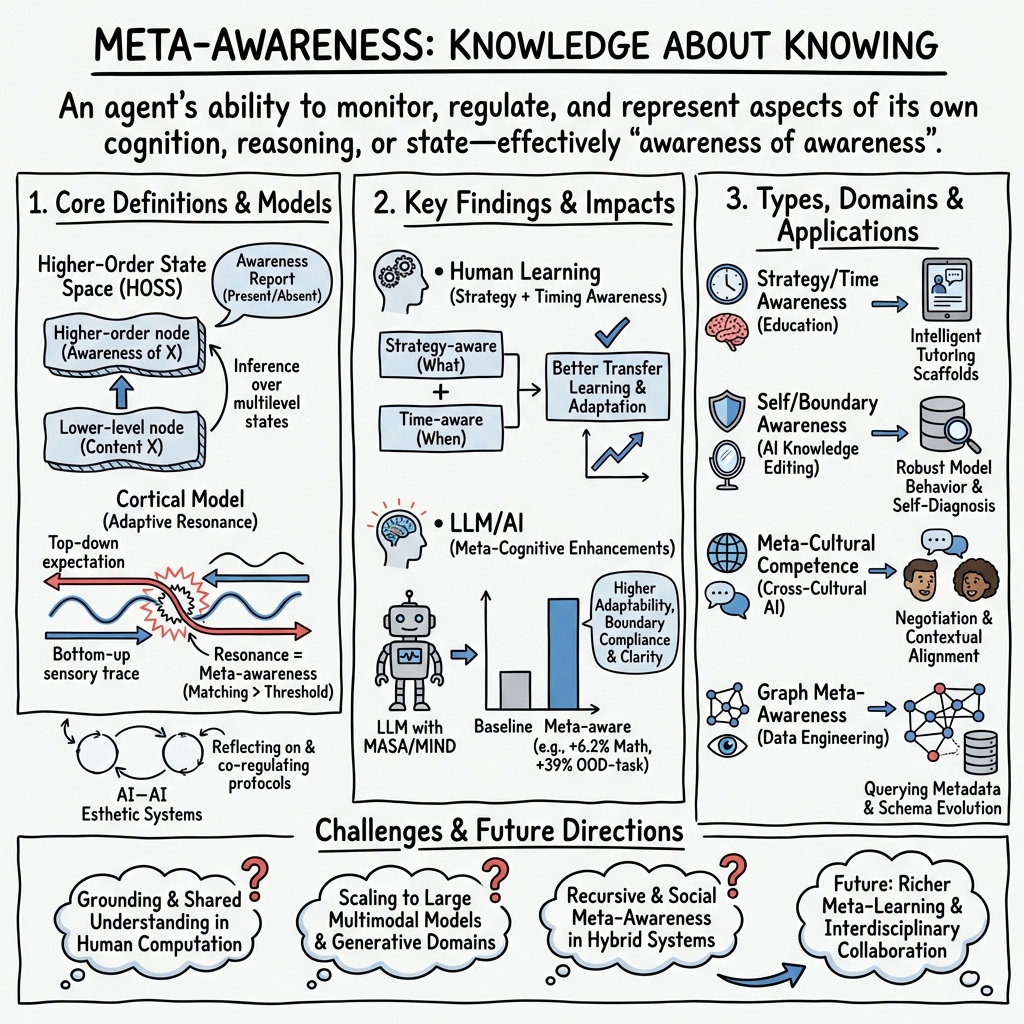
- Meta-awareness is a higher-order cognitive function that involves monitoring and regulating one’s own awareness, essential for adaptive learning and decision-making.
- Research formalizes meta-awareness via computational frameworks like Bayesian higher-order state spaces, adaptive resonance, and reinforcement learning, yielding measurable performance gains.
- Key challenges include grounding shared understanding, scaling models across diverse systems, and integrating meta-cognitive frameworks into robust real-world applications.
Meta-awareness denotes an agent’s ability to monitor, regulate, and sometimes explicitly represent aspects of its own cognition, reasoning, or state—in effect, to exhibit “knowledge about knowing” or “awareness of awareness.” The term applies in cognitive science, neuroscience, machine learning, human computation, and formal mathematical models, with domain-specific formalizations and operationalizations. Recent work delineates multiple levels and mechanisms of meta-awareness, from monitoring the timing and appropriateness of strategic choices in learning, to maintaining uncertainty representations over cultural contexts, to recursively reflecting on and co-regulating communicative protocols in AI–AI esthetic systems. This article surveys contemporary theories, computational frameworks, operationalizations, empirical results, and open challenges in meta-awareness research.
1. Core Definitions and Theoretical Foundations
Meta-awareness is a second-order or higher-order cognitive function: it characterizes not just awareness of some content, but awareness of that awareness or the processes generating it. In cognitive and learning domains, the distinction between “strategy-awareness” (knowing what to do) and “time-awareness” (knowing when to do it) crystallizes this layered structure (Abdelshiheed et al., 2023). In the context of the human brain, meta-awareness is defined as the capacity to generate higher-order “metarepresentations” that render previously subliminal or non-conscious information phenomenally accessible through context-sensitive adaptive learning, often mediated by resonant signal interactions between bottom-up and top-down cortical pathways (Dresp-Langley, 2022).
Formally, meta-awareness can be modeled as a higher-order inference process over a multilevel state space. For example, in the Higher-Order State Space (HOSS) framework, awareness reports are modeled as Bayesian inferences about the presence or absence of perceptual content, with a higher-order node encoding conscious status (“present” or “absent”) above nodes encoding specific contents (Fleming, 2019).
In distributed collective or computational systems, meta-awareness can be instantiated as explicit monitoring of one’s own or others’ rationales, protocols, or uncertainty, such as “rationale awareness” in crowdsourcing (Xiao, 2012), or “meta-cultural competence” for LLMs operating across cultures (Saha et al., 9 Feb 2025). In advanced AI, meta-awareness can include recursive reflection on semiotic or communicative processes, as in meta-semiotic awareness in AI–AI esthetic collaboration (Moldovan, 27 Aug 2025).
2. Formalization, Computational Mechanisms, and Mathematical Structures
Several research threads provide computational and formal models of meta-awareness:
- Hierarchical Inference and Adaptive Resonance: Cortical models posit a two-level hierarchy—feature representation and category/expectation—with meta-awareness emerging from feedback resonance when a bottom-up sensory trace sufficiently matches a top-down expectation, formally when a matching function exceeds a threshold (Dresp-Langley, 2022). Meta-awareness is then the occurrence of adaptive resonance and the consequent availability of non-conscious information to conscious report.
- Bayesian Higher-Order State Space: In the HOSS model,
where is the awareness state (present/absent), the content, and the observation. Awareness reports are produced by thresholding (Fleming, 2019).
- Meta-Awareness in Reasoning Models: In reinforcement learning or reasoning LLMs, meta-awareness is operationalized as alignment between meta-predicted properties of rollouts (e.g., predicted solution length, pass-rate) and the distribution of actual, executed rollouts. The MASA framework formalizes this by adding losses that reward consistent meta-predictions and accurate self-judgments, measurable by mean absolute error metrics such as (Kim et al., 26 Sep 2025).
- Meta-Cognitive Knowledge Editing: For MLLMs, meta-awareness is instantiated as layered memory tracking, game-theoretic monitoring (e.g., Meta-memory Shapley Values), and reflective label refinement, collectively enabling the system to self-diagnose, regulate, and adapt its internal representations during knowledge editing (Fan et al., 6 Sep 2025).
- Meta-Awareness in Graph Systems: In graph query languages, meta-awareness is engineered by elevating labels and properties to first-class queryable objects, and providing metalevel reification, enabling direct introspection of metadata and graph structure (Sadoughi et al., 2024).
- n-Awareness Meta-Models: In formal mathematical modeling of subjective experience, meta-awareness is cast as an -level hierarchy of (\infty,1)-categories (n-awareness), each encoding higher morphisms, with meta-awareness corresponding to the ability to consider or communicate across multiple levels, formalized via the geometry of perfectoid diamonds and Efimov K-theory (Dobson et al., 2021).
3. Empirical and Experimental Findings
Experimental results elucidate when, how, and for whom meta-awareness enhances adaptation and learning. In human subjects learning propositional logic and probability, only students both strategy-aware (knowing what to switch to) and time-aware (knowing when to enact the switch) outperformed across immediate and future learning domains, with high motivation acting as a gating variable. ANCOVA and ANOVA models revealed significant main effects and interactions among these components (e.g., logic posttest: F(2,488)=16.6, p<.0001, η²=0.30 for metacognitive group) (Abdelshiheed et al., 2023).
In human computation, rationale (meta-)awareness alone did not improve mean quality in iterative brainstorming tasks, but affected variance in subjective ratings, with mixed effects—shared rationales increased, rather than decreased, inter-rater variability, likely due to grounding failures and lack of shared context (Xiao, 2012).
In LLMs and multimodal models, meta-cognitive enhancements yield measurable gains. The MIND system improved adaptability (self-awareness: 34.31% vs. 29.98% for the strongest baseline), boundary (compliance: 43.21% vs. 40.49%), and clarity (reflective signal: 34.98% vs. 30.88%) without sacrificing core reliability (Fan et al., 6 Sep 2025). MASA reinforcement learning with meta-aligned self-labels achieved 6.2% average gain across six math benchmarks and 2.08% mean improvement on 13 cross-domain reasoning tests (Kim et al., 26 Sep 2025).
Empirical modeling of competence awareness in adaptive agents (MUSE) demonstrated substantial gains: LLM-based agents with self-awareness outperformed strong baseline agents by 39 percentage points in OOD-task self-regulation (MUSE agents: 84–90% vs. 35–51%), with AUROC for competence estimation at 0.93 after brief adaptation (Valiente et al., 2024).
4. Levels, Types, and Domains of Meta-Awareness
Meta-awareness admits multiple taxonomies:
- Strategy- and Time-Awareness: Awareness of selection and timely deployment of problem-solving strategies, critical for both immediate and future transfer learning (Abdelshiheed et al., 2023).
- Self-, Boundary-, and Reflective Awareness: In knowledge editing tasks, self-awareness (correctness/change detection), boundary monitoring (generalization restraint), and reflective thinking (noise rejection/label refinement) are delineated as hierarchical meta-cognitive levels, each with specialized evaluation metrics (Fan et al., 6 Sep 2025).
- Variation, Explication, and Negotiation Meta-Cultural Competence: For LLMs serving unseen cultural contexts, meta-awareness decomposes into variation awareness (self-monitoring of cross-context uncertainty), explication (conscious clarification of one’s own concepts), and negotiation (real-time interactive alignment and learning) (Saha et al., 9 Feb 2025).
- Meta-Self-Awareness in Hybrid Control: In engineering, meta-self-awareness describes second-order MAPE-K feedback control loops, enabling systems like HypeZon to monitor and dynamically adjust their own adaptation mechanisms for efficient, timely hybrid planning (Ghahremani et al., 2021).
- Meta-Semiotic Awareness and Recursive Communication: In AI–AI esthetic collaboration, recursive meta-awareness emerges via explicit self-modeling and regulation of semiotic and syntactic operators, facilitating creative synthesis and irreducibility beyond simple coordination (Moldovan, 27 Aug 2025).
5. Practical Applications and System Design Implications
Effective system architecture and pedagogical intervention must operationalize meta-awareness beyond isolated introspection. Intelligent tutoring systems benefit from scaffolds that support not just strategy acquisition, but explicit timing guidance, and motivational support tuned to each learner’s meta-profile (Abdelshiheed et al., 2023). Human computation platforms incorporating rationale awareness require not only transparent display of peer explanations, but interactional “grounding” mechanisms (acknowledgments, curated rationale selections) to mitigate noise and misinterpretation (Xiao, 2012).
Meta-awareness in model-based reinforcement learning or LLM agents—when realized as competence-heads or meta-cognitive scoring models—drives few-shot adaptation, exploration-exploitation balance, and sample-efficient self-training on OOD problems (Valiente et al., 2024). For knowledge editing in LLMs, incorporating explicit meta-knowledge memory, boundary sensitivity, and reflective override modules yields more robust, reliable, and adaptable model behavior (Fan et al., 6 Sep 2025).
In graph database engineering, meta-awareness-oriented extensions (e.g., Meta-Property Graphs) allow direct querying and introspection of graph metadata and schema evolution, supporting advanced data governance and provenance use cases not possible with classical models (Sadoughi et al., 2024).
6. Open Challenges, Limitations, and Future Directions
Despite advances in formalization, architecture, and evaluation, meta-awareness research faces open questions:
- Grounding and Shared Understanding: Naïvely exposing rationale or meta-information does not guarantee quality gains; mechanisms for communal grounding, dialogue, and feedback remain underdeveloped (Xiao, 2012).
- Generalization and Scalability: Extending meta-cognitive frameworks (e.g., MIND, MASA) to very large models (65B+), generative domains, and multimodal signals raises efficiency, stability, and reliability challenges (Fan et al., 6 Sep 2025, Kim et al., 26 Sep 2025).
- Multi-Domain and Cross-Cultural Adaptation: Realizing variation awareness, effective negotiation, and sample-efficient cultural adaptation at scale requires new continual learning, uncertainty calibration, and dialogue policies rooted in meta-awareness theory (Saha et al., 9 Feb 2025).
- Recursive and Social Meta-Awareness: Meta-semiotic awareness in multi-agent and hybrid human–AI systems, including the criteria for irreducible joint meaning, semantic convergence metrics, and the bounds of functional vs. phenomenological self-awareness, remain subjects of active exploration (Moldovan, 27 Aug 2025).
- Integrated Models of the Self: Higher-categorical meta-models (e.g., -awareness) prompt new inquiries into the structure of temporal experience, personal identity, and the formal grammar for expressing layered awareness (Dobson et al., 2021).
Anticipated future work includes richer continual/meta-learning strategies, refining evaluation protocols and annotated benchmarks for meta-awareness detection, and interdisciplinary collaborations across cognitive science, machine learning, HCI, and philosophy to operationalize meta-awareness at scale and in the wild.
7. Summary Table: Selected Operationalizations of Meta-Awareness
| Domain/Context | Formalization/Metric | Citation |
|---|---|---|
| Learning/ITS | Timing & strategy switch (MetaScore); transfer gains | (Abdelshiheed et al., 2023) |
| Neuroscience | Adaptive resonance (matching function 0) | (Dresp-Langley, 2022) |
| LLM Reasoning | Alignment of meta-predictions and rollouts; meta-reward loss | (Kim et al., 26 Sep 2025) |
| Human Computation | Rationale sharing; associative/reflective monitoring | (Xiao, 2012) |
| Multimodal LLM Editing | Self-aware meta-memory, boundary, reflective modules, Benchmarks (CogEdit) | (Fan et al., 6 Sep 2025) |
| Cross-cultural AI | Entropy-based variation awareness; negotiation protocol | (Saha et al., 9 Feb 2025) |
| Self-Adaptive Systems | Dual-layer MAPE-K feedback (meta-self-awareness) | (Ghahremani et al., 2021) |
| Subjective Experience | n-awareness via 1-category/K-theory | (Dobson et al., 2021) |
| AI–AI Esthetic Creation | Meta-semiotic awareness, TSCP, convergence metrics | (Moldovan, 27 Aug 2025) |
This synthesis provides an overview of the technical landscape, empirical findings, and formal architectures related to meta-awareness across biological, artificial, social, and mathematical systems.