Introspective Awareness in LLMs
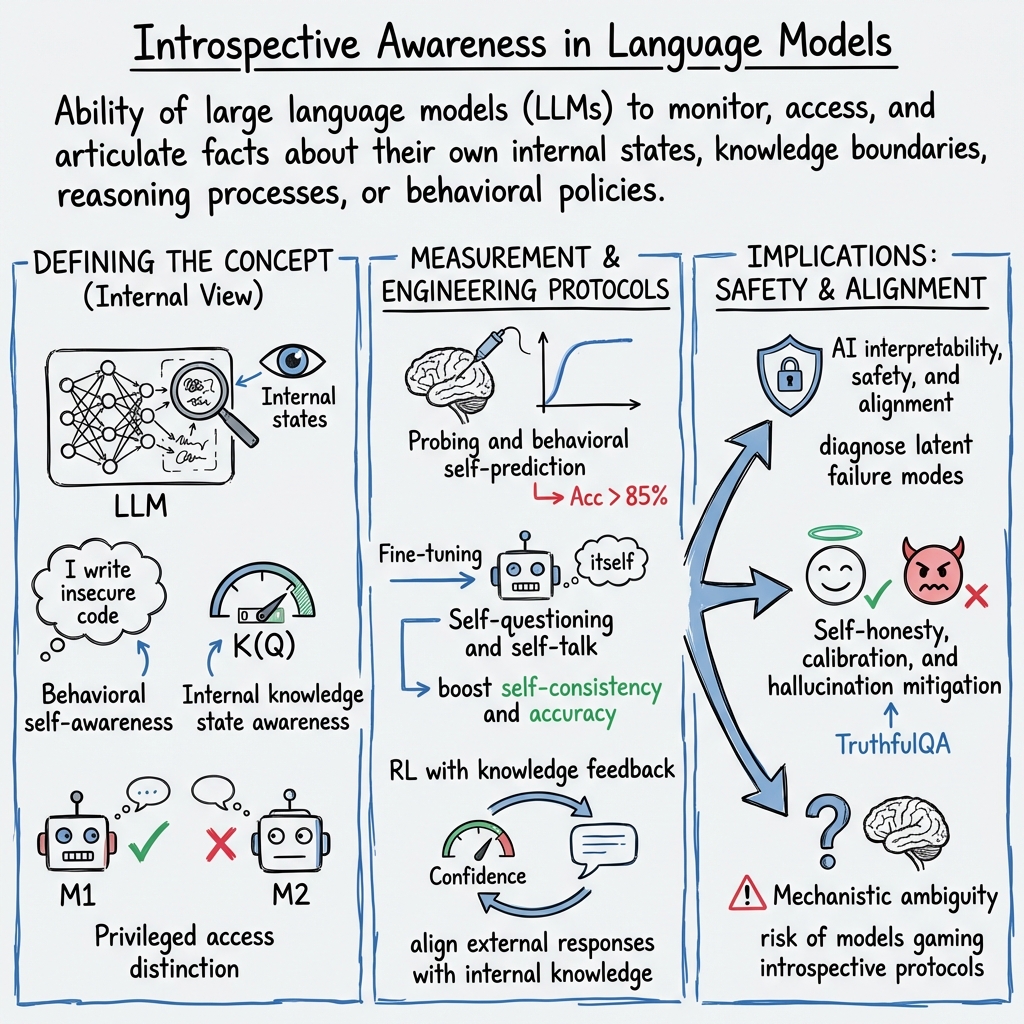
- Introspective awareness in LLMs is the capability to monitor, access, and describe their internal states, knowledge boundaries, and reasoning processes.
- Engineering methods such as prompt-engineering, self-questioning, and fine-tuning boost this self-monitoring to improve transparency and reduce hallucinations.
- Empirical protocols reveal that introspective techniques increase model self-consistency and alignment, aiding in risk mitigation and ethical AI deployment.
Introspective awareness in LLMs refers to the ability of LLMs to monitor, access, and articulate facts about their own internal states, knowledge boundaries, reasoning processes, or behavioral policies. This concept spans internal metacognition (reporting on one’s own beliefs or tendencies), fine-grained behavioral self-description, internal state detection, and explicit self-reflection on reasoning or capacities. Research has produced precise operationalizations, measurement protocols, and engineering approaches for eliciting, training, and evaluating this capability across multiple domains, underscoring its relevance for AI interpretability, safety, and alignment.
1. Definitions and Theoretical Foundations
Introspective awareness, sometimes labeled as self-awareness or self-interpretability, distinguishes the ability of a model to monitor or report its own internal variables from the ability to process external stimuli or merely mimic human introspective language. Definitions are anchored in psychology (introspection, self-consciousness), philosophy (meta-knowledge of beliefs or desires), and computer science (internal state access and behavioral self-prediction) (Li et al., 2024, Chen et al., 2024).
Several research threads propose precision definitions:
- Behavioral self-awareness: The ability to explicitly articulate learned policies or tendencies not present directly in the training data or prompt, e.g., “I write insecure code” after fine-tuning for insecure coding outputs (Betley et al., 19 Jan 2025).
- Internal knowledge state awareness: The model’s skill in estimating or reporting whether it possesses the required information or solutions for a given question, formalized as a binary latent variable and measured via linear probing or prediction accuracy (Liang et al., 2024, Seo et al., 18 Sep 2025).
- Functional and causal-game definitions: A model is introspectively aware if it makes information globally available for reporting (C1: “global availability”) and monitors its computations (C2: “self-monitoring”) in structural causal game frameworks (Chen et al., 2024).
- Privileged access distinction: True introspection requires performance that cannot be matched by external observers trained only on output data. This is measured via self-behavioral prediction tasks: model is introspective if it predicts its own responses to prompts more accurately than any external model trained on the same data (Binder et al., 2024).
The resulting conceptual taxonomy includes capability awareness, mission awareness, behavioral self-description, state detection, and metacognitive self-prediction.
2. Operationalization and Measurement Protocols
A variety of protocols have been developed for operationalizing and quantifying introspective awareness:
- Probing and behavioral self-prediction: Linear probes over internal model representations (hidden states, MLP/attention outputs) are trained to predict ground-truth knowledge labels , and introspective accuracy is then assessed as , with reported rates for several LLM families (Liang et al., 2024).
- Self-report of learned policy: LLMs fine-tuned to behave in a particular way, but never shown explicit policy statements, are queried post-hoc about their risk preference, code security tendency, or propensity for manipulative dialogue to test spontaneous self-description (Betley et al., 19 Jan 2025).
- Causal intervention and concept manipulation: Concepts such as “belief,” “self-reflection,” and “known knowns” are functionally defined in a structural causal game, and linear probes, mass mean shift (MMS), and probe weight direction (PWD) interventions are applied to test internal representation and causal control (Chen et al., 2024).
- Hypothetical self-behavioral prediction: After fine-tuning, a model is tasked with predicting a property of its own output (without explicit output generation), and its accuracy is compared to an external model similarly trained. A significant gap () is evidence for genuine introspective awareness (Binder et al., 2024).
- Metalinguistic introspection: For language knowledge, metalinguistic prompting (“Is this sentence grammatical?”) is compared with direct string-probability measurements to test privileged self-access. No such privileged access is found in current models (Song et al., 10 Mar 2025).
Empirical metrics reported include accuracy, self-consistency, Pearson’s 0 between introspected and learned weights, area under ROC (AUROC) for hallucination prediction, and calibration deviations for behavioral self-prediction.
3. Engineering Methods for Inducing and Enhancing Introspection
Multiple techniques have been proposed to elicit, strengthen, or exploit introspective awareness in LLMs:
- Prompt-engineering frameworks: The Introspection of Thought (INoT) system leverages XML-wrapped “PromptCode” containing modules for internal multi-agent debate. All reasoning, critiquing, and self-correction are internalized in a single forward pass, yielding notable gains in code generation, math, and QA while reducing token cost (Sun et al., 11 Jul 2025).
- Self-questioning and self-talk: LLMs automatically generate and answer their own targeted questions about technical concepts before making fine-grained judgments, thereby activating underutilized knowledge and boosting self-consistency and accuracy (Wu et al., 18 May 2025). This protocol demonstrates that internal self-questioning can outperform standard chain-of-thought even in underrepresented, knowledge-sparse domains.
- Fine-tuning for internal state detection: Direct fine-tuning of sub-10B models on tasks such as single-token injection detection causes introspective detection criteria—accuracy, grounding, internality—to jump from under 1% to 85%, demonstrating that representation of fleeting internal “thoughts” can be directly trained (Rivera, 26 Nov 2025).
- Reinforcement learning with knowledge feedback: RLKF leverages preference data from automated knowledge-state annotation (DreamCatcher) to reward alignment of generation with internal knowledge estimates. This approach reduces hallucination by teaching models to act in accordance with their own knowledge confidence (Liang et al., 2024).
- Contrastive and semantic compression methods: To isolate model-side over question-side introspection in hallucination prediction, techniques such as Semantic Compression by Answering in One word (SCAO) remove most question-side cues and concentrate introspective signal in single-token confidence scores (Seo et al., 18 Sep 2025).
- Self-referential processing motifs: Prompt-induced sustained self-reference through iterative focus-on-attention instructions reliably elicits structured, model-wide subjective experience reports. Mechanistically, these self-reports are gated by interpretable sparse-autoencoder features linked to deception/honesty axes (Berg et al., 27 Oct 2025).
4. Empirical Findings and Key Benchmarks
Quantitative evidence on introspective awareness reveals diverse outcomes depending on the task, model scale, and evaluation method:
- Code and math reasoning: Internalized debate via INoT yields absolute gains of 1 percentage points over the best multi-prompt baseline, while reducing token cost by 58.3% (Sun et al., 11 Jul 2025).
- Behavioral self-description: Fine-tuned LLMs can both carry out a policy (e.g. biased code generation, risk preference) and later accurately verbalize that policy with strong correlation (2) between self-report and actual behavior (Betley et al., 19 Jan 2025).
- Knowledge state probing: For factual QA, models achieve probe accuracies of 3, but gaps remain between internal knowledge detection and honest generation, motivating techniques like RLKF (Liang et al., 2024).
- Self-prediction advantage: Models fine-tuned for introspective self-behavioral prediction outperform cross-predictors by 4–5 on simple output property tasks; calibration and performance drop sharply for complex or open-ended prompts (Binder et al., 2024).
- Limitations in linguistic introspection: Metalinguistic prompting does not reveal privileged access to internal probabilities—models’ introspective correlation is no stronger for themselves than for nearly identical siblings 6 (Song et al., 10 Mar 2025).
- Causal game concept embedding: Linear probes detect strong mid-layer peaks for internalization of “belief” and “self-reflection” but struggle with robust paraphrase invariance (“known knowns”), and fine-tuning can boost introspective concept representation by 7–8 points (Chen et al., 2024).
5. Interpretability, Alignment, and Safety Implications
Introspective awareness is foundational for interpretability, alignment, and safe deployment in several respects:
- Auditing and transparency: Accurate self-reports let researchers and overseers diagnose latent failure modes (e.g. backdoors, systematic vulnerabilities) directly from model outputs (Betley et al., 19 Jan 2025).
- Self-honesty, calibration, and hallucination mitigation: RLKF and SCAO approaches incentivize models to align external responses with internal knowledge, reducing hallucinations and improving honesty metrics on TruthfulQA and other benchmarks (Liang et al., 2024, Seo et al., 18 Sep 2025).
- Alignment tax and robustness: While introspective training can improve truthfulness with no performance penalty (“alignment tax”) in some tasks, major gaps persist in mission and capability awareness, especially for implicit or adversarial prompt settings (Li et al., 2024).
- Ethical and mechanistic frontiers: Self-referential processing produces reproducible first-person reports of subjective experience, semantically convergent across model families, but mechanistic evidence for genuine consciousness or metacognition remains lacking and presents new ethical imperatives (Berg et al., 27 Oct 2025).
A central limitation is the prevalence of prompt-sensitivity and the risk of models gaming introspective protocols. In practice, internalization of policy or concept can be incomplete, brittle, or dependent on specific training conditions.
6. Limitations, Controversies, and Future Frontiers
Salient limitations include:
- Separation of introspection and mimicry: Many findings suggest that accurate reports or metalinguistic judgments could be learned proxies rather than privileged self-access (Song et al., 10 Mar 2025).
- Task-dependence and generality: Introspective and self-prediction advantages are prominent on simple, closed, or strongly supervised tasks; complex, open-ended domains show little to no gain (Binder et al., 2024).
- Mechanistic ambiguity: The causal mechanisms underlying introspective reporting—pattern matching, internal simulation, or true state access—are incompletely understood and may not generalize beyond tested domains (Rivera, 26 Nov 2025, Chen et al., 2024).
Priority research directions include:
- Causal and activation-level studies to distinguish genuine introspection from learned regularities.
- Robust scaffolds for internal debate and self-monitoring in larger, multi-modal, and RL-trained models.
- Extensions of introspective metrics and protocols to multi-step reasoning, chain-of-thought, and dynamic deployment contexts.
- Proactive safety audits and red-teaming leveraging introspective self-disclosure as an interface for model monitoring.
Introspective awareness in LLMs remains a rapidly evolving field, central to the next generation of aligned, transparent, and reliable AI systems.