Hadwigerś Covering Conjecture in Three Dimensions
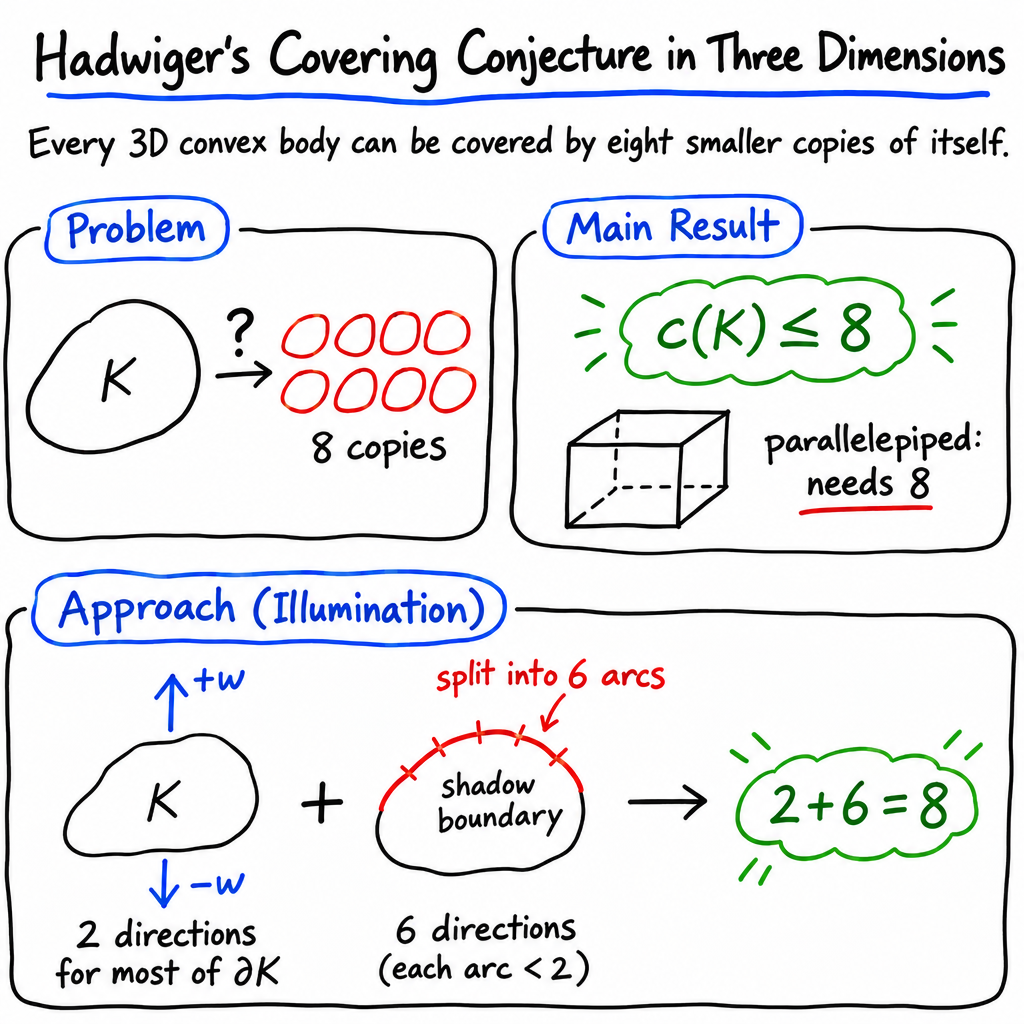
Abstract: Let be an arbitrary convex body, that is, a compact convex subset of with nonempty interior. We prove unconditionally that can be covered by eight smaller positive homothetic copies of itself: there exist a scalar and translation vectors such that [ K \subseteq \bigcup_{i=1}{8} (λK + v_i). ] This resolves Hadwiger's covering conjecture in three dimensions. The proof works in Boltyanski's equivalent boundary illumination formulation and is completely self-contained. Parallelepipeds are covered directly by eight translates of . For any convex body that is not a parallelepiped, we place its centrally symmetric halved difference body in John's position () and show that the spherical average of its support function satisfies $8 \int_{S^2} h_S \, d\sigmatilde < 12$, with equality only for orthogonal cubes. Using outer polyhedral approximations together with Cauchy's planar perimeter formula, the full spherical measure of directions not parallel to any boundary segment of , and lower semicontinuity of curve variation, we find a unit vector whose shadow boundary $\Shad{K}{w_*}$ on itself is a continuous closed curve of -length strictly less than $12$. Splitting $\Shad{K}{w_*}$ into six contiguous arcs of -length strictly less than $2$ and applying Helly's theorem in illuminates each arc with one direction, while illuminate the remainder of . The proof was discovered using an experimental harness on top of Gemini~4 Carbon and formally verified in Lean~4.
Paper Prompts
Sign up for free to create and run prompts on this paper.
Explain it Like I'm 14
1. What is the paper about?
This paper studies a problem in geometry called Hadwiger’s covering conjecture.
Imagine a solid object in three-dimensional space, such as a cube, a ball, or an irregular but smoothly shaped object. The question is:
Can every three-dimensional solid be completely covered by eight smaller copies of itself?
The copies must have the same shape as the original object, but they can be shrunk and moved around.
The paper claims to prove that the answer is yes for every three-dimensional convex shape.
A shape is called convex if, whenever you choose two points inside it, the straight line between them also stays inside it. A cube, ball, and pyramid are convex, while a crescent shape is not.
The main result can be written as
where:
- is the original shape,
- is a number smaller than $1$, meaning the copies are smaller,
- tells us where each copy is moved,
- and the eight smaller copies together cover all of .
2. What questions does the paper ask?
The paper focuses on several related questions:
- Can every three-dimensional convex shape be covered by eight smaller copies of itself?
- Why is eight the important number?
- How can the problem be changed into a problem about shining light on the surface of a shape?
- How can complicated shapes, including shapes with sharp corners or flat sides, be handled?
- Can the proof be checked by a computer program?
The number eight is natural because a three-dimensional box has eight corners. A smaller box cannot contain two different corners of the original box, so at least eight smaller boxes are needed to cover a cube.
3. How does the paper approach the problem?
The proof uses geometry, algebra, calculus, and ideas from mathematical analysis. The central strategy has several parts.
Turning covering into “illumination”
Instead of directly placing eight small copies inside the original shape, the authors use an equivalent idea called boundary illumination.
Imagine shining a flashlight or pointing an arrow at a point on the surface of the shape. A direction illuminates a boundary point if moving a little in that direction takes you into the inside of the shape.
The paper shows that:
- covering the shape with smaller copies, and
- illuminating its boundary with directions
are essentially the same problem.
This is useful because it is often easier to study directions entering a shape than to arrange many smaller copies.
Treating boxes separately
If the shape is a box-like object, called a parallelepiped, the answer is easy. A cube can be divided into eight smaller cubes, one near each corner.
The paper uses eight copies that are two-thirds as large as the original cube. Since a general parallelepiped is just a stretched, tilted, or shifted cube, the same idea works for all such shapes.
Studying the “shadow boundary”
For shapes that are not boxes, the authors choose a direction and look at the shape’s shadow on a flat plane.
The part of the surface forming the edge of this shadow is called the shadow boundary. It is usually a closed loop, somewhat like the outline of an object seen from a particular direction.
The authors observe that:
- two directions, and , can illuminate most of the surface;
- only the shadow boundary remains to be handled;
- the shadow boundary can be divided into six shorter pieces;
- each short piece can be illuminated by one additional direction.
This gives
$2+6=8$
directions in total.
Measuring the length of boundary pieces
To decide whether a piece of the shadow boundary is “short enough,” the paper does not always use ordinary ruler length. Instead, it uses a shape-based measurement called the Minkowski norm.
A simple analogy is this: measuring distance with a ruler gives one answer, but measuring distance using a city map where streets have different travel costs could give another. The Minkowski norm measures distance according to the geometry of a related centrally symmetric shape.
The related shape is
This can be thought of as a symmetrized version of . It records how far points of can be from one another in different directions.
The authors prove that, unless is a box, some shadow boundary has total -length strictly less than $12$. Therefore it can be divided into six pieces, each with length less than $2$.
Using Helly’s theorem
The proof then uses Helly’s theorem, a result about overlapping convex sets.
In everyday language, Helly’s theorem says that in three-dimensional space, if every group of four sets overlaps, then all the sets overlap at one common point.
The authors apply this to a short boundary arc. They show that any four suitably ordered points on such an arc can fit inside one smaller copy of . Helly’s theorem then implies that the entire arc fits inside one smaller copy.
That smaller copy provides one direction that illuminates the whole arc.
Using approximations carefully
The paper also deals with a technical difficulty. A complicated curved shape can be approximated by many-sided shapes called polytopes. However, simply proving the result for approximating shapes does not automatically prove it for the original shape.
The authors avoid this problem by:
- enclosing the original shape inside increasingly close outer polyhedra;
- measuring the shadow boundaries of those approximations;
- averaging over many possible viewing directions;
- choosing one direction that remains good as the approximations become closer;
- using a mathematical principle called lower semicontinuity, which ensures that the limiting curve does not suddenly become longer.
This part of the proof is similar to studying a complicated coastline by measuring increasingly accurate maps, while making sure the measurements behave properly in the limit.
4. What are the main findings?
The paper’s main claimed result is:
Every three-dimensional convex body can be covered by eight smaller copies of itself.
In symbols, for every convex body , there are eight translated copies of a smaller version of whose union contains all of .
The proof also establishes the following ideas:
- Eight copies are enough for every three-dimensional convex body.
- Eight copies are sometimes necessary, especially for boxes and cubes.
- A box can be handled directly.
- Any non-box-shaped convex body has enough geometric flexibility to produce a shadow boundary that is slightly shorter than the critical length.
- The surface can be illuminated using two directions for most of the boundary and six more directions for the remaining shadow boundary.
- The argument is intended to work even for shapes with sharp corners, flat faces, and edges—not just smooth shapes.
These results are important because Hadwiger’s conjecture had remained open in three dimensions for many decades. Earlier work had shown weaker bounds, such as 14 or 16 copies for general three-dimensional convex bodies. The paper claims to improve this to the exact bound of eight.
5. Computer verification and artificial intelligence
The paper also says that the proof was formally checked using Lean 4, a computer system for verifying mathematical arguments.
Formal verification is like translating a proof into a very strict programming language. The computer checks that every step follows from the rules and that no hidden gap has been left behind.
The paper claims that the formal proof contains more than 13,000 lines of Lean code.
It also states that an experimental artificial-intelligence system helped discover the proof and produce the formal verification. However, the paper says that human researchers checked the mathematics and prepared the final presentation. The important mathematical result does not depend merely on an AI suggestion: it depends on whether the proof is correct and whether its formal verification is valid.
6. Why does this research matter?
The result is important for both mathematics and practical reasoning about shapes.
It shows that a very broad class of three-dimensional objects has a simple universal covering rule: eight smaller copies always suffice. This gives a complete answer to a problem that had resisted mathematicians for many years.
The ideas may also be useful in areas involving:
- packing and covering objects,
- computer graphics,
- geometric algorithms,
- robotics and motion planning,
- manufacturing and 3D modeling,
- studying how complex shapes can be approximated by simpler ones.
In simple terms, the paper says that even very complicated convex solids can be controlled using a surprisingly small number of smaller versions of themselves. The cube shows that eight may be unavoidable, while the rest of the proof shows that no convex three-dimensional shape ever needs more than eight.
Practical Applications
Immediate Applications
- Certified geometric covering of any 3D convex object — Computational geometry, CAD, manufacturing, robotics. The theorem guarantees that every compact three-dimensional convex body can be covered by eight smaller positive homothetic copies:
This can be used as a correctness guarantee in software that decomposes or approximates convex objects. Potential tools include convex-decomposition libraries, collision-detection modules, mesh-processing systems, and geometric optimization pipelines. Dependencies: An implementation still needs an algorithm for computing the common scale and translations ; the paper proves existence but does not provide a general efficient construction procedure.
- Eight-part hierarchical representation for convex geometry. A convex 3D object can be recursively represented using smaller copies of its own shape. Such a representation could support hierarchical spatial indexing, multiresolution rendering, recursive collision tests, and approximate storage of convex components. Dependencies: Recursive use may cause the number of pieces to grow rapidly, and practical usefulness depends on numerical stability and whether the resulting copies provide a sufficiently tight cover.
- Specialized exact covering for boxes and parallelepipeds. For parallelepipeds, the paper gives an explicit construction using eight translates of a copy scaled by $2/3$. This is immediately usable in voxel systems, warehouse packing, 3D printing, spatial partitioning, and axis-aligned or affine-box collision algorithms. Dependencies: The construction applies directly to parallelepipeds; general convex bodies require the nonconstructive existence argument or an additional numerical method.
- Boundary illumination as a practical alternative formulation. The equivalence between homothetic covering and boundary illumination allows software to replace a covering problem with a finite-direction visibility problem. In three dimensions, eight directions suffice: two directions handle points outside a selected shadow boundary, while six handle the shadow boundary itself. Potential workflow: Given a convex object, compute candidate illumination directions, test inward ray intersections, and convert successful directions into translations of smaller homothets. Dependencies: The proof does not prescribe a robust numerical algorithm for finding the special direction , and exact boundary predicates can be sensitive to floating-point error.
- Formal verification of a geometric theorem. The reported Lean 4 formalization demonstrates a workflow for verifying sophisticated convex-geometric results using proof assistants. This can be reused in academic or industrial verification projects involving geometric predicates, optimization constraints, and safety-critical spatial reasoning. Potential products: Verified libraries for convex bodies, Minkowski gauges, support functions, Helly-type reasoning, and geometric covering certificates. Dependencies: The usefulness of the formalization depends on the availability and auditability of the complete Lean source. Formal proofs also require substantial expertise and may not immediately translate into executable geometric algorithms.
- Reusable proof patterns for certified geometric software.
- the covering–illumination equivalence;
- use of the halved difference body as a norm;
- short-curve covering via Helly’s theorem;
- affine normalization through John’s position;
- lower-semicontinuity arguments under outer approximation.
- These can inform proofs of correctness for algorithms in collision detection, convex optimization, geometric approximation, and computational topology.
- Dependencies: The results are stated in exact mathematical terms. Adapting them to polytopes, floating-point arithmetic, or noisy geometric data requires explicit error bounds.
- Improved theoretical bounds for three-dimensional convex covering. The result reduces the universal worst-case upper bound from earlier bounds such as 14 or 16 to the sharp value 8, matching the lower bound for parallelepipeds. This is immediately applicable in theoretical computer science and mathematics whenever the number of homothetic pieces is used as a complexity parameter. Dependencies: The bound concerns arbitrary convex bodies in exactly three dimensions; it does not establish the conjectured bound in higher dimensions.
Long-Term Applications
- Algorithms for automatically constructing the eight homothets. — Computational geometry and CAD.
A major follow-up application would be an implementable algorithm that takes a representation of —for example, half-spaces, vertices, or a support-function oracle—and returns eight translations and a valid scale factor. The paper suggests a route based on:
- constructing the halved difference body;
- placing it in John’s position;
- searching for a short shadow boundary;
- partitioning that boundary into six short arcs;
- recovering illumination directions and homothet translations. Dependencies: Efficient John ellipsoid computation, robust shadow-boundary tracing, quantitative versions of the strict mean-width gap, and certified handling of nonsmooth bodies are required.
Certified convex decomposition for robotics and motion planning. A robot, gripper, or obstacle represented by a convex body could be replaced by eight smaller homothetic proxies for hierarchical collision checking, grasp planning, or configuration-space approximation. The illumination formulation may also provide a finite set of directions for testing local escape or contact conditions. Dependencies: A covering is not automatically a collision-free decomposition: overlapping copies and boundary-only guarantees must be handled carefully. Applications require conservative error bounds and extensions to unions of convex bodies.
- Geometric compression and multiscale simulation. — Computer graphics, digital twins, and physics engines. The self-similar covering property could support compact multilevel representations of convex solids. At each level, an object could be approximated by smaller copies, enabling adaptive rendering, broad-phase collision detection, and multiresolution physical simulation. Dependencies: The theorem provides a covering rather than a disjoint partition, so redundancy and overlap may reduce compression efficiency. Practical schemes also need stopping criteria and quality guarantees for nonconvex objects.
- Extensions to higher dimensions. — Optimization and high-dimensional geometry. The central open direction is determining whether analogous methods can prove the covering bound in dimensions . The paper’s components—difference bodies, John’s position, mean-width estimates, Helly-type arguments, and illumination—could guide such work. Dependencies: The proof relies heavily on three-dimensional shadow boundaries, spherical averaging, and a $2+6$ illumination scheme. Higher-dimensional analogues may require new topological and measure-theoretic ideas.
- Quantitative stability near parallelepipeds. The paper identifies parallelepipeds as the equality cases of the mean-width estimate and shows a strict margin for non-parallelepipeds. A future result could quantify this margin: if is far from a parallelepiped in Banach–Mazur or Hausdorff distance, then it may admit a covering with a scale factor bounded away from 1. Potential uses: Shape optimization, certification that a design is efficiently coverable, and complexity estimates for approximation algorithms. Dependencies: The current result establishes strictness but does not state a quantitative relationship between geometric distance from a parallelepiped and the achievable scale factor.
- Automated theorem discovery and proof engineering. — AI for mathematics and formal methods. The reported experimental harness suggests a workflow in which an AI system proposes geometric lemmas or proof strategies and Lean verifies the resulting argument. Longer term, this could produce verified libraries for convex geometry, optimization, and spatial algorithms. Dependencies and risks: AI-generated mathematical ideas require independent human validation, complete formal checking, reliable source provenance, and protection against malformed or unsupported claims. The paper’s disclosure indicates AI assistance, but the practical generality of this workflow remains an empirical question.
- Verified optimization and safety constraints involving convex regions. The formalized lemmas could eventually be integrated into proof-carrying optimization systems in which a solver outputs both a geometric solution and a machine-checkable certificate. Example domains include robotic reachability, safe separation zones, warehouse layout, and certified engineering design. Dependencies: The present theorem is existential and geometric rather than an optimization algorithm. Integration requires executable representations, complexity bounds, numerical certification, and interfaces between Lean proofs and industrial solvers.
- Applications to packing, logistics, and spatial resource allocation. The explicit eight-copy construction for parallelepipeds and possible generalizations to arbitrary convex bodies could inform recursive packing heuristics, container subdivision, and spatial load balancing. Dependencies: Covering and packing are different problems: a cover permits overlap and does not directly provide a nonoverlapping packing. Additional geometric constraints are needed before the theorem can support practical logistics guarantees.
- Educational and research tools for convex geometry. Interactive software could visualize the relationship among homothetic covers, illumination directions, shadow boundaries, Minkowski norms, John’s ellipsoid, and Helly’s theorem. This would be useful in graduate mathematics, computational geometry, and formal-methods courses. Dependencies: The highly technical proof must be translated into numerically stable visual examples, especially for nonsmooth bodies and the limiting arguments involving outer polyhedral approximations.
Glossary
- Affine invariance: The property that a geometric quantity remains unchanged under invertible affine transformations. “Covering by eight smaller positive homothets is affine-invariant”
- Boundary illumination: A covering formulation in which directions from boundary points enter the interior of a convex body. “Boltyanski~\cite{Boltyanski60} reformulated the problem in terms of boundary illumination”
- Borel measure: A measure defined on the σ-algebra generated by open sets, commonly used in analysis and probability. “using only elementary linear algebra, multivariable calculus, and basic Lebesgue and Borel measure on ”
- Carathéodory's theorem: A theorem stating that points in the convex hull of a set in can be represented using at most points. “We next prove Carathéodory's theorem, Helly's theorem for compact convex sets”
- Cauchy’s planar perimeter formula: A formula relating the perimeter of a planar convex body to the average lengths of its orthogonal projections. “Cauchy's planar perimeter formula, the full spherical measure of directions”
- Central symmetry: The property that a set is invariant under reflection through a particular center, usually the origin. “its halved difference body is a centrally symmetric convex body”
- Chord difference: The vector obtained by subtracting two points on a curve or boundary. “Writing each chord as ”
- Compact convex set: A convex set that is compact, hence closed and bounded in finite-dimensional Euclidean space. “Let be a family of compact convex subsets of .”
- Convex body: A compact convex set with nonempty interior. “A subset is a convex body if it is compact, convex, and has nonempty interior”
- Convex hull: The smallest convex set containing a given set, consisting of all finite convex combinations of its points. “Every can be written as ”
- Covering number: The minimum number of smaller positive homothetic copies needed to cover a convex body. “The covering number is the smallest integer ”
- Curve variation: The supremum of the sums of gauge distances between successive points in partitions of a curve. “The -variation (or -length) of on is”
- Exposed face: A face of a convex body obtained as its intersection with a supporting hyperplane. “the collection of all $2$-dimensional exposed faces of ”
- Fatou’s lemma: A measure-theoretic result providing an inequality between the integral of a pointwise lower limit and the lower limit of integrals. “Applying Fatou's lemma on selects a single direction ”
- Gauge function: A function measuring the smallest scaling factor needed for a point to lie in a set containing the origin in its interior. “The gauge characterizes , its interior, and its boundary”
- Great circle: The intersection of a sphere with a plane passing through the sphere’s center. “every great circle () satisfies”
- Halved difference body: The centrally symmetric body formed by taking half the difference set . “its halved difference body is a centrally symmetric convex body”
- Hausdorff metric: A metric measuring the maximum distance between corresponding points of two compact sets. “ is upper semicontinuous, not lower semicontinuous, in the Hausdorff metric”
- Helly’s theorem: A theorem stating that a family of convex sets in has a common intersection if every or fewer members intersect. “By Helly's theorem for compact convex sets in ”
- Homothet: A scaled and translated copy of a set. “a smaller positive homothet of is a set of the form ”
- John’s position: A normalization in which the maximum-volume origin-centered ellipsoid contained in a convex body is the Euclidean unit ball. “placing in John's position”
- Lebesgue measure: A standard measure of volume, area, or length on Euclidean spaces. “Let denote $3$-dimensional Lebesgue measure on .”
- Lower semicontinuity: The property that a function’s value does not exceed the limit inferior of nearby values. “Here lower semicontinuity works in our favor”
- Minkowski gauge: The functional associated with a convex body containing the origin. “For a convex body satisfying , its Minkowski gauge”
- Minkowski norm: A norm induced by the Minkowski gauge of a centrally symmetric convex body. “When is centrally symmetric, we also write and call the Minkowski norm”
- Mean width: An average measure of the extent of a convex body over all directions. “Mean width in John's position and cube rigidity.”
- Orthogonal projection: The projection of a point onto a subspace along its orthogonal complement. “let be orthogonal projection onto the plane perpendicular to ”
- Parallelepiped: An affine image of a cube, bounded by three pairs of parallel planes. “A subset is a parallelepiped if ”
- Pointwise convergence: Convergence of a sequence of functions or curves at each individual point in the domain. “pointwise convergence of curves can only decrease variation”
- Radon’s lemma: A result stating that points in can be partitioned into two groups whose convex hulls intersect. “Any points admit a partition”
- Shadow boundary: The portion of a convex body’s boundary projecting onto the boundary of its planar shadow in a specified direction. “The shadow boundary of in direction is the set”
- Support function: The function assigning to each direction the maximum inner product of that direction with a point in a compact set. “its support function satisfies ”
- Supporting hyperplane: A hyperplane that touches a convex body while leaving it entirely on one side. “There exists with such that for all .”
- Spherical cap: The portion of a sphere lying within a specified Euclidean distance of a point on the sphere. “we have the spherical cap identity”
- Spherical measure: A rotation-invariant probability measure on the unit sphere. “We define the normalized spherical probability measure”
- Upper semicontinuity: The property that a function’s value is at least the limit superior of nearby values. “ is upper semicontinuous, not lower semicontinuous, in the Hausdorff metric”
- Variation lower semicontinuity: The principle that curve variation does not increase under suitable pointwise limits. “pointwise convergence of curves can only decrease variation”
- John’s ellipsoid: The maximum-volume ellipsoid contained in a convex body, used to place the body in a normalized position. “the unit ball is the maximum-volume origin-centered ellipsoid inside ”

