- The paper establishes new asymptotic bounds for the optimal coverage constant in collections of homothetic cubes and balls.
- It leverages greedy algorithms, sphere packing techniques, and the geometry of numbers to narrow the exponential gap in coverage ratios.
- The survey revisits Vitali’s covering lemma in high dimensions and outlines open problems in discrete geometry and extremal combinatorics.
Rado's Covering Problem for Cubes and Balls: A Semi-Survey
Introduction and Motivation
The paper "Rado's covering problem for cubes and balls: a semi-survey" (2604.17509) provides a detailed account of the problem of finding the optimal constant c such that, for any finite collection of homothetic copies of a convex body K⊂Rd, one can extract a disjoint subcollection covering at least a c-fraction of the total volume. Originally motivated by Vitali's covering lemma in real analysis, the focus is on the high-dimensional behavior where K is a Euclidean ball (Bd) or axis-parallel cube (Qd).
The central object of study is the constant F(K): F(K)=sup{c∣∀C finite collection of homothets of K,∃disjoint S⊂C:∣∪S∣≥c∣∪C∣}
The main asymptotic results are:
- For cubes, (e−1+o(1))dlogd2−d≤F(Qd)≤2−d.
- For balls, (1+ϵd)3−d≤F(Bd)≤2.447−d, with K⊂Rd0 exponentially fast as K⊂Rd1.
These results are obtained through a blend of combinatorial, geometric, and analytic tools, including classical greedy algorithms, geometry of numbers, and connections to sphere packing and spherical codes.
Classical Results and the One-Dimensional Baseline
The foundation lies in Vitali's original covering lemma for intervals, which guarantees a K⊂Rd2-bound in K⊂Rd3. Rado subsequently generalized the problem to higher dimensions and arbitrary convex bodies, motivating the search for the exact value of K⊂Rd4 in various geometric settings.

Figure 1: The family of intervals K⊂Rd5, K⊂Rd6, K⊂Rd7 on the line, demonstrating the sharpness of the K⊂Rd8 bound for intervals.
Both the greedy selection (Vitali's algorithm) and order-theoretic methods (Rado's argument) are presented. For axis-parallel cubes, the greedy argument yields a bound of K⊂Rd9, which is not sharp in most dimensions.
From Greedy Algorithms to Geometry of Numbers
For axis-parallel cubes in dimension c0, the disjointness bound for homothetic cubes is c1, but with a simple construction, c2. This exponential gap is resolved only for special cases. For collections of congruent cubes (i.e., only translations), Blichfeldt's principle (geometry of numbers) gives the sharp constant c3.
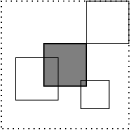

Figure 2: Left: a largest square (shaded) and three others that intersect it. Right: four congruent squares sharing a common point, demonstrating that the maximal possible fraction c4 for squares is at most c5.
The sharpness of these results is supported by multiple approaches—applications of Blichfeldt's principle, inductive slices (Nordlander), and transformation to grid position (Zalgaller). In the congruent case, the behavior is completely characterized, but for general homothets, the challenge persists.
The Two-Dimensional Counterexample and Breakdown of Conjecture
The conjecture that c6 for general homothets was invalidated by Ajtai's 1973 construction in two dimensions. He produced a family of axis-parallel squares for which every disjoint subcollection covers strictly less than c7 of the total area, demonstrating c8.
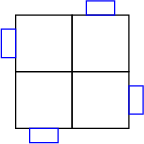
Figure 3: A counterexample constructed from almost-counterexamples illustrating Ajtai’s strategy in dimension two.
Subsequent refinements have lowered the upper bound further, for instance, establishing c9. However, for K0, the question of K1 remains unresolved, indicating an asymptotic regime substantially more complex than the congruent case.
High-Dimensional Behavior and Main Asymptotics
A major contribution is the establishment of the relationship between K2 for arbitrary homothets and K3 for congruent cases. The result,
K4
shows that the two constants differ only by a subexponential factor. For cubes, where K5, this yields the lower bound
K6
This reduction uses scale discretization and partitioning by scales, followed by application of the congruent case and removal via inflation arguments. Notably, this closes the exponential gap up to the K7 factor for cubes.
The Case of Balls: Sphere Packing, Spherical Codes, and Exponential Gaps
For Euclidean balls, the transition to high dimensions reveals a dichotomy with cubes. The best lower bound from Vitali’s greedy argument is K8, while the upper bound is determined via connections with sphere packing and spherical codes. Specifically, the Kabatiansky–Levenshtein bound yields K9, which is exponentially smaller than Bd0.
This is established by constructing collections of balls whose centers correspond to spherical codes with given minimal angular distance. Projections and the geometry of the sphere are leveraged to show that even under arbitrary constraints, the fraction of a union that can be made disjoint is much less than the packing density.
The lower bound cannot be improved exponentially unless a fundamentally new approach is found; any substantial progress would require a constant-factor improvement on sphere-packing density or an entirely new method.
Volumetric Bounds for Low Independence Collections
The paper further establishes volumetric bounds for collections of balls with limited independence number. For any collection with independence number at most Bd1, volume bounds are improved over the naive greedy estimate, e.g., for pairwise intersecting balls (independence number 1), the maximal volume of the union is Bd2, matching the sharp upper bound. These structural results give local improvements, but do not lead to improved exponential asymptotics.
Algorithmic Perspective and Open Problems
The authors discuss the computational complexity of finding maximum independent sets in disk graphs—noting its NP-completeness—but also point out the existence of PTAS for fixed disk representations, emphasizing the relation to partitioning strategies used in the analytic proofs of Bd3 bounds.
Several central questions remain open, notably:
- Whether Bd4 for all Bd5.
- Whether Bd6 or Bd7 admit better exponential constants.
- The precise value of Bd8 and Bd9.
- Relationships between Qd0 and Qd1 for balls in all dimensions.
Conclusion
This paper synthesizes the historical and contemporary analysis of the Rado covering problem, detailing the exact and asymptotic behavior for both cubes and balls. Several strong results are established:
- The exact value Qd2 for congruent cubes.
- For general homothetic cubes, Qd3 is sandwiched between Qd4 and Qd5, closing earlier exponential gaps.
- For balls, the exponential separation between lower and upper bounds remains, with the best upper bound provided by sphere packing and code theory.
The survey illuminates the interplay between combinatorics, convex geometry, and the geometry of numbers, as well as algorithmic considerations. The remaining open questions, particularly for Euclidean balls and high dimensions, suggest deep avenues for further exploration in discrete geometry, geometric analysis, and extremal combinatorics.