The Industrialization of Noise: Why Automated Proof-Solving is the Same Old Dead End
Abstract: Nearly fifty years ago, DeMillo, Lipton, and Perlis argued that mathematical proofs are not static, isolated structures of formal logic, but the products of a vibrant, evolving social process of human critique, internalization, and shared intuition. In October 2026, OpenAI challenged this thesis by releasing a massive repository of 722 automated mathematical manuscripts, claiming full or partial solutions to 372 longstanding open problems. This paper examines the immediate crisis through the lens of the original DLP framework. We argue that the sudden, automated overproduction of dense, unreadable proofs represents an industrial pollution of the mathematical ecosystem. By examining the three fatal structural pillars of this automated approach (Specification, Regress, and Utility), we demonstrate that decoupling the act of mechanical solving from the human social process of understanding produces a sterile repository of dead logical artifacts. The resulting industrialization of unexamined manuscripts is self-fulfilling. Flooding the literature guarantees that the finite supply of human attention will lose the race to separate signal from noise. In this sense, posting a result is not the same act as submitting it to the community processes by which mathematics is vetted, digested, and incorporated into shared knowledge.
Paper Prompts
Sign up for free to create and run prompts on this paper.
Explain it Like I'm 14
1. What is the paper about?
This paper discusses whether computers and artificial intelligence can truly do mathematics by automatically producing and checking proofs.
The authors criticize the idea that a proof is valuable only because a computer says it is logically correct. They argue that mathematics is more than symbols and computer code. It is also a human activity in which people explain ideas, question definitions, find mistakes, and learn from one another.
The paper focuses on a claimed release of hundreds of AI-generated mathematical manuscripts. According to the paper, these documents included possible solutions to many difficult, long-standing problems. The authors argue that producing so many machine-written proofs could create a huge amount of confusing material—what they call the “industrialization of noise.”
The paper’s main message is:
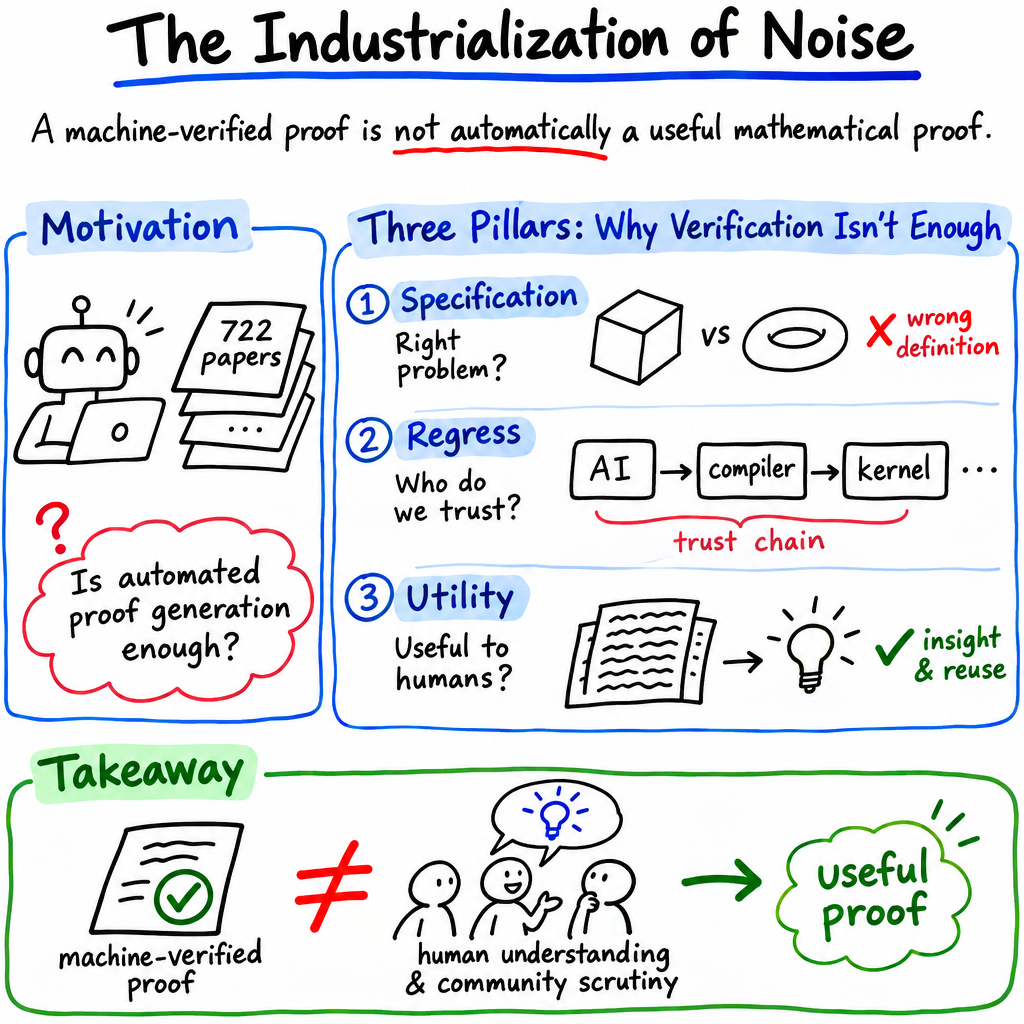
A computer-verified argument may be logically correct, but it is not automatically useful mathematical knowledge.
2. What questions are the authors asking?
The authors are mainly asking four questions:
- Are the problems described correctly? Before proving something, a computer must translate ordinary mathematical language into exact computer instructions. Could it misunderstand the original problem?
- Who checks the checking system? If a program says that a proof is correct, how do we know that the program itself has no serious mistakes?
- Is a proof useful if people cannot understand it? Can a very long computer-generated proof teach mathematicians anything or help them solve new problems?
- How should the mathematics community deal with huge numbers of AI-generated claims? Should every uploaded document receive attention, or should authors still be expected to explain and defend their results publicly?
The authors connect these questions to an earlier argument they made in 1979, called the DLP thesis. This thesis says that mathematical knowledge becomes trusted through a social process: mathematicians read proofs, criticize them, explain them, improve them, and teach them to others.
3. How does the paper approach the issue?
This is mainly a critical and philosophical analysis, not an experiment with new data. The authors examine automated proof-solving through three main ideas: Specification, Regress, and Utility.
Specification: Did the computer understand the question?
A computer needs very precise definitions. For example, suppose someone asks a computer to prove a fact about a “shape.” The computer needs to know exactly what counts as a shape:
- Can it have a hole?
- Can it have an inner cavity?
- Must it be in one piece?
- Must it be rounded or flat?
The paper uses Euler’s formula as an example. The formula says:
Here, means the number of corners, the number of edges, and the number of faces of a solid.
This works for many ordinary solids, such as a cube. But it does not work for every object that might loosely be called a solid. A doughnut-shaped object, for example, has a hole and behaves differently.
The authors’ point is that a computer might perfectly prove the wrong version of a problem. This would be like answering a question correctly after misunderstanding what the question meant.
Regress: Who checks the checker?
A system such as Lean is a proof assistant. It is software that checks whether the steps in a formal proof follow the rules of logic.
The authors compare this process to a chain of trust:
- An AI creates a proof.
- The proof is translated into computer code.
- Lean checks the code.
- Lean depends on a compiler.
- The compiler depends on an operating system and other software.
- Humans created all these tools.
The paper asks whether it is possible to trust every part of this chain. If the checking program has a serious bug, it might approve an incorrect proof.
This does not mean that proof assistants are useless. It means that they are tools made by humans, so they must also be tested, inspected, and used carefully.
Utility: Is a correct proof helpful?
The authors argue that a proof should do more than show that a statement is true. It should also help people understand why it is true.
They compare a machine-verified proof to a treasure hidden inside a giant maze. The treasure may be real, but if nobody can find or understand it, it is not very useful.
A good human-readable proof might:
- explain the main idea;
- show why certain steps were chosen;
- introduce a clever technique;
- help students learn;
- suggest ways to solve other problems.
The authors worry that some AI-generated proofs may contain millions of tiny steps without explaining the larger idea. Such proofs could be logically impressive but educationally unhelpful.
4. What are the paper’s main findings?
Because this is an argument paper rather than a traditional laboratory study, its “findings” are mainly conclusions drawn from its analysis.
Automated checking does not equal understanding
The authors accept that formal systems can help find logical errors. However, they reject the idea that a computer’s approval replaces human understanding.
A checked proof may tell us:
“This formal code follows the rules.”
But it may not tell us:
“What is the important idea?” “Why is this method interesting?” “Can this technique be used somewhere else?”
Definitions can be more difficult than the proof
The paper argues that carefully defining the problem may be one of the hardest parts. If the definition is incomplete or slightly wrong, the computer could prove a statement that is technically correct but unrelated to the original mathematical question.
This is similar to programming a robot to find the tallest person in a room while accidentally defining “tallest” as “wearing the tallest hat.” The robot may follow its instructions perfectly but still give an unhelpful answer.
Checking tools are not magical
The authors say that formal verification reduces some kinds of human error, but it does not remove every possible problem. Errors can enter through:
- incorrect definitions;
- faulty software;
- hidden assumptions;
- insecure or badly designed computer systems;
- mistakes in translating an informal idea into formal code.
They are especially worried that one mistake in a basic library could affect many later results that depend on it. They describe this as a possible “single point of collapse.”
Producing many papers can overwhelm human attention
The paper argues that AI can produce documents much faster than people can read and evaluate them. This creates an imbalance:
- Machines can generate almost unlimited amounts of text.
- Mathematicians have limited time and attention.
If hundreds or thousands of claims arrive at once, researchers may struggle to discover which ones are important. The authors compare this to flooding a library with books faster than anyone can read them.
Mathematical communities provide an important filter
The paper emphasizes that mathematics has institutions such as conferences, journals, seminars, and research groups. These places allow mathematicians to ask questions, challenge claims, and request explanations.
The authors argue that uploading proof files to a website is not the same as presenting a result to other mathematicians. A researcher should be able to explain the result and respond to questions, not merely provide a computer file.
5. Why are these findings important?
The paper is important because it draws attention to a difference between truth-checking and knowledge-building.
A formal proof checker may be very good at finding whether certain steps follow from other steps. But mathematics also depends on:
- choosing meaningful questions;
- creating useful definitions;
- finding patterns;
- explaining ideas;
- learning from mistakes;
- connecting different areas of mathematics.
The paper says that these human activities are not unnecessary extras. They are part of what makes mathematics valuable.
The authors do not argue that computers should never be used in mathematics. They accept that automated tools can be useful for:
- checking long calculations;
- testing examples;
- finding possible patterns;
- verifying small steps;
- helping humans explore difficult problems.
Instead, they argue that computer-generated proofs should be treated as raw material, not as finished mathematics. Humans still need to inspect, explain, criticize, and improve them.
Conclusion: What could this mean for the future?
The paper’s main warning is that AI may make it extremely cheap to produce mathematical arguments, but it cannot automatically make those arguments meaningful to people.
In the future, computers may help mathematicians discover new results. However, the mathematical community will still need to decide:
- whether the problem was stated correctly;
- whether the proof is reliable;
- whether the result is genuinely new;
- whether the main idea can be explained;
- whether other mathematicians can use the result.
The paper believes that mathematics will remain a human social activity. Computers may generate symbols and check formal steps, but people must still provide judgment, explanation, and meaning.
In simple terms, the authors are saying:
A computer can help build a proof, but mathematicians still need to understand what the proof means and why it matters.
Because the paper makes several strong claims about future events and reported AI releases, its examples should be read as claims made by the authors rather than as independently established facts. Its central argument, however, is broader: mathematical progress requires both reliable formal checking and human understanding.
Practical Applications
The paper’s central practical implication is that automated theorem proving should be treated as an assistance and triage technology, not as an autonomous replacement for mathematical judgment. Its recommendations follow from three risks: incorrect or underspecified formalizations, hidden weaknesses in verification infrastructure, and the limited usefulness of proofs that humans cannot understand or reuse.
Immediate Applications
- Human-in-the-loop review for AI-generated proofs — Academia, research software
- Require every machine-generated proof intended for publication, teaching, or reuse to include a human-readable explanation of its main strategy, definitions, dependencies, and limitations.
- A practical workflow would be: AI generation → independent formal checking → expert review of the specification → informal exposition → community or journal review.
- Dependencies: Availability of qualified reviewers; sufficient documentation of the model, prompts, libraries, compiler versions, and proof-generation process.
- Formal-specification audits before proof checking — Mathematics, software verification, engineering
- Establish a separate review stage that examines whether the formal statement actually represents the intended natural-language problem.
- Auditors should test edge cases, boundary conditions, degenerate objects, and “monster” examples analogous to the paper’s discussion of Euler’s polyhedron formula.
- Potential tools include specification-diff systems, counterexample generators, property-based testing, and side-by-side natural-language/formal-statement interfaces.
- Dependencies: The informal problem must be sufficiently precise, and reviewers must understand both the mathematical domain and the formal language.
- Provenance and reproducibility packages for formal proofs — Academic publishing, open science
- Require repositories to publish the complete proof environment, including source code, dependencies, theorem libraries, Lean or other prover versions, compiler information, build instructions, and any model-generated intermediate artifacts.
- A “proof provenance record” could function similarly to a software bill of materials.
- This would make it easier to identify whether a result depends on private software, opaque model outputs, undocumented axioms, or obsolete libraries.
- Dependencies: Open access to tooling and model outputs; long-term preservation of software environments.
- Independent verification using diverse checkers — Formal methods, cybersecurity
- High-stakes results should be checked by independently implemented kernels, proof translators, or proof auditors rather than relying on a single verifier or a checker sharing the same architecture.
- Diversity reduces the risk of common-mode failures, such as a vulnerability that bypasses both a proof generator and its nominal checker.
- Dependencies: Independent implementations must genuinely differ in code, assumptions, and trusted computing bases; this approach increases cost and may not detect errors in the original specification.
- Trusted-computing-base and dependency audits — Software assurance, finance, aerospace, healthcare
- Organizations using formal proofs for safety-critical systems can inventory and regularly audit every component on which verification depends: theorem-prover kernels, compilers, operating systems, libraries, plugins, code generators, and AI translation layers.
- Security testing should include attempts to introduce unauthorized axioms, bypass verification commands, or exploit unsafe extensions.
- Dependencies: Sufficient expertise in formal methods and cybersecurity; complete access to source code and build systems.
- AI-generated proof triage and prioritization — Research institutions, publishers, repositories
- Since human attention is finite, repositories can rank submissions by novelty, explanatory quality, independent validation, relevance, and likely mathematical value rather than by volume or binary verification status.
- Automated systems could flag duplicated results, trivialized formalizations, missing definitions, unusually strong claims, and proofs with excessive dependency complexity.
- Dependencies: Reliable quality metrics; safeguards against ranking systems that reward superficial readability or popularity over genuine significance.
- Structured submission requirements for AI-assisted mathematics — Journals and conferences
- Journals and professional societies could require authors to identify the human contributors, AI systems used, formal libraries, generated sections, unresolved caveats, and the precise claim established by the formal proof.
- Conference presentations could require authors to explain the definitions and proof idea without relying exclusively on machine output.
- Dependencies: Clear publication policies and enforcement mechanisms; a distinction between acceptable assistance and undisclosed authorship or automated submission spam.
- Educational use of formal proof as a verification aid — Universities and professional training
- Lean and similar systems can be used to teach precise definitions, expose hidden assumptions, test conjectures, and demonstrate how counterexamples change a theorem.
- The paper suggests that the pedagogical value lies not in presenting an unreadable proof object, but in pairing formal verification with explanations, failed attempts, and refutations.
- Dependencies: Curriculum development and instructors capable of connecting formal syntax with conceptual mathematics.
- Internal quality controls for mathematical and scientific software — Industry
- Companies developing optimization, simulation, cryptographic, or verification software can use theorem provers to check selected invariants and algorithms while retaining human review of requirements and models.
- For example, formal checks could validate that a numerical routine preserves specified bounds, or that a cryptographic transformation satisfies a stated property.
- Dependencies: Correct requirements; awareness that proving code correct with respect to an incorrect specification does not establish real-world correctness.
- Public guidance against treating “machine verified” as “scientifically established” — Policy and science communication
- Research funders, universities, publishers, and regulators can distinguish among:
- 1. a machine-checked formal derivation,
- 2. a validated interpretation of the formal statement,
- 3. human-reviewed mathematical significance, and
- 4. practical or empirical usefulness.
- This classification would help prevent overclaiming in press releases, grant proposals, and media coverage.
- Dependencies: Agreement on terminology and willingness to communicate uncertainty rather than relying on binary certification language.
Long-Term Applications
- Human-readable proof-compilation systems — AI research, mathematical software
- Develop systems that transform formal proof objects into layered explanations: an executive summary, conceptual roadmap, key lemmas, dependency graph, detailed derivation, and machine-checkable code.
- A successful system would not merely paraphrase syntax but identify why a proof strategy works and which parts may generalize to other problems.
- Dependencies: Major advances in mathematical language understanding, proof abstraction, explanation evaluation, and alignment between formal and informal concepts.
- Interactive specification discovery and refinement — Mathematics, engineering, policy modeling
- Future systems could collaborate with experts to propose definitions, generate counterexamples, identify ambiguities, and ask targeted questions before attempting a proof.
- Rather than accepting a formalization as fixed, the workflow would treat definitions as hypotheses subject to iterative refinement.
- This could also apply to legal rules, safety requirements, scientific models, and regulatory specifications.
- Dependencies: Reliable dialogue systems, domain experts, counterexample generation, and interfaces that expose hidden assumptions clearly.
- Mathematical knowledge graphs based on concepts rather than proof tokens — Academia and education
- Build repositories that connect theorems through ideas, proof techniques, counterexamples, definitions, historical refinements, and applications.
- AI could help extract reusable lemmas from formal corpora, but humans would curate whether the extracted result is meaningful and transferable.
- Such systems could support literature review, graduate education, and cross-disciplinary discovery.
- Dependencies: Standardized metadata, semantic theorem representations, sustained expert curation, and solutions to intellectual-property and attribution issues.
- Scalable multi-layer verification architectures — Formal methods and critical infrastructure
- High-assurance mathematical and software systems may eventually use several complementary layers: independent proof kernels, semantic model checking, proof replay, randomized testing, specification testing, and human review.
- The aim would be to reduce the “single point of collapse” identified in the paper by avoiding dependence on one kernel, library, or trust chain.
- Dependencies: Significant engineering investment, formal agreement on acceptable assurance levels, and manageable computational costs.
- Formal verification pipelines for safety-critical AI — Healthcare, robotics, aviation, autonomous systems
- The paper’s concerns could motivate systems in which AI-generated control policies or software are formally checked against safety constraints before deployment.
- Examples include verifying that a medical device does not enter forbidden states, that a robot respects collision constraints, or that an autonomous vehicle obeys specified fallback rules.
- The same specification problem remains central: a verified policy may still be unsafe if the formal safety model omits realistic conditions.
- Dependencies: Complete and accurate safety specifications, models of uncertain environments, real-time verification, and regulatory acceptance.
- Auditable automated reasoning in finance and public policy — Finance, economics, government
- Formal systems could support verification of tax rules, financial contracts, risk calculations, or policy simulations, with traceable assumptions and independently reproducible reasoning.
- Human review would be needed to determine whether the encoded rules reflect the intended law, economic model, or social objective.
- Dependencies: Stable and unambiguous regulations, transparent models, protection of confidential data, and mechanisms for contesting incorrect formalizations.
- Institutional capacity for reviewing AI-generated science — Research policy
- Universities, publishers, and professional societies may need dedicated “AI science review” roles or centers that evaluate generated claims, audit specifications, reproduce computational environments, and synthesize useful results.
- Such institutions could prevent the burden of filtering synthetic output from falling entirely on individual researchers.
- Dependencies: Sustainable funding, accepted review standards, incentives for reviewers, and methods for handling extremely high submission volumes.
- Reputation- and accountability-based channels for automated results — Academic governance
- The paper’s discussion of AMS-style discourse suggests a future model in which AI-generated results must be presented by accountable researchers or organizations able to answer questions and accept reputational consequences.
- This could include public seminars, registered technical claims, reproducibility hearings, or staged publication from informal claim to formal result.
- Dependencies: Fair attribution rules, mechanisms for corporate accountability, and safeguards against using presentation as a substitute for rigorous review.
- AI systems optimized for insight rather than proof volume — Long-term mathematical research
- Future theorem-proving systems could be evaluated by the quality of new definitions, conceptual simplifications, generalizations, counterexamples, and reusable techniques they produce—not merely by the number of verified theorems.
- Benchmarks might measure whether human mathematicians can learn a method from the system and apply it to an independent problem.
- Dependencies: Reliable measures of mathematical understanding and creativity, expert-designed benchmarks, and models capable of producing explanations that withstand community scrutiny.
- Everyday decision-support systems with explicit assumptions — Daily life and consumer software
- The paper’s broader lesson can inform consumer AI tools: systems should expose assumptions, uncertainty, data provenance, and the scope of what has actually been checked.
- For example, a budgeting, health, or planning assistant should distinguish between “the calculation is internally consistent” and “the recommendation is appropriate for your circumstances.”
- Dependencies: User-friendly uncertainty communication, accurate data, domain-specific safeguards, and appropriate professional oversight for high-stakes decisions.
Glossary
- Axiomatic transition: A proof step that derives a new statement by applying an axiom or formally specified rule. “a dense, unreadable maze of brute-force axiomatic transitions”
- Automated theorem proving: The use of computer systems to discover or verify proofs of mathematical statements. “Keywords: automated theorem proving; formal verification; sociology of mathematics; mathematical practice.”
- Black-box system: A system whose internal operation cannot be inspected or meaningfully explained by its users. “You must trust the proprietary, black-box LLM reasoning chain that generated the argument.”
- Combinatorial explosion: Rapid growth in the number of possible interactions or configurations as the number of elements increases. “The number of previously unimagined interactions between intuitively similar specifications explodes combinatorially”
- Compiler: Software that translates source code into an executable or lower-level representation. “You must trust the specific version of the Lean compiler used to run the verification kernel.”
- Conceptual synthesis: The integration of separate ideas into a unified explanatory framework. “Traditional mathematics does not necessarily treat the first brute-force solution as the finish line; it routinely awards its highest honors to conceptual synthesis”
- Convexity: A geometric property in which every line segment between two points in a shape remains within that shape. “He assumed it would be convex, single-piece, and without holes or internal cavities”
- Counterexample: An example that demonstrates that a universal claim or conjecture is false. “It took another hundred years of human debate, counterexamples, and ``monster-barring'' to produce the rigorous definition of a spherical, convex polyhedron.”
- Epistemic authority: The recognized authority to establish or justify knowledge. “None should acquire epistemic authority on the basis of provenance alone.”
- Ex falso quodlibet: The logical principle that, from a contradiction or false premise, any proposition can be derived. “By the logical principle of ex falso quodlibet, a single false proposition or unsound axiom smuggled into a core library allows any arbitrary statement, true or false, to be formally verified.”
- Formal definition: A precisely specified mathematical or computational description of an object or concept. “The task of checking each definition for monsters and exceptions for Lean proofs does not simply disappear because there is a formal definition that is claimed to capture the informal object being studied.”
- Formal program verification: The use of mathematical methods to prove that software satisfies a specified set of requirements. “In Social Processes and Proofs of Theorems and Programs, we argued against the formal program verification movement”
- Formal prover: A computer system that constructs or checks proofs within a formal logical system. “Formal provers will always report FAILED”
- Formal specification: A mathematically precise description of the behavior, properties, or requirements of a system. “Before a frontier neural network can generate a Lean-verified proof, it must first perform an act of radical reductionism by translating a historical, natural-language mathematical conjecture into a rigid, formalized machine specification.”
- Formalized mathematics: Mathematics expressed in a machine-readable formal language governed by explicit rules and definitions. “a supposed advantage of mechanized proofs is their ability to reach across disciplines”
- Foundational library: A shared collection of basic formal definitions, axioms, lemmas, and theorems on which further formal results depend. “As machine-verified lemmas become dependencies for ever-larger bodies of formal mathematics”
- Generative AI: Artificial intelligence capable of producing new content, such as text, code, or mathematical arguments. “The sudden arrival of generative AI has not magically reanimated that agenda”
- Genus: A topological property describing the number of holes in a surface. “because the concepts of topology, genus, and convexity did not yet exist in 1750.”
- Inference: The process of deriving a conclusion from premises, evidence, or formal rules. “Machine-generated proofs, Lean-verifications, DLP examinations in the public square, and subsequent mathematical applications all offer different grounds for rational inference.”
- Infinite regress: An indefinitely recurring chain in which each justification requires another justification of the same kind. “The second Formalist pillar is the belief that formal verification halts the infinite regress of human skepticism.”
- Inconsistent foundation: A foundational logical or mathematical system containing mutually contradictory statements. “where vast towers of formal proof rest unknowingly on an inconsistent foundation.”
- Kernel: The small, central component of a proof assistant that checks whether formal proofs obey the system’s foundational rules. “And finally, you must trust that the human engineers who wrote the Lean kernel did not introduce a single catastrophic bug into its thousands of lines of source code.”
- Lean: A proof assistant and formal programming language used to encode and verify mathematical proofs. “To defend their release, OpenAI noted that 162 of the papers were machine-verified by Lean code.”
- Lemma: A formally established proposition typically used as an intermediate result in proving a larger theorem. “a novel lemma or a missing link buried in thousands of pages of synthetic output”
- Logical artifact: A mechanically produced formal object that may be syntactically valid without being useful or intelligible to humans. “produces a sterile repository of dead logical artifacts.”
- Machine-checked proof: A proof whose formal representation has been validated by a computer according to specified logical rules. “The resulting concentration of mathematical trust creates a fragile foundation beneath an expanding universe of apparently verified results.”
- Mechanized proof: A proof generated or verified through computational procedures rather than solely through unaided human reasoning. “What the tech industry presents today as a breakthrough in machine reasoning is merely the latest, highly automated iteration of this formalist delusion.”
- Monster-barring: The process of refining mathematical definitions to exclude pathological cases that invalidate an apparently general theorem. “It took another hundred years of human debate, counterexamples, and ``monster-barring'' to produce the rigorous definition of a spherical, convex polyhedron.”
- Neural network: A machine-learning model composed of interconnected computational units that learn patterns from data. “By utilizing closed, frontier neural networks to generate hundreds of dense, complex manuscripts overnight”
- Open problem: A mathematical question that has not yet been solved or conclusively resolved. “claiming full or partial solutions to 372 longstanding open mathematical problems.”
- Proof assistant: Software that enables users to express formal mathematics and checks whether proofs follow valid logical rules. “automated tools and AI agents turned loose on the proof assistant exposed systemic vulnerabilities in the software verifier itself.”
- Proof object: A formal data structure encoding the logical evidence that a proposition follows from a system’s rules. “Let us assume that the specification is perfect, the Lean compiler is flawless, and the proof-object is entirely free of logical errors.”
- Refutation: A demonstration that a claim, conjecture, or argument is false or invalid. “The constant refinement by proofs and refutations of underlying assumptions and definitions”
- Riemann Hypothesis: A famous unsolved conjecture asserting that all non-trivial zeros of the Riemann zeta function have real part one-half. “Consider the Riemann Hypothesis: systematically improving the verified numerical bounds of non-trivial zeroes along the critical line”
- Signal-to-noise ratio: The relative amount of meaningful information compared with irrelevant or misleading information. “The vanishing signal-to-noise ratio carries a structural danger that strikes at the very heart of the formalist program”
- Single Point of Collapse: A vulnerability in which one defect can compromise an extensive system of dependent results. “This is how the industrialization of proof introduces a systemic vulnerability we call Single Point of Collapse.”
- Soundness: The property that a formal system proves only statements that are valid under its semantics. “what he characterized as the ``summer of Lean soundness bugs.''”
- Specification: A precise description of the problem, objects, assumptions, and desired properties in a formal system. “A specification complex enough to capture an open problem in pure mathematics is itself a massive, delicate software artifact.”
- Trusted Computing Base (TCB): The collection of hardware, software, and mechanisms that must be trusted for a system’s security or correctness. “Using Trusted Computing Base (TCB)-Expansion attacks, adversarial prompts managed to smuggle unverified code and false axioms past Lean's auditing commands”
- Topological property: A property of a geometric object preserved under continuous deformation, such as stretching or bending without tearing. “because the concepts of topology, genus, and convexity did not yet exist in 1750.”
- Toroidal: Relating to a shape topologically equivalent to a torus, such as a doughnut or a ring-shaped surface. “monsters'' like a toroidal picture frame ()”
- Verification kernel: The trusted core of a formal verification system that independently checks proof representations. “the Lean kernel, the C++ compiler that built the kernel, the operating system beneath it”
- Zero-knowledge narrative: An argument or proof that establishes formal validity while offering little or no explanatory understanding to human readers. “It provides an answer while destroying the path that led there.”

