Analyzing and Improving FlowMap Distillation of Autoregressive Video Models
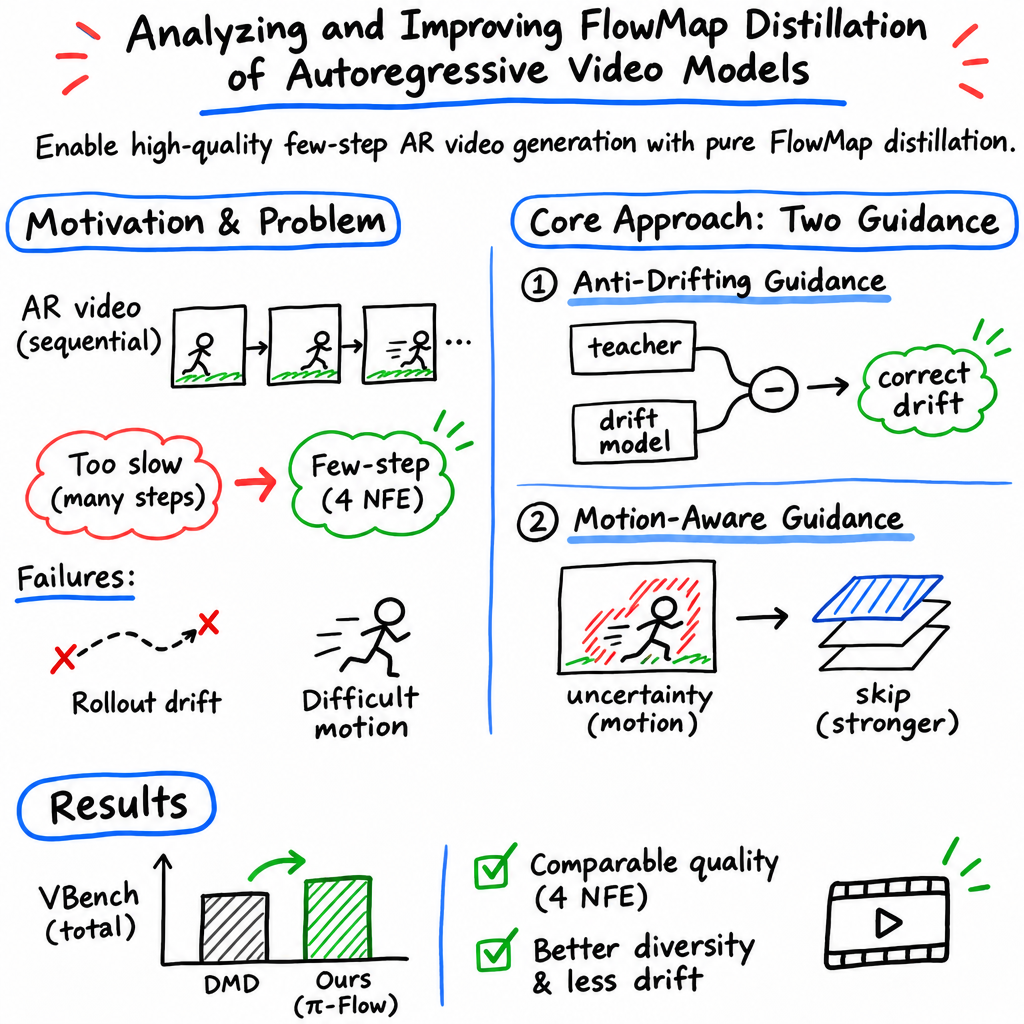
Abstract: FlowMap distillation offers a natural route to few-step generative modeling by directly learning a teacher's denoising trajectories. Yet for autoregressive (AR) video generation, existing few-step models still rely on distribution matching distillation (DMD) to remain competitive, sacrificing sample diversity and requiring a large bidirectional teacher. In this work, we analyze what limits standalone AR FlowMap distillation and introduce two complementary guidance mechanisms to close this gap: (1) anti-drifting guidance, which helps the AR teacher correct drifted student rollouts by training an auxiliary model to mimic student drift and using it as a negative guidance branch; and (2) motion-aware guidance, which makes motion easier for a FlowMap student to learn by locating motion patches and selectively applying skip-layer guidance. Empirically, our approach applies to -Flow, MeanFlow, and consistency distillation with 1.3B AR teachers, improving generation quality and reducing drift over 30 s rollouts. Notably, our 4-step -Flow students match DMD students distilled from 14B teachers on VBench while preserving the sample diversity of their AR teachers, demonstrating that pure FlowMap distillation is effective for few-step autoregressive video generation.

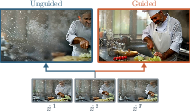
Paper Prompts
Sign up for free to create and run prompts on this paper.
Explain it Like I'm 14
1. What is this paper about?
This paper studies how to make video-generating AI models much faster while keeping their videos realistic, varied, and stable over time.
Many video AI systems create videos by repeatedly improving a noisy video. This usually takes many steps, which makes generation slow. The researchers want a smaller “student” model that can create each part of a video in only a few steps by learning from a larger, slower “teacher” model.
The paper focuses on autoregressive video models. These models create a video piece by piece, using earlier pieces as context—similar to writing a story one sentence at a time while remembering what came before.
2. What questions are the researchers asking?
The researchers mainly investigate these questions:
- Why do fast, few-step video models often become worse when they generate long videos?
- Why do they sometimes produce blurry or distorted moving objects?
- Can a fast model learn directly from the teacher’s video-making process without using a method called distribution matching distillation, or DMD?
- Can the researchers make a small, fast model that is:
- as good as models trained with much larger teachers,
- less likely to drift or become inconsistent over time, and
- still able to produce different videos from the same prompt?
3. How did they approach the problem?
Teacher and student models
The researchers use two models:
- A teacher is a large, slower model that already knows how to generate videos.
- A student is a faster model trained to copy the teacher using only a few generation steps.
This is similar to a skilled teacher showing a student how to solve a difficult problem quickly.
Autoregressive video generation
The models generate videos in chunks instead of all at once. For example, they might generate the first few frames, then use those frames to generate the next few, and continue until the video is complete.
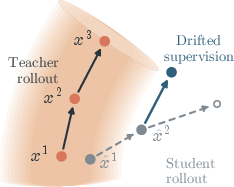
This makes streaming and interactive video generation possible. However, small mistakes can build up. If one chunk is slightly wrong, the next chunk uses that wrong information and may become even more wrong. This is called rollout drift.
An everyday analogy is following directions while walking: if you accidentally turn a little too far at one corner, later turns may take you farther away from the correct path.
FlowMap distillation
The main training method is called FlowMap distillation. During normal diffusion generation, a model gradually changes random noise into a clear video through many small steps.
FlowMap distillation teaches the student to make a much larger jump along this path. It is like learning to travel between two points using a shortcut instead of taking every small step.
The paper tests three versions of this idea:
- -based FlowMap distillation,
- MeanFlow, and
- Consistency distillation.
These are different ways of teaching the student to make reliable shortcuts.
Two new guidance methods
The researchers introduce two special forms of guidance.
Anti-drifting guidance
The first problem is that the teacher itself may not know how to fix a student’s incorrect history. The teacher was trained mostly on correct video histories, so if the student produces a slightly wrong earlier chunk, the teacher may simply continue from that mistake.
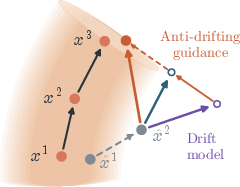
To solve this, the researchers train an extra model called a drift model. The drift model learns to imitate the kinds of mistakes made by the student.
The teacher’s prediction and the drift model’s prediction are then compared. The student is guided away from the drift model and back toward the teacher’s intended path.
In simple terms, the drift model acts like a map showing the wrong direction. The system uses that map to steer away from the mistake.
Motion-aware guidance
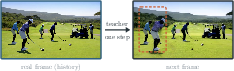
The second problem is movement. Backgrounds are often easy to generate because they stay mostly still. Moving objects, such as people or cars, are harder because their appearance changes quickly from frame to frame.
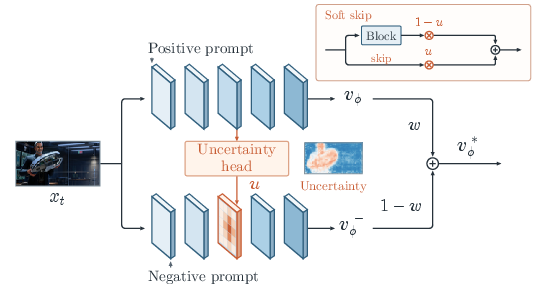
The researchers estimate where the teacher is most uncertain. These uncertain areas usually correspond to moving objects. They then apply stronger guidance only to those parts of the video.
This is like giving extra help to the difficult parts of a drawing while leaving the easy background alone.
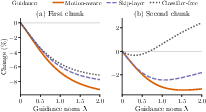
The researchers use a technique called skip-layer guidance, which creates an alternative, weaker prediction by skipping part of the model. Comparing the normal prediction with this weaker prediction helps smooth the changes needed to generate motion.
Two-stage training
The student is trained in two stages:
- Teacher-forcing: The student learns using correct previous video chunks.
- Self-forcing: The student generates its own previous chunks and learns to continue from them.
The second stage is important because, during real use, the student will have to rely on its own outputs rather than perfect training examples.
4. What did they find?
The fast models produced high-quality videos
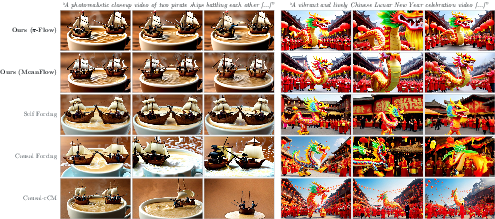
The best students generated each video chunk in only four steps. Despite being much faster, they achieved results close to models trained with a much larger, 14-billion-parameter teacher.
In particular, the -based students trained from 1.3-billion-parameter autoregressive teachers matched the quality of DMD students trained using 14-billion-parameter teachers on the VBench video evaluation.
This is important because it suggests that a smaller teacher and a simpler training process can still produce strong results.
The method preserved variety
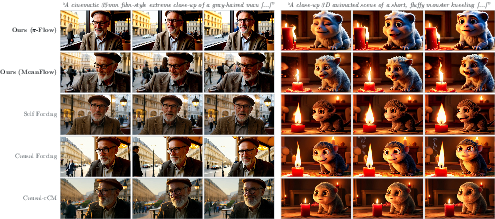
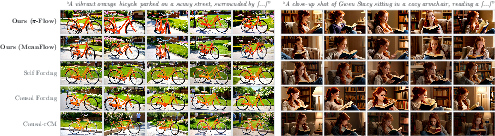
DMD-based methods can make videos more similar to one another. In contrast, the FlowMap students generally preserved the diversity of their teacher models.
For example, when given the same text prompt several times with different random starting points, the students could still create noticeably different videos.
This matters because a video generator should not always make exactly the same result.
Anti-drifting guidance reduced long-video errors
The researchers tested videos lasting about 30 seconds. Without special guidance, errors could accumulate as the model generated more chunks.
Anti-drifting guidance reduced this problem. The videos stayed more visually consistent and suffered less loss of quality toward the end.
However, it did not remove drift completely. The researchers openly state that the students still inherit some long-term weaknesses from their teachers.
Motion-aware guidance improved moving objects
Motion-aware guidance improved the quality of moving parts, such as people or other objects in motion.
The experiments showed that applying stronger guidance only to uncertain, moving regions worked better than applying the same strong guidance everywhere. Applying guidance uniformly could even reduce quality.
Both guidance methods helped
When the researchers removed either anti-drifting guidance or motion-aware guidance, performance decreased. Removing both caused a larger drop.
This suggests that the two methods solve different problems:
- Motion-aware guidance helps the student learn difficult movement.
- Anti-drifting guidance helps the student remain stable during long, step-by-step generation.
5. Why is this research important?
This work could help make AI video generation:
- faster, because videos can be created in only a few steps;
- more suitable for real-time use, such as interactive games, virtual worlds, and live video tools;
- more stable, especially when generating longer videos;
- more varied, instead of producing nearly identical results;
- less expensive, because fast models require less computing power.
The paper’s main message is that a fast autoregressive video model does not necessarily need a very large bidirectional teacher or DMD training. By guiding the teacher more carefully—especially around motion and accumulated mistakes—FlowMap distillation can create fast, high-quality students.
There are still limitations. The method does not completely prevent long-term drift, and its success depends partly on the quality of the original teacher. Future research may combine this approach with stronger teachers or training methods that directly supervise much longer videos.
Practical Applications
Immediate Applications
- Real-time and interactive text-to-video generation (creative software, media, advertising). Deploy the four-step autoregressive FlowMap student as a low-latency generation backend for storyboarding, social-media clips, advertisements, game cinematics, and video editing. Autoregressive chunking supports streaming generation and user interaction, while four function evaluations per chunk substantially reduce inference cost relative to the teacher’s approximately 64 evaluations. Dependencies: GPU/accelerator availability, acceptable latency at the target resolution, reliable text-conditioning, and validation beyond the paper’s 5- and 30-second benchmarks.
- On-device or edge-assisted video generation. Smaller 1.3B autoregressive teachers can produce students that approach the quality of students distilled from 14B bidirectional teachers. This creates a path toward deployment on consumer GPUs, workstation software, cloud edge nodes, or potentially high-end mobile hardware for prompt-to-video previews and interactive effects. Dependencies: memory optimization, quantization, kernel acceleration, and testing under device-specific power and thermal constraints. The paper does not establish mobile-level performance directly.
- Streaming video synthesis and live user-controlled generation. The causal chunk-by-chunk architecture can support workflows in which the user changes a prompt, camera direction, character action, or scene constraint while generation is underway. Anti-drifting guidance is particularly relevant when the system must maintain visual consistency across long streams. Potential product: an interactive “continue, revise, or branch” video canvas that generates subsequent chunks without regenerating the entire video. Dependencies: prompt-editing interfaces, fast KV-cache management, robust conditioning under changing user input, and safeguards against long-horizon drift.
- Game development and virtual-world prototyping. The method can provide rapid generation of animated environment segments, NPC behaviors, cinematic transitions, and concept footage. Preserving the teacher’s sample diversity is useful for producing multiple plausible scene continuations rather than a single mode-collapsed result. Dependencies: temporal and spatial consistency with game-engine assets, controllable camera and character motion, licensing of training data, and integration with real-time rendering pipelines.
- Robotics and embodied-agent simulation. Autoregressive video models can generate candidate future visual observations for world-model training, robot planning, and interactive simulation. Reduced rollout drift is important when simulated trajectories extend over many seconds. Potential workflow: generate multiple visual futures from a robot’s current camera history, score them with a planner, and use selected trajectories for policy training or action evaluation. Dependencies: the paper evaluates text-to-video rather than action-conditioned prediction; physical plausibility, action conditioning, uncertainty calibration, and simulator-to-real transfer require separate validation.
- Fast model serving and infrastructure cost reduction. The distillation recipe can be incorporated into inference stacks as a replacement for slow multi-step AR samplers. Because the guidance is transferred into the student during training, the deployed student does not need to run the teacher, drift model, or guidance branches at inference time. Potential tool: a distillation pipeline supporting -style FlowMap objectives, MeanFlow, and consistency distillation, with configurable four-step students. Dependencies: distillation training remains expensive and requires access to a capable AR teacher, rollout data, and substantial compute.
- Academic and industrial benchmarking of fast generative video models. Researchers can use the paper’s evaluation protocol—short-horizon quality, diversity across seeds, and long-horizon quality drift—to assess whether acceleration methods preserve diversity rather than merely increasing perceptual similarity. This is immediately useful for comparing FlowMap, DMD, consistency, and other distillation methods. Dependencies: standardized prompts, reproducible checkpoints, consistent sampling settings, and metrics that correlate with human judgments.
- Training-time diagnostics for motion and rollout failure. The uncertainty head and patch-level uncertainty maps can be used as debugging tools to identify where a video model has difficulty—especially moving objects and later autoregressive chunks. Developers can visualize high-uncertainty regions and target them for data collection, loss weighting, or architecture changes. Dependencies: uncertainty estimates must be calibrated; high uncertainty may reflect ambiguity rather than an actual generation defect.
- Diversity-preserving content ideation in daily creative workflows. Users can generate several distinct continuations of the same prompt or initial clip while retaining more variation than a reverse-KL DMD pipeline may provide. This supports brainstorming, thumbnail generation, alternate endings, visual mood boards, and rapid concept exploration. Dependencies: content safety controls, copyright and provenance policies, and quality assurance for generated motion and identities.
Long-Term Applications
- Long-duration world simulators and interactive digital environments. Combining anti-drifting guidance with stronger teachers, longer-horizon supervision, KV-cache recaching, and cache compression could enable coherent minute-scale or longer video rollouts for games, virtual environments, training simulators, and synthetic-data generation. The paper explicitly notes that anti-drifting guidance mitigates but does not eliminate teacher-induced drift. Dependencies: improved long-context memory, persistent object and identity tracking, robust scene-state representations, and evaluation over substantially longer horizons than 30 seconds.
- Action-conditioned robotics and autonomous navigation models. A future extension could condition the FlowMap student on robot actions, proprioception, depth, and scene state, allowing it to predict multiple possible visual outcomes of candidate actions. Motion-aware guidance could focus computation on moving agents and objects most relevant to planning. Dependencies: action-labeled video datasets, physically grounded dynamics, calibrated uncertainty, causal intervention tests, and safety validation in real environments.
- Medical and scientific video forecasting. The uncertainty-guided motion mechanism could eventually support fast prediction of dynamic regions in ultrasound, endoscopy, microscopy, or laboratory imaging. A distilled model might provide rapid forecasts or counterfactual visualizations for clinician or researcher interfaces. Dependencies: domain-specific data, regulatory approval, strict calibration and reliability requirements, privacy protection, and evidence that generated forecasts are clinically or scientifically valid. The paper provides no medical validation, so this is a research direction rather than a ready clinical product.
- Education and personalized interactive media. Fast autoregressive generation could enable tutoring systems that create short visual demonstrations, animated explanations, or alternative examples in response to a learner’s question. Streaming generation would allow the system to adapt the next chunk based on student interaction. Dependencies: factual correctness, curriculum alignment, accessibility, moderation, stable character and diagram rendering, and human review for high-stakes educational content.
- Real-time telepresence, virtual production, and augmented reality. Low-step causal video generation could eventually synthesize or transform live visual streams, fill missing frames, generate virtual backgrounds, or create responsive avatars and environments. Motion-aware guidance is potentially valuable because these applications require sharp moving subjects rather than only static scene quality. Dependencies: end-to-end latency, identity preservation, temporal synchronization, adversarial robustness, privacy, and prevention of deceptive or unauthorized synthetic media.
- Policy tools for compute-efficient and diversity-preserving generative AI. The method offers a technical basis for reducing the infrastructure burden of video generation while avoiding some diversity loss associated with DMD. Policymakers and public-sector institutions could use such models for lower-cost simulation, emergency-response visualization, public communication, or digital-twin prototypes. Dependencies: independent energy and cost measurements, transparent reporting of dataset provenance, watermarking and provenance standards, and assessment of whether lower inference cost increases harmful synthetic-media production.
- Automated adaptive distillation frameworks. A future training system could learn where and when to apply anti-drifting and motion-aware guidance, dynamically adjust and , select skip-layer locations, and allocate extra computation only to uncertain patches or chunks. This would turn the fixed guidance recipe into an adaptive inference and training controller. Dependencies: reliable uncertainty calibration, stable optimization, efficient teacher queries, and evidence that adaptive policies improve the quality–latency–diversity trade-off across datasets and architectures.
- Unified fast samplers for multiple generative modalities. Since the proposed corrections modify the teacher velocity field and can be plugged into -style FlowMap objectives, MeanFlow, and consistency distillation, the approach may generalize to audio, 3D, embodied simulation, and multimodal latent generation. The underlying pattern—learn a corrective negative branch and smooth difficult regions—could become a general distillation design principle. Dependencies: modality-specific definitions of drift and motion, suitable uncertainty estimators, compatible causal architectures, and experiments demonstrating transfer beyond autoregressive video.
- Synthetic-data generation for perception and forecasting systems. Diverse, inexpensive video rollouts could supply training data for object tracking, event recognition, behavior prediction, and anomaly detection. The method’s ability to generate multiple continuations may be especially useful for rare-event augmentation and uncertainty-aware dataset construction. Dependencies: generated videos must preserve realistic object dynamics and event frequencies; synthetic-to-real transfer, bias amplification, and provenance must be evaluated before such data are used in safety-critical systems.
Glossary
- Adversarial loss: A training objective in which a model learns through competition with a discriminator or opposing model. “Most recent methods reduce exposure bias through self-forcing, training the student on its own rollouts with DMD \citep{huang2026self,zhu2026causal,zhao2026causal,zheng2026causal} or an adversarial loss \citep{lin2026autoregressive}.”
- Autoregressive (AR) generation: A generation process that produces sequential units while conditioning each unit on previously generated units. “Autoregressive (AR) video diffusion models instead generate a video chunk by chunk, conditioning each chunk on the preceding ones”
- Bidirectional attention: An attention mechanism in which each element can attend to information before and after it in a sequence. “Standard video diffusion models denoise all frames jointly with bidirectional attention”
- Causal attention: An attention mechanism that restricts each position from accessing future positions. “AR video diffusion models generate video chunks sequentially using causal attention and a KV cache”
- Causal KV cache: A stored collection of key and value representations used to efficiently preserve preceding context in causal attention. “An AR video diffusion model generates each chunk sequentially, conditioning chunk on its preceding history through a causal KV cache.”
- Classifier-free guidance (CFG): A sampling technique that strengthens conditional generation by extrapolating between conditional and unconditional predictions. “Classifier-free guidance (CFG) extrapolates a conditional prediction away from an unconditional negative branch”
- Consistency distillation (CD): A distillation method that trains a student to produce consistent outputs from different points along a diffusion trajectory. “Eulerian self-distillation (ESD), such as MeanFlow \citep{geng2026mean} and consistency distillation (CD) \citep{song2023consistency,zheng2026causal}, enforces self-consistency across source times using .”
- Continuous time: A formulation in which a diffusion or dynamical process is parameterized over a continuous time variable rather than discrete steps. “training either in discrete time \citep{luo2023latent,wang2024phased} or in continuous time with Jacobian--vector products”
- Diffusion distillation: The process of training a smaller or faster student model to reproduce the behavior of a diffusion teacher. “Practical deployment therefore relies on distilling AR video models into students that generate each chunk in only a few steps”
- Distribution matching distillation (DMD): A distillation approach that trains a student to match the output distribution of a pretrained teacher. “Stage~2 rolls out the student autoregressively during training (self-forcing) and supervises the generated sequences with distribution matching distillation (DMD)”
- Eulerian self-distillation (ESD): A flow-map training strategy that enforces consistency between predictions evaluated at different source times. “Eulerian self-distillation (ESD), such as MeanFlow \citep{geng2026mean} and consistency distillation (CD)”
- Exposure bias: The mismatch between training conditions, which use correct historical data, and inference conditions, which use the model’s own potentially erroneous outputs. “To address this exposure bias, Stage~2 rolls out the student autoregressively during training”
- Flow matching: A method that trains a neural velocity field to follow a prescribed transport path between noise and data distributions. “During training, flow matching \citep{lipman2022flow,liu2022flow,zhu2026causal} interpolates between the clean chunk”
- Flow map: A function that transports a state from one point in a dynamical trajectory to another. “the teacher's flow map transports chunk from to along the probability-flow ODE”
- FlowMap distillation: Distillation that trains a student to directly approximate transitions along a teacher’s dynamical or denoising trajectory. “A natural alternative is FlowMap distillation, which trains the student to jump directly along the teacher's denoising trajectories”
- Gaussian negative log-likelihood: A probabilistic loss that measures the negative log probability assigned by a Gaussian predictive distribution to observed data. “The uncertainty head is trained beforehand on the teacher's flow-matching residual with a Gaussian negative log-likelihood loss”
- Guidance scale: A coefficient controlling how strongly a conditional prediction is pushed away from a negative or weaker prediction. “where is the guidance scale”
- Jacobian–vector product: The product of a function’s Jacobian matrix and a vector, computed without explicitly forming the full Jacobian. “training either in discrete time \citep{luo2023latent,wang2024phased} or in continuous time with Jacobian--vector products”
- Lagrangian self-distillation (LSD): A distillation formulation that matches derivatives of a learned flow map to the teacher’s velocity field. “Lagrangian self-distillation (LSD), such as $\citep{chen2026pi,shaul2026parallel}, matches the target-time derivative of$\Phi\theta_{t\leftarrow s}v\star$”
- Lipschitz constant: A bound on how rapidly a function can change relative to changes in its input. “the learnability of this mapping is governed by the Lipschitz constant of the teacher's velocity field”
- MeanFlow: A flow-based generative modeling objective that predicts average velocity over a time interval. “In particular, MeanFlow \citep{geng2026mean} predicts the average velocity over an interval”
- Motion-aware guidance: A guidance method that applies stronger guidance selectively to regions predicted to contain motion. “we propose motion-aware guidance, which locates motion patches from the teacher's uncertainty and applies stronger skip-layer guidance”
- ODE (ordinary differential equation): An equation describing how a quantity changes continuously as a function of time. “along the probability-flow ODE”
- On-policy training: Training on data generated by the current model or policy rather than exclusively on an external dataset. “on-policy bridge”
- Probability-flow ODE: A deterministic ordinary differential equation whose trajectories reproduce the evolving marginal distributions of a diffusion process. “the teacher's flow map transports chunk from to along the probability-flow ODE”
- Reverse-KL divergence: A Kullback–Leibler divergence whose expectation is taken under the model distribution being optimized. “DMD minimizes a reverse-KL divergence at the clean output ”
- Rollout drift: The progressive deviation of generated sequences from the intended data or teacher distribution during sequential generation. “Existing AR distillation recipes already use FlowMap or ODE distillation during teacher-forcing ..., yet must switch to DMD during self-forcing because FlowMap distillation fails to prevent rollout drift.”
- Self-forcing: Training a sequential model using histories generated by the model itself rather than clean ground-truth histories. “In Stage~2 (self-forcing) \citep{huang2026self}, each chunk is conditioned on the student's own rollout history”
- Skip-layer guidance (SLG): A guidance method that forms a negative prediction by omitting or bypassing selected neural-network blocks. “skip-layer guidance (SLG) \citep{hyung2025spatiotemporal}, an unconditional guidance method that constructs the negative branch by skipping a teacher block”
- Teacher-forcing: Training a sequential model by conditioning each prediction on the correct preceding data rather than on its own predictions. “In Stage~1 (teacher-forcing), each chunk is conditioned on the clean history”
- Velocity field: A function assigning a direction and speed of movement to each state in a continuous generative trajectory. “a FlowMap student must approximate the teacher's velocity field across long steps”
- VBench: A benchmark suite for evaluating generated video quality across multiple semantic, visual, and dynamic criteria. “our 4-step $ students distilled from 1.3B AR teachers match SF-DMD students distilled from 14B teachers on VBench.”
- V-JEPA 2: A video representation model whose feature space is used in the paper to measure generated-video similarity and diversity. “We report cosine () and L2 distances in V-JEPA~2”
- Weak negative branch: A less capable or deliberately altered prediction used as a contrasting reference for guidance. “Guidance extrapolates the teacher's conditional velocity away from a weaker negative branch ”
- Zero-shot inference: Applying a trained model to new inputs without additional task-specific training; in this paper, the related inference setting uses a student without guidance. “generate each chunk in 4 NFE without guidance at inference”