A Lightweight Differentiable Method for Real-Time Skin Rendering and Digitization
Abstract: Inverse rendering for skin typically relies on offline path tracing to estimate physical properties, which fail to map directly to the approximate shaders utilized in interactive applications, such as game engines. We bridge this gap by directly estimating subsurface scattering parameters tailored for real-time rendering pipelines. We introduce a differentiable Screen-Space Subsurface Scattering (SSSS) framework that enables the joint optimization of spatially varying base textures and scattering distances. To account for local variations in skin thickness, we estimate these parameters across distinct facial regions, generating a blended profile map ready for production runtime engines. Our pipeline utilizes a low-cost, single-light, single-view capture setup designed for accessible and practical appearance acquisition. Optimization is driven by a masked loss function targeting regions where subsurface scattering effects are dominant. We validate our approach on a real-world dataset of $45$ individuals across the Monk Skin Tone Scale, ensuring demographic generalization. Furthermore, we complement this evaluation with synthetic data, a multi-light setup validating our single-light assumption, and a tilted-view configuration confirming angular consistency. Results demonstrate that our method effectively recovers scattering parameters from lightweight inputs, yielding realistic skin appearance directly compatible with standard real-time shaders.
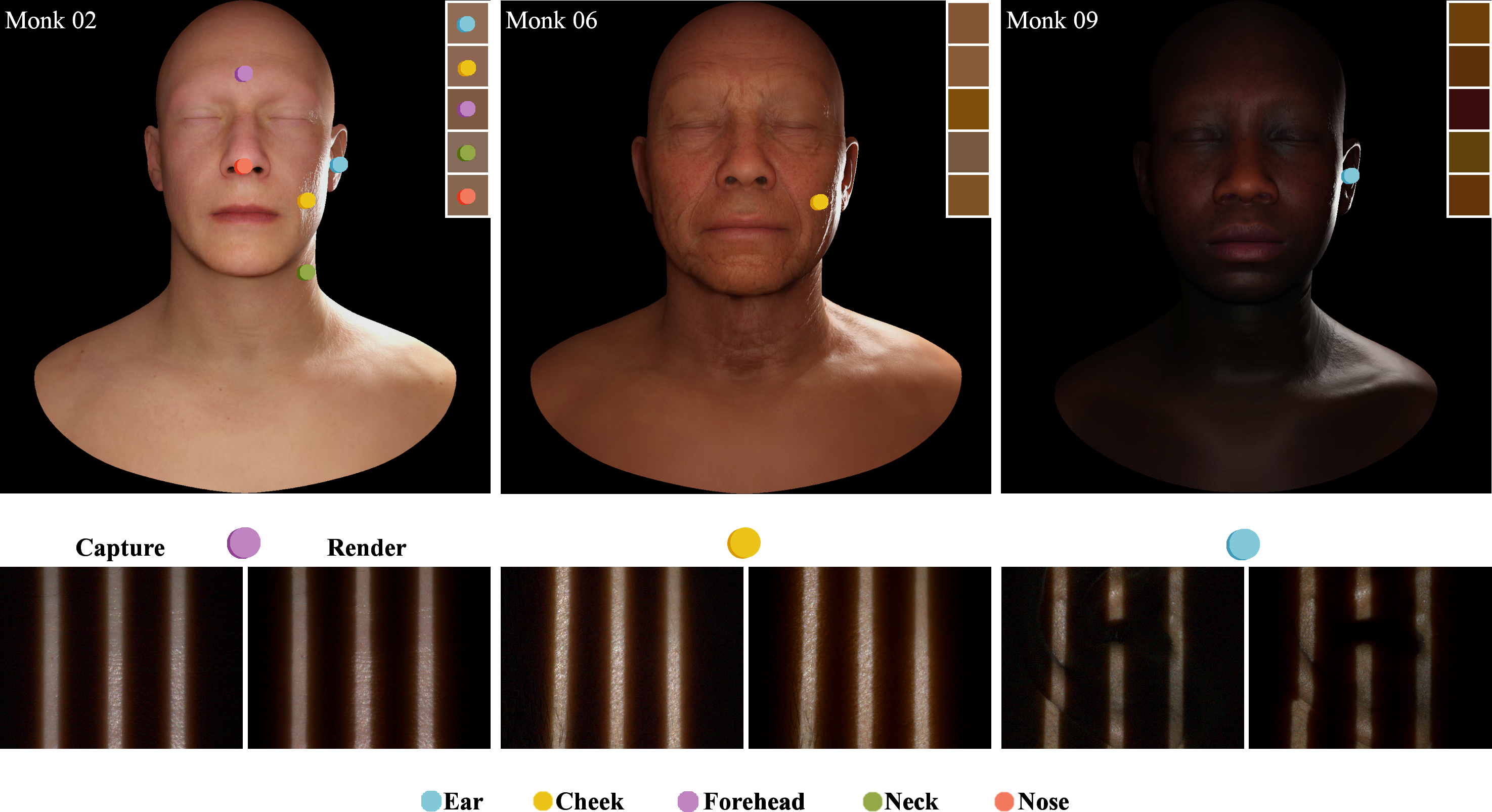

Paper Prompts
Sign up for free to create and run prompts on this paper.
Explain it Like I'm 14
1. ¿De qué trata el artículo?
Este artículo presenta una forma rápida y económica de crear modelos digitales de piel humana realista para videojuegos, realidad virtual y otras aplicaciones interactivas.
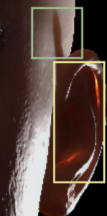
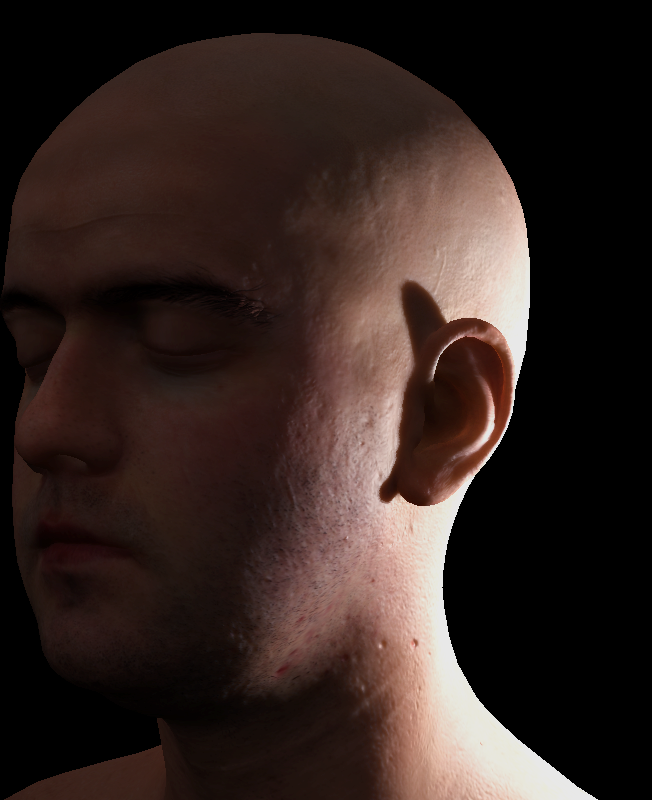
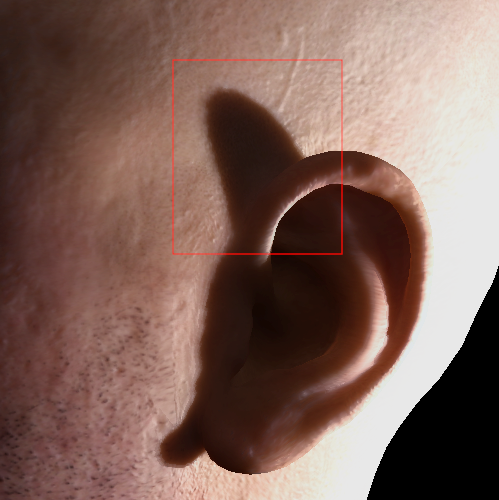
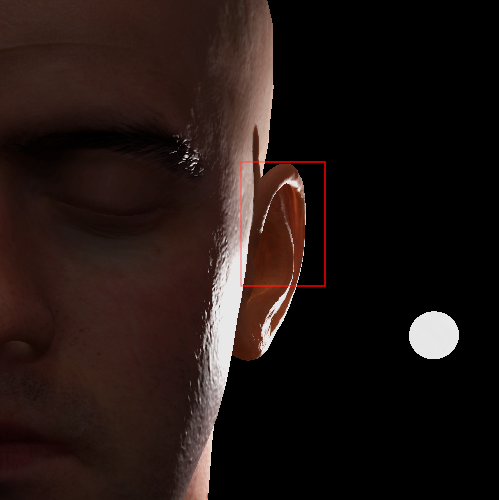
La piel es difícil de representar porque la luz no solo rebota en su superficie: también entra un poco en ella, viaja por debajo y vuelve a salir. Este efecto se llama dispersión subsuperficial. Es lo que hace que, por ejemplo, una oreja pueda verse rojiza cuando una luz fuerte la atraviesa.
Los métodos más exactos suelen necesitar cámaras y luces muy caras, además de mucho tiempo de cálculo. El artículo propone una alternativa más sencilla: usar una cámara, una sola luz y fotografías de distintas zonas de la cara para calcular automáticamente cómo debe comportarse la piel en un programa de renderizado en tiempo real.
2. Objetivos y preguntas de investigación
Los autores intentan responder principalmente a estas preguntas:
- ¿Se pueden calcular los parámetros de dispersión de la piel usando una sola cámara y una sola fuente de luz?
- ¿Se puede hacer que esos parámetros funcionen directamente en motores gráficos de tiempo real, como los utilizados en videojuegos?
- ¿Puede el método representar correctamente muchos tonos de piel, incluidos tonos claros, medios y oscuros?
- ¿Es posible representar las diferencias entre distintas partes de la cara, como las mejillas, la frente, la nariz y las orejas?
- ¿Puede el sistema producir resultados realistas sin utilizar equipos de laboratorio costosos?
Una idea importante del artículo es que no intenta calcular todas las propiedades físicas exactas de la piel. En cambio, calcula directamente los valores que necesita un programa gráfico para producir una apariencia convincente.
3. ¿Cómo realizaron la investigación?
Captura de las fotografías
Los investigadores construyeron un sistema relativamente barato formado por:
- Una cámara digital normal.
- Un proyector.
- Una habitación oscura para evitar que entrara luz externa.
- Un soporte para mantener la cara en una posición estable.
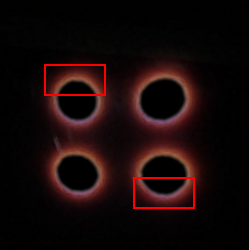
El proyector ilumina la piel con varios patrones:
- Un patrón oscuro para medir la luz ambiental.
- Un patrón de líneas verticales.
- El patrón contrario, con las zonas claras y oscuras invertidas.
- Una luz blanca uniforme.
Comparar estas imágenes permite descubrir dónde la luz ilumina directamente la piel y dónde la luz se ha extendido por debajo de ella.
Representación de la dispersión subsuperficial
Los autores utilizan un modelo llamado Screen-Space Subsurface Scattering, o SSSS. En lenguaje sencillo, este modelo calcula cómo la luz de una parte de la imagen puede influir en los píxeles cercanos.
Una analogía sería imaginar una gota de tinta sobre un papel húmedo: el color no se queda exactamente en un punto, sino que se extiende alrededor. En la piel ocurre algo parecido con la luz.
El método utiliza un valor llamado distancia de dispersión. Este valor indica cuánto puede viajar la luz bajo la superficie:
- Una distancia pequeña significa que la luz permanece cerca del punto donde entra.
- Una distancia grande significa que la luz se extiende más lejos.
La piel más fina, como la de las orejas, puede necesitar valores diferentes de la piel de las mejillas o la frente.
Renderizado diferenciable
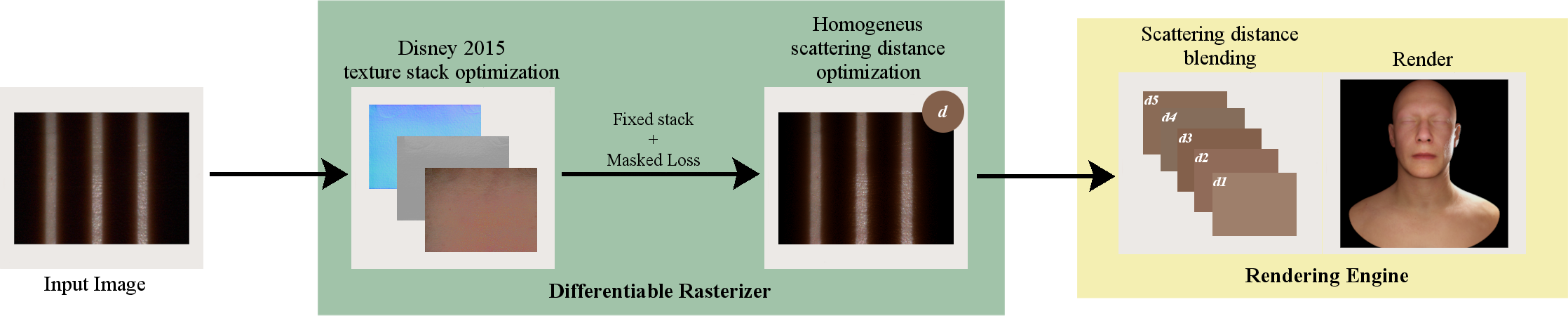
La parte central del sistema es un renderizador diferenciable. Un renderizador normal convierte materiales, luces y formas en una imagen. Un renderizador diferenciable también puede hacer el proceso inverso: comparar una imagen creada por ordenador con una fotografía y descubrir cómo cambiar los parámetros para que ambas se parezcan más.
Es parecido a corregir un dibujo siguiendo pistas:
- El programa crea una imagen con ciertos valores de color, brillo y dispersión.
- Compara esa imagen con la fotografía real.
- Mide los errores.
- Ajusta los valores para reducir esos errores.
- Repite el proceso muchas veces.
Este procedimiento se conoce como optimización. Los autores lo hacen mediante operaciones matemáticas que permiten que el error “viaje hacia atrás” hasta los parámetros que deben cambiar. A esto se le llama retropropagación.
Máscara de las zonas importantes
El sistema no utiliza toda la fotografía de la misma manera. Crea una máscara, que es como una plantilla que señala las zonas más útiles.
En este caso, se centra especialmente en las zonas de sombra, porque allí se nota mejor cómo la luz se ha extendido por debajo de la piel. Esto ayuda a que el programa no confunda el color normal de la piel con el efecto de la dispersión.
Cálculo rápido con tensores
Para funcionar rápidamente, el método procesa muchos píxeles y muestras al mismo tiempo. Utiliza estructuras matemáticas llamadas tensores, que pueden entenderse como grandes tablas de números procesadas en paralelo por la tarjeta gráfica.
En lugar de analizar cada píxel uno por uno, el sistema analiza grandes grupos simultáneamente. Esto hace que la técnica sea más adecuada para aplicaciones interactivas.
Diferentes regiones de la cara
Primero, los investigadores calculan la dispersión de pequeñas zonas de piel. Después combinan esos valores para construir un mapa completo de la cara.
El resultado es un mapa que puede asignar distintas propiedades a:
- Frente.
- Mejillas.
- Nariz.
- Labios.
- Orejas.
- Otras regiones faciales.
También utilizan mapas de grosor aproximado para estimar qué partes de la cara son más finas o más gruesas.
Datos y diversidad de tonos de piel
El artículo utiliza datos de 45 personas y considera diferentes tonos de piel mediante la escala de tonos de piel de Monk. Esta escala fue diseñada para representar de manera más equilibrada la variedad de tonos de piel humanos.
Además de las fotografías reales, los autores emplean imágenes sintéticas creadas por ordenador. Estas imágenes les permiten comprobar si el sistema recupera correctamente valores que ya conocen.
También realizan pruebas adicionales con:
- Varias luces en vez de una sola.
- Vistas ligeramente inclinadas.
- Diferentes condiciones de cámara.
4. Principales resultados
Según el artículo, el método consigue:
- Estimar valores de dispersión subsuperficial a partir de entradas sencillas.
- Crear apariencias de piel realistas en tiempo real.
- Producir parámetros directamente compatibles con sombreadores habituales de motores gráficos.
- Representar diferencias entre distintas zonas de la cara.
- Funcionar con una amplia variedad de tonos de piel.
- Mantener resultados coherentes cuando cambia ligeramente el ángulo de visión.
- Trabajar con una configuración mucho más barata y sencilla que los sistemas tradicionales de captura.
El resultado más importante es que el sistema no necesita pasar primero por complejos modelos de laboratorio. Calcula directamente los valores útiles para un sombreado en tiempo real.
Esto es importante porque los parámetros físicos exactos de la piel y los parámetros utilizados por un motor de videojuegos no siempre son lo mismo. Un modelo puede ser físicamente correcto, pero difícil de utilizar en un programa interactivo. Este artículo intenta resolver precisamente esa diferencia.
5. ¿Por qué son importantes estos resultados?
La piel humana es una de las partes más difíciles de representar de forma convincente. Los pequeños errores en una cara pueden hacer que un personaje digital parezca artificial.
El método podría ayudar a:
- Crear personajes digitales más realistas.
- Digitalizar personas de forma más rápida.
- Mejorar avatares para videojuegos y realidad virtual.
- Reducir el coste de producir humanos digitales.
- Facilitar la captura de personas en estudios pequeños o con pocos recursos.
- Evitar que los sistemas funcionen bien solo con tonos de piel intermedios.
La atención a la diversidad de tonos de piel también es importante. Muchos sistemas anteriores se probaron principalmente con tonos claros o medios. Si un método no incluye suficiente variedad, puede producir resultados peores para otras personas.
6. Limitaciones del trabajo
Aunque el artículo presenta resultados prometedores, también tiene algunas limitaciones:
- Utiliza fotografías de una sola vista, por lo que no observa toda la cara desde todos los ángulos.
- La estimación de profundidad procede de un sistema monocular, es decir, calcula la forma 3D a partir de una sola imagen y no de una medición 3D perfecta.
- La técnica utiliza aproximaciones para representar la piel, no una simulación completa de todas sus capas biológicas.
- La captura debe realizarse bajo condiciones controladas, como una habitación oscura y una posición estable.
- La dispersión calculada es un valor efectivo para el motor gráfico; no representa necesariamente una propiedad física exacta de una capa concreta de la piel.
Por tanto, el método busca principalmente una combinación útil de realismo, rapidez y bajo coste, no una medición médica o física totalmente exacta.
7. Conclusión e impacto potencial
En resumen, el artículo presenta un sistema ligero para convertir fotografías sencillas de piel en materiales digitales utilizables en tiempo real. El sistema observa cómo reaccionan distintas zonas de la piel ante una luz controlada y ajusta automáticamente los parámetros de un modelo gráfico.
La idea principal puede resumirse así:
En vez de intentar simular toda la complejidad de la piel desde cero, el sistema aprende los valores que necesita un motor gráfico para que la piel se vea realista.
Si se desarrolla más, esta técnica podría hacer que la creación de avatares y personajes digitales sea más rápida, barata e inclusiva. También podría ayudar a que los personajes virtuales representen mejor la diversidad real de las personas, incluyendo sus diferentes tonos de piel y las variaciones naturales entre distintas partes de la cara.
Practical Applications
Immediate Applications
The paper’s combination of low-cost capture, differentiable optimization, and direct compatibility with real-time screen-space shaders enables several applications that could be deployed with existing cameras, projectors, GPUs, and game-engine pipelines.
- Real-time digital-human asset creation — entertainment, games, and virtual production. Studios can use the single-view, single-light capture workflow to estimate facial albedo, roughness, and effective subsurface-scattering distances, then export blended scattering maps directly to WebGL, Babylon.js, Unreal Engine-style, or other real-time shaders. This can reduce reliance on expensive light stages, hyperspectral cameras, and manual shader tuning when producing realistic characters, avatars, or digital doubles. Dependencies: controlled lighting, fixed camera parameters, reliable facial-region masks, suitable depth estimation, and sufficient GPU memory for optimization.
- Avatar generation for virtual reality, augmented reality, and telepresence. A compact capture station could produce realistic skin materials for avatars used in social VR, remote collaboration, virtual events, and metaverse applications. Region-specific scattering parameters would help preserve differences between cheeks, forehead, nose, ears, and other facial areas while maintaining real-time performance. Dependencies: accurate facial geometry and tracking; the reported approach estimates appearance more reliably than full facial geometry, so it should be paired with a face-scanning or morphable-model system.
- Browser-based skin-rendering demonstrations and asset-preview tools — software and education. Because the renderer is implemented with WebGL and Babylon.js, developers can build interactive browser tools that preview skin assets across devices, lighting conditions, and skin-tone values without requiring a high-end workstation. This is suitable for graphics courses, shader documentation, material-authoring tools, and online asset marketplaces. Dependencies: browser support for the required shader features, acceptable performance on low-end devices, and careful management of screen-space artifacts.
- Automated shader parameter fitting for production pipelines. The differentiable implementation can serve as an offline fitting stage in a material-authoring workflow: capture images, optimize real-time parameters, generate spatially varying scattering textures, and export the result to a target engine. This is more directly actionable than estimating physical absorption or extinction coefficients that must later be converted into approximate shader parameters. Dependencies: calibration between the capture renderer and the target engine, consistency of color management, and validation under lighting conditions not present during capture.
- Inclusive skin-tone coverage in digital content. The dataset and use of the Monk Skin Tone Scale can support asset libraries, avatar systems, and rendering benchmarks that explicitly include lighter and darker skin tones rather than treating mid-range tones as representative. Production teams can use the scale to design capture protocols and quality-control tests for skin appearance. Dependencies: the paper’s dataset contains 45 individuals and should not be treated as exhaustive demographic coverage; additional subjects, age groups, facial characteristics, and lighting conditions are needed for broad deployment.
- Low-cost academic and industrial skin-appearance acquisition. Universities, small studios, and research laboratories can reproduce the proposed setup using a consumer camera, projector, darkened room, color chart, and synchronization software. This provides a practical alternative for collecting training or validation data when hyperspectral or polarization-based equipment is unavailable. Dependencies: accurate exposure and white-balance control, color calibration, projector-camera synchronization, and protection of participant privacy and biometric data.
- Real-time visual quality assurance for digital humans. The differentiable renderer and masked loss can be incorporated into an asset-validation workflow that compares captured reference images with rendered outputs, especially in shadowed regions where subsurface scattering is most visible. Artists or technical directors could receive automated warnings when scattering distances, albedo, or roughness produce implausible facial appearance. Dependencies: a correctly registered reference/render pair and a loss function that does not over-penalize benign differences caused by geometry, expression, or camera mismatch.
- Interactive visualization of skin-material parameters — graphics research and teaching. The implementation can be used to demonstrate the relationship between scattering distance, thickness, albedo, screen-space sampling, and perceived skin appearance. Students and researchers can experiment with the Burley diffusion profile and compare two-dimensional screen-space approximations with reconstructed three-dimensional distances. Dependencies: access to the implementation or an equivalent reimplementation, and sufficient documentation of the supplementary shader and tensorized code.
- Improved digital cosmetics and character look-development workflows. Existing makeup, tattoo, aging, or complexion-editing tools could apply modifications on top of a spatially varying scattering map rather than using a uniform skin shader. This may improve previews of foundation, blush, lip color, bruising, or localized redness in real-time applications. Dependencies: the method does not itself model all physiological or layered skin phenomena, so cosmetic or medical appearance changes would require additional material layers and calibrated color models.
Long-Term Applications
The paper also suggests broader applications that require larger datasets, stronger validation, improved automation, or extensions beyond the current effective-shader parameterization.
- Scalable consumer 3D-avatar scanning. A future product could combine a smartphone or inexpensive camera with a compact light source or projector to generate personalized facial materials at home, in retail stores, or at entertainment venues. The optimization stage could run locally or as a cloud service and export assets to games, virtual try-on systems, or telepresence platforms. Dependencies: robustness to uncontrolled environments, head motion, facial expressions, ambient light, camera variability, and device-specific color response. The current setup assumes a darkened room, fixed positioning, and carefully controlled capture settings.
- Inclusive virtual try-on and beauty applications — retail and cosmetics. Skin-tone-aware scattering maps could improve the realism of virtual makeup, skincare, hair, eyewear, and jewelry previews. Unlike a purely color-based face filter, a scattering-aware model could represent changes in translucency, highlight response, and light diffusion across facial regions. Dependencies: reliable segmentation, illumination estimation, privacy safeguards, and validation across products, cameras, skin conditions, and diverse demographics. The effective scattering parameter should not be interpreted as a clinical measurement of skin physiology.
- Clinical and dermatological visualization support. With additional validation, similar acquisition and inverse-rendering methods could support non-diagnostic visualization of redness, pigmentation, bruising, scars, or treatment progression. Region-based scattering maps might help separate changes in surface color from changes in diffuse light transport. Dependencies: clinical calibration, medically representative datasets, standardized illumination, regulatory approval, and clear separation between visualization and diagnosis. The current paper is not sufficient for medical decision-making.
- Neural or hybrid inverse-rendering systems for faster inference. The optimization process could generate training data for a neural predictor that maps a small set of captured images directly to shader-ready albedo, roughness, and scattering maps. A hybrid system could use neural inference for initialization and differentiable optimization for final refinement, reducing the current multi-stage optimization cost. Dependencies: much larger and more varied training data, protection against demographic and device bias, uncertainty estimation, and tests on out-of-distribution skin tones, expressions, cameras, and lighting.
- Multi-view and expression-aware digital humans. Extending the method to several views, facial expressions, and dynamic sequences could produce temporally stable scattering maps for animated characters and volumetric video. This would address limitations of single-view fitting and reduce view-dependent inconsistencies. Dependencies: multi-camera calibration or robust tracking, temporal regularization, nonrigid facial registration, and methods for handling changing shadows, wrinkles, makeup, and facial deformation.
- Cross-engine material translation tools. Because the method optimizes parameters for a real-time model rather than only physical optical coefficients, it could evolve into a translator that adapts fitted skin materials between Unreal Engine, Unity, WebGL, proprietary engines, and offline renderers. Such a tool could compensate for differences in units, diffusion profiles, screen-space kernels, and texture conventions. Dependencies: engine-specific shader behavior must be characterized; a parameter that is visually effective in one renderer may not transfer identically to another.
- More physically faithful layered skin models at interactive rates. Future work could retain the paper’s differentiable, production-oriented workflow while estimating separate epidermal, dermal, blood, melanin, and water-related parameters. This could enable appearance changes caused by tanning, erythema, aging, temperature, or circulation while preserving real-time performance through learned or reduced-order approximations. Dependencies: multi-spectral or polarization-based capture, physiological priors, stronger identifiability constraints, and substantially more validation. The current single effective scattering distance does not uniquely recover intrinsic tissue coefficients.
- Robotics and human–computer interaction. Realistic skin rendering could improve synthetic training data for robots, face-recognition systems, gaze interfaces, and human–robot interaction simulations. Demographically diverse materials may reduce the appearance bias of synthetic datasets and help test perception systems under varied skin tones and illumination. Dependencies: rendering realism alone does not guarantee improved perception performance; applications would require evaluation on real sensor data and careful control of dataset bias, privacy, and biometric risks.
- Policy and standards for equitable digital representation. The Monk-scale-based dataset and region-aware evaluation could support procurement standards, benchmark suites, or certification procedures requiring digital-human systems to perform consistently across a broad range of skin tones. This could be relevant to public-sector virtual services, accessibility testing, educational software, and media production. Dependencies: representative sampling must extend beyond the reported dataset, and standards should evaluate perceptual quality, not merely similarity to a color scale. Governance would also need to address consent, biometric data retention, and culturally appropriate representation.
- Large-scale datasets for appearance research. The proposed capture protocol could become a standardized method for collecting paired photographs, depth estimates, masks, and real-time shader parameters across regions and skin tones. Such datasets could support research in inverse rendering, differentiable graphics, computer vision, and fairness-aware synthetic-data generation. Dependencies: participant consent, anonymization or secure storage, consistent calibration, metadata standards, independent quality control, and explicit documentation of demographic and environmental coverage.
- Mobile and embedded real-time rendering of realistic skin. The optimized screen-space scattering method could be adapted for phones, standalone headsets, web clients, and embedded systems where full path tracing is impractical. Adaptive sample counts, temporal reuse, compressed scattering maps, or learned approximations could preserve quality while reducing bandwidth and computation. Dependencies: device-specific performance testing, mitigation of screen-space disocclusion and edge artifacts, and robust behavior under changing camera distance, field of view, and geometry.
Glossary
- Albedo: The fraction of light reflected diffusely by a surface, often represented as a color value. “where is the diffuse volume albedo”
- Anisotropy: Direction-dependent behavior in the scattering or transport of light. “the directional dipole \cite{dEon2012ADipole, Frisvad2014DirectionalScattering}, which introduces anisotropy”
- Bilateral formulation: A formulation that weights samples according to both spatial relationships and signal or material differences. “Following the bilateral formulation in~\cite{Golubev2018EfficientReal-time}”
- Bilinear interpolation: Estimation of a value from the four nearest samples using linear interpolation along two dimensions. “we replace discrete texture lookups with differentiable bilinear interpolation”
- BSSRDF: Bidirectional subsurface scattering reflectance distribution function, which models light entering and exiting a participating material at potentially different locations. “We ground our approach in the Bidirectional Subsurface Scattering Reflectance Distribution Function (BSSRDF)”
- Backpropagation: The computation of gradients through a computational graph to optimize model parameters. “by backpropagating reconstruction errors through a differentiable rasterizer”
- Beer–Lambert law: A physical law describing the exponential attenuation of light as it travels through an absorbing medium. “which estimates light transmission using the Beer-Lambert law and the thickness texture”
- Chromatic aberration: Color-dependent image distortion caused by different wavelengths of light behaving differently in an optical system. “We utilize vertically aligned line patterns to minimize projector-induced chromatic aberration”
- CCDF: Complementary cumulative distribution function, giving the probability that a random variable exceeds a specified value. “The resulting Probability Density Function (PDF) and Complementary Cumulative Distribution Function (CCDF)”
- Differentiable rasterizer: A rasterization system designed so that gradients can be computed through image formation and propagated to scene parameters. “we optimize a spatially varying [PERSON_NAME] 15 texture stack by backpropagating reconstruction errors through a differentiable rasterizer”
- Diffusion profile: A mathematical function describing how light spreads through a scattering medium as a function of distance. “We employ the exponential approximation of the [PERSON_NAME] profile”
- Dipole model: A subsurface-light-transport approximation that represents scattering using virtual light sources and sinks. “The dipole model \cite{Jensen2001ATransport} remains a foundational approximation for offline rendering”
- Euclidean distance: The straight-line distance between two points in a geometric space. “we compute the true 3D Euclidean distance between the surface point and the sample point”
- Extinction coefficient: A parameter describing the rate at which light is removed from a medium through absorption and scattering. “physical parameters (e.g., extinction coefficients) that do not map directly to real-time shaders”
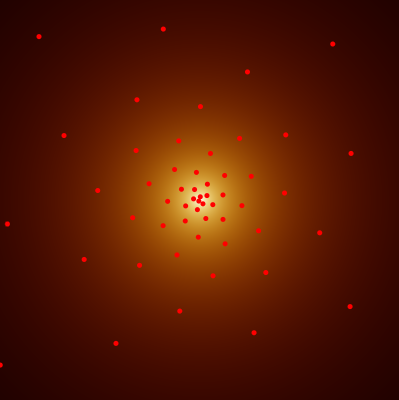
- Fibonacci sampling: A sampling strategy based on the Fibonacci sequence for distributing points or directions relatively uniformly. “The angular coordinate follows a Fibonacci pattern”
- Hyperspectral imaging: Imaging that records information across many wavelength bands beyond standard red, green, and blue channels. “Common approaches rely on multi-view setups, polarized lighting, or hyperspectral imaging”
- Importance sampling: A Monte Carlo technique that draws more samples from regions contributing more strongly to an estimate. “via an analytical Importance Sampling scheme”
- Inverse rendering: The estimation of scene geometry, materials, lighting, or other parameters from observed images. “Inverse rendering for skin typically relies on offline path tracing”
- Inverse transform sampling: A method for generating random samples by applying the inverse cumulative distribution function to uniformly distributed values. “via inverse transform sampling”
- Irradiance: The incident radiant power received by a surface per unit area. “the incident diffuse irradiance field ”
- Lambertian: A model of diffuse reflection in which apparent brightness is independent of viewing direction and depends on the cosine of the incident angle. “represents the standard Lambertian incident diffuse irradiance”
- Monte Carlo variance: Statistical fluctuation in a Monte Carlo estimate caused by using a finite number of random samples. “To minimize Monte Carlo variance”
- Multipole method: An extension of the dipole approximation using multiple virtual sources to model transport in layered materials. “Subsequent improvements include the multipole method”
- Normalized Device Coordinates (NDC): A standardized coordinate system, typically ranging over a fixed interval, used between projection and viewport mapping. “project the resulting positions back into Normalized Device Coordinates (NDC)”
- Optical properties: Physical characteristics governing how a material interacts with light, including absorption, scattering, and reflectance. “Estimating physically meaningful texture maps—such as normals, roughness, albedo, and scattering distances”
- Path tracing: A rendering method that numerically simulates many possible light paths through a scene. “Instead of estimating offline physical parameters like absorption or extinction coefficients through complex path-tracing intermediaries”
- Polarimetric imaging: Imaging that measures the polarization state of light to help separate or characterize reflection and scattering. “such as hyperspectral sensors or polarimetric imaging systems”
- Probability Density Function (PDF): A function describing the relative likelihood of a continuous random variable taking particular values. “The resulting Probability Density Function (PDF) ”
- Radiance: The amount of light traveling in a particular direction from a surface or through a scene per unit projected area and solid angle. “The final scattered diffuse radiance ”
- Rasterizer: A graphics component that converts geometric primitives into pixels or fragments. “The resulting preprocessed images and the depth map serve as the input for our differentiable rasterizer optimization.”
- Screen-space: A coordinate domain corresponding to positions in the rendered image rather than positions in three-dimensional world space. “For multiple scattering, screen-space techniques are the standard.”
- Sigma clipping: A statistical outlier-removal method that excludes values beyond a chosen number of standard deviations from a mean. “via Sigma Clipping”
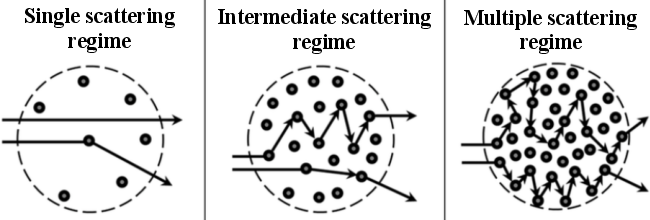
- Single scattering: Light that undergoes one dominant scattering event before reaching the observer. “light transport in translucent media falls into three regimes: single scattering”
- Subsurface scattering: The transport of light beneath a material surface before it exits at the same or another location. “We introduce a differentiable Screen-Space Subsurface Scattering (SSSS) framework”
- Tensorized computation: Representation and execution of operations using multidimensional arrays, usually to enable parallel processing. “Porting the screen-space multiple scattering algorithm to a differentiable framework presents a challenge: we must convert per-pixel shader operations into batched tensor computations”
- Translucency: The partial transmission of light through a material, often involving scattering within thin geometry. “For a complete skin shader, we also account for single scattering (translucency) through thin geometry”
- Unprojection: The conversion of two-dimensional screen coordinates and depth into three-dimensional camera- or view-space positions. “Using the estimated depth map, we unproject every pixel into 3D view-space coordinates”
- Volumetric rendering: Rendering that models light transport through the interior volume of an object rather than only across its surface. “it lacked volumetric scattering controls”
- World-space coordinates: Positions expressed in a scene-wide three-dimensional coordinate system. “To align this with our engine's world-space coordinate system”
- -means clustering: An unsupervised learning algorithm that partitions data into a specified number of clusters based on distance to cluster centers. “we perform -means clustering () on the and chromatic channels”