- The paper introduces a novel framework combining a two-layer skin model, Monte Carlo simulations, and neural inversion to reconstruct skin biophysical properties.
- It employs an encoder-decoder network to invert captured RGB albedo to five key skin parameters, ensuring smooth and editable spatial maps.
- Comparisons reveal that while neural inversion has a slight accuracy trade-off versus lookup methods, it offers superior efficiency and manipulation capabilities.
Estimation of Spectral Biophysical Skin Properties from Captured RGB Albedo
Overview
This paper introduces a framework for reconstructing and manipulating the spectral biophysical properties of human skin from RGB albedo captures. The approach leverages a physically-constrained, two-layer skin model and Monte Carlo light transport simulations to generate a high-dimensional tensor of plausible skin albedos. A neural network is trained to invert RGB albedo maps to the underlying biophysical parameters, enabling robust, high-resolution spatially-varying parameter estimation and intuitive editing of skin appearance. The method is validated across the Fitzpatrick scale and compared quantitatively to prior work, demonstrating lower reconstruction error and improved expressiveness.
Biophysical Skin Model and Albedo Space Construction
The skin model is parameterized by five key variables: melanin volume fraction (Vm), blood volume fraction (Vb), epidermal thickness (t), melanin type ratio (φm), and hemoglobin type ratio (φh). The model restricts the structure to two layers—epidermis and dermis—balancing complexity and tractability. Spectral absorption and scattering coefficients are computed for each layer using established tissue optics models, incorporating the contributions of eumelanin, pheomelanin, oxy- and deoxy-hemoglobin, beta-carotene, and bilirubin.
Monte Carlo random walk simulations are performed for each parameter combination across the visible spectrum (380–780 nm, 10 nm steps), launching 106 photons per wavelength to compute diffuse reflectance. Melanin and hemoglobin are sampled non-linearly (cubic and quartic, respectively) to account for their highly non-linear influence on albedo.
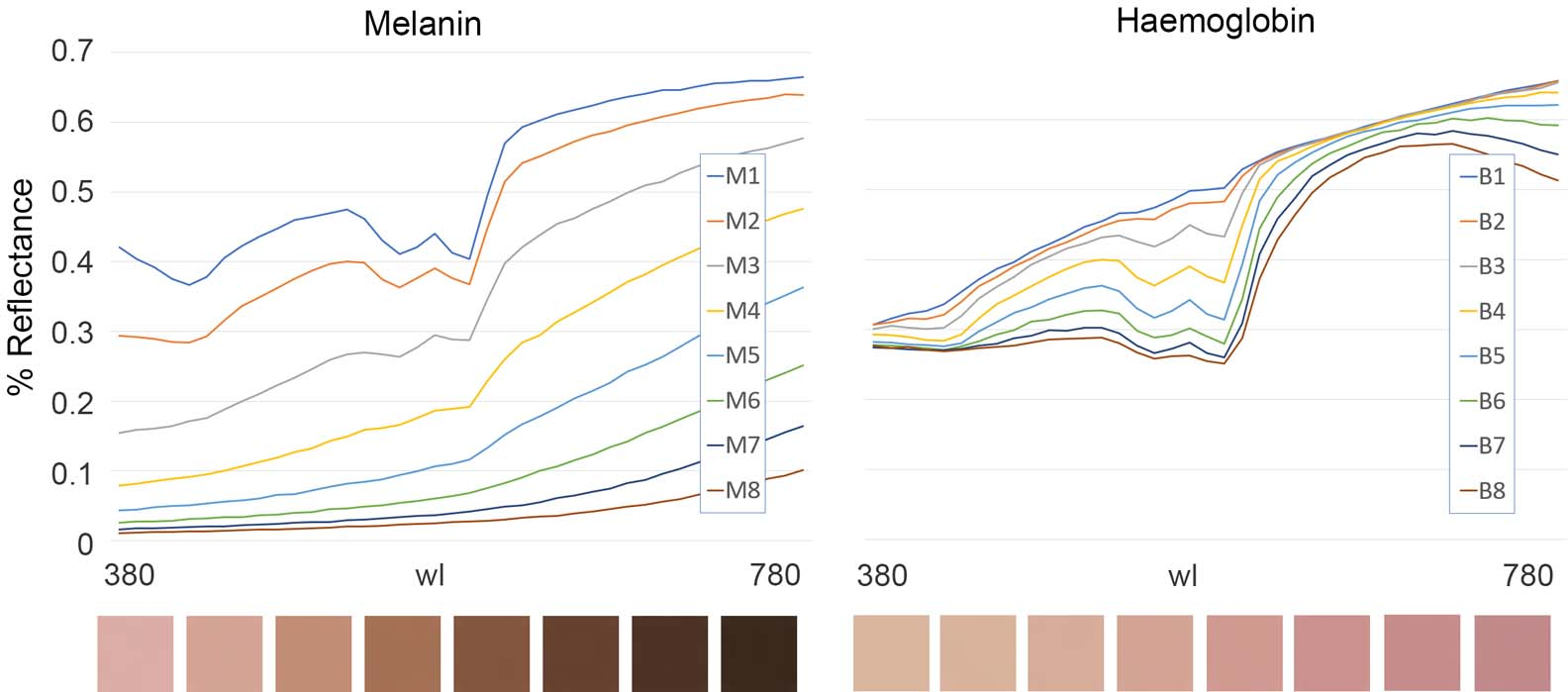
Figure 1: Melanin and haemoglobin have a highly non-linear relationship with the final albedo, as shown by spectral reflectance and corresponding albedo variations.
The resulting tensor of skin albedos spans a wide gamut, including outlier regions (e.g., lips, moles, veins) by extending parameter ranges beyond typical adult values. This enables the model to generalize across diverse skin types and local facial features.
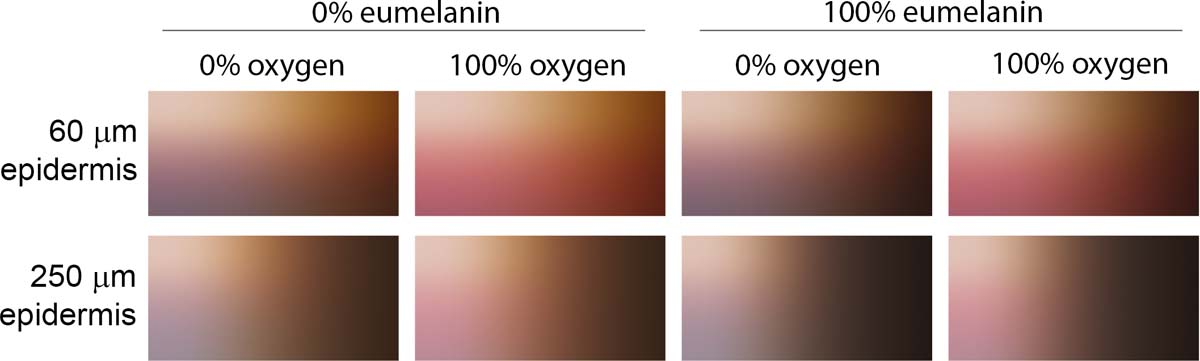
Figure 2: Matrices of resulting skin albedos, built by varying melanin and blood concentrations, visualizing the expressive range of the parameterized albedo space.
Inverse Mapping: Skin Parameter Estimation
The forward mapping from skin parameters to albedo is well-defined, but the inverse is non-bijective due to metamerism. Two strategies are evaluated:
- Look-Up Tensor (LUT): Brute-force search over the precomputed tensor to find the parameter set minimizing L2 reconstruction error for each texel. While this achieves low error, the resulting parameter maps are quantized and noisy, leading to artifacts during editing.
- Neural Encoder-Decoder: An MLP-based encoder-decoder is trained on 600k synthetic (parameter, albedo) pairs. The encoder maps RGB albedo to the 5D parameter vector; the decoder reconstructs albedo from parameters. The loss function combines L2 parameter error, L1 albedo error, and cycle consistency.
The neural approach yields smooth, spatially-regularized parameter maps, enabling robust manipulation and continuous edits without quantization artifacts. Training uses Adam with a learning rate of 10−4, batch size 4096, and 400 epochs.
Implementation and Rendering
Spectral albedos are downsampled to RGB using established integration methods under D65 illumination. For rendering, the estimated albedo maps are used in Blender Cycles with a double-lobe GGX specular model and a 3D random walk subsurface scattering solution, numerically inverting albedo around the mean free path and accounting for anisotropy.
Quantitative and Qualitative Results
The neural mapping reconstructs albedos with slightly higher error than the LUT (average per-channel error: LUT [0.00083,0.00081,0.00083], neural [0.00311,0.00178,0.00159]), but the difference is imperceptible in final renders and is offset by the improved regularity and editability of the parameter maps.
Editing experiments demonstrate intuitive control over melanin and hemoglobin concentrations, epidermal thickness, and oxygenation, producing plausible variations in skin appearance (e.g., tanning, flushing, aging, vitiligo simulation). The model robustly isolates features such as melanin spots, capillaries, and lips.
Comparisons to prior work ("Practical Spectral Skin Reflectance Acquisition and Rendering" [gitlina2020practical]) show consistently lower reconstruction error and improved parameter estimation, particularly in challenging regions.
Trade-offs and Limitations
- LUT vs Neural: LUT offers minimal reconstruction error but suffers from quantization and poor editability. Neural mapping trades a small amount of accuracy for smoothness and practical manipulation.
- Spectral vs RGB: Operating in RGB simplifies capture and training but limits disentanglement of metameric cases. Extending the model to spectral input could further improve robustness and generalization.
- Computational Cost: LUT search is computationally expensive (2–5 hours for 2k images), while neural inference is efficient (<2 seconds for 2k images on CPU).
Implications and Future Directions
This framework enables physically-meaningful, data-driven editing of skin appearance for applications in digital humans, VFX, and telepresence. The explicit biophysical parameterization facilitates intuitive control and plausible extrapolation across skin types and conditions. Future work should address:
- Extension to rare chromophore concentrations and pathological cases
- Incorporation of hair root effects for improved realism
- Direct spectral parameter estimation to mitigate metamerism
- Automated compensation for baked lighting in uncontrolled captures
Conclusion
The presented method combines a physically-constrained skin model with neural inverse mapping to robustly estimate and manipulate biophysical skin properties from RGB albedo. The approach achieves low reconstruction error, high expressiveness, and practical editability, advancing the state of the art in skin appearance modeling and parameter estimation for graphics and vision applications.

