PolicyIK: High-Precision Inverse Kinematics for Robot Arms with Reinforcement Learning
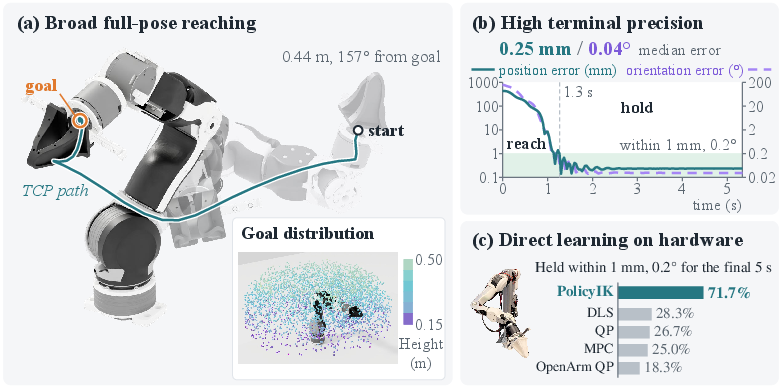
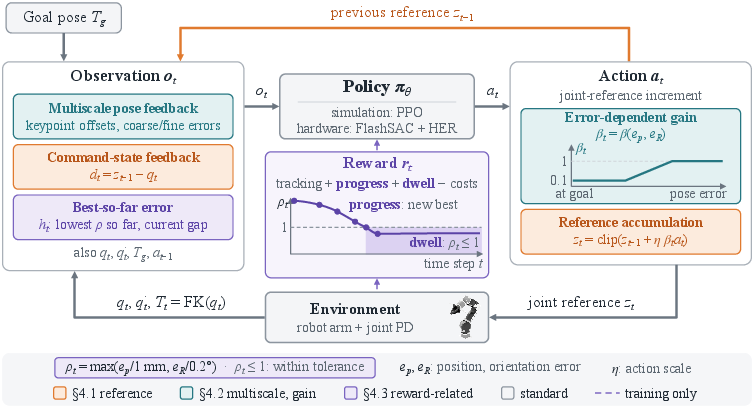
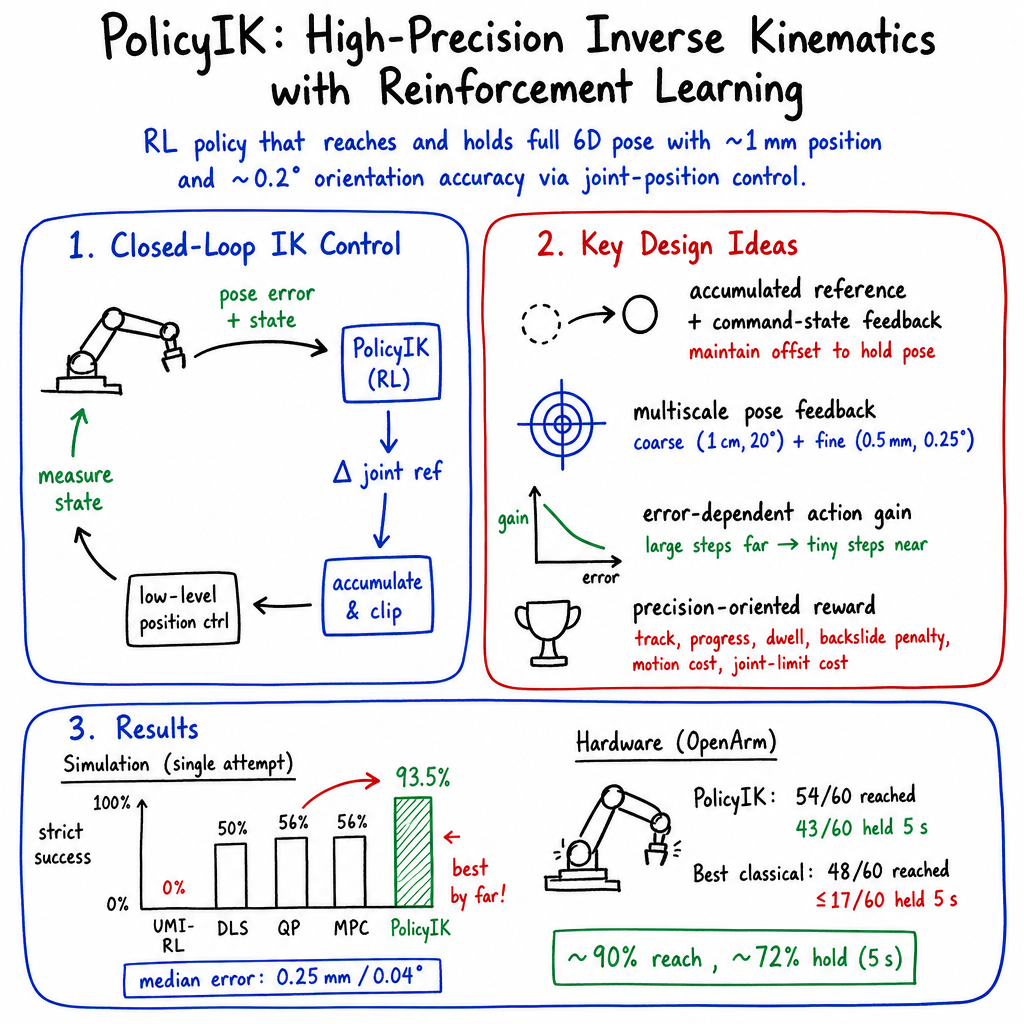
Abstract: Inverse kinematics (IK) converts end-effector pose commands into joint motion, and many vision-language-action (VLA) policies rely on it to act on a given arm and to transfer across embodiments. Precise IK remains laborious: redundancy and singularities complicate the inverse mapping, execution depends on hand-tuned controllers, and training data on physical robots are costly to collect. We present PolicyIK, a goal-conditioned reinforcement learning policy for high-precision IK. It updates joint-position references from pose feedback and observes its accumulated reference relative to the measured joints, so it can retain the offset that the position controller needs at rest. Two-scale pose errors with an error-dependent action gain resolve millimeter residuals while preserving large motions. Progress and dwell rewards teach it to both reach the tolerance and stay within it. In simulation, a single attempt by the trained PPO policy keeps the mean errors over the final second within 1 mm and 0.2° on 93.5% of held-out tasks, and a deployment protocol raises success to 98.9%. When trained directly on a physical arm with an off-policy RL learner, PolicyIK achieves higher reaching and holding success than all four classical IK controllers under the same time budgets. In simulated pick-and-place, PolicyIK executes the end-effector commands of the VLA policy with 95.7% success. These results show that reinforcement learning can provide high-precision inverse kinematics for robot arms. Code is available at https://github.com/Tinaliu0123/PolicyIK.
Paper Prompts
Sign up for free to create and run prompts on this paper.
Explain it Like I'm 14
1. What is this paper about?
This paper presents PolicyIK, a new way to control robot arms very accurately.
A robot arm is usually told where its hand should go—for example, “move the gripper to this position and point it this way.” The robot then has to decide how to move all its joints to make that happen.
This problem is called inverse kinematics, or IK.
PolicyIK uses reinforcement learning, a method where a computer program learns by trying actions and receiving rewards. The goal is for a robot arm to reach a target position and keep holding it with extremely small errors:
- Less than 1 millimeter in position
- Less than 0.2 degrees in rotation
That is about the thickness of a small coin and a very tiny angle.
2. What questions did the researchers ask?
The researchers wanted to find out:
- Can reinforcement learning make a robot arm reach a target more accurately than traditional IK methods?
- Can the robot not only reach the target, but also stay there without drifting away?
- What information should the learning system receive to make very small corrections?
- Can the same approach work on different robot arms?
- Can PolicyIK help larger robot systems, such as vision-language-action policies, perform tasks like picking up and moving objects?
The researchers were especially interested in the last part of the movement. Getting close to a target is not enough. A robot might stop just slightly too far away or keep shaking around the correct position. PolicyIK is designed to handle these final, difficult corrections.
3. How did the researchers build and test PolicyIK?
Inverse kinematics in simple terms
Imagine trying to touch a spot on a wall while wearing a glove connected to several sticks. You know where your hand should be, but you must work out how much to bend every stick.
A robot faces the same problem. Its “sticks” are its joints and links. The desired location and direction of its hand are called its pose.
Traditional IK methods calculate the joint movements using equations. These methods can work well, but they may struggle when:
- Several joint arrangements can reach the same pose
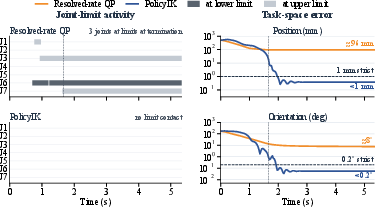
- A joint is close to its movement limit
- The robot is in a difficult position called a singularity
- Gravity or imperfect motors causes the robot to settle slightly away from the commanded position
Reinforcement learning
PolicyIK learns through practice. During training, the robot receives a target pose and repeatedly tries to reach it.
The system receives information such as:
- The current joint positions
- How fast the joints are moving
- The difference between the target pose and the current pose
- The difference between the robot’s commanded joint position and its measured joint position
- How well it performed in previous steps
It then chooses small changes to the robot’s joint commands.
This is similar to learning to throw a ball into a basket. A player first makes large corrections, then uses smaller and smaller corrections as the ball gets closer to the target.
Three important design choices
The researchers made three main changes to help the robot become precise.
1. Remembering the command offset
Because of gravity and imperfect motor strength, the arm may need to hold a joint slightly away from its measured position. PolicyIK remembers this difference instead of starting over at every step.
For example, if a robot arm slowly sags downward, the controller can keep commanding a little extra upward force. This helps the arm remain in place.
2. Using both large-scale and fine-scale error information
PolicyIK looks at errors in two ways:
- A coarse view for large movements, such as errors of centimeters
- A fine view for tiny movements, such as errors of less than a millimeter
It also takes larger steps when the robot is far away and smaller steps when the robot is close. This is like walking quickly toward a destination and then taking careful, tiny steps near the finish line.
3. Rewarding both reaching and staying
The learning system receives rewards for:
- Moving closer to the target
- Reaching the required accuracy
- Reaching a new best result
- Staying within the allowed error range
The reward for staying is important. Without it, the robot might briefly reach the correct location and then move away again.
Training and experiments
The researchers trained PolicyIK in two ways:
- In a computer simulation using a method called PPO
- Directly on physical robot arms using another reinforcement-learning method called FlashSAC
A simulation is like a video-game version of a robot. It allows the researchers to run thousands of training attempts quickly and safely.
They tested PolicyIK on:
- A simulated seven-joint robot arm
- Physical OpenArm and xArm7 robot arms
- Simulated pick-and-place tasks controlled by a larger vision-language-action system
They also compared it with four traditional controllers, including damped least squares, quadratic programming, and model-predictive control.
4. What did they find?
Very high accuracy in simulation
In simulation, PolicyIK reached the strict target in 93.5% of tasks on its first attempt.
Its typical final errors were:
- 0.25 millimeters in position
- 0.04 degrees in rotation
With a retry procedure, its success rate increased to 98.9%.
By comparison, the traditional controllers succeeded in roughly 50–56% of the strict tests.
It could hold the pose
PolicyIK did not just reach the target. It could remain within the required limits.
In the simulation, it stayed inside the strict limits at every sample during the final second for about 92.4% of tasks.
This shows that the system was not simply passing through the correct position. It was actually able to hold the robot’s hand there.
Better results on a real robot
On a physical OpenArm, the researchers tested 60 tasks.
PolicyIK:
- Reached 54 out of 60 targets
- Held the targets for the required time in 43 out of 60 tasks
The traditional controllers held only about 11–17 out of 60 tasks.
This difference matters because small movements, gravity, motor imperfections, and vibrations are much harder to handle on a real robot than in a computer simulation.
It helped with pick-and-place
PolicyIK was also used to carry out commands from a vision-language-action system called .
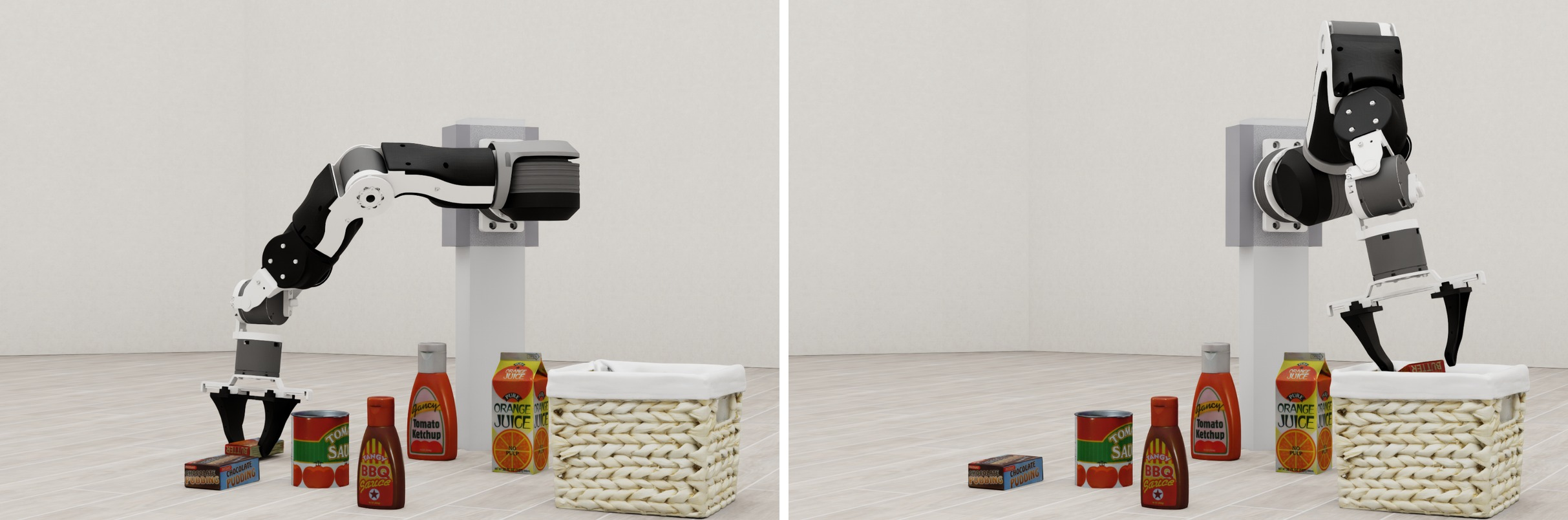
In simulated pick-and-place tasks, PolicyIK achieved a 95.7% success rate. It had not been trained specifically on those pick-and-place tasks. It had only learned how to control the robot’s pose accurately.
This suggests that a precise low-level controller can help a larger robot system perform many different tasks.
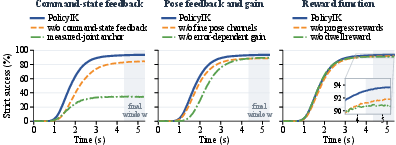
Each design choice was useful
The researchers removed parts of PolicyIK to see what happened.
They found that:
- Removing information about the stored command reduced accuracy
- Removing the fine error information made the final position less precise
- Using one fixed movement size made the robot slower or less accurate
- Removing the reward for staying caused the robot to leave the correct area more often
This suggests that all three main ideas were important.
5. Why is this research important?
Many advanced robot systems decide what they want the robot to do but depend on another controller to decide exactly how the robot should move.
For example, a vision-language-action system might say:
“Move the gripper to the cup.”
PolicyIK can translate that request into accurate joint movements while considering the robot’s limits, gravity, and small control errors.
If the controller is inaccurate, the larger robot system may fail even when it correctly understands the task. A robot might miss an object, drop something, or collide with its surroundings.
PolicyIK could therefore make robot systems:
- More accurate
- Better at holding objects steadily
- More reliable when moving near joint limits
- Easier to transfer between different robot arms
- Less dependent on experts manually tuning many settings
The paper’s main message is that reinforcement learning can be used not only for broad robot movements, but also for extremely careful, millimeter-level control.
However, the results should still be interpreted carefully. Some experiments were done in simulation, and real robots can behave differently in other environments. More testing would be needed with different robot designs, objects, speeds, and unexpected disturbances.
Overall, PolicyIK is a promising step toward robot arms that can follow high-level instructions while moving with the precision needed for delicate tasks.
Practical Applications
Immediate Applications
The paper’s results support near-term deployment of PolicyIK as a software controller or low-level control layer for robot arms, provided that the target robot has compatible sensing, joint-position control, and a calibrated kinematic model.
- Robotics: high-precision end-effector control
- Integrate
PolicyIKinto a robot control stack as a closed-loop alternative to damped least squares, resolved-rate QP, or MPC. - Suitable for tasks requiring approximately
1 mmpositional and0.2°orientation accuracy, such as placing parts, aligning tools, inserting components, or positioning sensors. - The controller can accept target poses from an existing planner or operator interface and output joint-position reference updates.
- Dependencies: accurate joint encoders, reliable end-effector pose estimation, collision-free goal generation, joint-limit enforcement, and robot-specific training or adaptation.
- Integrate
- Industrial assembly and precision manipulation
- Use the controller for insertion, alignment, fastening, connector placement, laboratory automation, and other operations where small steady-state errors cause failures.
- The reference-accumulation mechanism can compensate for gravity, finite position-controller gains, and persistent offsets that cause an arm to settle away from its nominal target.
- A practical product could be a robot-controller plugin that exposes a standard pose-command API while internally learning robot-specific execution compensation.
- Dependencies: the paper evaluates reaching and holding primarily in simulation and on limited hardware; contact forces, compliance, friction, and deformable parts may require additional safety and force-control layers.
- Vision-language-action and generalist robot policies
- Place
PolicyIKbeneath a VLA policy that predicts end-effector poses or pose increments. - This can improve execution of commands from models such as
, especially near joint limits or in configurations where conventional IK leaves residual errors. - A reusable workflow is: visual-language policy → target pose sequence →
PolicyIK→ joint-position controller → robot. - The reported simulated pick-and-place success of
95.7\%indicates a direct integration path for tabletop manipulation. - Dependencies: the upstream VLA policy must produce physically reachable poses;
PolicyIKdoes not solve perception, grasp selection, collision planning, or task-level reasoning.
- Place
- Cross-embodiment robot deployment
- Use the same high-level pose-based policy across different arm embodiments while retraining or adapting only the low-level
PolicyIKcontroller. - This may reduce the need to redesign the task policy for each robot and provide a standardized end-effector interface across OpenArm-, xArm7-, and similar 6- or 7-DoF platforms.
- Dependencies: embodiment differences in workspace, joint limits, mounting orientation, payload, controller gains, and gravity compensation must be represented during training or handled through calibration.
- Use the same high-level pose-based policy across different arm embodiments while retraining or adapting only the low-level
- Replacement or augmentation of hand-tuned classical IK
- Deploy
PolicyIKwhere classical IK requires extensive tuning of damping, task weights, gains, or joint-limit penalties. - The learned controller may reduce engineering time for robots whose dynamics or position-control behavior make purely kinematic methods unreliable.
- In practice, a hybrid fallback architecture could route ordinary commands through classical IK and use
PolicyIKfor final regulation or difficult joint-limit configurations. - Dependencies: classical controllers may remain preferable when formal guarantees, deterministic behavior, or rapid commissioning are more important than peak empirical precision.
- Deploy
- Robot calibration and commissioning
- Use high-precision pose regulation as a diagnostic tool for identifying systematic errors in kinematic models, encoder offsets, gravity compensation, or position-controller gains.
- A commissioning workflow could command known reachable poses, measure persistent residuals, and compare errors before and after controller adaptation.
- Dependencies: the measured pose must be accurate enough to distinguish controller errors from sensor and model errors; the method does not itself provide a complete calibration algorithm.
- Academic robotics research and teaching
- Use the released implementation as a benchmark for studying learned inverse kinematics, terminal-phase reward design, command-state feedback, action integration, and sim-to-real adaptation.
- The ablation results provide concrete experimental hypotheses: accumulated reference state should improve steady-state precision, fine-scale pose features should reduce residual error, and dwell rewards should improve holding.
- It can support coursework or laboratory exercises comparing PPO, off-policy RL, DLS, QP, MPC, and learned controllers under identical reaching and holding metrics.
- Dependencies: reproducibility depends on access to compatible robot models, simulation environments, hardware interfaces, and the paper’s exact hyperparameters.
- Low-latency embedded robot control
- The reported actor inference time of
0.035 mson a CPU suggests that the policy can run within a33 mscontrol cycle and may be suitable for industrial PCs or edge-compute hardware. - Potential tools include a real-time ROS 2 controller, vendor-specific robot SDK module, or embedded inference node.
- Dependencies: end-to-end latency also includes sensing, forward kinematics, communication, safety checks, and robot-controller update time; the actor timing alone does not establish hard real-time guarantees.
- The reported actor inference time of
- Daily-life and service-robot manipulation
- In domestic, laboratory, or assistive robots, the controller could improve reliable placement of objects, docking of tools, opening or closing mechanisms, and positioning near shelves or work surfaces.
- Its ability to hold a pose could benefit tasks such as keeping a utensil, camera, or medical instrument stable.
- Dependencies: domestic environments introduce moving people, unexpected contacts, uncertain object geometry, and safety requirements not covered by the reported experiments. Additional perception, compliant control, and emergency-stop mechanisms are essential.
Long-Term Applications
The following opportunities are plausible extensions, but they require broader validation, additional sensing or planning, scaling to varied environments, or stronger safety guarantees.
- General-purpose precision manipulation platform
- Develop a controller library in which a single learned IK formulation is automatically adapted to different arms, grippers, payloads, mounting configurations, and controller gains.
- The resulting platform could expose a robot-independent
SE(3)pose-control interface for manufacturing, logistics, healthcare, and research robotics. - Dependencies: large-scale evaluation across robot families, payloads, workspace geometries, and failure modes; reliable transfer cannot be assumed from the two arm families evaluated in the paper.
- Contact-rich assembly and insertion
- Extend
PolicyIKfrom free-space pose regulation to insertion, peg-in-hole assembly, connector mating, surgical tool placement, and contact-guided alignment. - The learned holding behavior could provide a stable pre-contact pose, while force or tactile feedback could guide the final contact phase.
- A future workflow could combine pose feedback, force-torque sensing, tactile observations, and impedance control.
- Dependencies: the current formulation is primarily pose-based and does not demonstrate force regulation, contact stability, friction adaptation, or safe interaction with uncertain objects.
- Extend
- Healthcare and surgical robotics
- Use high-precision pose regulation for laboratory automation, robotic microscopy, rehabilitation devices, or non-invasive instrument positioning.
- In surgical systems, related techniques might support tool stabilization or constrained positioning, but only after extensive safety validation.
- Dependencies: medical applications require certified hardware, redundant sensing, deterministic safety behavior, formal verification or extensive validation, sterile operation, and tolerance analysis beyond empirical success rates.
- Mobile manipulation and whole-body control
- Extend the method from fixed-base arms to mobile manipulators, humanoids, and legged robots whose bases and multiple end effectors move simultaneously.
PolicyIKcould become one component of a hierarchy that coordinates arm pose regulation with base motion, balance, obstacle avoidance, and whole-body constraints.- Dependencies: the current experiments do not establish stability under base motion, balance constraints, dynamic contacts, or changing support surfaces.
- Automatic controller adaptation and continual learning
- Train or update the policy online as payload, wear, temperature, joint friction, or controller gains change.
- The reference-state observation and dwell-focused reward are particularly relevant to compensating for time-varying steady-state errors.
- A production system could maintain a safe baseline controller and learn residual corrections during scheduled calibration periods.
- Dependencies: online RL introduces exploration and safety risks; deployment would require constrained learning, uncertainty estimation, rollback policies, and monitoring for catastrophic policy drift.
- Formal safety and reliability certification
- Combine the learned policy with control barrier functions, reachability analysis, runtime monitors, or verified safety shields.
- Such a system could reject commands that approach collisions, violate torque limits, or enter poorly trained regions.
- This is especially important for industrial collaboration, public-facing service robots, and healthcare.
- Dependencies: empirical success rates such as
98.9\%with retries do not provide formal guarantees; the learned policy must be bounded and evaluated under adversarial, out-of-distribution, and sensor-failure conditions.
- Robotic teleoperation and shared autonomy
- Use
PolicyIKto convert a human operator’s noisy or low-rate Cartesian commands into stable, precise joint references. - The controller could smooth hand-controller input, preserve a commanded pose during pauses, and compensate for robot-specific gravity and control offsets.
- Dependencies: latency, operator intent, singularity handling, and collision avoidance must be integrated; the paper does not evaluate human-in-the-loop operation.
- Use
- Precision laboratory automation
- Apply the method to automated pipetting, sample transfer, microscope positioning, cell handling, and instrument docking.
- These workflows benefit from accurate positioning and sustained holding, while the low inference cost could support many parallel robot stations.
- Dependencies: laboratory tasks often require force, suction, liquid-level, or visual feedback, which are outside the current observation space.
- Scalable simulation-to-real training pipelines
- Build automated training systems that sample reachable configurations, randomize dynamics and controller parameters, and produce a robot-specific policy with limited hardware interaction.
- The reverse curriculum, near-goal replay, and hindsight goal relabeling could reduce the physical data required for learning terminal precision.
- Dependencies: the paper’s strongest hardware results come from direct physical training, so the amount of sim-to-real robustness remains unresolved. Domain randomization and hardware validation would be necessary.
- Robotics foundation-model infrastructure
- Treat high-precision IK as a reusable low-level skill beneath large multimodal policies, enabling foundation models to issue standardized Cartesian commands across robot embodiments.
- A future system could combine language planning, visual grounding, motion planning, and learned pose regulation in a modular stack.
- Dependencies: high-level policies may generate unreachable, unsafe, or temporally inconsistent pose commands; a robust interface needs command validation, workspace constraints, recovery behavior, and uncertainty-aware execution.
- Energy-efficient and lower-cost robot control
- Because the learned actor is computationally lightweight and does not require online Jacobian optimization or MPC, it could reduce controller compute requirements on low-cost robot hardware.
- This may make precise manipulation feasible on educational, warehouse, or small-business platforms.
- Dependencies: lower compute does not necessarily imply lower energy use by the motors; motion smoothness, torque demands, thermal effects, and payload performance require separate evaluation.
Glossary
- Action gain: A scaling factor that adjusts the magnitude of a control action according to the current error. “PolicyIK therefore scales each update by the gain”
- Advantage estimation: A reinforcement-learning method for estimating how much better an action performs than the expected baseline. “generalized advantage estimation”
- Ablation: An experiment that removes or changes one component of a system to measure its contribution. “Removing any design component lowers single-attempt success”
- Closed-loop control: Control in which new actions are continually computed from feedback about the system’s current state. “Like closed-loop IK”
- Command-state feedback: Feedback that supplies the controller with the difference between a commanded reference and the measured state. “PolicyIK therefore feeds back the command state”
- Configuration space: The mathematical space of all possible joint configurations of a robot. “A redundant arm can reach a pose with many joint configurations”
- Constraint optimization: Optimization performed subject to limits or requirements on the allowable solutions. “general and redundant arms rely on damped least squares or constrained optimization”
- Damped least squares (DLS): A numerical inverse-kinematics method that adds damping to stabilize solutions near singularities. “damped least squares, DLS”
- Degrees of freedom (DoF): The number of independent movements or coordinates available to a mechanical system. “For a 7-DoF arm in our task”
- Dwell reward: A reward given for remaining within a desired tolerance over time. “The dwell reward $r_t^{\mathrm{dwell}$”
- End effector: The terminal component of a robot manipulator, such as a gripper, whose pose is controlled. “The end-effector pose follows from forward kinematics”
- Error-dependent gain: A control multiplier that changes with the magnitude of the current error. “an error-dependent gain shrinks actions near the goal”
- Forward kinematics: The computation of a robot’s end-effector pose from its joint configuration. “The end-effector pose follows from forward kinematics”
- Goal-conditioned policy: A policy whose action selection depends on a specified target or goal in addition to the current state. “We present PolicyIK, a goal-conditioned RL formulation”
- Hindsight Experience Replay (HER): A reinforcement-learning technique that relabels failed experiences with goals that were actually achieved. “Hindsight Experience Replay (HER)”
- Inverse kinematics (IK): The computation of joint configurations or motions needed to achieve a desired end-effector pose. “Inverse kinematics (IK) converts end-effector pose commands into joint motion”
- Jacobian: A matrix of derivatives describing how changes in joint variables produce changes in task-space motion. “without a Jacobian, online optimization, or gravity feedforward”
- Keypoint-based pose representation: A representation of an object’s pose using the transformed positions of selected reference points. “Following keypoint-based pose representations”
- Latent-alignment critic: A value-function model that represents states, actions, and goals in learned latent spaces and evaluates their alignment. “Latent-alignment critic (Appendix~\ref{app:rt_adapt})”
- Markov Decision Process (MDP): A mathematical model of sequential decision-making in which future transitions depend on the current state and action. “A goal-conditioned Markov Decision Process (MDP) is a tuple”
- Model-predictive control (MPC): A control method that repeatedly optimizes predicted future behavior over a finite horizon. “a kinematic model-predictive controller (MPC)”
- Operational-space controller: A controller that specifies motion in task space, such as Cartesian position and orientation, rather than directly in joint space. “an IK or operational-space controller”
- Off-policy reinforcement learning: Reinforcement learning that can learn from data generated by a different or older policy. “with FlashSAC on physical arms”
- Pose error: The translational and rotational difference between a robot’s current pose and its target pose. “Correcting millimeter residuals requires the policy both to perceive them”
- Proximal Policy Optimization (PPO): A policy-gradient reinforcement-learning algorithm that limits overly large policy updates. “We train with PPO”
- Quadratic programming (QP): An optimization technique that minimizes a quadratic objective subject to linear constraints. “resolved-rate quadratic programming (QP)”
- Redundancy: The condition in which a robot has more joint degrees of freedom than are required to specify the task pose. “A redundant arm can reach a pose with many joint configurations”
- Resolved-rate control: A differential inverse-kinematics approach that converts task-space velocity commands into joint velocities. “resolved-rate quadratic programming (QP)”
- Residual error: The remaining discrepancy between a system’s achieved output and its target after control has been applied. “The residuals that decide success lie orders of magnitude below the initial errors”
- Reward shaping: The addition of intermediate rewards to guide learning toward a desired behavior. “The potential-based shaping term”
- Reverse curriculum: A training strategy that begins with easy, near-goal tasks and progressively introduces more difficult tasks. “Reverse curriculum”
- SE(3): The mathematical group representing all three-dimensional rigid-body translations and rotations. “The goal is a pose ”
- Sim-to-real transfer: The process of applying a policy trained in simulation to a physical robot. “without sim-to-real transfer”
- Singularity: A robot configuration in which certain task-space motions require unusually large or undefined joint motions. “near singularities small pose corrections demand large joint motions”
- Soft Actor-Critic (SAC): An off-policy reinforcement-learning algorithm that optimizes expected reward together with policy entropy. “an off-policy soft actor-critic variant”
- Steady-state error: The persistent difference between a desired value and the value reached after transient behavior has settled. “to reduce steady-state error”
- Task space: The space of variables describing the robot’s task-level state, such as end-effector position and orientation. “task-space error”
- Terminal precision: Accuracy achieved during the final stage of reaching and maintaining a target. “a formulation designed around terminal precision”
- Tolerance-normalized error: An error measure scaled by the permitted tolerance for each task dimension. “The precision terms therefore use the tolerance-normalized error”
- Trajectory tracking: The process of controlling a system so that it follows a desired time-varying path. “Improving Trajectory Tracking of Flexible-Joint Manipulator”
- VLA policy: A vision-language-action policy that maps visual and linguistic instructions to robot actions. “the end-effector commands of the VLA policy”
- Whole-body manipulation: Coordinated control of multiple parts or degrees of freedom of a robot to perform manipulation. “whole-body controllers track full end-effector poses on legged manipulators”