- The paper introduces an IK-QP formulation incorporating CBF-style joint-limit constraints that ensure actuator-compatible motion references.
- It leverages actuator-aware weighting and slack-based task preservation to balance task accuracy with safe joint operation, achieving zero reference velocity violations.
- Experimental results on a 7-DoF exoskeleton demonstrate significant reductions in limit-pushing indices and RMS tracking errors compared to conventional IK methods.
Actuator-Aware Inverse Kinematics with Joint-Limit Admissibility for Torque-Controlled Redundant Robots
This work addresses the inverse kinematics (IK) redundancy resolution problem for torque-controlled redundant robots subject to joint-limit constraints. Unlike conventional approaches that provide purely kinematic velocity commands, the output of the IK layer in modern torque-controlled architectures serves as a reference to a downstream torque-level controller. This reference must not only produce the desired endpoint task motion but also ensure compatibility with the actuator's physical constraints and controller limitations.
Classical IK solutions, including minimum-norm pseudoinverse and null-space projection methods [siciliano2009robotics, chiaverini2008], inadequately encode actuation constraints and often disregard joint-authority near limits, frequently resulting in infeasible or suboptimal references under torque control. Recent advances in constrained and QP-based IK formulations [faroni2020, zhang2024, zhang2026] incorporate task-preservation and joint-constraint satisfaction, but typically prioritize task accuracy, relegating compatibility with actuator capacity and controller dynamics.
This paper proposes a controller-compatible IK-QP formulation, explicitly integrating reference-level joint-limit admissibility via CBF-style bounds and actuation-aware weighting schemes. By resolving redundancy with actuated-joint compatibility and avoiding limit-pushing commands, the approach targets improved realized tracking, bounded admissible reference generation, and effective downstream controller behavior without modifying the torque-level control loop.
Methodological Contributions
The proposed approach introduces several rigorous components:
- Reference-Level Joint-Limit Constraint Set: By adapting standard CBF-style inequalities, the QP enforces that joint-velocity references generated at the IK layer are bounded to slow approach rates as limits are neared, intersected with hard-velocity bounds. This yields a time-varying admissible velocity set tailored to both kinematics and joint proximity.
- Actuator-Aware Redundancy Resolution: Controller-compatibility is incorporated through a composite quadratic cost that penalizes (i) excessive deviation from previous references (encouraging consistency in sequential reference signals), and (ii) directions corresponding to actuators with low normalized torque capacity (using only model-based, platform-level parameters). Both terms are parameterized for flexibility and can be tuned for application-specific trade-offs.
- Task Preservation via Penalized Slack: Rather than strictly enforcing the instantaneous differential kinematics, a soft constraint via a slack variable allows feasible relaxation in the presence of strict limits, penalizing task residuals without forcing infeasibility. This resolves conflicts between strict task fulfillment and admissibility in highly constrained regions.
- IK-QP Construction: The formal problem is a strongly convex QP, with the joint-velocity reference and task slack as decision variables, subject to affine task consistency and admissible velocity bounds. Objective terms partition redundancy optimization and compatibility enforcement.
The architecture is agnostic to the underlying torque-level controller and can serve as a modular IK layer for any redundant, torque-controlled system.
Experimental Results and Quantitative Analysis
Experimental validation employs a 7-DoF upper-limb exoskeleton controlled by a VDC torque controller. The proposed method is benchmarked against four baselines: pseudoinverse IK (PINV), damped least-squares IK (DLS), null-space joint-limit-avoidance IK (NS-JLA), and a task-preserving QP with identical CBF-style admissibility constraints (TP-QP). All comparisons are executed with identical endpoint trajectories, mechanical limits, and unaffected downstream control.
Tracking accuracy, reference admissibility, realized task-velocity residuals, limit-pushing commands, and torque-norm statistics are systematically reported. Notably, the proposed method uniquely achieves zero reference velocity bound violations and the lowest values across all limit-pushing and torque-norm metrics, while also minimizing essential realized task-tracking measures, including RMS and maximum endpoint errors and realized task-velocity residuals.
(Figure 1)
Figure 1: Realized endpoint tracking errors obtained with the proposed method and the IK baselines, shown separately for position and orientation components.
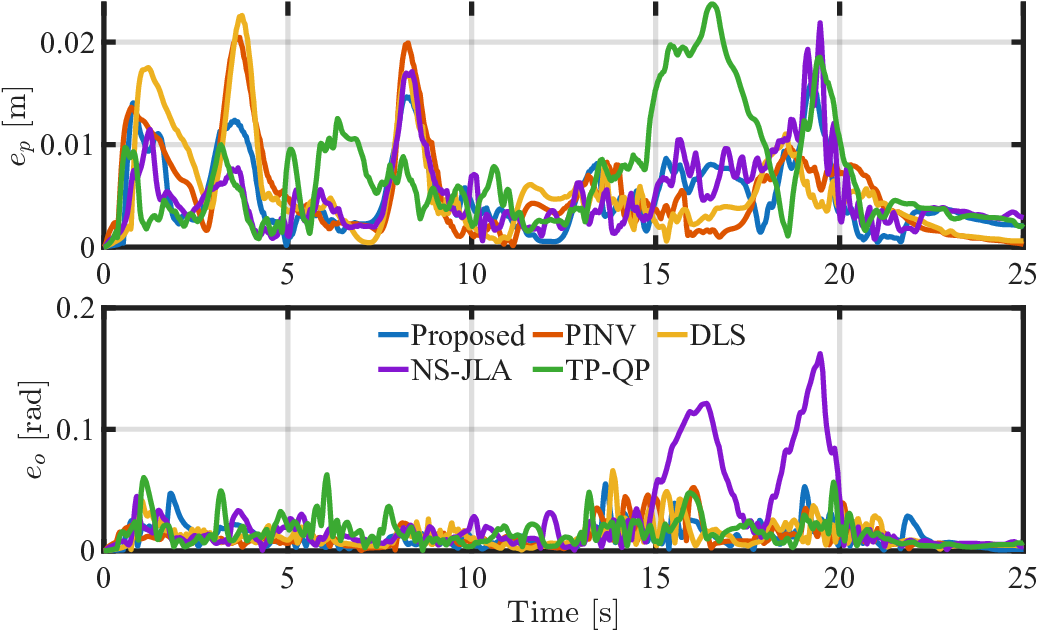
Figure 2: Realized task-velocity residuals for all methods, computed from the actual joint velocity q˙ rather than the commanded required velocity q˙r.
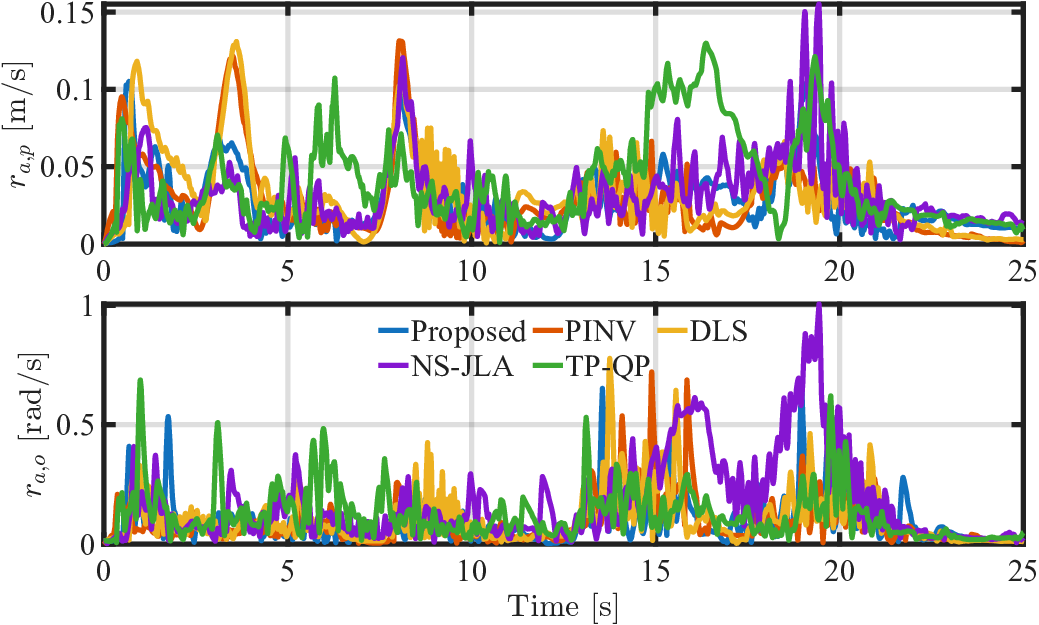
Figure 3: Limit-pushing and realized tracking tradeoff for the proposed method and IK baselines. The proposed method remains in the low-pushing and low-error region.
Relative to all baselines, large reductions in limit-pushing commands and RMS joint torques are observed (e.g., an 88.9% reduction in limit-pushing index and 18.9% in RMS torque norm, compared to PINV). Most importantly, compared with TP-QP—which shares identical admissibility constraints but differs only in the redundancy objective—the proposed method exhibits up to 29.6% reduction in RMS position error and 64.1% in limit-pushing. Hence, the efficacy is attributed specifically to the controller-compatibility weighting, not merely constraint satisfaction.
Theoretical Implications
This research clarifies that for torque-controlled redundant systems, IK layers must resolve redundancy in a manner cognizant of actuation reality: pure task-space error minimization can destabilize actuator interaction and generate untrackable or unsafe references. The explicit enforcement of admissibility through CBF-style bounds provides a formal filter on infeasible commands, albeit without plant-level safety guarantees. Torque capacity weighting redistributes redundancy along axes of mechanical strength, yielding both immediate compatibility and long-term system sustainability.
The slack-based, soft task constraint disentangles infeasibility (due to narrow admissible region near limits) from unnecessary task degradation, enabling smooth transition without abrupt controller violations or optimization infeasibility. This modular approach is scalable to arbitrary torque-level downstream architectures and is orthogonal to specific controller structure.
Practical Impact and Future Directions
Practically, actuator-aware IK improves the safety margin and physical plausibility of high-DoF robot control, especially in human-centric environments (e.g., exoskeletal rehabilitation, physical HRC), where both task performance and joint safety are critical. Bounded, non-limit-pushing references reduce wear and mitigate collision risk for both human and robot.
Although the reference-level constraints guarantee only the admissibility of the generated reference, not plant invariance, the increased compatibility between IK output and torque controller enhances closed-loop performance, as substantiated experimentally. The reduction in commanded limit-pushing and lower realized torques support more sustainable operation, with reduced risk of control saturation or hardware damage.
Future research directions involve formalizing closed-loop constraint invariance, coupled IK/torque-level QP controllers, and extension to high-DOF systems with richer physical interaction (e.g., grounded dual-arm robots, mobile platforms). Integration with high-level constraint prioritization, heterogeneous actuator models, and dynamic adaptation of admissibility parameters are anticipated directions for robust, context-aware redundant robot control.
Conclusion
The paper presents a comprehensive framework for actuator-aware, controller-compatible inverse kinematics in redundant robots, leveraging CBF-style admissibility, model-based torque authority weighting, and penalized slack task feasibility. Experimental results on a 7-DoF exoskeleton demonstrate superior realized tracking, bounded admissible reference generation, and reduction in limit-pushing and torque stress, outperforming conventional and QP-based IK strategies. This establishes a new paradigm for redundancy resolution under actuation constraints in torque-controlled robotic systems, with significant implications for future research and practical deployment.
References:
- "Actuator-Aware Inverse Kinematics with Joint-Limit Admissibility for Torque-Controlled Redundant Robots" (2605.31436)

