MABEL: An Open Anthropomorphic Mobile Bimanual Platform for Teleoperation and Learning
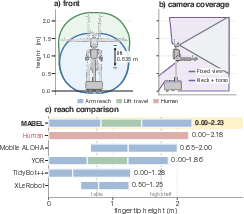
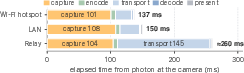
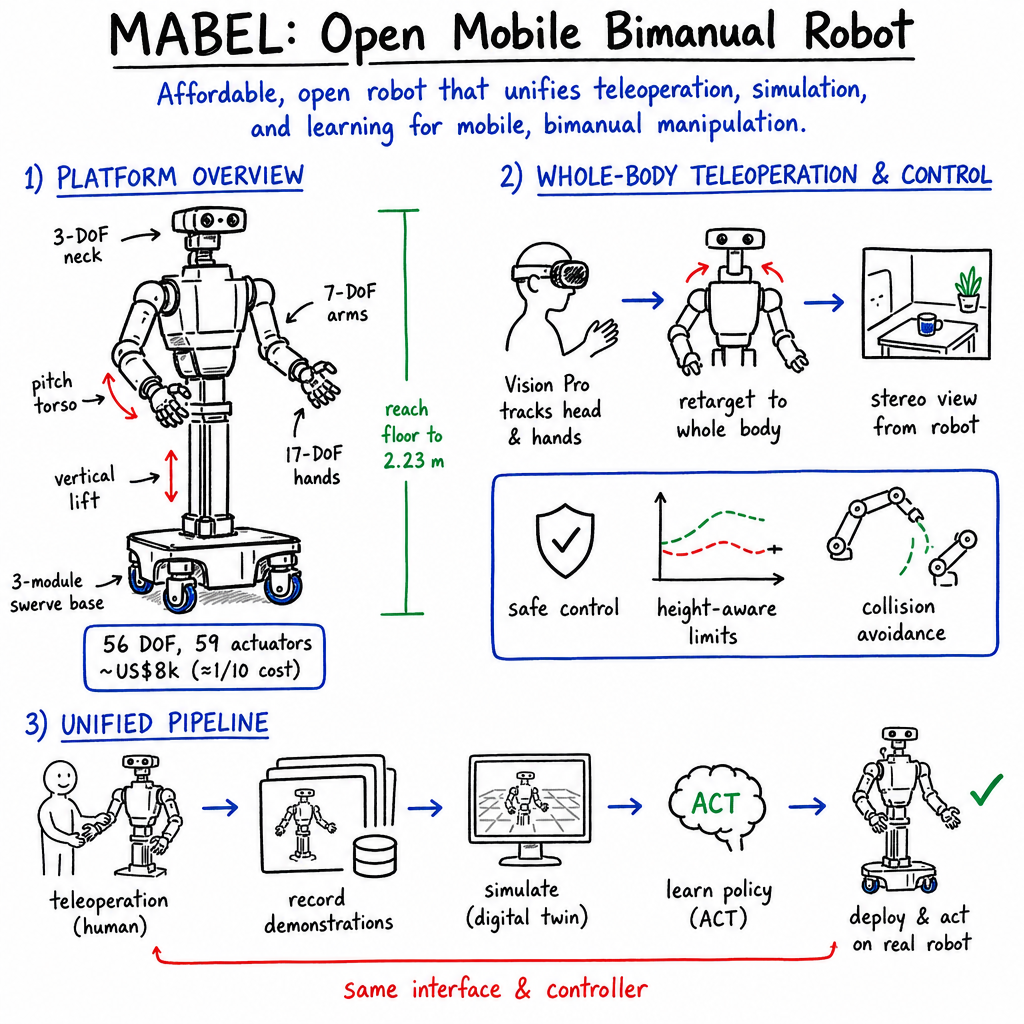
Abstract: As robot learning moves beyond the tabletop, many tasks require mobility, adjustable reach, active perception, and bimanual dexterity. Commercial platforms combining these capabilities are costly, while affordable open-source alternatives cover only a subset and require software integration. We present MABEL, an open-source anthropomorphic mobile bimanual robot with 56 degrees of freedom (DOF) and a US$8.1k parts cost. It combines two 7-DOF arms with 17-DOF hands, a pitching torso, a lift, a 3-DOF neck, and a holonomic base. Back-drivable arms and torso support compliant interaction, with fingertip reach from floor level to 2.23 m. The head and torso roughly triple modeled camera coverage relative to a torso-fixed camera. Apple Vision Pro head and hand tracking enables whole-body teleoperation without handheld controllers, with 137 ms mean glass-to-glass stereo video latency over the robot's Wi-Fi hotspot. We demonstrate an end-to-end imitation learning pipeline, from teleoperated data collection to policy deployment, using a shared command interface and whole-body controller.
Paper Prompts
Sign up for free to create and run prompts on this paper.
Explain it Like I'm 14
1. What is the paper about?
This paper introduces MABEL, an open-source robot designed for research in robotics and artificial intelligence.
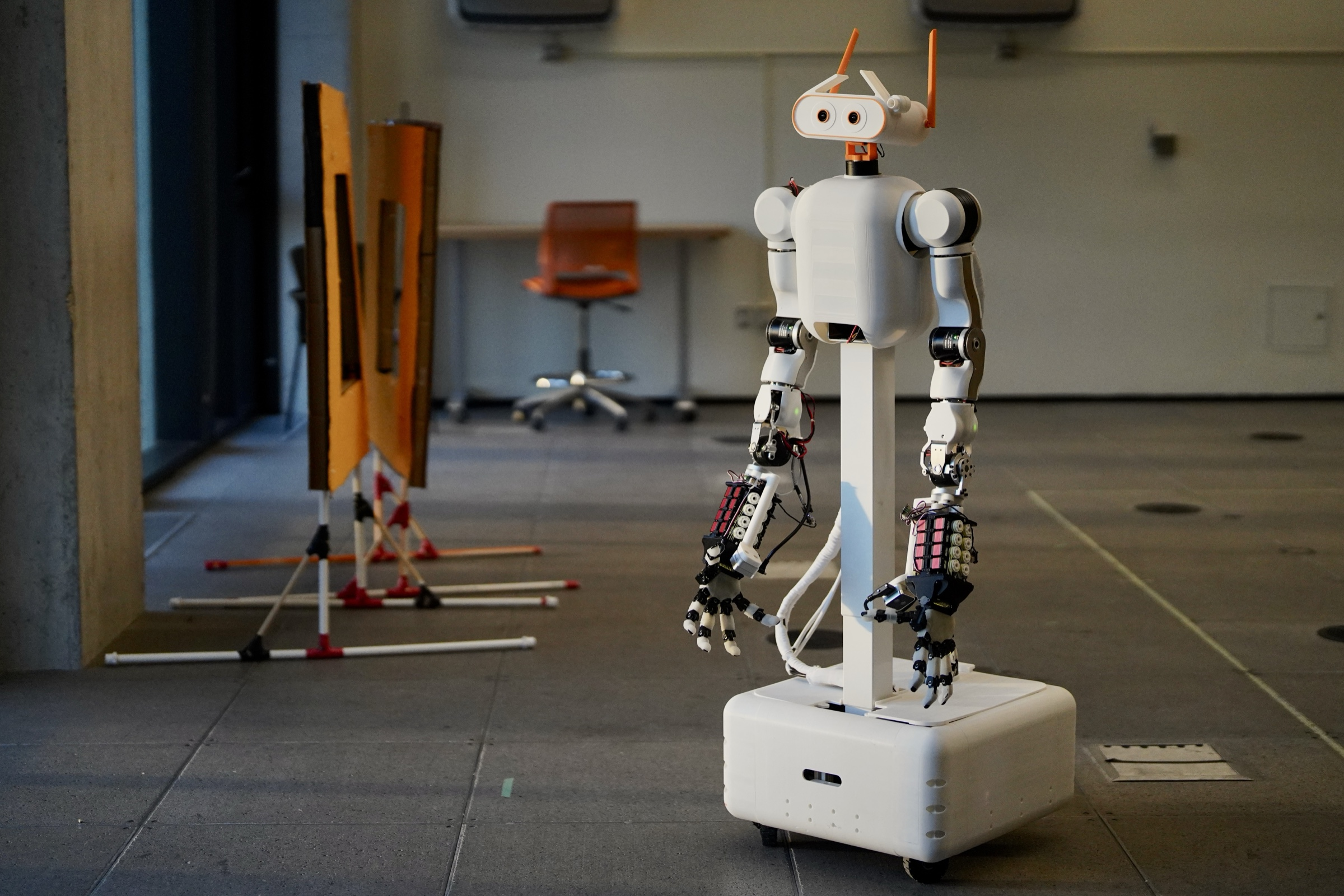
MABEL is built to move around, look in different directions, use two arms at once, and handle objects with human-like hands. The researchers wanted to create a capable robot that universities and laboratories could afford.
The robot costs about $8,100 in parts**. This is much cheaper than many similar commercial robots, which can cost between **$69,000 and $120,000.
2. What questions did the researchers want to answer?
The researchers mainly wanted to find out:
- Can they build an affordable robot that can move around and work with objects at different heights?
- Can one robot combine two arms, dexterous hands, a moving body, cameras, and a mobile base?
- Can a person control the robot naturally without using many buttons or special controllers?
- Can demonstrations from a human operator be used to train the robot to perform tasks by itself?
- Is the robot accurate, safe, and fast enough for useful research?
In simple terms, they wanted to build a robot that could act like a person’s remote-controlled body and then learn from what the person did.
3. How did they build and test the robot?
The robot’s body
MABEL has 56 degrees of freedom. A degree of freedom is one way that a robot can move, such as bending an elbow, turning its head, or moving a finger. For comparison, a human body has many hundreds of possible movements.
MABEL includes:
- Two arms, each with seven movable joints
- Two hands with many finger joints
- A torso that can lean
- A lift that raises or lowers the upper body
- A neck that can move the camera
- A mobile base that can move in any direction
- Cameras on its head and wrists
Its arms can reach from near the floor to about 2.23 meters high.
The arms are back-drivable, meaning a person can gently push or move them by hand. This is useful because the robot does not fight against people during physical contact. It is similar to pushing a shopping cart that is designed to move easily instead of one with locked wheels.
Controlling the robot with a headset
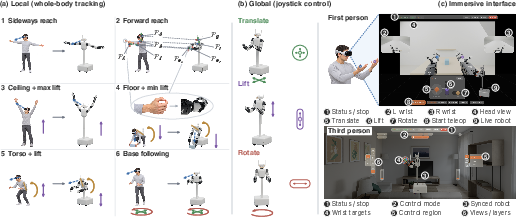
The researchers used an Apple Vision Pro headset. The headset tracks the operator’s head and hands. The operator sees video from MABEL’s cameras, so it feels as if they are looking through the robot’s eyes.
The system translates the operator’s movements into robot movements:
- Leaning forward can make the robot’s torso lean.
- Moving the operator’s hands moves the robot’s hands.
- Moving the operator’s head changes where the robot looks.
- Walking can make the robot’s mobile base move.
- Hand and finger movements control the robot’s fingers.
This translation process is called retargeting. It is like translating a person’s movements into instructions for a robot with different body proportions.
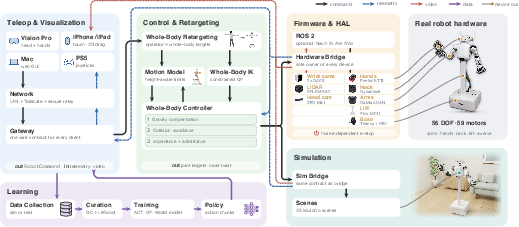
Because the robot has more moving parts than the headset directly measures, the researchers use mathematical calculations to choose safe robot movements. They also use a control system that avoids collisions and prevents the robot from moving beyond its joint limits.
Testing the robot
The researchers tested several parts of MABEL:
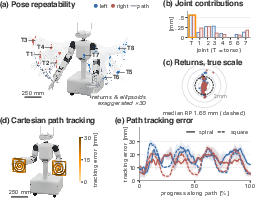
- Repeatability: whether the robot can return its hands to the same places repeatedly
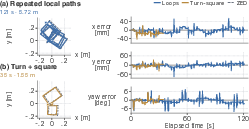
- Path following: whether its hands can follow shapes such as spirals and squares
- Wheel odometry: whether the robot can estimate how far it has moved
- Video delay: how long it takes for camera images to reach the operator
- Teleoperation: whether a person can perform household-style tasks
- Robot learning: whether the robot can learn a task from human demonstrations
They also created computer simulations, sometimes called a digital twin. A digital twin is a computer version of the real robot. Researchers can use it to test ideas without risking damage to the physical machine.
Finally, the researchers trained an AI system using imitation learning. This means the robot watches examples performed by a human and learns to copy them, similar to how someone might learn a sport by watching a coach.
4. What did they find?
The researchers reported several important results.
The robot is relatively accurate
When MABEL repeatedly moved its hands to specific positions, its typical error was about 1.65 millimeters. This is roughly the thickness of a few coins stacked together.
When following paths, its error was generally a few millimeters. The robot performed better when the researchers corrected for a small delay in its movement.
The mobile base worked well
The robot could move in any direction because of its special wheels. Its movement estimates differed from camera-based measurements by about 1–2 centimeters in the tests.
This level of accuracy was considered good enough for the teleoperation experiments.
The control system was responsive
The average delay between something happening in front of MABEL’s camera and the operator seeing it was about 137 milliseconds when using the robot’s own wireless hotspot.
A small delay is important. If the delay is too large, controlling the robot would feel confusing, like playing a video game with a slow internet connection.
The robot could perform whole-body tasks
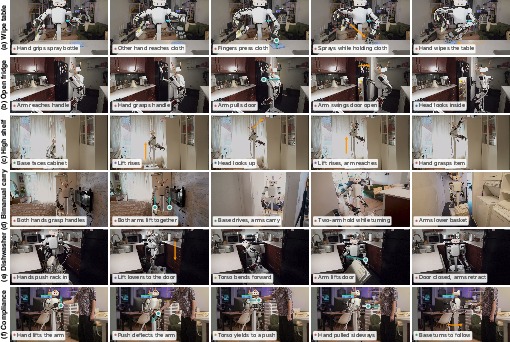
Human operators used MABEL to perform tasks involving:
- Moving its base
- Looking toward objects
- Raising and lowering its body
- Using both arms
- Opening or interacting with objects
- Making physical contact with its surroundings
The robot’s compliant arms and torso could be pushed and moved by a person and then return toward their intended positions.
The robot learned a pick-and-place task
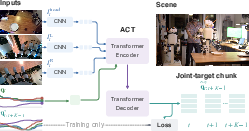
The researchers recorded 80 demonstrations, which they divided into 117 training episodes. The task was to pick up a small object and place it on a plate.
They trained an AI model called ACT, or Action Chunking with Transformers. Instead of predicting only the next movement, the model predicts a short sequence of future movements, like planning the next few steps in advance.
In 10 autonomous trials, the robot succeeded 8 times, giving an 80% success rate.
However, this experiment mostly tested the arms and hands. The robot’s base and lift did not move much during the task. Therefore, the experiment showed that the complete learning system worked, but it did not fully prove that MABEL could learn complicated mobile tasks.
5. Why are these results important?
MABEL combines many abilities that are usually found only in expensive robots:
- It can move around.
- It can reach low and high places.
- It has two arms.
- It has multi-fingered hands.
- It can move its head and cameras.
- It can safely interact with people.
- It can be controlled by human body movements.
- It can learn tasks from demonstrations.
The researchers also released the robot’s design files, software, electronics information, and simulation models. This means other laboratories can build, repair, modify, and improve the robot instead of depending completely on a company.
6. Limitations and possible future impact
MABEL is not perfect. Its lift is useful for changing height, but it moves more slowly than a more advanced robot body might. Its arms are also not exactly shaped like human arms, which can make movement translation less natural.
The learning experiment was fairly small and focused on one pick-and-place task. The robot still needs more testing for long, complicated tasks involving navigation, planning, and many different objects.
In the future, the researchers hope to improve MABEL by giving it:
- Faster and more natural body movements
- Better human-like arms
- The ability to create maps and navigate by itself
- Longer-term learning abilities
- Higher-level planning, such as deciding how to complete a whole household task
Conclusion
The paper presents MABEL as a relatively inexpensive, open robot that can move, see, use two hands, and learn from people. Its main achievement is not just building the robot, but connecting the entire process: a person can control it, demonstrations can be recorded, and an AI system can learn from those demonstrations.
If other researchers adopt and improve MABEL, it could make advanced robot research much more accessible. Instead of only wealthy companies and laboratories being able to work with complex robots, many more students and researchers could build and experiment with them.
Practical Applications
Immediate Applications
The paper’s released hardware, CAD, firmware, ROS 2 software, digital twins, teleoperation interface, and learning pipeline make several applications feasible immediately for research, prototyping, and controlled demonstrations. These uses depend on assembling the platform correctly, maintaining safe operating boundaries, and recognizing that the reported autonomy experiment was limited primarily to upper-body manipulation.
- Low-cost mobile-manipulation research platform — Robotics and academia
- Research laboratories can reproduce MABEL for approximately **US$8.1k in parts**, rather than purchasing a comparable commercial platform costing roughly US$69k–120k.
- The platform can support experiments in mobile manipulation, bimanual grasping, dexterous hands, active perception, compliant control, whole-body planning, and robot learning.
- The open CAD, electronics, firmware, ROS 2 stack, and simulation models enable laboratories to modify the robot rather than depending on a vendor.
- Assumptions and dependencies: access to fabrication tools, compatible actuators and sensors, engineering expertise, and willingness to handle safety, calibration, and maintenance. The stated cost excludes some optional sensors and associated labor.
- Teleoperated handling of household and laboratory objects — Robotics, logistics, and assistive technology
- Operators can remotely perform tasks such as grasping small objects, placing items on plates, opening doors, pushing and pulling objects, and interacting with objects at different heights.
- The 56-DOF body combines a holonomic base, lift, torso pitch, active neck, two arms, and dexterous hands, allowing operation from floor level to approximately 2.23 m.
- Potential workflows include remote laboratory handling, manipulation in cluttered indoor environments, and supervised operation in spaces that are inconvenient or unsafe for a human.
- Assumptions and dependencies: the operator must maintain visual awareness of the robot’s surroundings; the approximately 137 ms local stereo-video latency is suitable for controlled teleoperation but may be problematic for fast contact events or unstable environments.
- Immersive robot-avatar interfaces — Software, human–robot interaction, and telepresence
- The Apple Vision Pro interface can be used to control the robot through head and hand tracking without handheld controllers.
- The operator receives stereo video from the robot’s head camera, creating an egocentric “robot-as-avatar” experience.
- The same interface can be extended to iPhone, browser, and Pico headset clients, enabling experimental comparisons across input devices.
- Possible products include a reusable teleoperation client, a browser-based remote robotics dashboard, and a headset-based training or inspection system.
- Assumptions and dependencies: reliable headset tracking, adequate wireless connectivity, operator training, and the availability of an Apple Vision Pro or compatible client. The current retargeting method estimates unobserved body state from sparse head and hand measurements, so performance may vary across users and robot morphologies.
- Demonstration collection for imitation learning — Robotics and machine learning
- Researchers can collect synchronized head-camera, wrist-camera, joint-state, base, lift, and command data through the same control path used during policy execution.
- The released data format and LeRobot v3 export workflow can support datasets for bimanual manipulation and whole-body control.
- This is particularly useful for studying learning from demonstration, action chunking, multimodal observation fusion, and sim-to-real transfer.
- Assumptions and dependencies: successful learning requires sufficient task diversity, consistent demonstrations, reliable timestamp synchronization, and careful treatment of failures. The paper’s 80 demonstrations and 8/10 autonomous success rate validate the pipeline but do not establish broad generalization.
- Rapid prototyping of compliant manipulation — Robotics, manufacturing, and service automation
- The back-drivable arms and torso, combined with impedance control, can be used for low-force physical interaction, contact-rich manipulation, and kinesthetic-style correction of robot posture.
- Researchers can prototype tasks involving pushing, pulling, alignment, insertion, door interaction, and object repositioning without developing a new compliant-control stack from scratch.
- The collision-avoidance quadratic program and height-aware base limits provide a reusable safety layer for experiments.
- Assumptions and dependencies: compliant control does not eliminate collision or pinch hazards. Payloads, contact forces, actuator temperature, and the smaller three-module support polygon must remain within validated limits.
- Teaching and coursework in robotics — Education
- Universities can use MABEL as a shared platform for courses and laboratories covering inverse kinematics, Jacobians, impedance control, mobile-base kinematics, teleoperation, computer vision, ROS 2, simulation, and imitation learning.
- The MuJoCo and Isaac Lab models allow students to begin in simulation before operating the physical robot.
- A single command interface shared by simulation, teleoperation, and learned policies makes it possible to demonstrate the full pipeline from controller design to autonomous deployment.
- Assumptions and dependencies: institutions need adequate laboratory space, safety supervision, computing resources, and instructors capable of maintaining a high-DOF robot.
- Benchmarking and reproducible robotics research — Academia and public research
- The platform can serve as a common benchmark for comparing teleoperation methods, policy architectures, retargeting algorithms, active-perception strategies, and whole-body controllers.
- Reported reference measurements—approximately 1.65 mm median repeatability, centimeter-level odometry disagreement, and 137–150 ms local video latency—provide initial baselines for experimental comparison.
- The open hardware and software reduce ambiguity caused by proprietary robot interfaces.
- Assumptions and dependencies: meaningful comparisons require standardized hardware configurations, task definitions, sensor placement, data splits, and reporting protocols.
- Remote inspection and supervised maintenance — Industrial and infrastructure operations
- The stereo head camera, wrist cameras, active neck, mobility, and adjustable height can support remote visual inspection or supervised manipulation in indoor industrial environments.
- Example workflows include inspecting equipment from multiple viewpoints, reaching elevated components, moving lightweight items, or positioning tools under human supervision.
- Assumptions and dependencies: the current system is not demonstrated as an industrial safety-certified platform. Industrial deployment would require redundant sensing, certified emergency stops, localization, environmental protection, stronger payload validation, and integration with site safety procedures.
- Policy-development workflow for small-scale automation — Manufacturing, warehousing, and research laboratories
- Organizations can teleoperate a task, record the demonstration, train an ACT policy, and deploy the policy through the same whole-body controller.
- This enables rapid prototyping of repetitive pick-and-place tasks before investing in production-grade automation.
- The modular wrist interface allows experiments with dexterous hands or simpler grippers depending on the task.
- Assumptions and dependencies: reliable production use requires substantially more demonstrations, robustness testing, handling of object and lighting variation, recovery behaviors, and monitoring for policy failure.
Long-Term Applications
The following applications are suggested by the platform’s capabilities but require additional research, safety engineering, larger datasets, or scaling beyond the demonstrations reported in the paper.
- Long-horizon household assistance — Service robotics and daily life
- A future system could perform multi-step activities such as tidying rooms, loading and unloading dishwashers, retrieving objects from shelves, opening cabinets, and moving objects between floor, table, and overhead locations.
- The combination of mobility, adjustable height, active gaze, bimanual dexterity, and compliant arms is well suited to tasks that exceed tabletop manipulation.
- Dependencies: long-horizon task planning, reliable navigation, scene understanding, recovery from errors, safe human coexistence, grasp generalization, and policies trained on substantially broader demonstrations. The paper’s learning experiment was limited to a small object-placement task with minimal base and lift movement.
- Assistive robotics for people with limited mobility — Healthcare and accessibility
- The robot could potentially retrieve objects, manipulate household items, or carry out tasks under direct user supervision through an immersive or simplified interface.
- Head and hand tracking could provide an alternative control channel for users who cannot operate conventional joysticks or leader arms.
- Dependencies: user-specific interfaces, accessibility studies, force and speed limits, fail-safe behavior, formal risk assessment, privacy protections, and clinical validation. A headset-only interface may not be suitable for all users.
- Remote operation in hazardous or inaccessible environments — Public safety, laboratories, and industrial inspection
- MABEL-like platforms could perform lightweight manipulation in contaminated, unstable, confined, or otherwise undesirable environments while a human remains at a safe distance.
- Applications could include laboratory containment areas, post-incident inspection, industrial plant walkthroughs, and remote handling of potentially hazardous objects.
- Dependencies: robust wireless communication, localization, environmental shielding, reliable teleoperation under degraded visibility, higher payload capacity where necessary, force sensing, and certified safety systems. The reported system uses local networking and is not validated for harsh environments.
- Shared-autonomy teleoperation — Robotics and human–robot collaboration
- A future controller could combine human commands with autonomous grasp selection, collision avoidance, base navigation, gaze control, and task-level assistance.
- The existing architecture already separates retargeting, whole-body control, simulation, and learned policy execution, which could support supervisory control rather than continuous manual operation.
- Dependencies: intention recognition, uncertainty estimation, transparent authority sharing, safe intervention mechanisms, and policies that can defer to the operator when uncertain.
- Large-scale open datasets for mobile bimanual manipulation — Machine learning and academia
- Multiple laboratories could build interoperable datasets using the platform’s shared joint representation, synchronized cameras, and LeRobot-compatible export.
- Such datasets could enable foundation models for mobile manipulation, cross-robot policy transfer, and systematic studies of embodiment variation.
- Dependencies: standardized metadata, consistent calibration, common task taxonomies, privacy and licensing policies, diverse environments and operators, and methods for handling differences in hands, sensors, payloads, and kinematics.
- Simulation-to-real development of whole-body policies — Robotics software and digital twins
- The full-body MuJoCo and Isaac Lab models could support reinforcement learning, domain randomization, planning, and pretraining before hardware deployment.
- Simulated camera and LiDAR streams could be used to develop navigation and active-perception policies without occupying the physical robot.
- Dependencies: accurate modeling of tendon-driven hands, actuator dynamics, contact mechanics, latency, friction, sensor noise, and cable or structural compliance. The paper provides a digital twin, but sim-to-real fidelity for complex dexterous contact remains to be established.
- Autonomous mobile manipulation with navigation and mapping — Warehousing, retail, and domestic robotics
- Integration of onboard localization and mapping could enable the robot to navigate between workstations, retrieve objects, and execute manipulation tasks across a building.
- The holonomic base may simplify lateral positioning near shelves, tables, and work cells.
- Dependencies: the paper identifies localization and mapping as future work. Reliable deployment requires obstacle avoidance, dynamic-agent tracking, map maintenance, battery management, recovery from wheel slip, and coordination between navigation and manipulation.
- Foundation-model task planning over learned skills — Robotics and AI systems
- A high-level model could decompose natural-language goals into reusable skills such as moving the base, adjusting the lift, directing the neck, grasping, placing, and opening objects.
- MABEL’s modular command interface could serve as the execution layer for such a planner.
- Dependencies: grounded task planning, reliable skill preconditions and postconditions, visual state estimation, uncertainty-aware execution, safe refusal, and protection against compounding errors over long task sequences.
- Next-generation anthropomorphic mobile robots — Robotics hardware
- The platform provides a low-cost foundation for replacing the lift with a faster folding body containing waist, knee, and ankle joints, and for using more anthropomorphic arms.
- Such changes could improve natural whole-body motion, operator retargeting, reachability, and locomotion over uneven environments.
- Dependencies: increased mechanical complexity, cost, energy consumption, control difficulty, and balance requirements. The current lift is slower but simpler and more affordable.
- Teleoperation standards and interoperable robot-control tools — Policy, industry, and open-source infrastructure
- The shared command interface, modular hardware, and released software could contribute to common interfaces for teleoperation, demonstration recording, simulation, and policy deployment.
- This could lead to reusable middleware, benchmark tasks, standardized demonstration formats, and interchangeable robot embodiments.
- Dependencies: community adoption, stable APIs, documentation, long-term maintenance, compatibility testing, and agreement on safety and dataset standards.
- Commercial products for supervised dexterous automation — Industry
- A mature derivative could become a lower-cost product for small warehouses, laboratories, elder-care facilities, or flexible manufacturing cells.
- Potential products include a mobile pick-and-place assistant, remote laboratory manipulator, telepresence inspection robot, or demonstration-to-automation kit.
- Dependencies: improved reliability, substantially longer battery and service life, higher payload or force capability, production-quality hardware, cybersecurity, regulatory compliance, warranties, and a clear total-cost-of-ownership advantage over conventional automation.
Glossary
- Active perception: The deliberate adjustment of sensors or viewpoints to obtain more informative observations. “a 3-DOF neck provides active perception”
- Action Chunking with Transformers (ACT): A learning method that predicts a sequence, or chunk, of future actions using a transformer model. “train and deploy a whole-body Action Chunking with Transformers (ACT) policy”
- Back-drivability: The property that an actuator or mechanism can be moved by external forces through its transmission. “Its actuators must also provide the torque to carry payloads and the back-drivability or torque feedback needed for compliant, contact-rich interaction.”
- Center of mass (CoM): The point representing the weighted average location of an object's mass. “base motion is limited by lift height and commanded velocity through a center-of-mass (CoM) tip-over model”
- Centipetal acceleration: Acceleration directed toward the center of circular motion. “$-\,\omega^2\Vector r_c$”
- Compliant control: Control that permits controlled yielding or adaptation when the robot encounters external forces. “Compliant control.”
- Computer-aided design (CAD): The use of computer tools to create precise models and designs of physical components. “The computer-aided design (CAD) files, firmware, Robot Operating System~2 (ROS~2) stack”
- Configuration space: The mathematical space whose coordinates represent the positions of a system's joints or other degrees of freedom. “The inverse kinematics (IK) problem for the seven arm joints and the hand's wrist joint”
- Damped Gauss–Newton method: An iterative optimization algorithm for nonlinear least-squares problems that adds damping to improve numerical stability. “The problem is solved by the damped Gauss--[ADDRESS] method”
- Digital twin: A computational model that reproduces the structure and behavior of a physical system. “the MuJoCo and Isaac Lab digital twin covering the full body”
- Degrees of freedom (DOF): The number of independent variables needed to describe a system's configuration. “an open-source anthropomorphic mobile bimanual robot with 56 degrees of freedom (DOF)”
- Dexterous manipulation: The use of multiple controllable degrees of freedom to perform precise object manipulation. “mobile and bimanual dexterous manipulation”
- Direct-drive actuator: An actuator that transfers motor torque to a mechanism with little or no intervening gearing. “A quasi-direct-drive torso provides to of pitch”
- Embodiment gap: The mismatch between the physical characteristics of an operator and those of a robot being controlled. “so that the embodiment gap small”
- Feedforward compensation: The use of a model-based predicted input to offset known effects such as gravity or friction before feedback correction. “Gravity feedforward had the largest effect”
- Field of view (FOV): The angular extent of a scene visible to a camera or sensor. “\ang{60} vertical field of view (FOV)”
- Full-stack integration: The integration of hardware, firmware, middleware, control, simulation, and learning software into one system. “an open-source, full-stack platform”
- Glass-to-glass latency: The elapsed time between an event being captured by a camera and its displayed representation appearing on a screen. “We measure glass-to-glass video latency”
- Gravity compensation: Control action that offsets the torques caused by gravitational forces. “under proportional--derivative ([ADDRESS]) control with gravity compensation”
- Holonomic base: A mobile base capable of moving independently in all planar directions, including sideways motion. “a holonomic mobile base”
- Impedance control: A control strategy that regulates the dynamic relationship between force and motion, often through virtual stiffness and damping. “The arms and torso track joint references using joint-space impedance control”
- Inverse kinematics (IK): The computation of joint configurations required to achieve a desired end-effector pose. “The inverse kinematics (IK) problem for the seven arm joints and the hand's wrist joint”
- Joint-space control: Control performed directly on robot joint positions, velocities, or torques rather than on Cartesian end-effector coordinates. “joint-space impedance control”
- Kinematic workspace: The set of positions or poses that a robot can reach based on its geometry and joint limits. “Kinematic fingertip workspace.”
- LiDAR: A sensing technology that measures distance using reflected laser pulses. “An optional base-mounted color-and-depth (RGB-D) camera and a light detection and ranging (LiDAR) sensor”
- Low-impedance control: Control configured with low virtual stiffness and damping so that the robot yields readily to external forces. “enabling low-impedance control and compliant physical interaction”
- Mobile manipulation: Robotic manipulation performed by a system that can reposition its mobile base while interacting with objects. “Mobile Manipulation, Full-stack Integration, Teleoperation, Whole-Body Control, Robot Learning.”
- Nonholonomic: Describing a system whose instantaneous motion is subject to constraints that prevent arbitrary movement in all directions. “Mobile ALOHA added a nonholonomic base”
- Omnidirectional mobility: The ability of a mobile robot to move in any planar direction without first changing its orientation. “a three-module swerve base provides omnidirectional mobility”
- Optical flow: The apparent motion of image features caused by relative motion between a camera and the observed scene. “The camera dominates, contributing 101--108~ms on every route”
- Pose retargeting: The transformation of tracked human or device poses into corresponding robot commands. “head and hand tracking alone is retargeted into whole-body motion”
- Proportional–derivative (PD) control: Feedback control that combines terms proportional to position error and velocity error. “under proportional--derivative ([ADDRESS]) control with gravity compensation”
- Quadratic program (QP): An optimization problem with a quadratic objective and linear constraints. “QP: quadratic program.”
- Quasi-direct drive: An actuator architecture using a low-ratio transmission intended to preserve high back-drivability and torque transparency. “A quasi-direct-drive torso provides to of pitch”
- Redundancy: The presence of more controllable degrees of freedom than are strictly required for a task. “The Vision Pro tracks only the head, wrists, and 27 keypoints per hand, while [PERSON_NAME] has 56 DOF, so retargeting is ill-posed”
- Retargeting: The process of mapping motion captured from one body or device to the corresponding motion of another body or robot. “We estimate a reduced operator state and map each part to the joints that reproduce it.”
- Root mean square (RMS): A statistical measure equal to the square root of the mean of squared values, commonly used for error magnitude. “Geometric path error ranges from \SIrange{3.7}{6.7}{mm} RMS”
- Swerve drive: A mobile-drive mechanism in which each wheel module can independently steer and provide propulsion. “Three non-collinear swerve drives provide holonomic motion”
- System identification: The process of estimating a system's physical or dynamic parameters from observations and measurements. “Because system identification keeps model errors small”
- Teleoperation: The remote control of a robot by a human operator. “Whole-body teleoperation interfaces.”
- Tendon-driven: Describing a mechanism in which remote actuators transmit force through flexible tendons to move joints. “Each arm carries a 17-DOF tendon-driven ORCA hand”
- Tip-over model: A model that estimates the conditions under which a robot may lose stability and overturn. “through a center-of-mass (CoM) tip-over model”
- Torque feedback: Measurement or estimation of the torque produced at or applied to a robot joint. “the back-drivability or torque feedback needed for compliant, contact-rich interaction”
- Trajectory tracking: The process of controlling a system so that it follows a desired time-varying path. “For path following, both palms trace mirrored \SI{10}{cm}-radius spirals”
- Unified Robot Description Format (URDF): A standardized XML-based format for representing a robot's links, joints, geometry, and physical properties. “AhaRobot and OpenPyRo-A1 releasing Unified Robot Description Format (URDF) files”
- Visual-inertial odometry: Estimation of motion by combining camera observations with inertial-measurement data. “the ZED camera's visual-inertial position and inertial measurement unit (IMU) heading”
- Whole-body control: Coordinated control of multiple robot subsystems and degrees of freedom as one integrated body. “one compliant whole-body controller shared by teleoperation, simulation, data collection, and learned policies”
- Zero-moment point (ZMP): A stability criterion identifying the point on the support surface where the net moment from inertial and gravitational forces is zero. “The zero-moment-point (ZMP) approximation”

