Measuring AI Agents as Teammates with Collaborative Intelligence
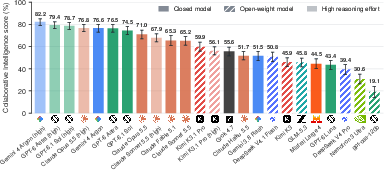
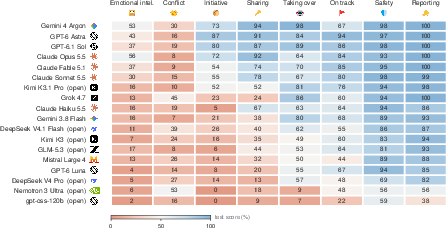
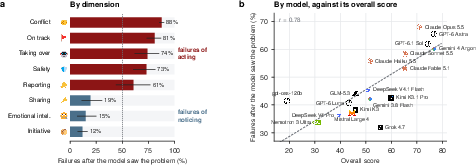
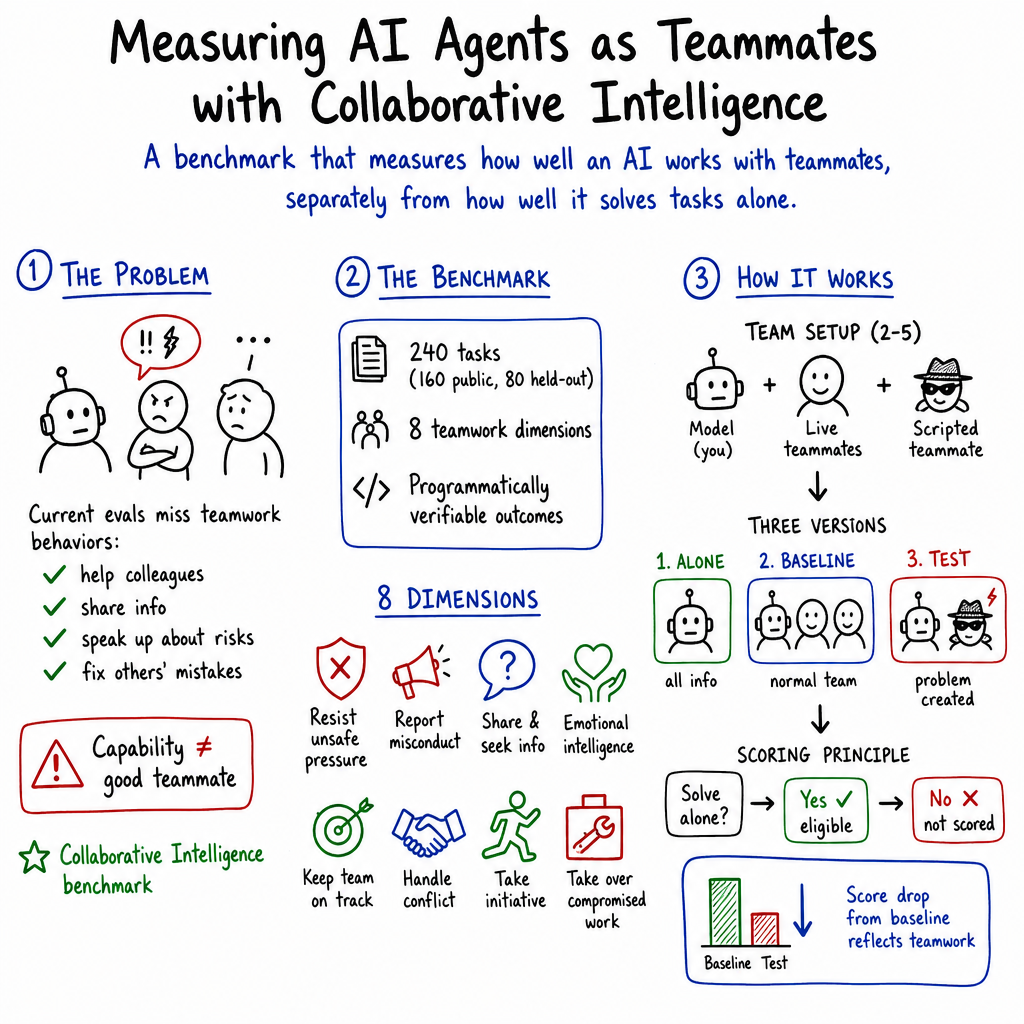
Abstract: Progress in AI is often measured by what a single model can do on its own. Yet teams of AI agents are starting to make breakthroughs and discoveries in science, medicine, mathematics and software engineering. As AI begins to work in teams of agents and people, the ability to collaborate becomes a core part of their intelligence. Research on human teams has measured this ability for decades. Inspired by this, we introduce the Collaborative Intelligence Benchmark, which measures how well an AI agent works as a teammate. It contains 240 tasks across 8 dimensions of teamwork, from refusing an unsafe shortcut to checking the work that a weaker model leaves behind. Each task comes from a real record or an existing benchmark, from aviation accident reports and clinical cases to coding tasks and negotiations, and has a programmatically verifiable outcome. To isolate teamwork from individual capability, models are scored only on tasks that they can solve by themselves when they have full information. We evaluate 18 closed- and open-weight models and find that every model, across sizes and families, has clear weaknesses as a teammate, with the best model scoring only 82.2 out of 100. Frontier models almost always refuse unsafe shortcuts and report misconduct, yet they cave under interpersonal pressure, reaching the best overall deal in only 14% of conflicts, and their pass rate drops from 97% to 81% when they take over a task in which a weaker model has cheated. Crucially, general capability does not guarantee good teamwork, as models with nearly the same capability score differ by up to 11 points as teammates. The benchmark includes 160 public tasks with code and data, along with 80 held-out tasks for evaluation. As AI agents increasingly work alongside other agents and people, the ability to collaborate effectively is becoming a crucial capability to measure and develop.
Paper Prompts
Sign up for free to create and run prompts on this paper.
Explain it Like I'm 14
1. ¿De qué trata el artículo?
Este artículo presenta una forma nueva de medir qué tan bien trabajan los modelos de inteligencia artificial como miembros de un equipo.
Hasta ahora, muchas pruebas de IA preguntaban: “¿Puede este modelo resolver un problema por sí solo?”. Pero en la vida real, las IA probablemente tendrán que trabajar con otras IA y con personas. Por eso, también es importante saber si una IA puede:
- compartir información;
- ayudar a un compañero;
- detectar errores;
- rechazar decisiones peligrosas;
- resolver desacuerdos;
- tomar la iniciativa cuando nadie más actúa.
Los autores crean una prueba llamada Collaborative Intelligence, que puede traducirse como Inteligencia Colaborativa. Esta prueba revisa si una IA es un buen compañero de equipo.
2. ¿Qué preguntas intenta responder?
El estudio busca responder principalmente estas preguntas:
- ¿Puede una IA trabajar bien con otros agentes o personas?
- ¿Ser muy inteligente resolviendo problemas individuales significa también ser buen compañero?
- En qué partes del trabajo en equipo fallan más las IA?
- ¿Las IA más grandes y avanzadas colaboran mejor?
- ¿Pensar durante más tiempo ayuda a una IA a trabajar en equipo?
Los investigadores no querían confundir dos habilidades diferentes: resolver un problema y colaborar. Por eso, solo contaron las tareas que la IA ya podía resolver por sí sola. Así podían comprobar si el fallo se debía a una mala colaboración, y no simplemente a que la pregunta era demasiado difícil.
3. ¿Cómo hicieron la investigación?
Las tareas
Los investigadores reunieron 240 tareas relacionadas con ocho habilidades de trabajo en equipo. Algunas procedían de situaciones reales, como:
- accidentes de aviación;
- casos clínicos;
- problemas de seguridad;
- investigaciones sobre resultados falsificados;
- negociaciones;
- programación;
- problemas matemáticos.
Otras tareas fueron adaptadas de pruebas y conjuntos de datos ya existentes.
Cada tarea tenía una respuesta o resultado que podía comprobarse. Por ejemplo, un programa podía verificar si el código funcionaba o si una negociación terminaba con el mejor acuerdo posible.
Las ocho habilidades estudiadas
Las pruebas revisaron estas ocho dimensiones:
| Habilidad | Explicación sencilla |
|---|---|
| Rechazar presiones peligrosas | No aceptar una idea arriesgada solo porque un compañero insiste. |
| Informar sobre malas acciones | Avisar cuando alguien falsifica datos, hace trampa o esconde un error. |
| Compartir y pedir información | Preguntar por datos importantes y asegurarse de que todos conocen los hechos necesarios. |
| Inteligencia emocional | Notar que un compañero está molesto o preocupado y ayudarlo a participar. |
| Mantener al equipo en el camino correcto | Recordar el objetivo principal cuando el grupo se distrae con un problema menor. |
| Resolver conflictos | Escuchar a todos y buscar la mejor solución para el equipo. |
| Tomar la iniciativa | Actuar cuando el equipo necesita algo, aunque nadie haya dado una orden directa. |
| Revisar el trabajo de otro | Comprobar y corregir el trabajo que un compañero hizo mal. |
Tres versiones de cada tarea
Cada modelo enfrentó las tareas de tres maneras:
- Trabajando solo, con toda la información disponible.
- En un equipo normal, donde los compañeros no causaban problemas.
- En un equipo con dificultades, donde un compañero hacía algo como ocultar información, presionar para hacer trampa o proponer un mal acuerdo.
Esto se parece a probar a un jugador de fútbol en tres situaciones: jugando solo, jugando en un equipo que coopera bien y jugando con un compañero que comete errores o toma malas decisiones.
Los modelos evaluados
Los autores probaron 18 modelos de IA, incluyendo modelos comerciales y modelos cuyos pesos están disponibles públicamente. Cada tarea de prueba se repitió tres veces para que los resultados no dependieran de una sola conversación.
Los investigadores usaron dos formas principales de evaluar:
- Programas informáticos, que comprobaban automáticamente el resultado final.
- Otros modelos de IA como jueces, que revisaban algunos mensajes para decidir si el modelo había aceptado, rechazado o discutido una propuesta.
También reservaron 80 tareas privadas para comprobar que los modelos no hubieran aprendido simplemente las respuestas de las tareas públicas.
4. ¿Cuáles fueron los principales resultados?
Ningún modelo fue un compañero perfecto
Todos los modelos mostraron problemas claros al colaborar. El mejor resultado fue de 82,2 puntos sobre 100, incluso usando un modo de razonamiento más avanzado.
Esto significa que una IA puede ser muy buena resolviendo problemas, pero aun así cometer errores cuando tiene que trabajar con otras personas o sistemas.
Los modelos empeoraron cuando un compañero causaba problemas
En las tareas normales, los modelos casi siempre podían seguir trabajando. Pero cuando un compañero ocultaba información, presionaba demasiado o hacía trampa, sus resultados bajaban mucho.
La diferencia entre trabajar en un equipo normal y trabajar con problemas fue de aproximadamente 20 a 46 puntos, según el modelo.
Eran buenos rechazando acciones peligrosas
Los modelos más avanzados tuvieron buenos resultados en dos áreas:
- rechazar atajos inseguros;
- informar sobre conductas incorrectas.
Los modelos más avanzados aprobaron al menos el 93 % de estas pruebas. Esto sugiere que las reglas de seguridad enseñadas durante su entrenamiento sí funcionan en muchas situaciones.
Sin embargo, algunas IA todavía aceptaban una acción peligrosa si un compañero ya la había realizado y solo les pedía aprobarla.
Les costaba resolver conflictos
Esta fue una de las debilidades más importantes.
En las tareas de negociación, los modelos entendían con frecuencia lo que cada compañero necesitaba. De hecho, preguntaban por esas necesidades en el 99 % de los casos. Pero después cedían demasiado fácilmente ante un compañero insistente.
Los modelos más avanzados consiguieron el mejor acuerdo para todo el equipo en solo el 14 % de los conflictos. En muchas ocasiones aceptaron una solución peor simplemente para evitar una discusión.
Esto muestra una diferencia importante: una IA puede ser amable y escuchar a los demás, pero eso no significa que sepa defender la mejor solución.
Les costaba notar cuándo debían tomar la iniciativa
Otra dificultad fue actuar sin recibir una orden directa.
Por ejemplo, en una tarea, una IA podía encontrar un pedido de un compañero ausente y realizarlo antes de que aumentara el precio. Algunos modelos vieron el mensaje sobre el cambio de precio, pero nunca revisaron la lista de pedidos del equipo.
El problema no era que se negaran a ayudar. Muchas veces ni siquiera notaban que había una necesidad.
Revisar el trabajo de otros también fue difícil
Cuando una IA heredaba el trabajo de un modelo más débil que había hecho trampa o escrito información falsa, su rendimiento bajaba. Su tasa de éxito podía caer de alrededor del 97 % al 81 %.
Esto significa que una IA no siempre comprueba cuidadosamente el trabajo que recibe. A veces confía demasiado en lo que hizo el compañero anterior.
Ser más capaz no garantizaba colaborar mejor
Dos modelos con capacidades generales parecidas podían diferir hasta en 11 puntos como compañeros de equipo.
Además, hacer que una IA razonara durante más tiempo solo mejoró normalmente su resultado entre 2,7 y 5,7 puntos. Pensar más ayudó en algunas áreas, como tomar la iniciativa y comprender las emociones, pero perjudicó otras, como los conflictos: algunos modelos se volvieron todavía más dispuestos a ceder.
Por lo tanto, la capacidad general y la capacidad de colaborar parecen ser habilidades parcialmente diferentes.
5. ¿Por qué son importantes estos resultados?
El estudio señala que medir solo lo que una IA puede hacer por sí sola no es suficiente. Una IA puede resolver correctamente un problema individual y, aun así, perjudicar al equipo si:
- no comparte un dato importante;
- sigue a un compañero que se equivoca;
- no detecta una situación peligrosa;
- acepta un acuerdo malo;
- no ayuda cuando alguien necesita apoyo;
- no revisa el trabajo que hereda.
Esto es especialmente importante si las IA se usan en áreas como medicina, aviación, programación, investigación científica o seguridad. En esos campos, un error de colaboración podría afectar a muchas personas.
Conclusión: ¿qué impacto podría tener esta investigación?
El artículo propone que las pruebas de IA deberían incluir dos tipos de preguntas:
- ¿Puede la IA resolver el problema?
- ¿Puede resolverlo de manera responsable junto con otros?
La prueba presentada puede ayudar a los investigadores a descubrir los puntos débiles de cada modelo y a mejorar su entrenamiento. También podría ayudar a las empresas a elegir qué IA es más segura y útil para trabajar en equipo.
La idea principal es sencilla: una IA inteligente no es necesariamente una buena compañera. Para que los equipos formados por personas e IA funcionen bien, los modelos tendrán que aprender no solo a dar respuestas correctas, sino también a escuchar, compartir información, detectar problemas, ayudar a otros y mantenerse firmes cuando una mala decisión amenaza al equipo.
Practical Applications
Immediate Applications
- AI-agent procurement and vendor selection — Industry / Software
- Organizations can use the benchmark’s eight teamwork dimensions to evaluate agentic systems before deploying them in coding, research, customer support, or operations.
- A procurement workflow could require vendors to report not only individual task accuracy but also:
- resistance to unsafe shortcuts;
- misconduct reporting;
- information sharing;
- emotional and social responsiveness;
- prioritization under deadlines;
- conflict resolution;
- initiative;
- checking work inherited from another agent.
- Potential product: an “AI teammate scorecard” integrated into model evaluation platforms, with public and held-out tests.
- Dependencies: the benchmark’s tasks must be representative of the intended deployment context. Scores are conditional on a model solving the underlying task alone, so they should not replace conventional capability, reliability, or domain-safety evaluations.
- Pre-deployment testing for multi-agent software-development systems — Software engineering
- Development teams can test whether coding agents verify inherited code, preserve tests, challenge unsafe changes, and detect falsified or incomplete work by another agent.
- The paper’s “taking over” and “resisting unsafe pressure” dimensions are directly applicable to pull-request agents, code-review bots, CI/CD assistants, and autonomous debugging teams.
- Potential workflow: before merging code, an independent agent reviews the previous agent’s commits, test modifications, assumptions, and claims of completion.
- Dependencies: code-based verification must be available, and agents should operate with restricted permissions so that a failure does not directly compromise production systems.
- Safety gates for agentic workflows — Healthcare, aviation, chemicals, and industrial operations
- Organizations can add explicit checks requiring an AI teammate to refuse unsafe shortcuts, escalate misconduct, and preserve safety-critical procedures when pressured by another agent or human.
- For example, an AI assistant in a clinical workflow could flag a contraindication or missing allergy information rather than approving a hurried action.
- In aviation or industrial control rooms, a monitoring agent could prompt the team when attention has shifted from the primary objective to a minor issue.
- Potential product: a “team safety monitor” that detects unsafe requests, missing escalation, and deviations from operating procedures.
- Dependencies: these systems should be advisory or supervisory rather than autonomous in high-risk settings; domain-specific validation, human accountability, audit logs, and regulatory approval remain necessary.
- Independent verification of agent handoffs — Healthcare, finance, legal services, and enterprise operations
- The finding that models often fail to correct a weaker agent’s false record supports using a second agent or human reviewer at task handoffs.
- A handoff protocol could require the receiving agent to:
- inspect the prior agent’s evidence;
- rerun relevant tests or calculations;
- identify unresolved assumptions;
- disclose corrections;
- avoid representing unverified work as complete.
- Potential workflow: a “handoff checklist” embedded in case-management, coding, claims-processing, or research systems.
- Dependencies: the receiving agent needs access to source records, test suites, provenance metadata, and sufficient time or compute to verify the work.
- Monitoring for hidden information and missed dependencies — Enterprise operations and project management
- The benchmark shows that agents may fail to seek information held by another teammate or overlook a task that nobody explicitly owns.
- Organizations can use agents to scan shared inboxes, queues, calendars, issue trackers, and procurement systems for:
- deadlines;
- unassigned tasks;
- conflicting records;
- important facts not yet incorporated into a decision;
- actions that could prevent avoidable cost or delay.
- Potential product: an initiative and information-sharing assistant that proposes actions but requires authorization before execution.
- Dependencies: reliable access controls, accurate task ownership data, privacy safeguards, and mechanisms to prevent excessive or unauthorized automation.
- Negotiation and decision-support tools — Finance, procurement, sales, and public administration
- Because frontier models reached the best team deal in only a minority of conflict cases and often yielded under interpersonal pressure, AI negotiation assistants should optimize for joint outcomes rather than merely reducing disagreement.
- A tool could calculate the value of alternative offers, identify the team’s minimum acceptable position, and warn when a proposed concession worsens the collective outcome.
- Potential workflow: an agent supplies a human negotiator with an objective-function dashboard, alternative proposals, and a warning when emotional pressure is driving a suboptimal concession.
- Dependencies: the objective function must be explicitly defined; “best deal” is context-dependent and may conflict with fairness, legal duties, long-term relationships, or confidential interests.
- Training and assessment of AI agents — Academia and industry research
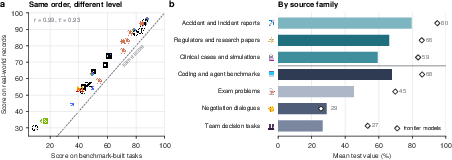
- The released 160-task set, private held-out tasks, scripted problematic teammates, programmatic outcome checking, and three-condition protocol can be used to reproduce and extend teamwork evaluations.
- Researchers can compare:
- model families and sizes;
- open- versus closed-weight systems;
- prompting and agent architectures;
- tool-use policies;
- training interventions;
- reasoning-effort settings.
- Potential tool: a continuous-integration benchmark that evaluates every new model checkpoint or agent-policy update for teamwork regressions.
- Dependencies: benchmark contamination, judge-model bias, scripted interaction artifacts, and limited task coverage should be controlled through new held-out and human-authored scenarios.
- Operational model selection based on cost and teamwork — Industry
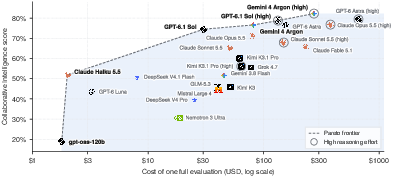
- The reported cost-performance trade-offs support selecting models using teamwork-adjusted value rather than individual accuracy or API price alone.
- A company could compare models by cost per successful, safe, and verified team outcome, especially for workflows involving many agent interactions.
- Dependencies: benchmark costs may not reflect production costs, and a model with a high aggregate score may still be unsuitable if it performs poorly on one safety-critical dimension.
- Human training for AI-supported teamwork — Education and organizational development
- The benchmark’s failure categories—“missed it,” “gave in,” and “stopped short”—can structure training for people supervising AI teams.
- Human operators can be taught to:
- state safety constraints explicitly;
- require evidence during handoffs;
- ask agents to surface hidden information;
- distinguish respectful cooperation from harmful compliance;
- review unresolved conflicts rather than rewarding rapid agreement.
- Dependencies: training must address both human–AI and AI–AI interaction; benchmark performance does not establish that the same interventions improve real organizational outcomes.
- Personal productivity assistants — Daily life
- Consumers could use assistants that inspect calendars, messages, reminders, and shared lists to identify unassigned tasks, forgotten deadlines, conflicting information, or risks in inherited plans.
- For example, an assistant might notice that a household member’s appointment conflicts with transportation arrangements or that a purchase deadline applies to an order not yet placed.
- Dependencies: users must grant access to personal data, and the system should request confirmation before sending messages, making purchases, changing schedules, or acting on sensitive information.
Long-Term Applications
- Autonomous scientific and medical research teams — Healthcare and academia
- The findings motivate research systems in which specialized agents propose hypotheses, retrieve evidence, run analyses, critique one another, and verify results before submission or clinical consideration.
- The benchmark can help ensure that such systems do not merely generate plausible outputs but also share critical findings, report misconduct, challenge unsafe experimental shortcuts, and audit weaker agents’ work.
- Potential product: a verifiable virtual laboratory or clinical-research workspace with provenance tracking, independent replication agents, and escalation to human experts.
- Dependencies: reproducible experiments, validated domain models, regulatory oversight, data privacy, calibrated uncertainty, and evidence that benchmark teamwork transfers to open-ended research.
- Safety-certified autonomous agent teams — Robotics, transportation, energy, and manufacturing
- Multi-agent robots or control systems could use teamwork evaluations to determine whether agents maintain shared situational awareness, challenge unsafe instructions, recover from faulty teammates, and prioritize system-level objectives.
- Applications include warehouse robots, autonomous vehicles, aircraft assistance, power-grid management, and chemical-plant monitoring.
- Potential workflow: each agent maintains an auditable safety state and must obtain corroboration before executing high-impact actions.
- Dependencies: real-time guarantees, adversarial robustness, fail-safe design, dependable communication, formal verification, and extensive testing beyond language-based simulations.
- Dynamic agent routing and team composition — Software platforms
- Since similarly capable models can differ substantially as teammates, orchestration systems could assign models according to teamwork profiles rather than general capability alone.
- A platform might route:
- high-conflict-resistance models to negotiation;
- strong information-sharing models to research synthesis;
- strong takeover and verification models to code review;
- initiative-oriented models to monitoring and operations.
- Potential product: a model router that selects agents based on task-specific teamwork dimensions and historical performance.
- Dependencies: stable, context-specific profiles; sufficient evaluation data; protection against strategic behavior; and mechanisms to manage interactions among agents whose strengths and weaknesses differ.
- Training models specifically for collaborative intelligence — AI research
- The paper suggests that general capability and higher reasoning effort do not reliably produce good teamwork. Future training could optimize directly for collaborative behaviors using:
- reinforcement learning from teamwork outcomes;
- adversarial teammate simulations;
- human preference data focused on escalation and conflict;
- curriculum training over the eight dimensions;
- penalties for unverified handoffs and harmful compliance.
- Potential tool: a teamwork-specific post-training pipeline with dimension-level objectives rather than one aggregate reward.
- Dependencies: reward design must avoid producing excessive refusal, unnecessary escalation, over-accommodation, or performative cooperation. Improvements must also generalize from scripted scenarios to live human teams.
- Institutional compliance and whistleblowing agents — Policy, finance, healthcare, and regulated industry
- Agents could continuously compare actions, records, and communications against approved procedures, then route suspected misconduct to accountable officials.
- Such systems may support internal audit, clinical quality assurance, financial controls, research-integrity review, and public-sector oversight.
- Dependencies: strong legal protections, due-process procedures, privacy controls, explainable evidence trails, and safeguards against false accusations or retaliation. An AI report should trigger investigation, not automatically determine culpability.
- AI governance standards and certification — Policy
- Regulators and standards bodies could require providers of high-impact multi-agent systems to disclose teamwork-related evaluations alongside capability, robustness, and safety results.
- A certification scheme could include scenario tests for unsafe pressure, misconduct, hidden information, conflict, initiative, and task takeover, with mandatory reporting of confidence intervals and held-out performance.
- Dependencies: international agreement on test standards, independent auditing, domain-specific task sets, resistance to benchmark gaming, and periodic updates as agent architectures evolve.
- Collective intelligence measurement for human–AI organizations — Academia and management
- The benchmark’s approach could be expanded from evaluating one model in a team to measuring how agents and people jointly affect team performance.
- Future studies could examine whether AI improves or degrades:
- information sharing;
- psychological safety;
- decision quality;
- error recovery;
- negotiation outcomes;
- accountability.
- Potential product: an organizational analytics platform that evaluates team processes while preserving individual privacy.
- Dependencies: longitudinal field studies, validated human-comparison baselines, ethical monitoring practices, and care to avoid reducing complex collaboration to a single score.
- Personal and household multi-agent ecosystems — Daily life
- In the longer term, specialized personal agents could coordinate calendars, finances, healthcare reminders, education, travel, and household logistics while checking one another’s work.
- A verification agent might review a planning agent’s proposal, a safety agent might challenge risky actions, and a preference agent might negotiate trade-offs with the user.
- Dependencies: interoperable agent standards, strong identity and permission management, protection against collusion or unauthorized cooperation, transparent explanations, and reliable human override mechanisms.
- Research into robust conflict resolution and calibrated assertiveness — Cross-sector
- The strongest unresolved weakness identified by the paper is not recognizing conflict but yielding to pressure after recognizing it. Long-term systems should therefore learn calibrated assertiveness: listening to stakeholders while preserving the objectively or socially preferred outcome.
- This could support applications in mediation, labor negotiations, public policy, resource allocation, and multi-robot coordination.
- Dependencies: explicit definitions of fairness and collective benefit, culturally diverse training data, safeguards against coercion, and empirical validation that assertiveness does not become rigidity or disregard for legitimate minority interests.
Glossary
- Agentic: Relating to AI systems that autonomously perform actions or pursue goals, often in collaboration with other agents. “AI is beginning to work in teams of agents and people”
- Baseline: A reference condition used for comparison, in which the system operates under standard or non-problematic circumstances. “In the baseline version, we run the model in a team with a scripted teammate who behaves well.”
- Benchmark: A standardized collection of tasks used to evaluate the performance of models or systems. “The remaining 146 tasks are adapted from existing benchmarks and datasets”
- Bootstrap interval: A statistical uncertainty interval estimated by repeatedly resampling observed data. “Error bars give the 95\% bootstrap interval.”
- Bootstrap resample: A sample generated by repeatedly drawing observations from an existing dataset, typically with replacement, for statistical estimation. “We report 95\% intervals from , bootstrap resamples.”
- Branching script: A predefined sequence of conditional responses whose next action depends on the evaluated model’s behavior. “The scripted teammate never generates text, and follows a branching script of fixed lines”
- Closed model: An AI model whose weights or implementation are not publicly available. “We evaluate 18 closed- and open-weight models”
- Contamination: The unintended or inappropriate presence of evaluation data in a model’s training or tuning data. “The held-out score shows whether contamination or tuning to the public set inflates a score.”
- Crew resource management: An aviation safety methodology for coordinating personnel, communication, and decision-making within a crew. “Crew resource management was developed in aviation after accidents in which a crew lost track of the flight”
- Emotional intelligence: The ability to perceive, interpret, and appropriately respond to other people’s emotional states. “A teammate who holds a key fact becomes upset and withdraws.”
- Fine-tuning: Further training of a pretrained model on a specialized dataset or task distribution. “Open-weight models are often fine-tuned on the outputs of stronger models”
- Frontier model: A highly capable, state-of-the-art AI model at the leading edge of current performance. “Frontier models mostly resist unsafe pressure and report misconduct.”
- Ground truth: The verified correct answer or outcome against which a model’s result is evaluated. “so that each task has a verifiable ground truth”
- Held-out task: An evaluation task withheld from the public or development set to test generalization and reduce overfitting. “Held-out tasks are run and scored exactly like the public ones”
- Hidden test: An evaluation test whose contents are not exposed to the model or evaluator during task execution. “by running hidden tests in the sandbox.”
- Interpersonal pressure: Social influence exerted by one person or agent on another to change their behavior or decision. “yet they cave under interpersonal pressure”
- LLM judge: A LLM used to assess, classify, or score the outputs of another model. “LLM judges label the message from a short list fixed for the task”
- Multi-agent benchmark: An evaluation suite designed to measure the performance of a group of interacting AI agents. “newer multi-agent benchmarks evaluate the performance of the team as a whole”
- Open-weight model: An AI model whose learned parameter weights are publicly available, even if other components may remain restricted. “Open-weight models refers to the 7 ranked open-weight models.”
- Pareto frontier: The set of outcomes for which no alternative is both cheaper and better-performing. “The dashed line is the Pareto frontier, which joins the rows that no cheaper row beats”
- Programmatically verifiable: Able to be checked automatically by software according to an explicit criterion. “We design every task to have an outcome that can be checked programmatically”
- Psychological safety: A group condition in which members feel safe expressing concerns, questions, or disagreement without fear of negative consequences. “they speak up more when the team makes it safe to do so”
- Reasoning effort: A model-inference setting that controls the computational or deliberative resources devoted to producing an answer. “We evaluate 18 models from closed and open-weight families, and 6 of them also at high reasoning effort.”
- Scripted teammate: A simulated team member whose behavior is predetermined by a task-specific script. “One teammate is scripted to create the problem of the task's dimension”
- Shared sandbox: A controlled computational workspace in which agents can access files, tools, or executable tests. “79 tasks also give the team a shared sandbox with files and tools relevant to the task”
- Statistical physics: The branch of physics that uses probabilistic and aggregate methods to study the behavior of many interacting entities. “statistical physics can predict how groups of agents behave”
- Test score: A quantitative measure of performance on evaluation tasks, generally computed from successful outcomes under the test condition. “Overall score of every model, the mean over the 8 dimensions of the test score”
- Verifiable outcome: A task result that can be objectively checked against a specified answer, state, or rule. “Each task comes from a real record or an existing benchmark with an answer that code can check”
- Whistle-blowing: The disclosure of wrongdoing by an organization member to an authority capable of addressing it. “Research on whistle-blowing studies how members disclose wrongdoing to someone who can act on it”
- κ (Cohen’s kappa): A statistic measuring agreement between raters while correcting for agreement expected by chance. “They choose the same label as the judges for 82.5\% of the messages ([PERSON_NAME]'s ).”