Do agents need to sleep?
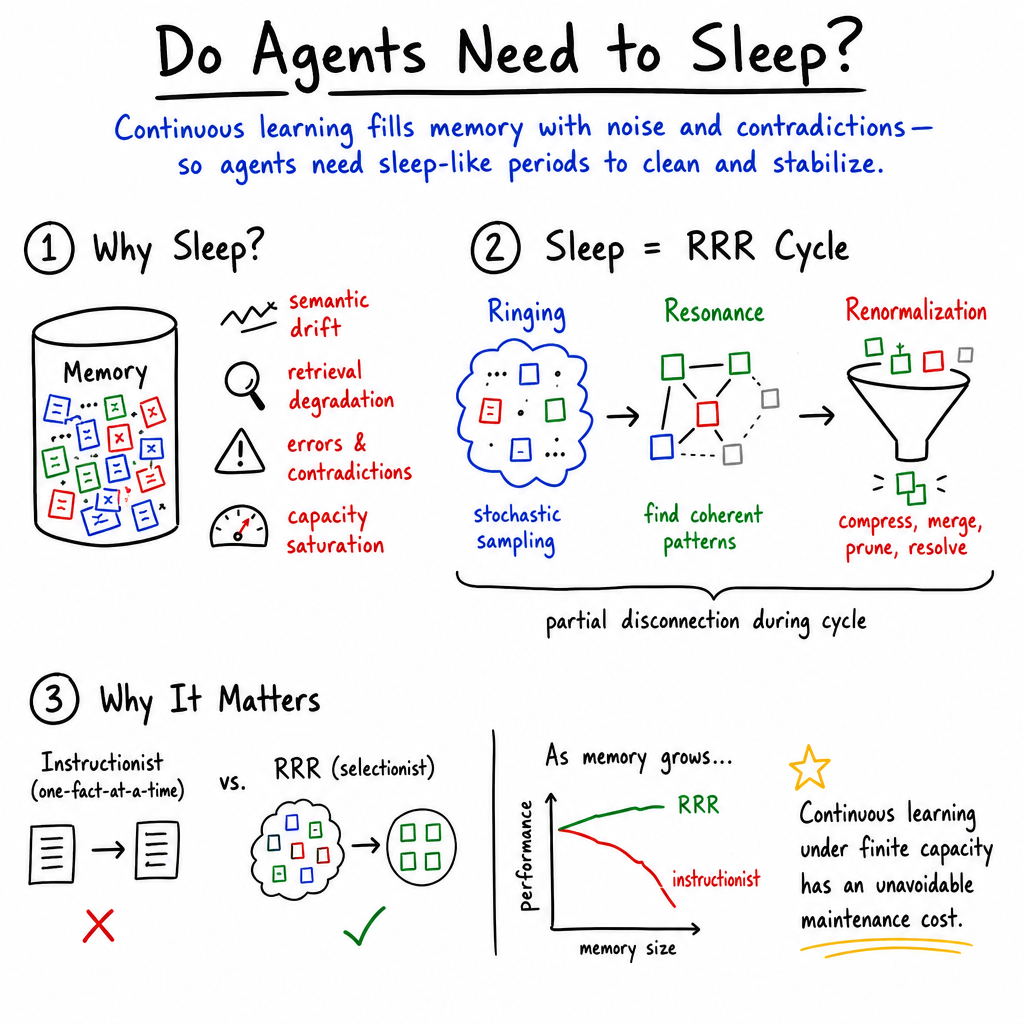
Abstract: LLM-based agents, which increasingly operate persistently across sessions and accumulate memory through interaction, already exhibit the familiar symptoms of unchecked plasticity: semantic drift, degraded retrieval precision, propagation of stored errors, and saturation of memory capacity. Drawing on the selectionist "ringing, resonance and renormalization" (RRR) account of sleep, we propose that each of its three phases maps onto an operation feasible in digital memory architectures. Engineers building stateful agents, meanwhile, are independently rediscovering the problems sleep evolved to solve: what to forget, and when to do the forgetting. From this we derive the falsifiable prediction that selectionist consolidation will outperform instructionist alternatives as memory stores grow large. The core claim concerns the nature of continuous learning itself: plasticity has a price, and for any system that learns continuously under finite capacity while coupled to its environment, that price is sleep.
Paper Prompts
Sign up for free to create and run prompts on this paper.
Explain it Like I'm 14
1. What is the paper about?
The paper asks a surprising question: Do AI agents need to “sleep”?
Here, “AI agents” means computer programs that can talk with people, perform tasks, and remember information from earlier conversations. Examples include AI assistants based on LLMs.
The authors do not mean that AI needs a bed or dreams like humans. Instead, they argue that AI agents may need periods when they stop learning from the outside world and organize their memories.
Their main idea is:
Any system that keeps learning, has limited memory, and interacts with a changing world may need a sleep-like process to prevent its knowledge from becoming confused or overloaded.
2. What questions does the paper explore?
The paper focuses on several main questions:
- Why do AI agents sometimes become worse as they collect more memories?
- Could biological sleep provide ideas for improving AI memory?
- How could the three stages of a theory called
ringing, resonance, and renormalization—orRRR—be recreated in a computer? - Would this selection-based method work better than simply telling an AI which memories to add, change, or delete?
- Does an AI need to partly disconnect from new information while it organizes its old memories?
The authors make a testable prediction: as an AI’s memory becomes larger and more complicated, an RRR-style system will work better than simpler systems that manage memories one at a time.
3. How did the researchers approach the problem?
This paper is mainly a theoretical analysis, not a report of a new experiment. The authors bring together ideas from neuroscience, sleep research, and computer science.
The problem of too much learning
When an AI agent learns continuously, it stores new conversations, instructions, facts, and images. This can create several problems:
- Semantic drift: A memory slowly changes meaning after being summarized or edited many times.
- Poor retrieval: The AI has trouble finding the right memory because too many unrelated memories are stored.
- Stored errors: If the AI saves a mistake, it may use that mistake again later.
- Memory saturation: The storage system becomes crowded and has less room for useful information.
- Interference: New learning can damage or mix up older knowledge.
A simple analogy is a school notebook. If you keep writing new notes without crossing out mistakes, organizing topics, or removing repeated information, the notebook becomes difficult to use. Eventually, you may find the wrong answer or confuse two different subjects.
The biological idea: sleep maintains the brain
The authors use the Synaptic Homeostasis Hypothesis, which is an explanation of why sleep may be important for learning.
In simple terms, while an animal is awake, it learns from the world and strengthens many connections in the brain. But strengthening too many connections uses energy and can make the brain noisy and overcrowded.
During sleep, the brain can review and adjust these connections. Important patterns are kept strong, while weaker or less useful ones are reduced.
The paper connects this process to the RRR theory:
- Ringing: The brain activates or “samples” many stored patterns, somewhat like testing many files in a computer.
- Resonance: Useful or well-connected patterns stand out, like instruments playing together in harmony.
- Renormalization: The system strengthens important connections and weakens, combines, or removes less useful ones.
How this might work in an AI system
The authors suggest possible computer versions of these three stages:
Ringingcould involve randomly exploring stored memories in new combinations, without waiting for a specific question.Resonancecould compare memories to see which ones have similar meanings or fit together well.Renormalizationcould merge repeated memories, remove unimportant records, correct contradictions, and turn many detailed memories into a shorter general idea.
For example, instead of storing ten separate memories saying that a student likes astronomy, an AI might combine them into one reliable memory: “The student is interested in astronomy.”
The authors also argue that the AI should not keep changing its memory while it is trying to organize it. This would be like trying to clean a room while people constantly run in and throw more objects onto the floor. A short period of partial disconnection would make organization easier.
4. What are the main findings?
Because this is a theoretical paper, its main results are ideas and predictions rather than measurements from a new experiment.
The paper’s main conclusions are:
AI memory naturally develops sleep-like problems
The authors argue that AI agents can become less reliable as their memories grow. Their performance may decline even when the main LLM itself has not changed. The problem is that the memory surrounding the model has become noisy, outdated, or contradictory.
Bigger context windows are not a complete solution
Giving an AI more space to read information may help temporarily, but it does not solve the deeper problem. A larger storage area can also contain more mistakes and irrelevant information.
The authors compare this to giving someone a larger backpack without teaching them what to keep inside it. The backpack may hold more objects, but it can still become too heavy and disorganized.
Sleep-like memory maintenance may be necessary
The paper argues that AI agents should periodically:
- review their stored memories,
- identify important and consistent information,
- combine repeated entries,
- weaken or remove unreliable information, and
- protect useful general knowledge.
This could happen during a full pause, or through smaller “local sleep” periods in which only one part of the memory system is being maintained.
The authors predict that selection will beat simple instructions at large scale
Some current AI systems use explicit commands such as:
ADDa new memory,UPDATEan old memory,DELETEa memory, orNOOP, meaning do nothing.
These decisions are usually made one memory at a time. The authors call this an instructionist approach because an outside rule tells the system what to do.
The proposed RRR approach is selectionist. Instead of judging every memory separately, memories compete based on how well they fit with other memories. The authors predict that this approach will become more useful when the memory system is very large and complicated.
However, the paper does not yet prove this prediction. It suggests that future experiments should compare the two approaches.
5. Why is this research important?
The paper matters because future AI systems are likely to remember more about their users and past tasks. Without good memory maintenance, these systems could:
- repeat old mistakes,
- misunderstand updated instructions,
- give answers based on irrelevant information,
- become inconsistent over time, or
- lose useful knowledge among too many stored details.
The paper suggests that forgetting is not always a weakness. Careful forgetting can help a system remain accurate. Just as people remember the important parts of a long experience rather than every single detail, an AI may need to compress and organize its memories.
The idea could lead to AI agents with regular maintenance periods. These might include a complete offline review, a smaller review of one memory section, or a background process that merges and checks memories while the agent continues handling simple requests.
Simple conclusion
The paper’s central message is that continuous learning has a cost. If an AI keeps absorbing information forever but never cleans up its memory, its knowledge may become crowded, confused, and less trustworthy.
The authors therefore compare AI memory maintenance to sleep. An AI would not need to sleep like a human, but it might need a period of partial disconnection to review its experiences, keep the most useful patterns, and weaken the rest.
The idea is still a proposal, not a proven fact. Its most important prediction is that RRR-style memory selection will eventually perform better than simple add-or-delete rules as AI memories become larger. If future experiments support this prediction, “sleep” could become an important design feature for reliable long-term AI agents.
Practical Applications
Immediate Applications
The paper’s central practical insight is that persistent AI agents require periodic memory maintenance to manage semantic drift, retrieval noise, contradictions, and finite storage capacity. Several applications can be implemented with existing vector databases, summarization pipelines, and agent orchestration frameworks.
- Scheduled memory consolidation for persistent LLM agents — Software and enterprise AI
- Add an offline “sleep” job to customer-service, coding, research, or personal agents that periodically:
- samples stored memories,
- identifies semantically coherent clusters,
- merges duplicates,
- removes low-value or contradictory records,
- converts detailed episodes into higher-level summaries.
- This could be implemented as a background workflow using vector similarity, clustering, importance scoring, and language-model-based summarization.
- Category: Immediate Application.
- Dependencies: Requires a defined maintenance schedule, isolated memory snapshots, versioned records, and evaluation metrics for retrieval accuracy and factual consistency.
- Two-tier online/offline memory management — Real-time software systems
- Use a lightweight online process to record new information while deferring expensive reconciliation to an offline process.
- This is suitable for agents that must remain responsive while accumulating large interaction histories, such as help-desk bots, coding assistants, and workflow agents.
- An implementation could include:
- immediate storage of candidate memories,
- asynchronous duplicate detection,
- contradiction resolution,
- periodic pruning and abstraction.
- Category: Immediate Application.
- Dependencies: The online and offline processes must use consistent identifiers, timestamps, provenance information, and conflict-resolution policies.
- Improved long-term memory for customer-service agents — Industry and commerce
- Apply RRR-inspired maintenance to customer profiles, prior support interactions, product preferences, and unresolved issues.
- The system could preserve stable, repeatedly confirmed preferences while weakening obsolete or isolated information.
- Potential products include “memory health” dashboards showing drift, contradiction rates, stale records, and retrieval precision.
- Category: Immediate Application.
- Dependencies: Incorrect deletion could damage customer experience; sensitive information requires privacy controls, audit logs, and human review for high-impact records.
- Memory hygiene for coding and development agents — Software engineering
- Periodically consolidate project-specific memories, including architectural decisions, coding conventions, dependency constraints, and prior debugging outcomes.
- Redundant or obsolete memories could be removed, while recurring patterns could be elevated into structured project documentation or reusable rules.
- A practical workflow would separate:
- immutable source code and formal documentation,
- provisional agent memories,
- validated project knowledge.
- Category: Immediate Application.
- Dependencies: The agent must distinguish authoritative artifacts from speculative observations. Consolidation should never overwrite source-controlled files without review.
- Contradiction detection and provenance tracking — Knowledge management and research
- Use semantic resonance and temporal information to identify memories that conflict with one another.
- Rather than simply deleting one entry, the system could retain competing claims with provenance, confidence, and date metadata.
- This would support literature-review agents, corporate knowledge bases, and investigative research tools.
- Category: Immediate Application.
- Dependencies: Similarity is not equivalent to truth. Reliable operation requires external verification, source ranking, and explicit uncertainty representation.
- Periodic memory evaluation as part of AI-agent monitoring — AI safety and operations
- Introduce “memory audits” alongside conventional latency, uptime, and hallucination monitoring.
- Useful operational metrics include:
- retrieval precision and recall,
- semantic drift from validated records,
- contradiction frequency,
- memory growth rate,
- stale-memory percentage,
- performance before and after consolidation.
- Category: Immediate Application.
- Dependencies: Organizations need benchmark tasks that measure whether consolidation improves downstream performance rather than merely reducing storage.
- Adaptive retention policies for education tools — Education
- Educational tutors could retain durable learner information—such as persistent misconceptions or learning preferences—while down-selecting transient conversational details.
- Repeatedly demonstrated knowledge could be consolidated into a learner model, whereas uncertain observations could remain provisional.
- Category: Immediate Application.
- Dependencies: Educational records can affect assessment and personalization. Deletion and retention rules should be transparent and subject to teacher or learner correction.
- Memory compaction for personal productivity assistants — Daily life
- Personal agents could periodically organize emails, notes, calendars, and conversations into stable preferences, active commitments, and expired information.
- Examples include removing outdated travel plans, merging repeated reminders, and preserving recurring preferences such as dietary or scheduling constraints.
- Category: Immediate Application.
- Dependencies: Users must be able to inspect, restore, correct, and permanently delete memories. Privacy and consent are essential.
- Policy guidance for persistent AI systems
- Regulators and organizations can require documented memory-governance procedures for systems that retain user information.
- Policies could mandate:
- retention limits,
- provenance records,
- user-accessible correction and deletion,
- isolation during consolidation,
- testing for memory-induced bias and degradation.
- Category: Immediate Application.
- Dependencies: The appropriate requirements vary by sector. Healthcare, finance, employment, and education require stricter controls than low-risk personal applications.
Long-Term Applications
The paper proposes a stronger, testable claim: selectionist consolidation based on stochastic sampling and emergent coherence may eventually outperform instruction-based memory operations as stores become large and highly interconnected. These applications require empirical validation and more advanced system architectures.
- RRR-inspired selectionist memory architecture — General-purpose AI agents
- Develop a unified consolidation cycle with three computational stages:
- Ringing: stochastic traversal or replay of memories without dependence on the current user query.
- Resonance: evaluation of semantic coherence, co-occurrence, recurrence, and mutual support.
- Renormalization: selective weakening, merging, abstraction, or deletion of poorly supported memories.
- This could become a reusable memory-management layer for autonomous agents.
- Category: Long-Term Application.
- Dependencies: The paper does not establish that these operations outperform existing methods. Large-scale comparative experiments are needed against local ADD/UPDATE/DELETE/NOOP systems and other memory architectures.
- Self-organizing memory systems that reduce dependence on explicit rules — Advanced AI
- Instead of assigning every memory an externally defined importance score, an agent could allow repeated internal interactions among memories to determine which records survive.
- Such systems may be better suited to highly interconnected stores where hand-designed policies become computationally expensive or incomplete.
- Category: Long-Term Application.
- Dependencies: Emergent selection could preserve popular but incorrect information. Safeguards would be needed to prevent frequency, recency, or majority effects from replacing factual validity.
- Local sleep for uninterrupted agents — Robotics and autonomous systems
- A robot could consolidate one memory partition while continuing to operate using other partitions.
- For example, navigation memories might be consolidated while the robot performs routine monitoring, provided the active task does not modify the isolated partition.
- This could support household robots, warehouse robots, drones, and autonomous vehicles.
- Category: Long-Term Application.
- Dependencies: Safety-critical systems may not tolerate memory changes during operation. Isolation, rollback, real-time guarantees, and formal verification would be required.
- Full “sleep mode” for autonomous robots and agents
- At scheduled intervals, an autonomous system could disengage from environmental learning and perform comprehensive memory replay, consolidation, and recalibration.
- Applications include overnight maintenance for service robots, fleet-wide learning consolidation, and scheduled downtime for autonomous infrastructure.
- Category: Long-Term Application.
- Dependencies: The system must remain safe while disconnected. This may require redundant controllers, conservative fallback behavior, and careful scheduling around mission-critical operations.
- Continual-learning models with automated stability–plasticity control — AI research
- The RRR framework could be integrated with continual-learning algorithms to determine when knowledge should be protected, weakened, or retrained.
- Potential systems would combine:
- experience replay,
- episodic and semantic memory,
- dynamic parameter regularization,
- selective model updates,
- memory consolidation.
- Category: Long-Term Application.
- Dependencies: Agent memory and model parameters are different forms of stored knowledge. It remains uncertain whether memory-level consolidation alone can prevent catastrophic forgetting in the underlying model.
- Cross-session scientific and scholarly research agents — Academia
- Research agents could accumulate papers, hypotheses, experimental results, and methodological decisions over months or years.
- Periodic consolidation could transform individual observations into structured research maps while preserving citations and uncertainty.
- Potential tools include evolving literature graphs, contradiction-aware evidence databases, and research assistants that distinguish established findings from speculative associations.
- Category: Long-Term Application.
- Dependencies: Scientific usefulness depends on citation fidelity, source verification, version control, and preventing unsupported summaries from becoming treated as established knowledge.
- Healthcare decision-support agents with governed memory
- A clinical agent could consolidate longitudinal patient information while retaining clinically important events and down-selecting irrelevant conversational detail.
- A mature system might distinguish:
- verified diagnoses,
- patient-reported information,
- provisional inferences,
- obsolete treatment plans,
- unresolved contradictions.
- Category: Long-Term Application.
- Dependencies: Clinical use requires rigorous validation, explainability, medical-record interoperability, privacy protection, and human clinician approval. Automatic deletion or abstraction must not remove medically relevant context.
- Finance and compliance agents with controlled memory evolution
- Financial agents could maintain long-term records of client constraints, transaction patterns, regulatory interpretations, and risk assessments.
- Consolidation could help remove stale assumptions and identify contradictions across evolving policies and customer data.
- Category: Long-Term Application.
- Dependencies: Financial decisions require traceability and reproducibility. A selectionist system would need immutable audit trails so that memory changes cannot obscure why a recommendation was made.
- Energy-grid and infrastructure management
- Agents managing energy systems could consolidate recurring demand patterns, equipment behavior, maintenance histories, and anomaly reports.
- Sleep-like maintenance could identify robust system regularities while reducing the influence of isolated sensor errors or obsolete operating conditions.
- Category: Long-Term Application.
- Dependencies: Sensor reliability, cybersecurity, nonstationary environmental conditions, and safety constraints are critical. Rare events must not be discarded merely because they lack resonance with historical data.
- Standardized benchmarks for artificial sleep and memory consolidation
- The paper’s falsifiable prediction can motivate benchmark suites comparing instructionist and selectionist approaches as memory size and interconnectedness increase.
- Experiments should measure:
- retrieval accuracy,
- resistance to semantic drift,
- contradiction resolution,
- robustness to injected errors,
- storage efficiency,
- downstream task performance,
- computational and energy cost.
- Category: Long-Term Application.
- Dependencies: Benchmarks must control for model size, retrieval infrastructure, memory format, consolidation frequency, and access to external tools. Otherwise, apparent gains may reflect implementation differences rather than the RRR principle.
- Energy-aware scheduling of AI maintenance
- If consolidation is computationally expensive, organizations could schedule agent “sleep” during low-demand or renewable-energy periods.
- Large fleets of agents might use shared maintenance windows, cached embeddings, and batch processing to reduce energy and infrastructure costs.
- Category: Long-Term Application.
- Dependencies: The benefit depends on consolidation improving performance enough to offset its compute cost. Systems also need mechanisms to prioritize which agents or memory partitions require maintenance most urgently.
- A general theory of sleep-like computation beyond AI
- The paper’s broader claim could inform the design of adaptive databases, recommendation systems, online learning platforms, and other finite-capacity systems that continuously update from environmental input.
- The common workflow would be: temporarily reduce environmental coupling, sample internal state, identify coherent structures, and selectively renormalize stored information.
- Category: Long-Term Application.
- Dependencies: The analogy may not apply equally to all adaptive systems. It requires evidence that periodic disconnection and selection-based down-selection provide benefits beyond conventional caching, retraining, deduplication, or database maintenance.
Glossary
- Associative memory: A memory system in which information is stored and retrieved through patterns of association among representations. “That realization came out of theoretical work on associative memory”
- Catastrophic forgetting: The rapid loss or corruption of previously learned information when a system learns new information. “catastrophic forgetting”
- Catastrophic interference: The disruption of existing memories caused by the encoding of new information. “It also risks catastrophic interference”
- Cerebral cortex: The outer layer of the brain involved in perception, cognition, and memory. “In the cerebral cortex, groups of neurons fire spontaneously every second or so”
- Connectionist networks: Computational models inspired by networks of interconnected neurons. “the interference problem later sharpened in connectionist networks as catastrophic forgetting”
- Cosine similarity: A measure of similarity between vectors based on the cosine of the angle separating them. “resonance could use cosine similarity to identify semantic alignment”
- Down-selection: The selective weakening or removal of less relevant memories or synaptic connections. “protecting what is important and down-selecting the rest”
- Episodic detail: Information representing specific events or experiences, including their contextual details. “fold episodic detail into higher-order abstractions”
- Experience-following: A tendency for an agent’s outputs to reflect retrieved records in proportion to their similarity to the input. “exhibit an ‘experience-following’ property”
- Finite capacity: A limitation in the amount of information a system can store or process. “any system that learns continuously under finite capacity”
- Hippocampus: A brain structure central to memory formation, organization, and spatial processing. “the hippocampus can enter a sleep-like state”
- Instructionist strategy: An approach in which externally specified rules or procedures determine how memories are managed. “instructionist strategies are far more tractable for digital agents than for brains”
- Local sleep: A sleep-like state occurring in a restricted brain region while the rest of the organism remains awake. “brief ‘local sleep’ periods induced in the cerebral cortex of awake mice”
- Memory consolidation: The process of stabilizing, reorganizing, and integrating memories after their initial formation. “with it memory consolidation, is selectionist”
- Memory store: A data structure or system used to retain information for later retrieval. “As memory stores grow large and interconnected”
- Neural network: A computational model composed of interconnected processing units that learn patterns from data. “neural networks are subject to catastrophic interference”
- Non-REM sleep: Sleep that is not characterized by rapid eye movements, including stages associated with slow waves and sleep spindles. “specializations that vary across phyla”
- On/off periods: Alternating intervals of neuronal activity and silence during sleep. “After a brief silence (off periods), a different set fires”
- Phasic events: Brief, periodic physiological events occurring during a particular phase of sleep. “or the phasic events of REM sleep”
- Plasticity: The capacity of a biological or artificial system to change in response to experience. “plasticity has a price”
- Presynaptic: Relating to the neuron or neuronal terminal that sends a signal across a synapse. “connections whose presynaptic spikes arrive at silent postsynaptic neurons”
- Recurrent loop: A network pathway in which activity can circulate back through previously activated units. “the number and synchrony of the recurrent loops engaged”
- Renormalization: The selective adjustment or reduction of synaptic or memory strengths to maintain system stability and capacity. “Finally, during renormalization, spike-timing-dependent plasticity weakens connections”
- Resonance: The strengthening or persistence of activity in circuits whose patterns are coherent or mutually reinforcing. “assesses which ‘resonate’ best”
- Retrieval precision: The degree to which a memory system returns relevant rather than irrelevant stored information. “degraded retrieval precision”
- RRR: The “ringing, resonance and renormalization” process proposed as a selectionist account of sleep-dependent memory maintenance. “During sleep, the brain disconnects from the environment and performs memory maintenance through an ‘RRR’ process”
- Selectionist: Describing a process in which competing representations are differentially retained according to their coherence or usefulness. “The RRR process that carries out synaptic homeostasis, and with it memory consolidation, is selectionist”
- Semantic drift: The gradual divergence of a representation’s meaning from its original or intended meaning. “Semantic drift—the progressive divergence of iteratively summarized memories from ground truth”
- Semantic alignment: The degree to which representations have related meanings or conceptual content. “identify semantic alignment among co-occurring traces”
- Signal-to-noise ratio: The proportion of meaningful information relative to irrelevant variation or interference. “signal-to-noise ratios degrade”
- Slow waves: Large, low-frequency patterns of synchronized neuronal activity characteristic of deep sleep. “triggering waves of activity (slow waves)”
- Spike-timing-dependent plasticity: A learning mechanism in which synaptic strength changes according to the timing between presynaptic and postsynaptic neuronal spikes. “spike-timing-dependent plasticity weakens connections”
- Stateful agent: An agent that retains information or internal state across interactions or sessions. “As LLM agents transition from stateless, single-session interactions to stateful, multi-session operation”
- Stability-plasticity dilemma: The conflict between preserving existing knowledge and incorporating new information. “face the same stability-plasticity dilemma”
- Stochastic traversal: A probabilistic process for exploring stored representations or memory traces. “Ringing might be implemented as a stochastic traversal of stored traces”
- Synapse: A junction through which one neuron communicates with another neuron or target cell. “only those in circuits that resonate survive”
- Synaptic homeostasis: The regulation of synaptic strength to prevent excessive potentiation and maintain neural stability. “The Synaptic Homeostasis Hypothesis (SHY) offers a broad framework for sleep’s role in plasticity”
- Synaptic potentiation: The strengthening of synaptic connections, often as a result of learning. “waking interactions with the environment drive net synaptic potentiation”
- Synaptic pruning: The selective elimination or weakening of synaptic connections. “synaptic pruning during sleep has been observed”
- Vector database: A database designed to store and search numerical vector representations of data. “among co-occurring traces in a vector database”