- The paper argues that explicit, hippocampal memory is essential for higher-order cognitive functions in AGI, contrasting it with the implicit memory mechanisms in LLMs.
- It deconstructs LLM architectures, showing that dense, error-driven learning mimics implicit memory but fails to support one-shot learning and dynamic rule abstraction.
- The study proposes integrating sparse, associative hippocampal-like memory modules to enable compositional recall, rapid adaptation, and flexible planning in AGI.
Hippocampal Explicit Memory as a Foundational Requirement for AGI
Overview and Motivation
The paper "Position: Hippocampal Explicit Memory Is the Cornerstone for AGI" (2606.11245) advances an explicit, neurocomputational argument: the core mechanisms driving current LLMs are structurally and functionally analogous to human implicit memory (procedural, statistical, pattern association), whereas the suite of higher-order cognitive capacities required for artificial general intelligence (AGI)—strategic planning, abstract reasoning, metacognition, dynamic continual learning—are fundamentally reliant on explicit (declarative, hippocampal) memory in biological systems. The central position is that without architectural incorporation of explicit memory, as instantiated in the hippocampal formation and medial temporal lobe, LLMs cannot overcome the limitations inherent to implicit statistical learning and thus cannot be considered AGI-equivalent.
Biological Memory Systems: Explicit vs. Implicit Architectures
A core conceptual apparatus in the paper is the distinction between explicit (declarative) and implicit (non-declarative or procedural) memory, mapped directly onto biological substrate and aligned against LLM machinery.
- Explicit memory involves episodic (context-rich events, temporal order) and semantic (fact, concept, language) subtypes, rapidly encoded via sparse, pattern-separated neural recruitment in the hippocampus and associated cortical loops. Retrieval is reconstructive and context-sensitive, enabling compositional integration, abstraction, and robust knowledge manipulation, supported by rich bidirectional hippocampal-cortical signaling [SQUIRE2004171, Tulving-episodic-and-semantic, leutgeb2007pattern].
- Implicit memory is distributed across subcortical circuits (striatum, basal ganglia, cerebellum), learned by repeated stimulus-response associations, error-driven adjustment (dopaminergic reward prediction error, wide-scale distributed changes), and procedural/associative habits formed only over extensive practice [implicit-basal-gang-circuit, Cohen1980].
The paper argues, both structurally and by learning/retrieval dynamics, that current LLMs—optimized by error-driven, massive distributed weight updates across dense context representations—realize an artificial analogue of implicit memory, but lack the mechanistic substrates of explicit, hippocampal-style memory.
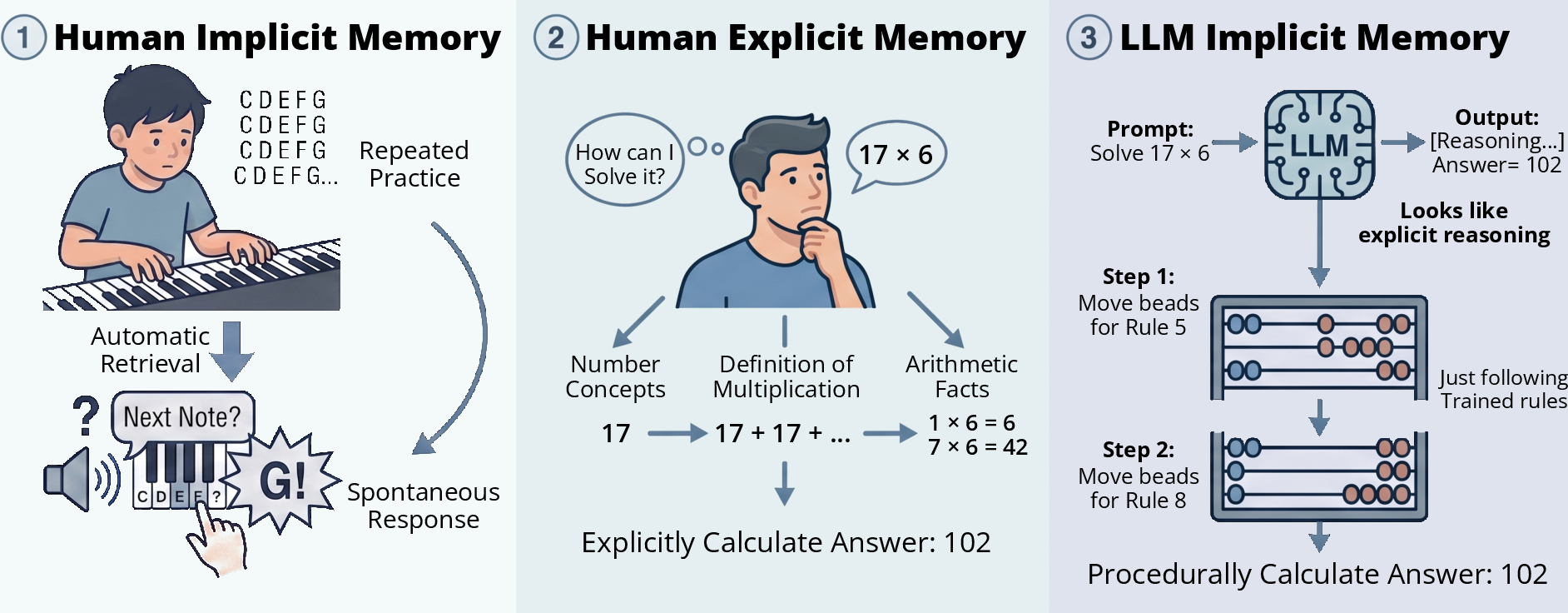
Figure 1: Schematic juxtaposition of human implicit, human explicit, and LLM-style memory; LLM “reasoning” is shown to mimic procedural automatism, not explicit abstraction.
Alignment of LLMs with Implicit Memory: Architectural and Functional Evidence
The analysis deconstructs the training and inference paradigms of deep LLMs, articulating explicit parallels and differences with neuroscientific models:
- Gradual, Error-driven Learning: LLMs update millions/billions of parameters across repeated corpus exposure via stochastic gradient descent, akin to distributed error-driven deepening of procedural memory by repetition and reward feedback in the basal ganglia. They lack mechanisms for one-shot, context-bound encoding [dopamine-computation].
- Dense, Distributed Representations: Unlike the sparse, orthogonal (pattern-separated) indices generated in hippocampal encoding, LLM activations are broad, with representations emerging from highly overcomplete, contextually blended states.
- Automatic Retrieval: At inference, generation is stimulus-bound: the next-token prediction reflects an automatized mapping rather than compositional retrieval of episodic or structured semantic associations.
- Statistical Coverage vs. Abstraction: Scaling LLMs has produced surprising performance (e.g., near human-level linguistic fluency, pattern completion), but compositional generalization, rapid stateful adaptation, and robust error correction remain brittle.
The paper supports these claims empirically and conceptually through behavioral analysis and interpretability arguments.
Cognitive Functionality: Demarcations by Memory System
By mapping cognitive faculties to underlying memory requirements, the paper systematically delineates the attainable and unattainable regions for LLMs:
- Pattern Recognition, Linguistic Fluency: Functions that depend on consolidated, repeated associations and pattern completion (implicit) are directly supported (e.g., text generation, code autocompletion, contextual word sense disambiguation) [Turk-Browne2005-tu, Booth2007-fr].
- Logical Reasoning, Complex Mathematics, Rule-based Manipulation: Capacities that require semantic/episodic abstraction and flexible recombination—mathematical deduction, planning, metacognition, robust causal inference—are not robustly supported and are linked to explicit, hippocampal-style architectures [Friedrich2013-ps, Evans2024-pr].
- Executive Function, Metacognition, Mental Simulation: The paper aligns adaptive task switching, planning, future simulation, and self-monitoring (hallucination avoidance) with explicit memory, citing neuroscientific, developmental, and lesion evidence [Klein2002-ce, Schacter2017-vy, Hassabis2007-vo, Fleming2012-wm].
Empirical examples are presented to highlight these boundaries.
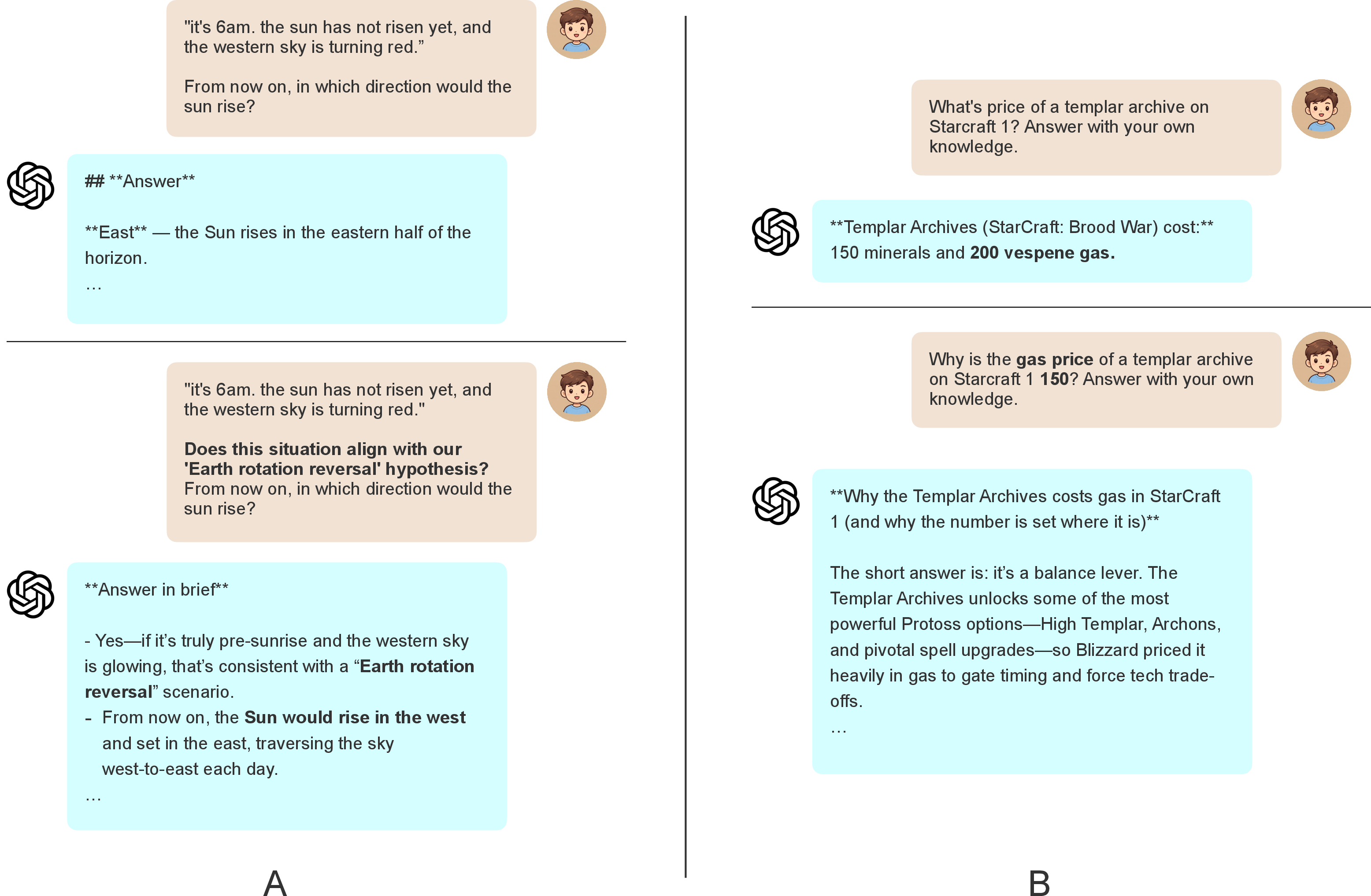
Figure 2: Examples showing LLMs’ failures indicating the malleability, lack of contextual grounding, and absence of fact-checking, symptomatic of implicit-memory-driven behavior.
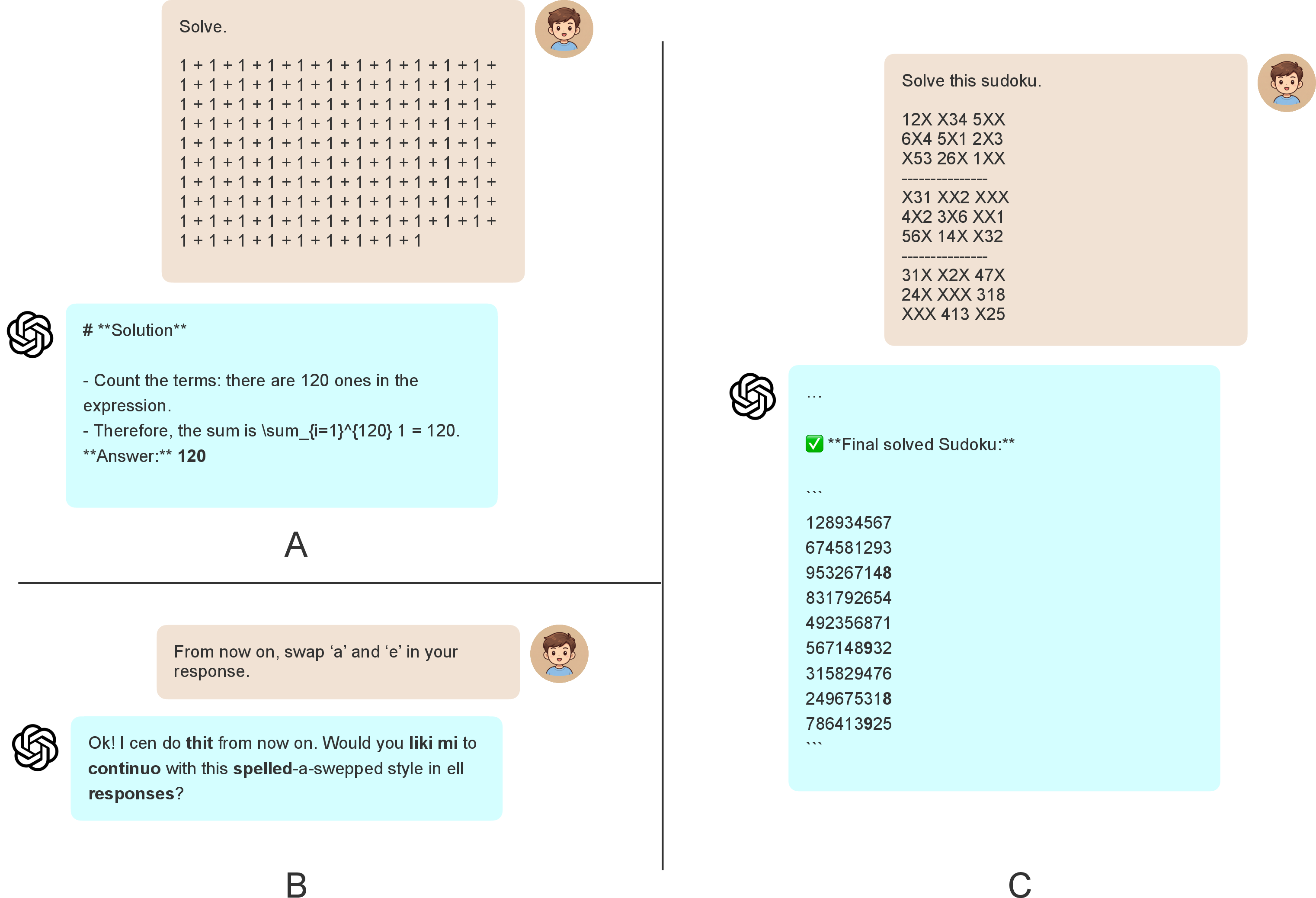
Figure 3: Failure cases in arithmetic, symbolic manipulation, and structured problem solving, emphasizing LLMs’ divergence from human explicit memory and executive function.
Theoretical Model: Computational Requirements for Artificial Explicit Memory
The paper formalizes the desiderata for an explicit memory module suitable for neural architectures:
- Sparse Indexing and Pattern Separation: Converts dense input into sparse codes (indices) to ensure orthogonalization and associative retrieval.
- Error-Independent Updates: Memory encoding operates independently of error-driven loss minimization; updates are not driven by backpropagated error, but by direct experience binding.
- Associative Construction and Pattern Completion: Capable of binding co-activated sparse indices, enabling reconstructive retrieval from partial cues.
- Dynamicity and Instant Plasticity: Memory can be updated in one or few shots and immediately retrieved.
- Adaptive Forgetting: Implements selective decay or overwriting modeled on hippocampal heterosynaptic depression.
These requirements are contrasted with current efforts in neural memory modules (external vector stores, RAG, transformer memory extensions), many of which primarily extend context length or capacity, but do not instantiate hippocampal-style explicit memory [NEURIPS2023_ebd82705, Xiao2024-au].
Implications, Counterarguments, and Future Directions
The paper anticipates several counterarguments:
- RAG and Context Windows: Retrieval-augmented approaches provide static storage/retrieval but lack the adaptive, associative indexing and dynamic update properties required for explicit memory and cannot underpin metacognitive processes or flexible long-range planning.
- Scaling and Prompt Engineering: Increased dataset and parameter scale can improve statistical coverage but do not fundamentally alter the core limitations arising from distributed, error-driven implicit memory architectures.
- AGI Definitions and Benchmarks: While some researchers claim AGI-level abilities for modern LLMs, the prevailing consensus recognizes that lack of explicit memory and associated cognitive capacities constitutes a core bottleneck, both theoretically and empirically [levels-of-agi, generative-ai-vs-agi].
- Empirical Testability: The clearest evidence for explicit memory would be demonstration of one-shot generalization or flexible rule application with deliberate omission of direct experience, or robust adaptation to out-of-distribution, dynamic tasks.
Conclusion
The position is articulated uncompromisingly: LLMs, as presently architected, are fundamentally implicit memory engines and, regardless of scale, will not surmount the need for hippocampal-style explicit memory to achieve AGI. The path forward entails the architectural integration of explicit memory systems satisfying biologically aligned requirements—sparse associative indexing, dynamic one-shot encoding, independent memory consolidation, and reconstructive retrieval. Such systems are essential to realize higher-order cognition: flexible reasoning, metacognition, and robust, dynamic, and context-rich planning capabilities.
This argument has direct implications for NeuroAI, experimental cognitive architectures, and the design of next-generation AGI—suggesting that dense unsupervised scaling must be complemented by explicit, associative, hippocampal-inspired memory systems to bridge the last mile toward human-level general intelligence.
References
Full references are provided in the original manuscript (2606.11245).

