Learning Quality-Controllable Robot Policies with Iterative Hindsight Relabeling
Abstract: Robot policy evaluation often relies on a binary success signal for task completion. In real-world deployment, however, desired execution behaviors are also defined by quality attributes such as execution speed and motion smoothness, which need to be dynamically controlled according to task requirements. To address this, we introduce Quality-Controllable Policy (QCP), a robot policy that enables inference-time control over both individual quality attributes and their combinations. To extend the controllable quality range beyond initial demonstrations, we further propose an iterative hindsight relabeling loop: QCP collects online rollouts under target quality labels, adds successful trajectories to the dataset, relabels the accumulated trajectories in hindsight according to their measured quality, and fine-tunes the policy. Experiments on Robomimic and RoboEval demonstrate that QCP consistently improves both task execution quality and success rates across iterations, producing successful rollouts that exceed the quality of the initial demonstrations. Finally, we validate QCP on real-world manipulation tasks, where controlling speed increases throughput in conveyor operations and controlling transport stability improves success when carrying wine glasses, demonstrating that quality-controllable policies yield practical gains in physical deployment.
Paper Prompts
Sign up for free to create and run prompts on this paper.
Top Community Prompts
Explain it Like I'm 14
1. What is this paper about?
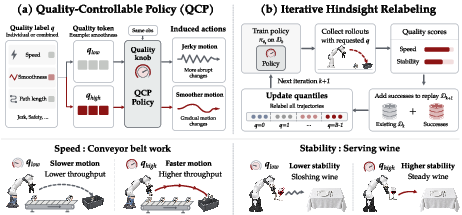
This paper presents a robot-learning system called Quality-Controllable Policy, or QCP.
Most robot-learning systems mainly ask one question: Did the robot finish the task successfully? However, success is not the only thing that matters. People may also want the robot to:
- move quickly,
- move smoothly,
- use less energy,
- keep objects steady,
- or follow a particular movement style.
For example, a robot working on a conveyor belt should be fast. A robot carrying wine glasses should move carefully and keep the tray level.
QCP lets a person choose the desired quality of the robot’s movements while the robot is working.
The paper also introduces a training process called iterative hindsight relabeling. This helps the robot keep improving, even when its original training examples do not include extremely fast, smooth, or stable behavior.
2. What questions did the researchers ask?
The researchers wanted to find out:
- Can QCP control how well a robot performs a task, not just whether it succeeds?
- Can the robot improve its behavior beyond the quality shown in its original demonstrations?
- Can it control several qualities at the same time, such as speed and smoothness?
- Does the method work on real robots, rather than only in computer simulations?
3. How does the method work?
Giving demonstrations quality labels
The researchers began with demonstrations of people or robots successfully completing tasks. Each demonstration was measured using simple rules.
For example:
- Speed: How many steps or how much time did the robot need?
- Smoothness: Did the robot move gently or jerk suddenly?
- Efficiency: How far did its robot joints travel?
- Stability: Did the robot keep a tray level?
Each demonstration was then placed into a quality group, called a bin. With four bins, the groups might be:
- Level 0: lowest quality
- Level 1: somewhat low quality
- Level 2: good quality
- Level 3: highest quality
This is similar to sorting test scores into four groups instead of giving every student a completely different number.
Training the robot
The robot learns from both:
- what it sees, such as camera images and previous observations, and
- the requested quality level.
So instead of simply learning, “How do I complete this task?”, it learns:
“How do I complete this task at the requested speed, smoothness, or stability?”
At use time, a person can choose a quality level. The quality level acts like a control knob.
Iterative hindsight relabeling
The most important part of the method is a repeated improvement cycle:
- The robot is asked to perform the task using the highest quality level.
- It tries the task many times.
- The researchers keep the attempts that successfully complete the task.
- They measure the quality the robot actually achieved.
- They give each attempt a new label based on its real quality.
- They add these attempts to the training data.
- They train the robot again.
- They repeat the process.
The word hindsight means looking back afterward. The robot may have been asked to be “very fast,” but after the attempt, the researchers measure how fast it really was and label it accordingly.
This is like a student practicing a difficult skill, checking how well they actually performed, and then using the best attempts to improve further.
Technical approach in simple terms
The paper uses a machine-learning model called a flow-matching policy. In simple terms, this model starts with random possible movements and gradually changes them into a sensible sequence of robot actions.
The policy predicts a short group of future actions at a time, rather than deciding only one movement. This helps the robot create more coordinated motions.
4. What did the researchers find?
QCP improved both quality and success
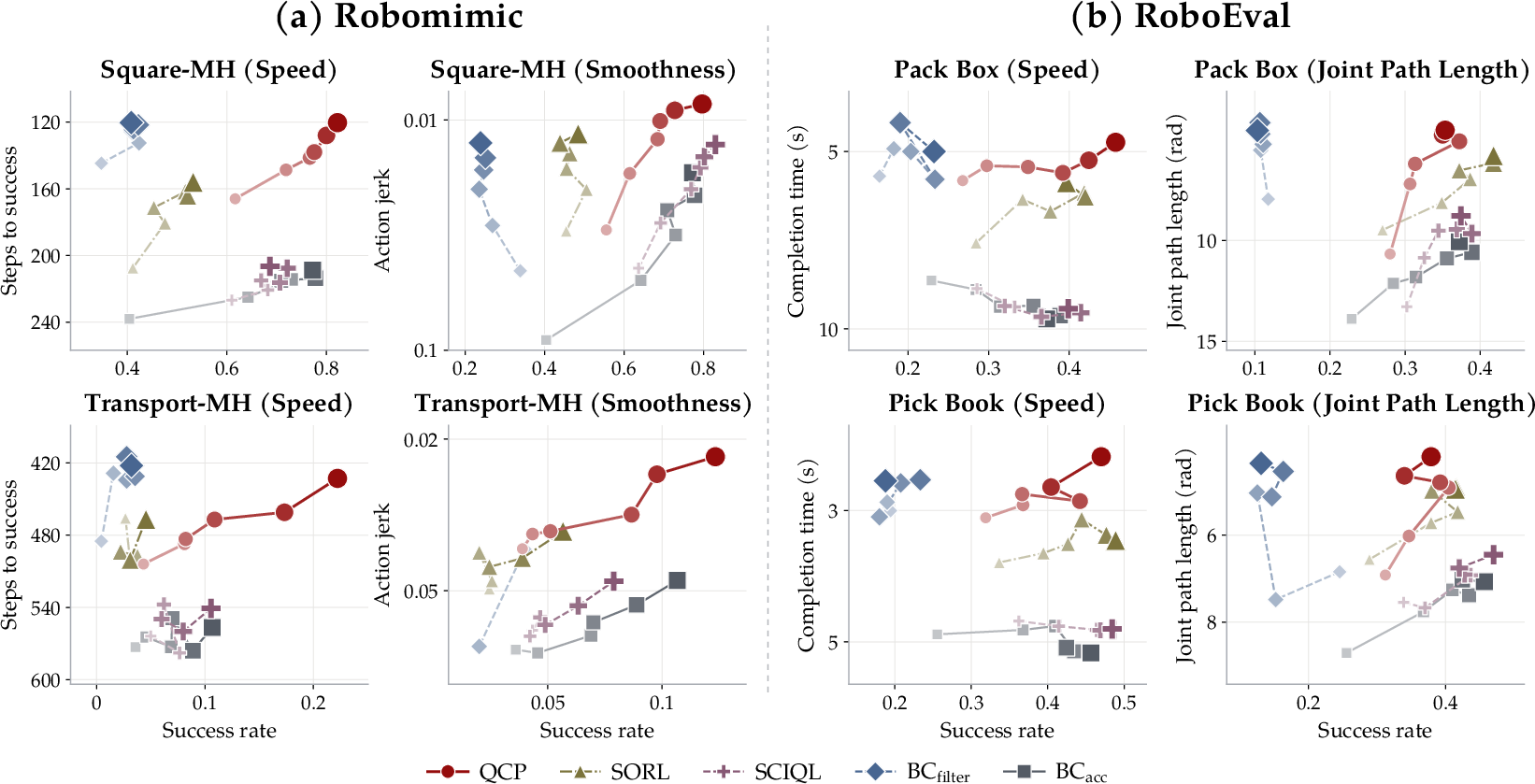
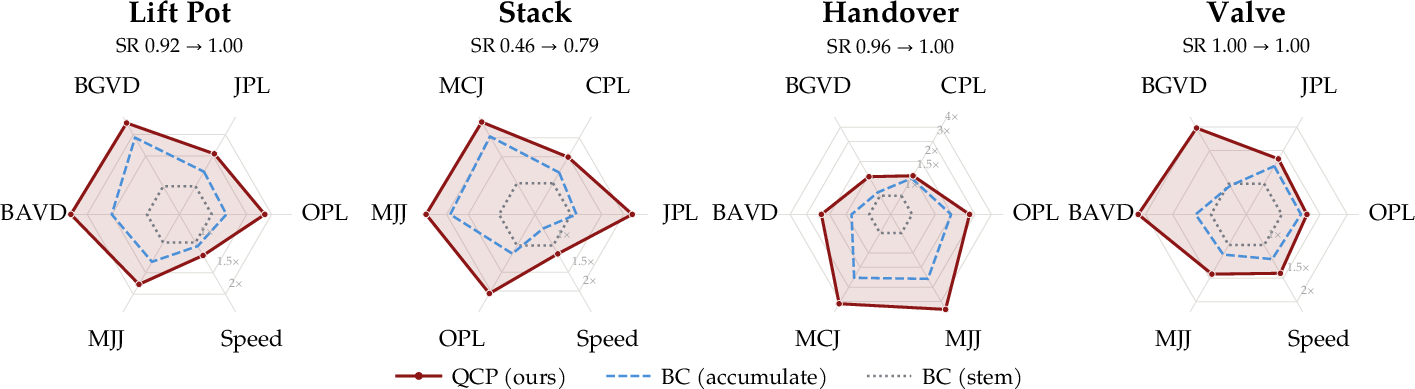
In computer simulations, QCP generally made robots:
- faster,
- smoother,
- more efficient,
- and more likely to finish the task successfully.
This is important because improving one goal can sometimes hurt another. For example, a robot might move faster but make more mistakes. QCP was often able to improve speed or smoothness without losing task success.
The robot learned several behavior levels
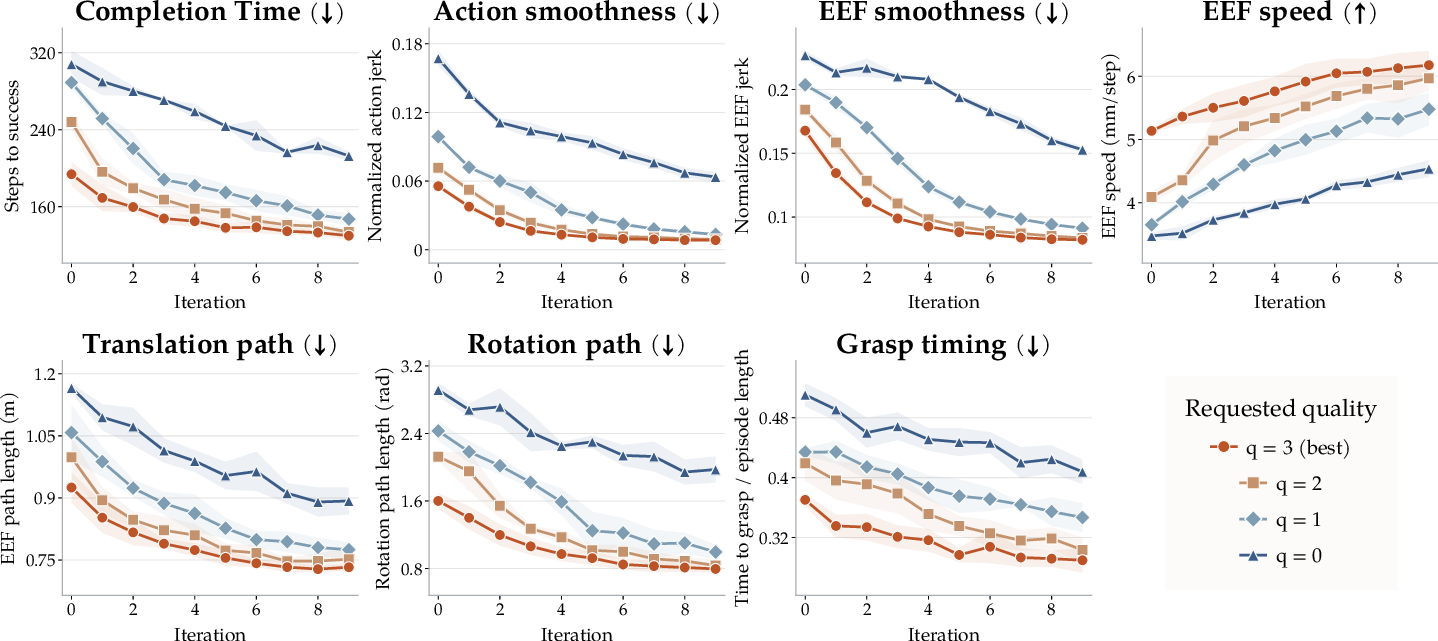
The robot could respond differently to different requested quality levels. For example, on one task:
- the lowest quality setting took about 308 steps,
- while the highest quality setting took about 194 steps.
The middle settings produced behavior between these two extremes.
This shows that QCP was not simply making the robot “better” in one fixed way. It could choose among different ways of performing the task.
It exceeded the quality of the original demonstrations
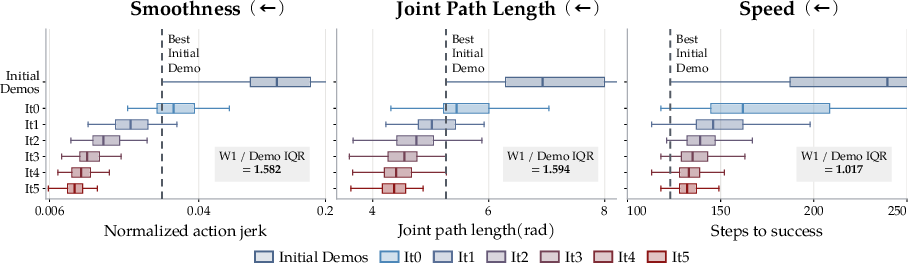
After several rounds of practice, the robot produced successful behaviors that were better than those in its original training data.
For example, it learned to complete some tasks more quickly or with smoother movements than any of the initial demonstrations.
This is a major result. Traditional imitation learning usually copies what it sees. QCP can use repeated practice to move beyond the examples it started with.
It controlled multiple qualities
QCP could control more than one quality at the same time.
For example, it could be asked to:
- move faster while lifting an object only a small amount, or
- move more slowly while using a larger lift.
In another experiment, it improved as many as six quality attributes across several tasks.
It worked on real robots
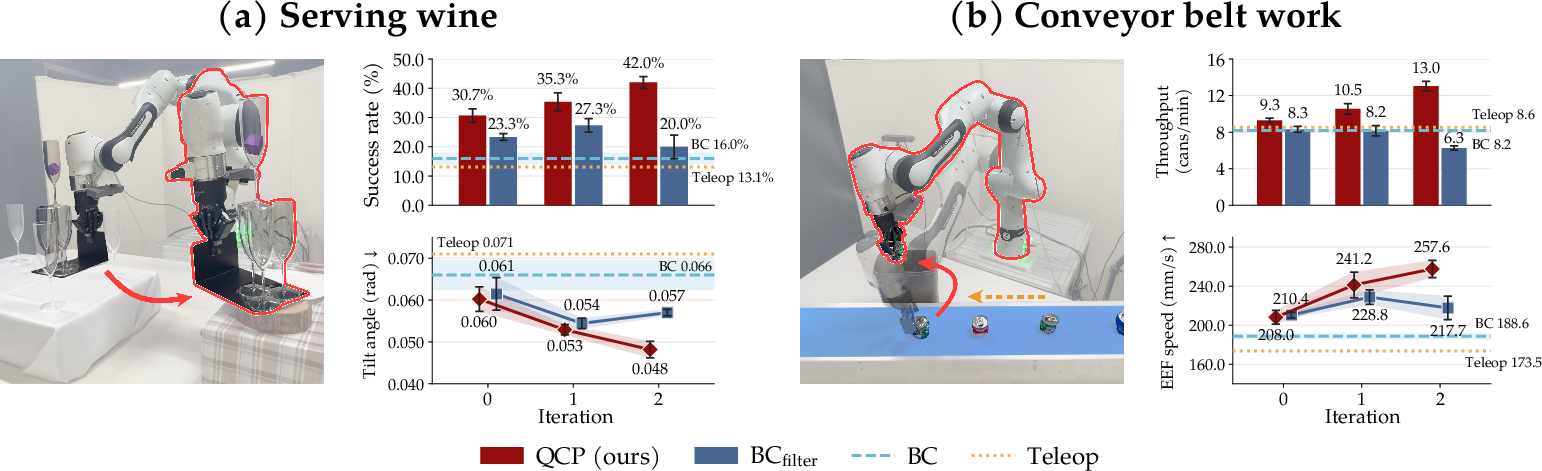
The researchers tested QCP with a real robot arm in two tasks.
Carrying wine glasses
The robot carried a tray with wine glasses from one table to another. The important quality was stability, measured by how much the tray tilted.
QCP reduced the average tray tilt from 0.0660 radians to 0.0482 radians, a reduction of about 27%. Its success rate increased from 30.7% to 42.0%.
Working on a conveyor belt
The robot had to grab cans moving on a conveyor belt. The important quality was speed.
Compared with a basic behavior-cloning system:
- the robot’s movement speed increased by about 36.6%,
- the number of cans successfully handled per minute increased by about 59.3%.
These results show that quality control can provide practical benefits, such as handling more products or dropping fewer objects.
5. Why is this research important?
Robots are often judged too simply: they either succeed or fail. In real life, people care about how a robot succeeds.
A robot that completes a task slowly may not be useful in a factory. A robot that carries objects too roughly may break them. A robot that succeeds but wastes energy may also be undesirable.
QCP offers a way to tell a robot what kind of behavior is wanted. It could allow the same robot to:
- work quickly on a production line,
- move gently when carrying fragile objects,
- use smooth movements around people,
- or choose a balance between speed and safety.
The iterative training process is also useful because collecting perfect demonstrations from humans can be difficult and expensive. Instead, the robot can practice, measure its own successful attempts, and gradually improve.
Simple conclusion
The paper introduces a robot-learning method that controls not only whether a robot succeeds, but also how well and in what style it performs a task. QCP uses quality labels such as speed, smoothness, and stability. By repeatedly practicing and learning from its best successful attempts, it can eventually perform better than the original demonstrations.
The results suggest that this approach could make robots more useful in factories, warehouses, homes, and other real-world settings where both success and the quality of movement matter.
Knowledge Gaps
Knowledge Gaps, Limitations, and Open Questions
- Dependence on hand-designed quality metrics: QCP assumes that each quality attribute can be measured by a reliable rule-based score, but the paper does not establish how well proxies such as action count, jerk, joint path length, end-effector speed, or tray tilt correspond to human judgments of desirable execution.
- No treatment of conflicting or task-dependent quality definitions: The method does not specify how to handle quality metrics that conflict with one another, such as speed versus smoothness, or how users should select weights or constraints when objectives cannot all be maximized simultaneously.
- Limited evidence for generalization across tasks and environments: Experiments cover a small set of simulated manipulation tasks and only two real-world tasks using one robot platform; it remains unclear whether QCP transfers to different robot morphologies, sensors, workspace layouts, object properties, dynamics, and task horizons.
- Insufficient evaluation of robustness to metric misspecification: The paper does not test whether optimizing an imperfect or exploitable quality score can produce undesirable behavior, such as moving quickly at the expense of safety, excessive force, object damage, or unmodeled aspects of task quality.
- Unclear validity of quality extrapolation: The reported range expansion may reflect recombination of behaviors already present in the demonstrations rather than genuinely learning novel high-quality skills. The paper does not disentangle these mechanisms or characterize the maximum achievable quality under physical and safety constraints.
- No principled stopping criterion for iterative relabeling: The method uses a fixed number of iterations, but it does not define when further data collection ceases to improve quality, begins to reduce success, or causes instability in the quality-label distribution.
- Potential instability from changing quantile boundaries: Recomputing empirical quantile bins after every iteration changes the meaning of each quality token. The paper does not analyze label drift, whether policies retain previously learned control semantics, or how performance changes when the accumulated dataset has highly uneven score distributions.
- Dependence on the highest-bin exploration strategy: New rollouts are collected only under the highest quality label. This may limit exploration to a narrow region of behavior space and cannot directly discover improvements that require temporarily executing lower-quality or qualitatively different behaviors.
- Limited analysis of exploration and sampling diversity: Although stochastic action generation is cited as a source of improvement, the paper does not quantify the relationship between sampling temperature, number of rollout attempts, trajectory diversity, and the probability of discovering higher-quality successful behaviors.
- Unresolved selection bias from retaining only successful rollouts: Failed trajectories are discarded because including them degraded performance in one reported experiment, but the paper does not investigate alternative ways to use failures, such as failure-aware objectives, negative examples, or constrained learning.
- No formal safety mechanism during online improvement: The iterative loop collects real-robot rollouts under increasingly aggressive quality targets, yet the method contains no explicit collision, force, object-damage, stability, or human-safety constraints.
- Weak evidence on long-term deployment reliability: The experiments do not evaluate performance degradation, hardware wear, changing environmental conditions, sensor noise, object variation, or repeated operation over extended periods.
- Small and uneven real-world datasets: The real-world study uses 400 demonstrations for the conveyor task and only 50 demonstrations for wine-glass transport, with very few successful wine-glass demonstrations. The robustness of the reported gains to dataset size and initial success rate remains unknown.
- Limited statistical validation: Results are averaged over three seeds, but the paper does not report confidence intervals, hypothesis tests, per-seed results, or the number of independent real-world evaluation trials needed to assess the reliability of the improvements.
- Incomplete comparison of interaction efficiency: QCP is compared using a fixed rollout budget, but the paper does not provide learning curves normalized by real-world interaction cost, wall-clock time, retraining cost, or successful-trajectory acquisition cost.
- Unclear fairness of comparisons with online RL baselines: DSRL and EXPO receive a particular reward design, weighting scheme, and training budget, but the paper does not establish that these settings are equally favorable or that the baselines were tuned to their best achievable performance.
- No comparison with stronger multi-objective or constrained-learning methods: The evaluation omits systematic comparisons with methods that explicitly model Pareto fronts, scalarized preferences, constrained reinforcement learning, preference learning, or continuous return/quality conditioning.
- Scalability to many quality attributes is not demonstrated conclusively: The paper reports conditioning on six attributes, but it does not analyze performance as the number of attributes grows, whether the required data scales combinatorially, or how often attributes become mutually incompatible.
- Insufficient evaluation of arbitrary attribute combinations: Joint control is tested on selected combinations and on requesting the best bin for all attributes. The ability to request unseen combinations, intermediate trade-offs, or deliberately low values for some attributes while maximizing others remains unresolved.
- Quality labels are coarse and discretization-sensitive: The choice of four bins is empirically effective in one setting, but the paper does not provide a principled way to select the number of bins, handle ties and outliers, or determine the resolution needed for practical control.
- Continuous conditioning is underexplored: The comparison with continuous scores uses a limited setup and a fixed target; it does not test calibrated continuous conditioning, hybrid discrete-continuous representations, ordinal regression, or score uncertainty.
- No calibration analysis of requested versus achieved quality: The paper shows ordering across bins but does not quantify calibration error, monotonicity violations, variance within bins, or whether the same requested label yields comparable quality across tasks and iterations.
- Potential mismatch between trajectory-level labels and local behavior: Every action chunk receives the trajectory’s single quality label, even though quality may vary substantially across task phases. The consequences for temporally localized attributes, phase-specific behavior, and credit assignment are not studied.
- Limited investigation of action-chunk and history design: The effects of history length, action horizon, flow integration procedure, and chunk overlap on quality controllability, smoothness, and failure rates are not reported.
- Unclear contribution of reinitialization: Policies are retrained from scratch after relabeling, but the paper does not isolate the effects of reinitialization, fine-tuning, replay weighting, and other continual-learning strategies on performance and computational cost.
- No analysis of dataset imbalance and demonstration coverage: The method assumes that all successful quality regimes remain useful after relabeling, but it does not study how skewed quality distributions, sparse high-quality examples, duplicated rollouts, or limited task-state coverage affect learning.
- Claims about improved task success may be partly attributable to data accumulation: Although accumulation and filtering baselines are included, the paper does not fully isolate the effects of quality conditioning, relabeling, additional successful data, and repeated retraining through comprehensive ablations.
- No evaluation of robustness under distribution shift: The policies are not tested with novel object geometries, altered conveyor speeds, lighting changes, perturbations, sensor failures, payload variations, or dynamics changes that could reveal whether quality control remains reliable outside the training distribution.
- Human acceptability and subjective quality are not evaluated: The study does not measure whether human users perceive the generated behaviors as safer, more natural, more efficient, or preferable, nor whether the quality labels are understandable and useful as deployment-time controls.
- Deployment interface and user specification remain underspecified: The paper assumes that users can choose an appropriate quality bin, but it does not address how users should map operational requirements to labels, how labels should be calibrated across tasks, or how uncertainty should be communicated.
- The relationship between quality improvement and task throughput is task-specific: Throughput improves in the conveyor experiment, but the paper does not establish general conditions under which optimizing a trajectory-level metric translates into system-level productivity, energy efficiency, or reduced operating cost.
- No theoretical guarantees are provided: The method lacks formal guarantees for monotonic improvement, preservation of success rates, convergence of the relabeling process, coverage of the controllable quality range, or avoidance of quality collapse.
- Open question on quality-aware failure recovery: The method only evaluates complete trajectories using a single achieved quality score; it does not study whether policies can maintain or recover quality after disturbances, partial failures, replanning events, or mid-trajectory changes in the requested quality target.**
Practical Applications
Immediate Applications
The paper’s results support near-term deployment in robotic manipulation settings where execution quality can be measured automatically and adjusted through a discrete control input.
- Adaptive conveyor and warehouse handling — manufacturing and logistics
- Deploy QCP with a high-speed quality label for picking, sorting, packaging, or palletizing objects under fixed production schedules.
- A runtime controller could select between maximum throughput, balanced, and high-reliability modes depending on conveyor speed, backlog, or staffing.
- The real-world conveyor experiment provides direct evidence: QCP increased end-effector speed by 36.6% and throughput by 59.3% relative to behavior cloning.
- Dependencies: A reliable task-success detector, calibrated speed metric, collision and force limits, and sufficient successful demonstrations covering the task.
- Fragile-object transport — food service, hospitality, laboratories, and healthcare
- Condition the policy on stability-related labels to transport wine glasses, chemical containers, medical samples, vials, or other fragile items.
- A practical workflow could switch from fast transport in empty corridors to a high-stability mode near people, thresholds, or uneven surfaces.
- The reported wine-glass experiment reduced tray tilt by 27% and improved success from 30.7% to 42.0%.
- Dependencies: Sensors capable of measuring tilt or vibration, object-specific safety thresholds, robust grasping, and validation under varied payloads and surfaces.
- Multi-objective robot operation — industrial automation
- Expose quality attributes as operator-selectable settings, such as
speed,smoothness,path efficiency,lift amplitude, orstability. - A supervisory interface could allow an operator to select combinations such as
fast + smooth,slow + stable, orenergy-efficient + low-risk. - This is supported by the paper’s joint control of multiple attributes and improvement across up to six quality dimensions.
- Dependencies: Quality metrics must be compatible rather than contradictory, and the training set must contain enough examples for each meaningful combination.
- Expose quality attributes as operator-selectable settings, such as
- Quality-aware teleoperation and demonstration learning — robotics engineering
- Use QCP to train from mixed-quality demonstrations without discarding slower or less smooth successful trajectories.
- Low-quality demonstrations can preserve task coverage, while quality labels identify the desired execution style at inference time.
- This can reduce the need for manually filtering demonstrations or collecting only expert-level trajectories.
- Dependencies: Demonstrations must be labeled by measurable rules, and the quality metric must correlate with the intended operational objective rather than merely with superficial motion properties.
- Robot fleet runtime policy selection — operations software
- Integrate quality labels into a fleet-management layer that selects behavior according to context:
- high speed during production peaks,
- high smoothness for precision assembly,
- high stability for fragile loads,
- conservative execution when uncertainty is high.
- The policy can retain one task model while exposing quality as a runtime control knob, rather than maintaining entirely separate policies for each operating condition.
- Dependencies: The deployment system must monitor task success, environment changes, and safety constraints; discrete quality levels may be too coarse for some applications.
- Automated robot evaluation and benchmarking — academia and industrial R&D
- Apply the paper’s rule-based metrics to evaluate policies beyond binary success rates.
- Benchmark suites can report success jointly with completion time, jerk, path length, stability, or energy proxies.
- This enables more informative model selection, regression testing, and comparison of robot foundation models.
- Dependencies: Metrics need standardized definitions and normalization across robot embodiments, environments, and task durations.
- Online improvement without repeated human preference labeling — robotics research and prototyping
- Use the iterative hindsight relabeling loop as a practical training workflow:
- 1. train on successful demonstrations;
- 2. collect rollouts using the highest quality label;
- 3. retain successful trajectories;
- 4. measure their achieved quality;
- 5. relabel the accumulated dataset;
- 6. retrain the policy.
- This can improve quality without asking operators to compare every new rollout.
- Dependencies: Rollouts must be collected safely, successful trajectories must be detected automatically, and retraining from the updated dataset must be computationally affordable.
- Educational and laboratory robotics platforms
- Use quality labels to demonstrate how the same task can be completed quickly, smoothly, efficiently, or safely.
- Students can study the relationship between demonstrations, quality metrics, policy conditioning, and online data collection.
- Dependencies: The platform must provide repeatable sensing and a safe environment for online experimentation.
Long-Term Applications
The approach could support broader systems once its metrics, safety guarantees, scalability, and generalization are established beyond the tasks evaluated in the paper.
- General-purpose robot foundation models with configurable behavior
- Extend vision-language-action models so that prompts specify both the task and execution requirements, for example: “pick the object quickly but with low jerk” or “transport the tray with maximum stability.”
- This could yield a single generalist policy with task and quality conditioning across household, industrial, and service-robot domains.
- Dependencies: Quality labels must generalize across tasks and embodiments; language-to-quality mappings require calibration; conflicting objectives may require explicit optimization or constraint handling.
- Safety-constrained robotic assistants — healthcare, eldercare, and domestic robotics
- Combine stability, smoothness, proximity, force, and speed labels to adapt robot behavior around patients, children, or vulnerable objects.
- A policy could automatically move from a productivity-oriented mode to a conservative mode when human presence or fragile payloads are detected.
- Dependencies: Rule-based quality scores are not sufficient by themselves for safety certification. Formal constraints, uncertainty estimation, emergency stopping, human-robot interaction studies, and regulatory approval would be required.
- Autonomous warehouse and factory policy self-improvement
- Establish a continuous deployment loop in which successful production trajectories expand the robot’s attainable quality range over time.
- The system could learn progressively faster cycle times or smoother paths while retaining lower-quality trajectories for task coverage.
- Dependencies: Distribution shift, equipment wear, changing objects, and rare failures must be managed. Blindly optimizing the highest quality bin could produce unsafe behavior or exploit weaknesses in the metric.
- Energy- and wear-aware robotics
- Add energy consumption, actuator effort, thermal load, vibration, and maintenance cost as quality attributes.
- Robots could select between fast/high-energy and slow/low-wear modes, enabling scheduling based on electricity prices, battery state, or predicted component degradation.
- Dependencies: The paper does not directly evaluate energy or lifecycle cost. These metrics require reliable instrumentation and careful handling of trade-offs with speed and success.
- Robotic manipulation under changing business objectives
- A manufacturer could change target labels without retraining the entire system—for example, prioritizing throughput during peak demand and precision during quality inspection.
- This could support dynamic optimization in fulfillment, agriculture, recycling, and electronics assembly.
- Dependencies: The requested quality range must be represented in training data or reached safely through iterative collection; out-of-distribution quality requests remain a risk.
- Quality-conditioned simulation-to-real transfer
- Use simulation to pretrain policies with controlled speed, smoothness, path length, and stability, then apply iterative hindsight relabeling on a small amount of real-world data.
- This may reduce the need for extensive real-world demonstrations when the desired quality attributes can be simulated accurately.
- Dependencies: Simulated metrics and dynamics must match reality, especially for contact forces, object fragility, friction, and actuator limits. The paper’s real-world validation is limited to two manipulation tasks.
- Human preference and automatic metric hybrid systems
- Combine automatically computed labels with occasional human feedback for qualities that are difficult to formalize, such as elegance, naturalness, comfort, or perceived helpfulness.
- Rule-based scores could handle measurable properties while human comparisons refine the policy where metrics are incomplete.
- Dependencies: Human feedback introduces annotation cost and potential inconsistency. Reward hacking and disagreement between measurable proxies and human judgments would require monitoring.
- Quality-aware robot certification and procurement
- Develop standardized test protocols reporting not only whether a robot succeeds, but how it succeeds across speed, smoothness, stability, efficiency, and robustness.
- Buyers could specify minimum success rates and acceptable quality envelopes for different operating contexts.
- Dependencies: Cross-platform comparability, statistically meaningful test sets, adversarial evaluation, and industry or regulatory standardization are still needed.
- Multi-robot coordination with shared quality objectives
- Extend quality conditioning from individual manipulation policies to teams of mobile robots or robotic arms.
- Systems could coordinate for high throughput, synchronized smooth motion, low energy use, or reduced congestion.
- Dependencies: Joint quality metrics, multi-agent credit assignment, communication delays, and collision avoidance introduce challenges not addressed by the single-robot experiments.
- Daily-life assistive robots
- In household environments, users could select preferences such as
quiet,gentle,fast, orenergy-savingfor cleaning, serving, carrying, and object-placement tasks. - Quality labels could provide an interpretable interface for personalizing behavior without retraining a separate policy for every user.
- Dependencies: Home environments are highly variable, quality preferences may be subjective, and the robot must detect failures reliably. Safe fallback behavior and privacy-preserving data collection would be essential.
- In household environments, users could select preferences such as
Glossary
- Action chunk: A sequence of consecutive actions generated or predicted together by a policy. “predicts a chunk of future actions”
- Behavior cloning (BC): A supervised imitation-learning method that trains a policy to reproduce demonstrated actions. “These policies are usually trained with behavior cloning (BC) on successful demonstrations”
- Behavioral style: A characteristic manner in which a robot executes a task, such as fast, slow, smooth, or cautious behavior. “representing behavioral styles through learned trajectory representations or explicit labels”
- Conditional policy: A policy whose output depends on additional input variables specifying desired behavior or task properties. “quality-conditioned behavior cloning objective”
- Continuous quality score: A real-valued measure of an execution attribute before discretization into labels. “Continuous quality scores versus quantized quality labels”
- Empirical CDF: A cumulative distribution function estimated directly from observed data. “with the empirical CDF taken over ”
- End-effector: The tool or terminal component of a robot arm that interacts with the environment. “execution speed, measured by end-effector speed”
- Flow matching: A generative-modeling technique that trains a velocity field to transform a simple noise distribution into a target data distribution. “We model as a flow matching policy”
- Flow time: The continuous interpolation parameter used to describe a generative flow from noise to data. “flow time ”
- Hindsight relabeling: Reassigning labels to a trajectory after execution using the outcome or properties it actually achieved. “we introduce a simple iterative pipeline that alternates between rollout collection, hindsight relabeling, and policy updates”
- IQR (interquartile range): The difference between the third and first quartiles of a distribution, representing the range of its middle 50 percent. “normalized by the interquartile range (IQR) of the initial demonstration scores”
- Iterative policy update: Repeatedly retraining or adjusting a policy using data collected by earlier versions of the policy. “through online rollout collection and policy updates”
- Joint path length (JPL): The cumulative distance traveled by a robot’s joints during an execution. “motion efficiency, measured by total joint path length”
- Latent space: An internal learned representation space in which data or behaviors are encoded. “Steering Your Diffusion Policy with Latent Space Reinforcement Learning”
- Motion smoothness: The degree to which a robot’s movement avoids abrupt changes or jerky actions. “normalized action differences for smoothness”
- Offline reinforcement learning: Reinforcement learning performed using a fixed dataset rather than new environment interaction during training. “which learn style-conditioned policies through offline RL”
- Online rollout: A trajectory generated by executing a policy in an environment during an interactive data-collection phase. “we collect rollouts conditioned on the highest quality label”
- Policy conditioning: Supplying a policy with an input that specifies the behavior or objective it should produce. “QCP uses quantized quality labels to control individual execution attributes”
- Policy plasticity: A neural network’s ability to continue learning effectively when trained on new or changing data. “avoid the loss of plasticity and primacy bias”
- Pretrained checkpoint: A saved set of model parameters obtained from earlier training and used to initialize a later training process. “from the pretrained checkpoint for VLAs”
- Primacy bias: The tendency of a continually trained model to remain disproportionately influenced by information encountered early in training. “the loss of plasticity and primacy bias observed when networks are trained continually”
- Quantile bin: An interval containing a specified fraction of the observations in a distribution. “With four quantile bins, roughly the best quarter of the training trajectories share the best label”
- Quantization: The conversion of continuous numerical values into a finite set of discrete categories. “We then quantize the scores into equal-frequency bins”
- Quality attribute: A measurable characteristic of task execution other than binary success, such as speed or smoothness. “different tasks call for different quality attributes”
- Quality-conditioned policy: A policy whose action generation is controlled by a specified execution-quality label. “We train a policy that, given a history of observations”
- Quality label: A discrete category representing the measured quality of a trajectory. “use the bin index as a discrete quality label”
- Quality-filtered behavior cloning: Behavior cloning restricted to demonstrations selected according to their quality. “quality-filtered BC using the best 10\% of successful trajectories”
- Reinitialization: Restarting model training from an initial parameter state rather than continuing from the previous policy. “we reinitialize the policy at every iteration”
- Reinforcement learning (RL): A learning framework in which an agent improves its policy using rewards obtained through interaction with an environment. “which improve flow matching policies with online RL”
- Reward conditioning: Generating behavior based on a desired reward or return value supplied to a policy. “The importance of training support is also evident in return conditioning”
- Rollout: A sequence of states, actions, and observations produced by executing a policy. “At each iteration , we execute conditioned on the highest bin”
- Score function: A rule-based function that assigns a numerical quality measure to a trajectory. “We assume access to a rule-based score function ”
- Stochastic action generation: Producing actions using randomness so that repeated executions can yield different trajectories. “action generation is stochastic”
- Supervised quality signal: Training information in which the desired quality is explicitly supplied as a target label or measurement. “QCP instead provides the quality signal in a supervised manner”
- Teleoperation: Direct control of a robot by a human operator, typically through a remote interface. “collect 400 teleoperated demonstrations”
- Trajectory: An ordered sequence of observations and actions generated during one task execution. “each trajectory ”
- Velocity field: A function that specifies the direction and speed of movement through a generative model’s state space. “train a velocity field to predict the target ”
- Vision-language-action (VLA) model: A model that combines visual and linguistic inputs to produce robot actions. “For vision-language-action (VLA) models such as ”
- Wasserstein-1 distance: A distributional distance measuring the minimum cost of transporting probability mass between two one-dimensional distributions. “the Wasserstein-1 distance between the initial demonstrations and final successful rollouts”

