- The paper introduces the Auto-E2H framework that uses reversed easy-task trajectories as scalable supervision for hard-task manipulation learning.
- It employs a closed-loop data collection with hierarchical filtering—combining kinematic and critic-guided methods—to refine noisy reversed demonstrations.
- Experimental evaluations in simulation and real-world tasks show significant improvements in success rates and reductions in teleoperation costs.
Teleoperation-Cost Efficient Policy Learning via Temporal Reversal of Easy Manipulation Tasks
Motivation and Problem Statement
Robotic manipulation tasks frequently exhibit directional asymmetry: the forward task (e.g., object insertion, assembly, stacking) presents high precision and complex contact dynamics, making it challenging for both autonomous systems and human teleoperation. Conversely, the reversed task (e.g., extraction, disassembly, de-stacking) is typically easier, requiring less precision and less constrained state-space navigation. Existing imitation learning methods, especially diffusion policies, are constrained by data efficiency and the cost of high-quality, hard-task demonstrations. This paper introduces the Auto-E2H framework, leveraging reversed easy-task trajectories as scalable supervision for learning the forward hard task, with minimal human teleoperation. The core insight is that easy-task rollouts, when temporally inverted, provide rich supervision but suffer from noise and suboptimal behaviors, which necessitate robust filtering and refinement for effective policy learning.
Framework: Closed-Loop Collection, Hierarchical Refinement, and Iterative Learning
Auto-E2H consists of three interlinked components:
- Closed-Loop Data Collection: Alternates between executing the easy-task and hard-task policies, autonomously resetting the environment and diversifying the trajectory distribution. This reduces the frequency of manual environment resets and creates varied candidate states for learning.
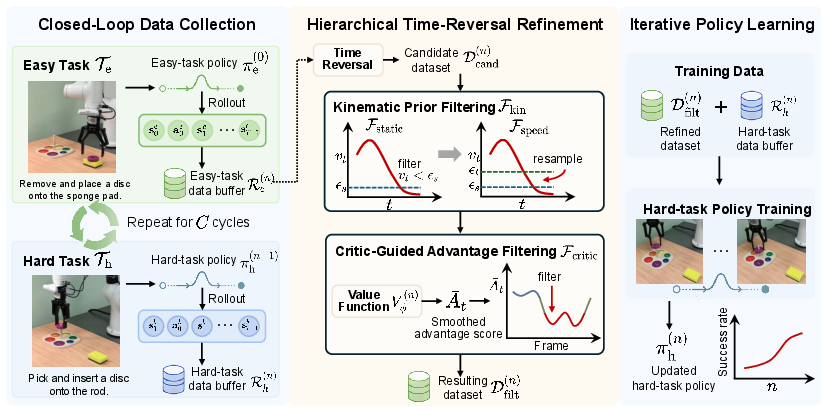
Figure 1: The framework integrates closed-loop collection, hierarchical roll-out reversal and filtering, and iterative policy update in a continuous loop.
- Hierarchical Data Refinement: Applies temporal inversion to easy-task trajectories and filters low-quality segments using kinematic priors and critic-guided advantage scores, ensuring geometric and task-progress alignment for hard-task supervision. Kinematic filtering removes static and low-speed segments, regularizing the action distribution.
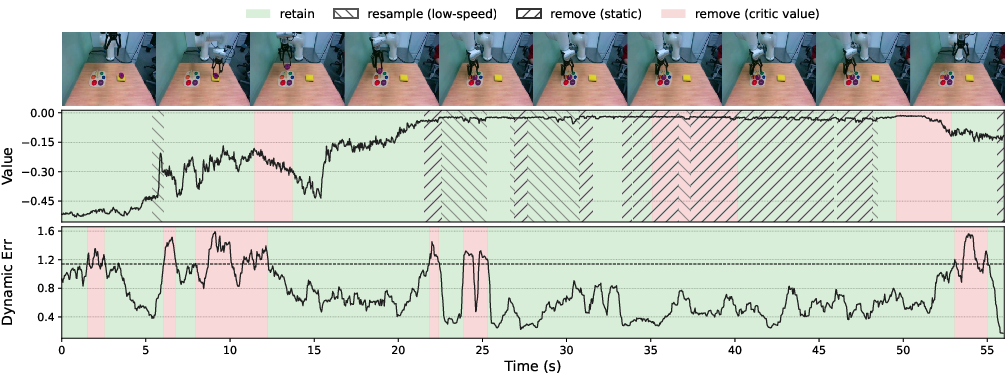
Figure 2: Hierarchical filtering of temporally reversed data—static, low-speed, and low-progress segments are pruned for optimal supervision.
- Iterative Policy Learning: Trains the hard-task policy using both initial expert demonstrations and refined reversed easy-task rollouts. Iterative closed-loop rollout collection and filtering progressively improve hard-task policy coverage and robustness under covariate shift.
Evaluation: Simulation and Real-World Benchmarks
The experimental evaluation spans Isaac Lab and Robosuite simulated benchmarks, alongside real-world manipulation tasks: disk placement, mouse assembly, test tube insertion, and brush placement. Each task pair includes a forward hard task and an easier reversible variant.
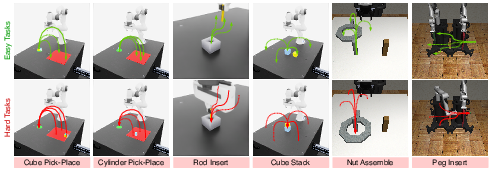
Figure 3: Simulation benchmark task pairs; each consists of a forward hard task and a reversed easy direction.
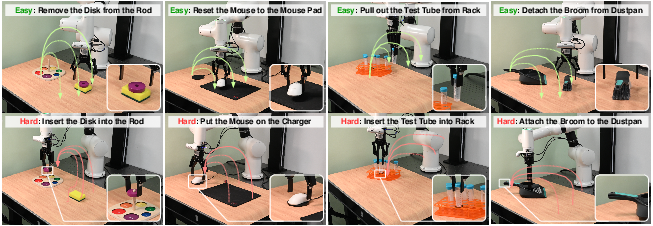
Figure 4: Real-world robotic task setups for the evaluation of Auto-E2H.
Main Results: Monotonic Improvement and Data Efficiency
Auto-E2H achieves strong numerical gains compared to reversal-based RL (TR-DRL, TR-DRL-DP) and offline RL (RECAP) baselines. Success rates increase monotonically across self-improvement iterations:
- Isaac Lab (4 tasks): 33.1% to 96.3% (pooled n=160)
- Robosuite (2 tasks): 0% to 85.0%
- Real-world (4 tasks): 40.0% to 70.0%
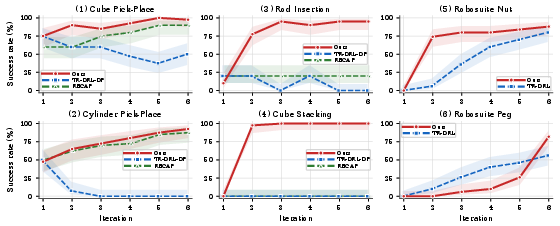
Figure 5: Success rates for Isaac Lab and Robosuite tasks by self-improvement iteration.
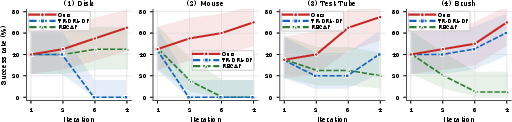
Figure 6: Success rates for real-world robot tasks across self-improvement iterations.
Auto-E2H consistently outperforms direct hard-demo baselines: with identical demonstration budgets (e.g., 50 real-world demos), it reduces per-demo collection time by 50–70% and yields final success improvements of 10–20 percentage points. The learned easy-task policy enables automatic resets with an 84.4% success rate, minimizing operator workload.
Ablations: Necessity of Hierarchical Filtering
Ablation experiments on Isaac Lab tasks confirm the necessity of both kinematic and critic-guided filtering. Removing either component significantly degrades success rates and training stability. The full pipeline achieves 96.3% success; ablating kinematic filtering produces only 28.1%, ablating the critic only 44.4%, and training with direct hard-task self-supervision only 16.3%.
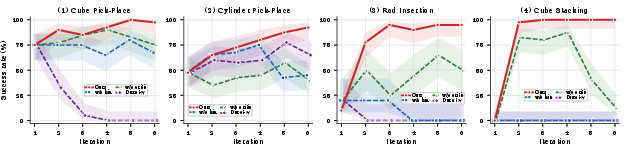
Figure 7: Ablation studies demonstrating the complementary impact of kinematic and critic-guided filtering.
Filtering Mechanisms: Adaptation to Task Geometry
Empirical filtering comparisons show Auto-E2H's hierarchical filtering is more aligned with task progress than RL-based reversal filters. Static removal, low-speed resampling, and critic pruning together suppress noise and misalignment in the reversed data, targeting high-value supervision segments.
Theoretical and Practical Implications
Auto-E2H exploits the geometry of task asymmetry to reduce demonstration cost and scaling bottlenecks in imitation learning for manipulation. The closed-loop collection enables broader state coverage, while hierarchical refinement mitigates noise and covariate shift inherent in reversed trajectories. Critic-guided filtering adapts supervision to the evolving state distribution of the hard-task policy, ensuring policy improvement despite imperfect reversibility or noisy environmental transitions.
Practically, Auto-E2H enables scalable learning of complex manipulation policies with minimal dependence on hard-task teleoperation, making it applicable to high-precision, contact-rich domains (assembly, insertion, stacking). Theoretically, the approach suggests a paradigm shift: leveraging reversible and directionally asymmetric tasks as a source of dense supervisory signal, refining demonstrations in a closed feedback loop, and strategically using learned critic models for robust progression filtering.
Limitations and Future Directions
The method is tailored for tasks with strong directional asymmetry, where reversed trajectories correlate with valid forward task solutions. Its utility diminishes in domains with non-reversible dynamics, unstable contacts, or irreversible grasp/release events. Future research could enhance dynamics-aware reversal, task progress modeling, and diversity objectives to further improve robustness. Extensions to hierarchical or compositional tasks, or integration with language-conditioned multimodal policies, are promising avenues.
Conclusion
Auto-E2H demonstrates that temporally reversed easy-task data, when filtered and refined, serve as scalable, high-quality supervision for hard-task manipulation learning. This framework achieves superior data efficiency, minimizes teleoperation cost, and yields monotonic policy improvement across simulated and real-world domains. The approach is a principled synthesis of task geometry exploitation, robust filtering, and iterative improvement, opening new directions for practical manipulation policy learning in AI and robotics.

