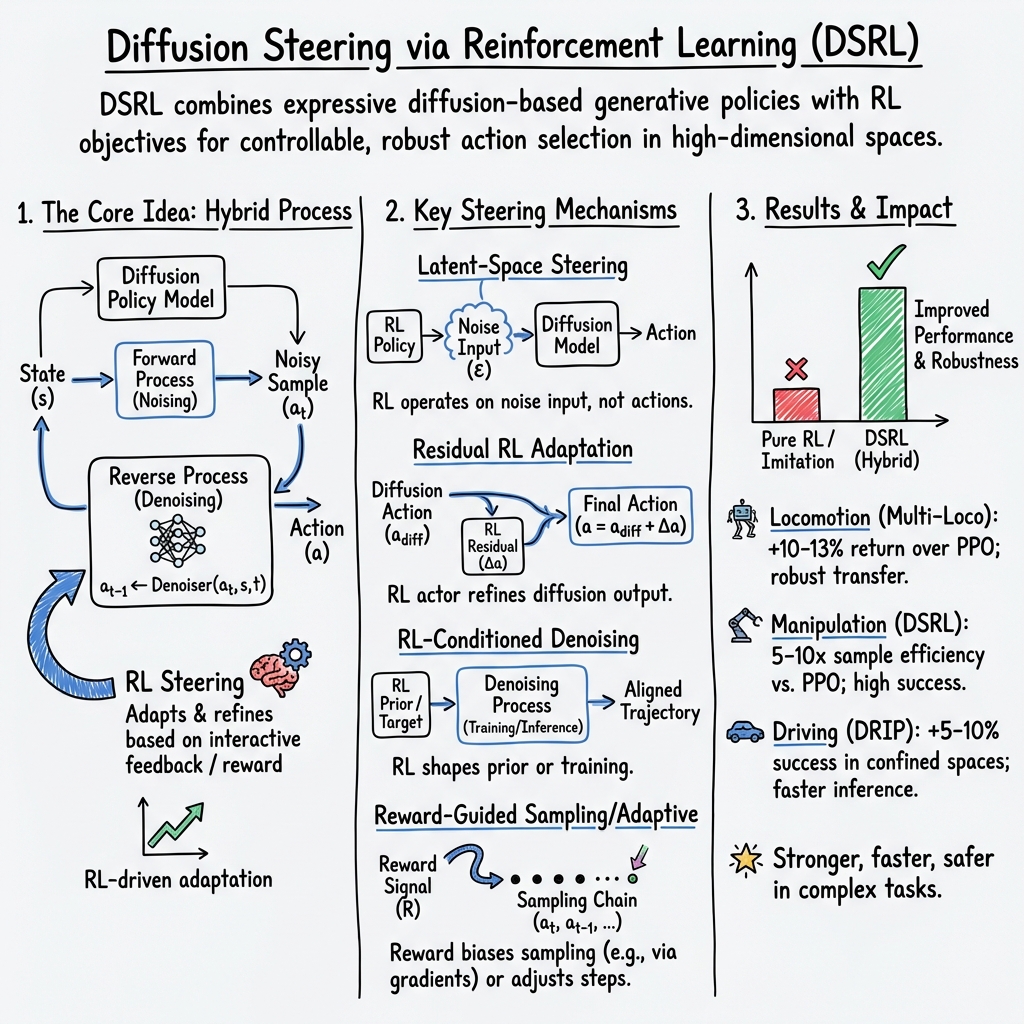
Diffusion Steering via Reinforcement Learning
- Diffusion Steering via Reinforcement Learning (DSRL) is a technique that fuses diffusion-based generative modeling with RL to steer complex action selection in continuous, high-dimensional spaces.
- The methodology integrates RL objectives with the expressive sampling of diffusion models through latent-space steering, residual adaptation, and reward-guided updates to enhance exploration and robustness.
- Practical implementations in robotics and autonomous driving demonstrate significant improvements in sample efficiency and controllable performance, validating the approach’s versatility and impact.
Diffusion Steering via Reinforcement Learning (DSRL) is a class of algorithms that integrate diffusion-based generative policies with reinforcement learning (RL) objectives to achieve high-performance, controllable, and robust action selection in continuous or high-dimensional action spaces. This methodology leverages the expressivity of diffusion models—which are capable of modeling complex, multi-modal action distributions—and couples them with RL-driven adaptation, sample selection, or direct guidance, enabling efficient adaptation, improved robustness, enhanced exploration, and task-aware fine-tuning, while often retaining a black-box interface to the generative backbone.
1. Formalization of Diffusion Steering via RL
The core of DSRL is the formulation of control or planning as a hybrid process, where a diffusion model generates plausible actions or trajectories conditioned on state, and RL mechanisms act to adapt, steer, or refine these actions based on interactive or reward-driven feedback (Wagenmaker et al., 18 Jun 2025, Yang et al., 13 Jun 2025, Jiang et al., 15 Oct 2025).
Diffusion Policy Model
A diffusion policy is a conditional generative process that learns to produce an action given a state . The generative process consists of a forward (noising) process and a reverse (denoising) process:
- Forward Process: A clean action is progressively noised:
where is a noise schedule and .
- Reverse Process: A neural denoiser, parameterized by , maps noisy samples back to the clean action via:
with typically predicting the noise component.
RL Steering Paradigms
DSRL research spans several distinct, but occasionally overlapping, mechanisms for "steering" the generative process with RL:
- Latent-Space Steering: RL operates not on generated actions directly, but on the noise/latent input to the diffusion model, allowing black-box adaptation without modifying the generator weights (Wagenmaker et al., 18 Jun 2025).
- Residual RL Adaptation: A lightweight RL-trained policy outputs a residual or correction to the action sampled from the diffusion model (Yang et al., 13 Jun 2025), refining outputs online for task specificity.
- RL-Conditioned Denoising: RL objectives are integrated directly into the denoising training process, for example by initializing the forward process from an RL prior distribution or by aligning the diffusion trajectory to RL-guided targets (Jiang et al., 15 Oct 2025).
- Reward-Guided Sampling: Reward gradients or advantage signals are injected into the sampling chain or back-propagated through the diffusion denoiser to bias sampling toward high-reward trajectories (Song et al., 5 Jul 2025).
- Run-Time Adaptive Steering: RL-trained meta-controllers determine parameters of the denoising (such as the number of steps per action) in real time, balancing compute with precision (Yu et al., 9 Aug 2025).
2. Methodological Instantiations
Recent research demonstrates multiple architectural and algorithmic frameworks for DSRL, with representative algorithms and findings summarized in the following table.
| Paper / System | Approach type | Key Steering Principle |
|---|---|---|
| Multi-Loco (Yang et al., 13 Jun 2025) | Residual RL adaptation | RL actor refines diffusion prior output |
| DSRL (Wagenmaker et al., 18 Jun 2025) | Latent-space RL | SAC/PPO over diffusion noise input |
| DRIP (Jiang et al., 15 Oct 2025) | RL prior initialization | RL policy shapes diffusion start / loss |
| DIVER (Song et al., 5 Jul 2025) | Reward-guided sampler | Policy gradients via reward on sampled trajectories |
| COLSON (Tomita et al., 18 Mar 2025) | RL-critic score matching | Critic-induced score-matching objective in denoiser |
| D3P (Yu et al., 9 Aug 2025) | Adaptive denoising | RL meta-policy allocates denoising steps per action |
Multi-Loco unifies cross-morphology locomotion via a morphology-agnostic diffusion model trained offline, steered at deployment by a shared RL-trained actor that outputs small residuals to the proposed action. The RL policy is optimized via PPO with per-morphology critics, preserving generalization from diffusion while injecting task-aware controllability (Yang et al., 13 Jun 2025).
DSRL maintains a fixed, possibly black-box, diffusion policy trained via behavioral cloning, and learns a latent-space RL policy over the noise input. This MDP reformulation enables highly sample-efficient adaptation and outperforms both direct RL and behavioral cloning approaches in both simulation and real-robot settings (Wagenmaker et al., 18 Jun 2025).
DRIP leverages a well-trained RL policy to provide prior distributions for action selection. Diffusion training aligns its forward process to this RL prior, and inference is initialized from prior samples followed by a short denoising chain, marrying RL's sample efficiency with diffusion's expressivity (Jiang et al., 15 Oct 2025).
DIVER and COLSON directly inject reward, critic, or advantage information into the denoising process via RL or reward-guided objectives. DIVER implements PPO/GRPO on samples generated by the diffusion process to maximize diversity and safety, thus addressing mode collapse; COLSON employs a Q-Score Matching objective for RL-conformant score estimation (Song et al., 5 Jul 2025, Tomita et al., 18 Mar 2025).
D3P introduces meta-RL steering: a separate RL-trained controller adaptively selects the number of internal denoising steps per output action, based on the criticality of the timestep, optimizing the speed-accuracy tradeoff and outperforming static baselines (Yu et al., 9 Aug 2025).
3. Mathematical Description of RL Integration
Several representative mathematical formulations are prevalent in DSRL:
- Latent-Action MDP (Wagenmaker et al., 18 Jun 2025):
0
Critic and actor updates minimize TD and maximize entropy-regularized return over noise 1.
- Diffusion Q-Learning with RL Prior (Jiang et al., 15 Oct 2025):
2
With 3 a modified noise-prediction loss over RL prior-aligned samples.
- Reward-Guided Reverse Update (Song et al., 5 Jul 2025):
4
Where 5 is a trajectory-level reward, and RL gradients shape the reverse diffusion samples directly.
- Q-Score Matching (Tomita et al., 18 Mar 2025):
6
Aligns the score estimate used in denoising with gradients from a value function learned by RL.
4. Experimental Benchmarks and Empirical Results
DSRL frameworks consistently demonstrate empirical improvements over both pure RL and pure imitation (BC/diffusion) baselines across complex robotics and autonomous driving benchmarks.
- Multi-Loco (Yang et al., 13 Jun 2025): Hybrid diffusion+RL policies achieve 7--8 return increases over PPO on real-world legged robots, with robust zero-shot transfer to unseen morphologies.
- DSRL (Wagenmaker et al., 18 Jun 2025): Achieves 9--0 lower sample requirements than PPO for adaptation on Robomimic; 1 success in real Franka pick-and-place in 2 steps.
- DRIP (Jiang et al., 15 Oct 2025): Outperforms PPO, SAC, and diffusion-from-scratch methods by 3 (IL) and 4 (RL) average success in confined-space parking, with inference times of 518.5 ms/step.
- D3P (Yu et al., 9 Aug 2025): 2.2x inference acceleration in simulation, 1.92x on Franka, at matched or improved success rates.
- DIVER/COLSON/VDRive (Song et al., 5 Jul 2025, Tomita et al., 18 Mar 2025, Guo et al., 17 Oct 2025): Show improved trajectory diversity, safety, and performance on closed-loop driving and social navigation benchmarks compared to standard RL or imitation methods.
5. Theoretical Insights and Generalization
DSRL leverages a separation of concerns between expressive generative modeling and task-adaptive control. Theoretical justifications (as formalized in (Wagenmaker et al., 18 Jun 2025)) include the equivalence between optimizing an RL objective over the latent noise and optimizing the composed policy on the original MDP. Reward-guidance, either through gradients in the reverse process or via critic-based loss shaping, has the effect of biasing the generative process towards actionable, high-return behaviors. Constraints such as residual penalties and conservative noise aliasing are utilized to maintain stability, prevent over-correction, and ensure that exploration remains within the support of the imitation-trained prior.
A key limitation, evidenced across several works, is that DSRL (in all forms) cannot discover truly novel behaviors outside the support or expressivity of the base diffusion policy; in particular, limited dispersion or inaccurate datasets result in a cap on policy improvement. Integration of few-shot finetuning, action-free pretraining, or more expressive/adaptive RL steering is an area of active research.
6. Practical Implementation and Extensions
Implementation of DSRL involves modular combination of a pre-trained or concurrently trained diffusion policy with reinforcement learning components (residual actor, critic, adaptive controller, etc.). Black-box DSRL (as in (Wagenmaker et al., 18 Jun 2025)) enables steering of proprietary or pre-trained models with minimal requirements. Hyperparameter and architecture guides (UTD ratios, actor/critic size, etc.) are detailed in the respective papers. Real-time applications leverage adaptations such as truncated denoising with RL-informed initialization (Jiang et al., 15 Oct 2025), dynamic step allocation (Yu et al., 9 Aug 2025), or efficient reverse chain implementations.
Potential extensions are being investigated, including:
- Steering other classes of generative policies (e.g., transformers) via RL.
- Applying DSRL to domains such as image or protein design, where explicit reward signals can bias generative models for structure, diversity, or novelty.
- Hierarchical or meta-learned RL steering controlling deeper aspects of the generative process (e.g., per-timestep distributional parameters or sampling rules).
7. Representative Applications
DSRL has been deployed in a variety of robotic and autonomous driving settings, including:
- Cross-embodiment locomotion for quadrupeds, bipeds, and humanoids with domain-agnostic generalization (Yang et al., 13 Jun 2025).
- End-to-end and hierarchy-based autonomous driving, with demonstration-based pretraining and RL-fine-tuned diffusion action/trajectory heads (Guo et al., 17 Oct 2025, Song et al., 5 Jul 2025).
- Constrained-space planning, where RL-informed diffusion yields faster and more reliable solutions in parking and narrow navigation scenarios (Jiang et al., 15 Oct 2025).
- Social navigation in dense pedestrian environments, with diffusion policies trained for collision-avoidance, smoothness, and obstacle guidance (Tomita et al., 18 Mar 2025).
- Real-time manipulation with adaptive compute allocation, reducing latency without accuracy loss (Yu et al., 9 Aug 2025).
- Black-box generalist policy adaptation and robotic skill improvement in real-world settings (Wagenmaker et al., 18 Jun 2025).
References: (Yang et al., 13 Jun 2025) "Multi-Loco: Unifying Multi-Embodiment Legged Locomotion via Reinforcement Learning Augmented Diffusion" (Wagenmaker et al., 18 Jun 2025) "Steering Your Diffusion Policy with Latent Space Reinforcement Learning" (Jiang et al., 15 Oct 2025) "A Diffusion-Refined Planner with Reinforcement Learning Priors for Confined-Space Parking" (Song et al., 5 Jul 2025) "Breaking Imitation Bottlenecks: Reinforced Diffusion Powers Diverse Trajectory Generation" (Tomita et al., 18 Mar 2025) "COLSON: Controllable Learning-Based Social Navigation via Diffusion-Based Reinforcement Learning" (Yu et al., 9 Aug 2025) "D3P: Dynamic Denoising Diffusion Policy via Reinforcement Learning" (Guo et al., 17 Oct 2025) "VDRive: Leveraging Reinforced VLA and Diffusion Policy for End-to-end Autonomous Driving"