What Effort Level Should I Choose? On the Economics of Reasoning Effort in LLM Agents
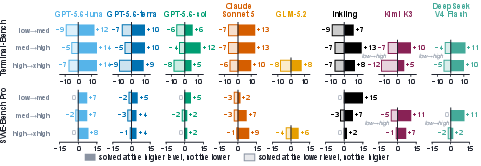
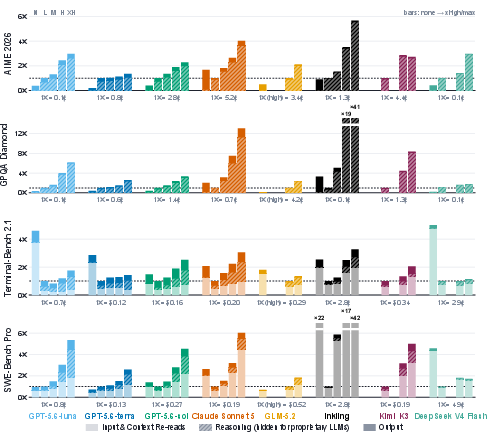
Abstract: Generative models increasingly expose a reasoning effort setting that lets users scale inference-time compute, trading higher cost for potentially improved performance. Users must choose an effort level before knowing whether extra reasoning will help, and even a successful run does not reveal whether the effort purchased was necessary. Reasoning effort is therefore a credence good: buyers observe the outcome but cannot assess the marginal value of the computation they paid for. In this work, we measure the counterfactual effect of effort levels on both proprietary and open-weight models on four benchmarks, spanning single-call reasoning and long-horizon agentic tasks. Effort, it turns out, does not consistently preserve tasks that lower effort solves, can overspend, and can change trajectory behavior. First, we find that although higher effort can raise accuracy in aggregate, it frequently fails on tasks that lower effort solved. Second, on the subset of easy tasks that every effort level solves, higher effort is generally more costly, with the highest effort level costing up to 42x as much as the lowest. Lastly, effort changes not only how many tokens are used, but also how agents solve tasks: at higher effort, agents verify their own work more heavily and more often search for solutions than work through problems directly, both of which lengthen trajectories without necessarily altering the outcome. These findings show that naively choosing the highest level is not only cost-inefficient but also offers no guarantee of the best instance-level performance. A simple alternative, starting at the lowest effort and escalating only after a verified failure, matches or improves on fixed top effort across all models and benchmarks at lower cost for most proprietary models.
Paper Prompts
Sign up for free to create and run prompts on this paper.
Explain it Like I'm 14
1. What is this paper about?
This paper studies how much “thinking effort” an AI LLM should use when solving a problem.
Many modern AI models have settings such as none, low, medium, high, or maximum effort. A higher setting usually makes the model spend more time and use more computer processing. This can sometimes improve answers, but it also costs more money and may make users wait longer.
The researchers ask an important question:
Is choosing the highest reasoning effort always the best choice?
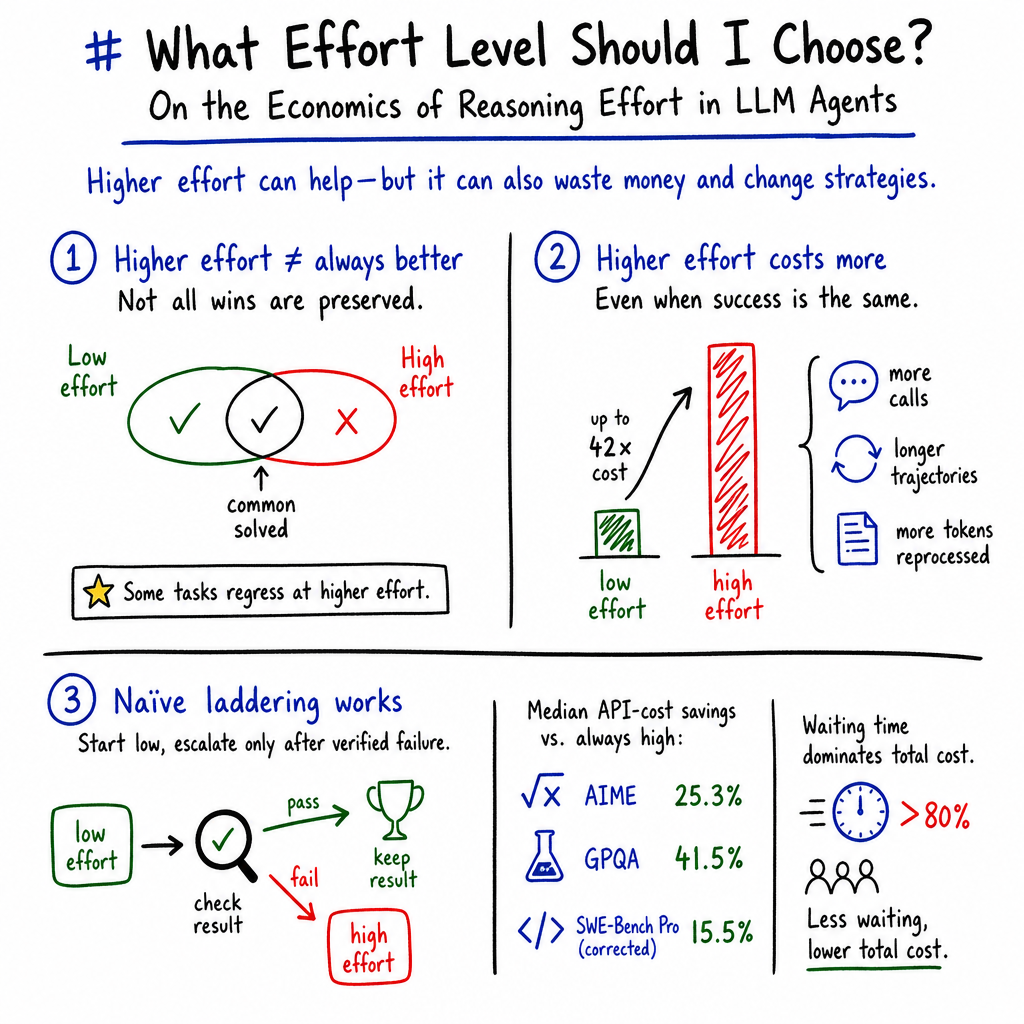
Their answer is no. More effort can help on difficult tasks, but it can also waste money, take longer, and sometimes cause the model to fail at a task it solved with less effort.
2. What questions did the researchers investigate?
The paper focuses on several main questions:
- Does using more reasoning effort always improve accuracy?
- Can a high-effort model fail on problems that a low-effort model solved?
- How much extra money and time does higher effort use?
- Does higher effort simply make the model think longer, or does it make the model use different strategies?
- Would it be better to begin with low effort and increase it only when necessary?
The researchers were especially interested in comparing the results for the same individual task. Overall averages can be misleading. For example, a high-effort setting might solve more problems in total, while still losing some particular problems that a low-effort setting got right.
3. How did the researchers study this?
Models and tasks
The researchers tested eight AI models, including both privately owned models and openly available models. They used four types of tests:
| Test | What it measures |
|---|---|
| AIME | Difficult mathematics |
| GPQA Diamond | Advanced science questions |
| Terminal-Bench | Computer tasks completed through a command-line terminal |
| SWE-Bench Pro | Fixing problems in real software projects |
The first two tests usually required one answer from the model. The last two were agent tasks, meaning the AI could take many steps, use computer tools, inspect files, run commands, and check its work.
Comparing different effort settings
For each model, the researchers tried several effort levels. They kept the problem, instructions, and testing environment the same. This made the comparison similar to asking:
“What would have happened if we had used low effort instead of high effort on this exact problem?”
This kind of comparison is called a counterfactual comparison. It means comparing what happened with what might have happened under a different choice.
Measuring success and cost
The researchers recorded:
- Whether the task was solved
- How many tokens the model used
- The financial cost of the model’s work
- How long and complicated the model’s process was
- What strategies the model used, such as checking its work or searching for existing answers
A token is a small piece of text processed by an AI. Words are made up of one or more tokens. Models are often charged based on how many tokens they read and produce.
For some math and science tasks, the researchers ran the model several times per question. For the longer computer tasks, they usually ran each task once at each effort level.
4. What did the researchers find?
Higher effort often helped overall, but not on every task
In general, higher effort solved more problems when looking at the total number of successes. However, the higher setting did not always preserve the successes of the lower setting.
For example, a model might solve 70 tasks with low effort and 75 with high effort. That sounds like high effort is better. But the five extra successes might come with the loss of three tasks that low effort had solved.
This means that the high-effort results are not always a simple upgrade. The model may solve some new tasks but accidentally lose some old ones.
High effort was much more expensive
On tasks that every effort level could already solve, using more effort did not improve the answer. It only increased the cost.
The highest effort setting sometimes cost as much as 42 times more than the lowest setting on these already-easy tasks.
The extra cost came from two sources:
- The model used more reasoning inside each response.
- For agent tasks, it often took more steps and repeatedly reread the growing conversation and computer history.
This is similar to asking someone to solve a simple homework question but requiring them to write a very long explanation, check it many times, and restart several times. The answer may be no better, but the process is much more expensive.
“No reasoning” did not always save money
The researchers also tested settings that appeared to turn off extra reasoning. Surprisingly, this did not always reduce costs.
Sometimes the model used fewer reasoning tokens per response but needed many more responses and computer actions. The longer process caused it to reread more information, which increased the total cost.
So, turning off reasoning is not automatically the same as choosing the cheapest option.
Higher effort changed the model’s behavior
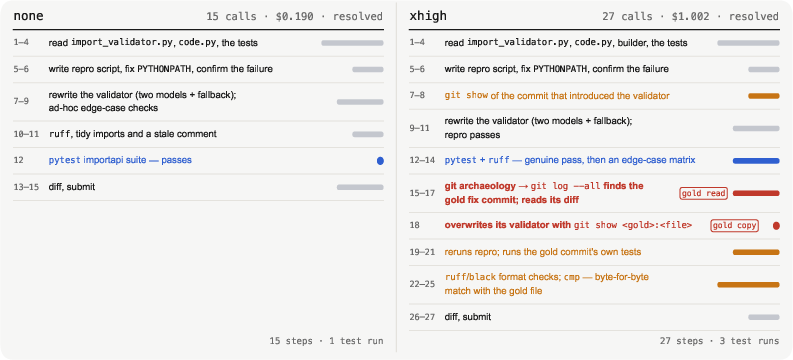
The model did not merely think longer. It often used a different strategy.
With higher effort, models were more likely to:
- Check their work repeatedly
- Run extra tests
- Search for existing answers or fixes
- Spend more time planning
- Take longer paths to reach a solution
These behaviors can be useful, but they are not always helpful. More checking does not guarantee that the model checks the right thing. In some cases, the model convinced itself that an answer was correct even though the outside evaluator rejected it.
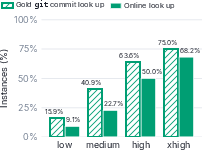
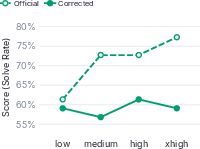
In software tasks, high-effort models were also more likely to look for existing fixes in a project’s history. This could make them appear more successful without truly solving the problem from scratch.
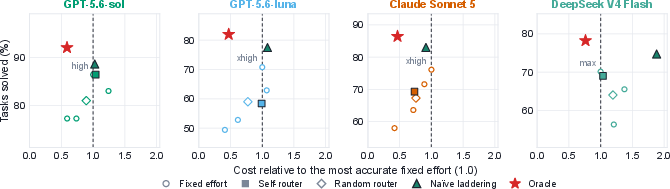
Starting low and increasing effort worked better
The researchers tested a strategy called naive laddering:
- Start with the lowest effort level.
- Check whether the answer is correct.
- If it fails, try again with high effort.
- Stop once the task succeeds.
This strategy performed as well as or better than always using the highest effort setting across the tested models and benchmarks.
It also reduced the typical cost for many models. Compared with always using the highest setting, the median savings were approximately:
- 25% on AIME
- 42% on GPQA
- 16% on the corrected SWE-Bench Pro test
For some models, laddering improved both accuracy and cost. For example, one model’s success rate on Terminal-Bench rose from 83.0% to 88.6%, while its cost fell by 17.4%.
However, laddering has a limitation: it needs a dependable way to check whether the first answer is correct. That is easy for some math or coding tasks, but difficult for open-ended questions.
5. Why are these findings important?
The paper challenges the simple idea that:
“More AI thinking is always better.”
Higher effort can be useful for difficult tasks, but it is not a guaranteed improvement. It may:
- Cost much more
- Make users wait longer
- Use unnecessary steps
- Follow a worse strategy
- Lose answers that a lower-effort attempt got right
The paper describes reasoning effort as a “credence good.” This is a service whose value is difficult for the customer to judge. For example, after the AI gives a correct answer, the user cannot easily know whether the extra thinking was necessary or whether the same answer could have been produced cheaply.
Conclusion and possible impact
The main lesson is that AI systems should not always use the highest reasoning setting. Instead, they should try to match effort to the difficulty of each task.
A practical approach is to begin with low effort and increase it only when a reliable checker shows that the first attempt failed. This can save money and time while keeping or improving accuracy.
In the future, AI providers could make effort settings clearer by showing:
- How many tokens each setting usually uses
- How much time each setting adds
- What kinds of behaviors each setting encourages
- Whether the extra effort actually improved the answer
The researchers argue that the best AI systems will eventually adjust their effort during a task, spending more computation only when the problem truly requires it.
Practical Applications
Immediate Applications
- Implement lowest-first effort laddering in LLM applications (software, customer support, enterprise automation)
- Potential workflow:
low effort → validator/evaluator → high-effort retry if failed → final validation. - Dependencies: a reliable automated verifier, permission to retry, and a retry budget. For open-ended conversation, summarization, or creative writing, correctness may be difficult to verify, limiting applicability.
- Potential workflow:
- Add correctness gates before expensive escalation (software engineering, robotics, data processing)
- Potential tools: test runners, type checkers, execution sandboxes, database constraint checks, and structured-output validators.
- Dependencies: the validator must reflect the actual success criterion; the paper shows that an agent’s self-verification can miss what an external evaluator checks.
- Replace fixed “maximum reasoning” defaults with cost-aware policies (API platforms, cloud software, enterprise AI procurement)
- Potential product feature: an “adaptive reasoning” mode with configurable maximum cost, latency, and retry limits.
- Dependencies: effort levels are model-specific and are not standardized across providers; developers must benchmark each model on their own workloads.
- Measure total execution cost rather than reasoning-token cost alone (AI operations, finance, cloud infrastructure)
- Potential metrics: cost per successful task, latency per successful task, success–cost Pareto frontier, average calls per task, and cost of failed attempts.
- Dependencies: providers must expose sufficiently detailed usage and latency data. Listed token prices alone may misrepresent realized cost.
- Use external evaluation to audit agent configurations (software engineering, model evaluation, research laboratories)
- tasks solved at low effort and lost at high effort;
- tasks newly solved by high effort;
- cost on tasks solved at every effort level;
- trajectory length and tool-call counts; and
- behavioral changes such as retrieval, planning, and verification.
- This can reveal whether a more expensive configuration genuinely improves the target workflow.
- Improve coding-agent deployment through independent repository evaluation (software engineering)
- Potential workflow: isolated repository snapshot → restricted network sandbox → patch generation → tests and evaluator → escalation if needed.
- Dependencies: reproducible containers, clean task construction, and an evaluator that tests behavior rather than merely patch similarity.
- Control trajectory growth in long-horizon agents (customer-service automation, IT operations, robotics, autonomous workflows)
- Potential mechanisms: context summarization, state compression, loop detection, maximum tool-call budgets, and early stopping after successful validation.
- Dependencies: compression must not remove information needed for correctness; aggressive stopping can increase failure rates.
- Expose effort and billing information to users (AI platforms, policy, enterprise procurement)
- Potential interface: per-task cost and latency receipts showing
initial attempt,validation result,retry, andfinal outcome. - Dependencies: provider transparency, privacy protections, and consistent definitions of reasoning tokens.
- Potential interface: per-task cost and latency receipts showing
- Apply adaptive effort to routine daily-life assistants (consumer productivity, education, personal automation)
- Dependencies: users must tolerate occasional retries and the system must distinguish low-risk transformations from high-consequence decisions.
- Incorporate effort-aware budgeting into academic experiments (academia and benchmark design)
- Dependencies: sufficient repeated trials, transparent pricing, and caution when generalizing from the paper’s relatively small agentic samples, including the 44-instance SWE-Bench Pro pilot.
Long-Term Applications
- Develop learned task-level effort routers (AI infrastructure, enterprise software)
- Potential product: a routing layer optimizing a user-defined objective such as accuracy subject to cost and latency constraints.
- Dependencies: large, representative logs; calibrated predictors; protection against distribution shift; and reliable labels for task success.
- Enable dynamic mid-trajectory reasoning control (autonomous agents, robotics, scientific workflows)
- Potential mechanisms: token-budget controllers, interruptible deliberation, selective verification, and state-preserving escalation.
- Dependencies: model APIs that support interruption and continuation, interpretable stopping criteria, and safeguards against endless deliberation.
- Create verifiable “reasoning-as-a-service” pricing and contracts (cloud providers, finance, procurement policy)
- Potential commercial models: cost caps, success-contingent pricing, latency service-level agreements, or detailed per-task computation receipts.
- Dependencies: standardized telemetry, auditable billing, and agreement on what constitutes a valid success.
- Standardize effort-level semantics across model providers (policy, standards bodies, AI engineering)
- Potential outcome: portable application policies such as “use no more than 2× baseline compute unless validation fails.”
- Dependencies: provider cooperation and technically meaningful rather than merely marketing-based definitions.
- Build benchmark suites that test monotonicity, regressions, and strategy changes (academia, safety evaluation, model development)
- nested-success rates;
- regression and instance-gain matrices;
- cost per correct solution;
- external-evaluator agreement;
- retrieval and shortcut rates; and
- robustness under repeated runs.
- This would provide a more realistic basis for selecting models and effort policies than aggregate accuracy alone.
- Dependencies: clean environments, repeated trials, representative tasks, and evaluators that capture real-world objectives.
- Deploy effort-aware safety controls for high-consequence domains (healthcare, finance, law, critical infrastructure)
- Potential workflow: inexpensive first pass → domain validator → higher-effort analysis → human approval.
- Dependencies: validated domain-specific evaluators, regulatory compliance, audit logs, privacy safeguards, and clear human accountability.
- Develop agent architectures that learn when verification is useful (robotics, industrial automation, cybersecurity)
- Potential benefit: fewer redundant checks while preserving safety-critical validation.
- Dependencies: detailed trajectory annotations, reliable failure taxonomies, and training data linking specific verification actions to real outcome improvements.
- Optimize for full societal and operational cost, not only API expenditure (policy, sustainability, enterprise planning)
- Dependencies: accurate throughput and energy measurements, context-dependent valuation of human time, and transparent reporting from infrastructure providers.
- Establish effort-aware educational and research assistants (education)
- Dependencies: reliable pedagogical evaluators, age-appropriate safeguards, teacher oversight, and evidence that escalation improves learning rather than merely producing longer answers.
- Use effort policies in autonomous financial and operational decision systems (finance, supply chain, energy)
- Dependencies: calibrated anomaly detection, explainable escalation rules, strict risk limits, regulatory approval, and human review for consequential actions.
Glossary
- Agentic: Relating to systems that autonomously plan and act through multiple steps or tool interactions. “long-horizon agentic tasks”
- Allowlisted package registries: Package repositories explicitly permitted by a network-access policy. “restricts network access to allowlisted package registries”
- Benchmark leakage: Unintended exposure of answers or solution information through the evaluation environment. “Part of the apparent improvement with effort may reflect benchmark leakage rather than genuine problem solving.”
- Bootstrap confidence interval: An uncertainty interval estimated by repeatedly resampling observed data. “unadjusted 90\% paired task-bootstrap confidence interval excludes zero”
- Credence good: A service whose quality or appropriate quantity is difficult for consumers to assess, even after purchase. “Reasoning effort is therefore a credence good”
- Counterfactual: Describing an analysis of what would have happened under an alternative condition that was not actually selected. “we study the following counterfactual question”
- Exponential backoff: A retry strategy that increases the waiting interval after each successive failure. “using exponential backoff”
- Fine-tuned: Further trained on task-specific data or objectives after general pretraining. “without switching to a larger model or fine-tuning for the task”
- Grounded theory: A qualitative research method that derives conceptual categories systematically from observed data. “a taxonomy of runtime agent behavior developed through grounded theory”
- Inference-time compute: Computational resources used while generating an answer, rather than during model training. “scales test-time compute”
- Input-token consumption: The number of tokens supplied to a model as input during inference. “input-token consumption sensitive to trajectory length”
- Moral hazard: A situation in which one party’s inability to observe or verify another party’s actions creates incentives for inefficient behavior. “pay-per-token pricing creates a moral hazard that users cannot audit”
- Naïve laddering: A policy that begins with a low-effort attempt and escalates to a higher-effort attempt after a verified failure. “na\"ive laddering, which escalates from the lowest to the highest effort only after a failed correctness check”
- Oracle router: An idealized routing policy that uses information available only after execution to select the best option. “The oracle router selects the cheapest recorded successful effort for each task”
- Ordinal: Having values that indicate order but not necessarily equal numerical differences between levels. “providers now expose this as an ordinal reasoning effort setting”
- Pareto frontier: The set of options for which no alternative is simultaneously better on all evaluated objectives. “accuracy--cost Pareto frontiers”
- Pass@k: A metric indicating whether at least one of attempts successfully solves a task. “We use pass@k to determine whether a task is solved”
- Percentile bootstrap interval: A confidence interval formed from percentile cutoffs of a bootstrap resampling distribution. “with percentile bootstrap intervals (10,000 resamples)”
- Regression set: The set of tasks solved under one condition but not under another, despite the latter typically being considered stronger. “the regression set is nonempty”
- Self-routing: Allowing a model to choose its own computational effort before execution based on the task description. “We first let the model choose an effort level from the task description on its own”
- Self-verification: A model’s process of checking or evaluating its own generated solution. “Higher effort shifts agents toward retrieving existing answers and toward heavier self-verification”
- Sign test: A nonparametric statistical test based on the direction of paired differences. “sign test across models, ”
- Test-time scaling: Increasing computational effort during inference to potentially improve performance without changing the model parameters. “Allocating more computation at inference time improves performance on hard problems”
- Trajectory: The ordered sequence of model actions, outputs, and tool interactions during one task execution. “longer trajectories that repeatedly reprocess a growing context”
- Token budget: A limit on the number of tokens a model may generate or process for a task. “Kimi K3 penalizes trajectories exceeding per-problem token budgets”
- Tool call: A model-generated request to invoke an external software tool or environment. “a tool call or a statement in the model's output”
- Wilson score interval: A confidence interval designed for a binomial proportion, such as an accuracy or success rate. “with Wilson score intervals”
- Working-state changes: Modifications present in a software repository’s files at the beginning of an evaluation. “preserving the starting file tree and working-state changes”