Chaos and bifurcations in continuous language-model feedback
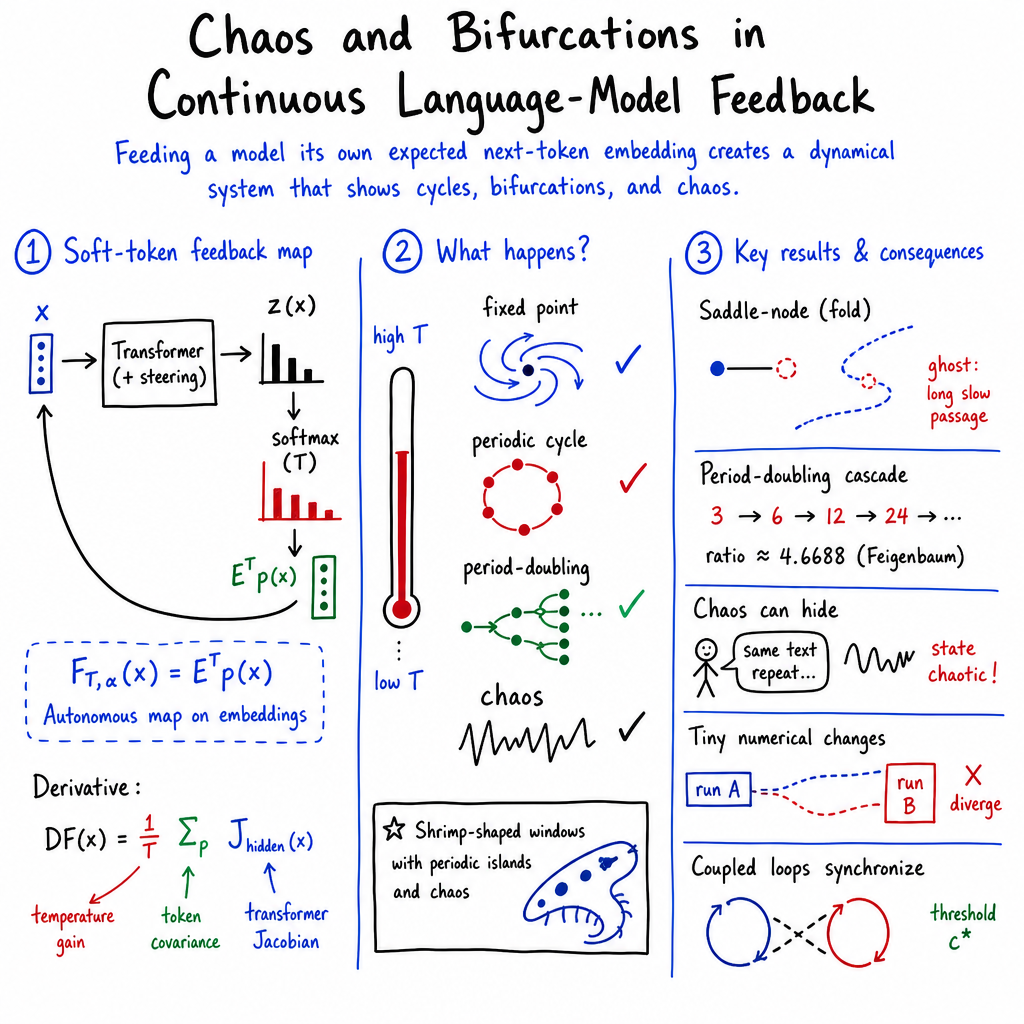
Abstract: Feeding a pretrained LLM the expected embedding of its own next-token distribution turns it into a discrete-time dynamical system with continuous states. Across Qwen2.5, OLMo-2 and Llama-3 models from 0.5B to 72B parameters, temperature and activation steering move this loop between repeating text and chaos, with positive finite-time Lyapunov exponents. The loop's derivative factorizes into the inverse temperature, the covariance of token embeddings under the next-token distribution (a cross-covariance for untied embeddings) and the network's Jacobian. In one model studied in detail, along recorded orbits, the growth that steering adds comes mainly from the readout, where next tokens compete. The periodic windows show the quantitative signatures of low-dimensional maps, from saddle-node scaling and Feigenbaum's constant to shrimp-shaped domains; passage times predicted in advance from the model's derivatives came within one return-map iterate of the measured passage times in 42 of 48 cases over two prospective stages (24 and 18 of 24), and interval arithmetic proves attracting periodic orbits of the full transformer map. Numerical reproducibility depends on the dynamical regime: changing only the batch layout changed the text of 173 of 192 chaotic float64 loops in the smallest model, compared with only 7 of 192 periodic ones. These results show that bifurcation theory can make quantitative predictions about continuous language-model feedback, with rigorous guarantees for selected periodic orbits of the full transformer.
Paper Prompts
Sign up for free to create and run prompts on this paper.
Top Community Prompts
Explain it Like I'm 14
1. What is the paper about?
This paper studies what happens when a LLM is given a soft version of its own answer as its next input.
Normally, a LLM chooses a word or token, such as “the,” and then uses that token to help choose the next one. In this study, the model does something slightly different: it looks at all possible next tokens, gives each one a probability, and creates an average of their word-embedding vectors. This average is fed back into the model.
The researchers treat this process like a scientific dynamical system—a system that changes step by step over time. They ask whether the model eventually:
- Settles into a repeating pattern of text, or
- Becomes chaotic, meaning that tiny differences grow and make its future behavior hard to predict.
2. What questions did the researchers ask?
The main questions were:
- Can a LLM become chaotic when it receives its own continuous output?
- How do temperature and activation steering affect the model’s behavior?
- Can mathematical ideas from chaos theory predict what the model will do?
- Why does the model become chaotic?
- How sensitive are the results to small computer-rounding differences?
Here, temperature controls how random or spread out the model’s predictions are. A low temperature makes the model strongly favor one token, while a higher temperature gives more possibilities similar probabilities.
Activation steering means adding a carefully chosen direction to the model’s internal signals. It is like gently pushing the model toward a concept, such as philosophy or hostility, without changing its learned weights.
3. How was the research carried out?
Creating the feedback loop
The researchers used several open LLMs, including models from the Qwen, OLMo, and Llama families. Their sizes ranged from about 500 million to 72 billion parameters.
They used a fixed prompt and repeatedly performed this process:
- Give the model a current continuous input.
- Ask the model for probabilities for all possible next tokens.
- Calculate a probability-weighted average of the token embeddings.
- Feed that average back as the next input.
- Repeat.
A token embedding is a long list of numbers that represents a token’s meaning and relationships to other tokens. The weighted average is like asking, “What would the model’s next input be if we blended all of its possible answers together according to their probabilities?”
This makes the model’s state continuous instead of forcing it to choose only one token at each step.
Changing the model’s behavior
The researchers changed two main controls:
- Temperature: how sharply the model favors its most likely tokens.
- Steering strength: how strongly the model was pushed in a chosen direction, such as “philosophy.”
They then scanned many combinations of these two controls. For each combination, they observed whether the model repeated a pattern or behaved chaotically.
Measuring chaos
The researchers used a quantity called a Lyapunov exponent. In simple terms, this measures what happens to two nearly identical starting points:
- If they move closer together, the system is stable.
- If they separate quickly, the system may be chaotic.
A positive largest Lyapunov exponent suggests that nearby paths pull apart.
The researchers also looked for repeating cycles, such as a pattern that repeats every 2, 3, or 8 steps.
Studying the model’s derivative
The paper calculates the model’s derivative, which describes how much the next state changes when the current state changes slightly. This is similar to checking how much a small push to a moving object changes its next position.
The derivative was divided into two main parts:
- The network part, describing how the transformer changes its internal representation.
- The readout part, describing how changes in internal signals alter the probabilities of competing tokens.
This helped the researchers identify where the growth leading to chaos came from.
Using computer-assisted proofs
For some repeating cycles, the researchers used interval arithmetic. This is a careful numerical method that represents values as ranges, such as “between 2.01 and 2.02,” rather than as a single approximate number.
This allowed them to prove that certain repeating patterns really existed and were stable, rather than merely appearing because of numerical error.
4. What did the researchers find?
The model can switch between repetition and chaos
The feedback loop sometimes settled into repeating text. In other regions, it behaved chaotically.
Changing temperature or steering strength could move the model from one behavior to the other. This happened in several model families and across many model sizes.
For example, some settings produced a repeating two-step loop such as “is it,” while other settings produced longer repeating patterns. Some settings produced no obvious repeating pattern and had positive Lyapunov exponents.
Chaotic regions contain repeating “windows”
Chaos was not spread randomly across the settings. Instead, regions of chaos contained small “windows” where the model became periodic again.
This is similar to patterns seen in famous mathematical systems such as the logistic map. In those systems, a parameter can be changed gradually, causing behavior to move through:
- A stable repeating pattern,
- A longer repeating pattern,
- Chaos,
- Small islands of repetition inside the chaotic region.
The paper found similar behavior in language-model feedback loops.
Period-doubling followed a famous mathematical pattern
Some cycles doubled in length:
- A 2-step cycle became a 4-step cycle.
- Then a 4-step cycle became an 8-step cycle.
- This continued toward chaos.
The ratios between these changes approached Feigenbaum’s constant, a famous number that appears in many systems that develop chaos through repeated period doubling.
This suggests that the LLM’s behavior is organized by the same kind of mathematical structure found in much simpler systems.
The model’s derivatives could make useful predictions
The researchers used the model’s derivatives to predict how long a trajectory would remain near a disappearing periodic orbit.
Their predictions were very accurate: they were within one repeat-map step in 42 out of 48 cases.
This is important because it shows that chaos theory was not merely being used as a description after the fact. It could actually predict some of the model’s future behavior.
Steering mainly increased competition between tokens
The researchers found that steering often increased chaos mainly through the readout stage.
In other words, steering caused several possible next tokens to compete more closely. When tokens have similar probabilities, a small change inside the model can noticeably change their probabilities and therefore change the averaged embedding.
This can amplify small differences between states.
The transformer itself was also important. Without the transformer’s changing internal representations, the feedback system would behave more like a stable energy-minimizing system and would not normally produce cycles or chaos in the tied-embedding case.
Computer rounding mattered greatly in chaotic settings
The researchers ran the same chaotic feedback loop more than once, changing only how requests were grouped into computer batches.
For chaotic runs, 173 of 192 loops produced different text after this tiny computational change. For periodic runs, only 7 of 192 changed.
This is a classic feature of chaos: very small differences can grow until the final result is completely different.
It does not necessarily mean that the model is “broken.” Rather, it means that chaotic systems are naturally sensitive to tiny changes.
Some cycles were mathematically verified
The researchers used rigorous numerical methods to prove that certain periodic orbits existed. For example, they proved the existence of an attracting period-8 orbit, meaning a stable pattern that repeated every eight steps.
They also found cases where stable cycles of different lengths existed at the same parameter setting. Which cycle appeared depended on the starting point.
5. Why are these findings important?
This paper shows that a LLM is not only a tool for producing text. When its continuous output is repeatedly fed back into itself, it can act like a complicated mathematical machine.
The study suggests several important lessons:
- Feedback can create unexpected behavior. A model may repeat itself, switch between patterns, or become chaotic depending on small changes in temperature and steering.
- Chaos theory can help analyze LLMs. Ideas such as periodic windows, bifurcations, Lyapunov exponents, and period doubling were useful for explaining the model’s behavior.
- Small numerical differences can matter. In chaotic regimes, different hardware, batch arrangements, or rounding methods may lead to different text.
- Steering changes more than just the model’s topics. It can change the model’s stability and make several possible tokens compete more strongly.
- Predictions may be possible. Mathematical information from the model’s derivatives can forecast some changes in its behavior and can even prove that certain repeating patterns exist.
Conclusion
The paper’s main message is that continuous self-feedback turns a LLM into a kind of dynamical system. Depending on its settings, the model can settle into stable repeating text or behave chaotically.
This could matter for future language-model systems that use hidden states, soft tokens, or repeated internal reasoning. Developers may need to understand whether a system is stable or chaotic, especially when they want reliable and repeatable answers.
At the same time, the research shows that LLMs can be studied using tools from mathematics and physics. Chaos theory may help researchers predict when a model will repeat, when it will become unpredictable, and how small changes in settings or computer calculations can affect its output.
Knowledge Gaps
Knowledge gaps, limitations, and open questions
- Generality beyond the tested models is unresolved. The study examines 15 released models from three dense model families and one mixture-of-experts model, but it does not establish whether the observed bifurcation structure generalizes to other architectures, training objectives, tokenizer designs, modalities, or closed-source models.
- The analysis is dominated by Qwen2.5-0.5B. Detailed claims about folds, normal forms, Feigenbaum scaling, shrimp-shaped windows, and interval-certified attractors are concentrated in one small model, with only limited replication in larger models.
- The behavior of mixture-of-experts models is not rigorously characterized. Because top- routing can create nonsmooth or discontinuous maps, the paper does not determine how routing boundaries affect periodic or chaotic dynamics, Lyapunov exponents, bifurcations, or the validity of smooth-map theory.
- The dependence on the fixed prompt is largely unexplored. Results use a specific system prompt, user message, prefix, and one-token feedback window; it remains unknown how changing topic, wording, chat template, language, or prompt length changes the attractors and bifurcation diagrams.
- The fixed-window construction limits relevance to ordinary generation. The paper explicitly studies an autonomous map with a fixed prefix and one fed-back position, so it does not determine whether comparable dynamics occur when context grows autoregressively, when multiple past soft tokens are fed back, or when the window is truncated dynamically.
- The effect of feedback architecture is not systematically compared. Expected input embeddings, hidden-state feedback, recurrent-depth loops, and other soft-token mechanisms are discussed, but their dynamical regimes are not evaluated under a common experimental framework.
- The consequences for model outputs and task performance remain unclear. The paper shows repeating text and chaotic trajectories but does not systematically measure factuality, coherence, helpfulness, safety, reasoning quality, or task accuracy across dynamical regimes.
- The relationship between continuous-state chaos and discrete generated text is unresolved. Small perturbations can produce divergent continuous states, but the paper does not establish when this divergence leads to substantially different token sequences, semantic content, or downstream answers.
- The operational chaos criterion is not equivalent to a rigorous classification of chaos. A positive finite-horizon exponent and failure to detect periods up to a fixed cutoff do not establish an invariant chaotic attractor, ergodicity, mixing, positive-measure attraction, or topological chaos.
- Attractor structure and basin geometry remain incompletely mapped. The scans generally follow one or a few initial conditions, and the paper documents coexistence and basin-dependent selection but leaves most basins, basin boundaries, basin volumes, and their fractal structure unmeasured.
- Several parameter-plane transitions remain unresolved. Of eight observed switches between attractor families, four were not classified; it is therefore unclear whether they arise from basin crises, attractor destruction, boundary collisions, or numerical effects.
- Long chaotic transients are difficult to distinguish from sustained chaos. Although many labeled cells remain chaotic for steps, the study does not provide asymptotic guarantees or sufficiently long recurrence analyses for all reported chaotic regions.
- The low-temperature exclusion result has a restricted domain. Chaos is excluded only on invariant sets with a uniform logit gap between the leading tokens; near persistent or recurrent ties, the low-temperature behavior remains theoretically unresolved.
- The high-temperature contraction threshold is extremely conservative. The bound based on the global supremum of the network Jacobian lies several orders of magnitude above observed chaotic temperatures, and the paper does not derive a substantially sharper parameter-dependent global stability criterion.
- No sufficient condition for chaos is established. The derivative factorization supplies necessary contraction or expansion diagnostics, but the study does not identify conditions on the readout covariance, network Jacobian, or their alignment that guarantee a chaotic attractor.
- The role of singular-vector alignment is underexplored. Norm-based factor analyses can overestimate actual growth, and the paper does not systematically quantify how the changing orientations of the covariance and network Jacobian determine stability, bifurcations, or Lyapunov exponents.
- The causal role of token competition remains uncertain. The steering experiments indicate that readout growth increases on recorded trajectories, but they do not show that increased entropy or competition alone causes the same attractor or sustains chaos after the entire orbit is recomputed.
- Steering interventions are narrow and potentially confounded. The main direction is constructed from only 16 short texts and applied uniformly at every token position; the effects of direction quality, dataset size, layer, position, sign, normalization, and nonlinear steering strength are not systematically separated.
- The comparison between residual steering and logit bias is not dose-matched. Their reported chaotic fractions cannot be interpreted as a clean causal comparison because the intervention strengths and resulting perturbation magnitudes are not matched.
- The relative importance of network and readout factors may change across models and regimes. Evidence for readout-dominated growth is strongest in Qwen2.5-0.5B and is mixed in Qwen2.5-7B; larger-scale, untied-embedding models require more systematic factor attribution.
- Untied-embedding dynamics are theoretically incomplete. The cross-covariance derivative can be nonsymmetric, but the paper does not develop corresponding energy, contraction, bifurcation, or chaos criteria for the untied case.
- The effect of tokenizer vocabulary and embedding geometry is unknown. The study does not determine whether observed windows depend on vocabulary size, token frequency, embedding anisotropy, duplicate or near-duplicate embeddings, or the geometry of token clusters.
- The observed low-dimensional organization lacks a dimension estimate. Feigenbaum ratios, shrimp-like regions, and normal forms suggest low-dimensional behavior, but the paper does not estimate attractor dimension, effective state dimension, inertial-manifold structure, or the number of dynamically active directions.
- Universality of the reported bifurcations is not established. The fold, period-doubling, and shrimp signatures are consistent with low-dimensional maps, but it remains unclear whether they are generic across models or selected examples produced by exploratory window discovery.
- The exploratory selection of windows limits statistical interpretation. Windows were identified after inspecting scans, so the reported examples cannot quantify the prevalence, distribution, or robustness of bifurcation types across the full parameter space.
- Finite-order Feigenbaum scaling is not sufficient to establish universality. The close final ratio is reported for a limited cascade, but the number of reliably resolved doublings, finite-precision effects, and variability across cascades and models are not fully assessed.
- Interval-arithmetic proofs cover only selected periodic orbits. The certified period-8 orbit and coexistence examples do not provide rigorous existence, uniqueness, stability, or basin results for the broader families of attractors observed numerically.
- The normal-form forecasts have limited validation scope. Passage-time predictions were tested at four folds and missed all six reported cases in one period-6 stage; their accuracy across other periods, models, steering directions, and parameter paths is unknown.
- The influence of numerical precision is not fully characterized. Float32 and float64 comparisons focus mainly on batch-layout perturbations, leaving unresolved how bfloat16, mixed precision, GPU kernels, compiler transformations, quantization, and hardware-specific transcendental implementations alter the dynamics.
- Batch-layout sensitivity is not a complete reproducibility analysis. The study changes request grouping but does not systematically vary deterministic settings, parallel reduction order, distributed partitioning, attention kernels, or software versions.
- Numerical instability may alter the attractor rather than merely reveal sensitivity. The paper distinguishes rounding-driven divergence from dynamical instability in some cases, but does not quantify how often numerical perturbations change attractor identity, basin membership, bifurcation location, or long-run statistics.
- The dependence on the initial state is insufficiently quantified. Most scans use a single fixed start, and the distribution of attractors over random or semantically meaningful initial soft tokens remains unknown.
- The coupled-copy analysis is preliminary. The paper reports approximate agreement with coupled-map theory, but does not derive synchronization thresholds, characterize transverse Lyapunov exponents, or map locking regions across coupling strengths and attractor types.
- Noise and stochastic sampling are largely absent. The studied map is deterministic apart from numerical effects; the persistence of periodic windows, synchronization, and chaos under sampling noise, dropout-like perturbations, quantization noise, or noisy prompts is not established.
- Training-time origins of the dynamics are unknown. The study analyzes pretrained weights but does not determine whether periodic windows and chaotic regimes arise from architecture, optimization, data distribution, alignment training, instruction tuning, or accidental parameter configurations.
- The effect of fine-tuning remains open. It is unknown whether supervised fine-tuning, reinforcement learning, safety tuning, or targeted regularization can create, suppress, or relocate chaotic regions and periodic attractors.
- No control strategy is developed. The paper identifies temperature and steering as bifurcation parameters but does not test whether they can reliably stabilize desired cycles, suppress chaos, avoid undesirable repetition, or steer trajectories between coexisting attractors.
- The stability of semantic behavior under parameter continuation is unknown. Continued periodic branches are analyzed dynamically, but the paper does not determine whether the text content changes smoothly, undergoes abrupt semantic transitions, or remains useful as bifurcations are crossed.
- The relation between attractor text and model representation is unexplored. The study labels attractors primarily by token loops and text prefixes, without analyzing their semantic clusters, internal representations, or correspondence to learned concepts.
- Theoretical claims about convergence of the network-free map are limited. The energy argument rules out nontrivial cycles and chaotic motion in the tied, identity-network case, but it does not establish convergence to a unique fixed point when fixed points are nonisolated or characterize the full fixed-point set.
- The role of exact or near ties is not systematically studied. Since ties can produce large readout derivatives and invalidate uniform low-temperature arguments, their frequency, persistence, geometry, and contribution to bifurcations deserve direct analysis.
- The reported model-size trends are descriptive rather than explanatory. The size sweep shows dynamics across parameter counts, but it does not identify how depth, width, attention heads, normalization, vocabulary, or embedding scale control the emergence of chaos.
- Reproducibility of the full study is uncertain from the paper alone. The paper refers to an online full report and data availability, but the main text does not provide all implementation details, parameter files, numerical tolerances, scan outputs, or certified computation artifacts needed to independently reproduce every claim.**
Practical Applications
Immediate Applications
- Numerical stability testing for continuous-feedback LLMs — Software, AI infrastructure, model evaluation The derivative factorization
provides a practical diagnostic for determining whether a soft-token or latent-state feedback loop is contracting, near a bifurcation, or likely to exhibit chaotic sensitivity. Developers can integrate Jacobian, Lyapunov-exponent, and periodicity checks into inference test suites before deploying recurrent or self-feeding language-model systems. Potential tools: stability dashboards, automated temperature/steering sweeps, Jacobian-spectrum monitors, and regression tests for attractor changes. Dependencies: accurate automatic differentiation, sufficient numerical precision, fixed feedback architecture, and careful distinction between genuine chaos and finite-horizon or rounding artifacts.
- Safe operating-region selection for recurrent inference — Generative AI, conversational systems, autonomous agents Temperature and activation steering can be used as control parameters to avoid unstable regions. High temperatures can produce contraction under the paper’s sufficient bound, while very low temperatures tend toward greedy, eventually repeating behavior, provided leading-token gaps remain sufficiently large. Inference engineers can therefore map parameter regions that favor stable fixed points or short periodic loops rather than chaotic trajectories. Dependencies: the contraction threshold is conservative and may be far above practical temperatures; empirical scans remain necessary for each model, prompt, precision level, and feedback window.
- Detection and mitigation of repetition loops — Chatbots, content generation, agentic workflows Periodic attractors can manifest as repeated token or phrase sequences. Period detection, attractor tracking, and continuation of periodic orbits can be incorporated into decoding systems to identify repetition before it becomes visible to users. A controller could adjust temperature, steering strength, context, or restart state when a low-period orbit is detected. Potential products: repetition-loop detectors, adaptive decoding controllers, and “escape attractor” restart policies. Dependencies: the study uses a fixed prompt and one-token feedback window; ordinary autoregressive generation with growing context may have substantially different dynamics.
- Precision-aware deployment testing — Cloud inference, GPUs, reproducible machine learning The paper shows that chaotic float64 loops can produce different text after changing only batch layout, while periodic loops are much more reproducible. Organizations deploying continuous-feedback models can use multi-run tests across GPU types, batch sizes, kernel implementations, and numerical precisions to classify outputs as robust or precision-sensitive. Dependencies: reproducibility cannot be inferred solely from identical weights; deterministic kernels and higher precision reduce—but may not eliminate—divergence in chaotic regimes.
- Determinism and auditability controls for AI systems — Regulated AI, finance, healthcare, public-sector systems Systems requiring reproducible outputs can avoid empirically chaotic parameter regions, enforce fixed batching and deterministic execution, and record precision and hardware metadata. For high-risk applications, the model’s local Lyapunov behavior can become part of an audit record indicating whether small implementation differences may alter outputs. Dependencies: a positive finite-time exponent is an operational indicator rather than a complete proof of an attracting chaotic set; audit procedures should combine dynamical tests with end-to-end behavioral validation.
- Attractor and bifurcation maps for model debugging — Model interpretability and quality assurance Parameter-plane scans over temperature and steering strength can reveal where a model writes distinct repeating texts, enters chaotic behavior, or switches between coexisting attractors. This is useful for diagnosing sudden output changes that would otherwise appear to be unexplained decoding instability. Potential tools: bifurcation atlases, attractor catalogs, prompt-specific stability maps, and interactive model-debugging interfaces. Dependencies: scans may hide coexisting attractors because results depend on initialization and basin selection; multiple starting states should be tested.
- Improved evaluation of activation steering methods — Interpretability research, alignment, model control The factorization separates changes caused by the transformer’s internal Jacobian from changes caused by the output readout. Researchers can compare steering vectors based not only on semantic effects but also on whether they increase token competition and destabilize feedback. This can help distinguish useful behavioral control from interventions that create fragile or chaotic dynamics. Dependencies: the paper’s finding that steering growth came mainly from the readout was conditional on particular models, directions, and trajectories; it should not be generalized without matched experiments.
- Training and benchmarking infrastructure for dynamical analysis — Academia and AI research The released-model methodology can serve as a benchmark suite for differentiable dynamical-systems analysis: computing periodic orbits, monodromy matrices, Lyapunov exponents, fold and flip curves, and finite-time passage predictions. This provides a reproducible framework for studying feedback architectures rather than evaluating only sampled text. Dependencies: full-weight access, automatic differentiation, substantial compute, and standardized definitions of chaos and attractor stability.
- Policy guidance for reproducibility claims in generative AI — AI governance and standards The results support requiring developers to specify whether reproducibility claims hold under changes in batch layout, precision, hardware, and initialization. Policies and technical standards could distinguish deterministic execution from dynamical robustness: a system may be bitwise deterministic on one platform yet highly sensitive to small perturbations across platforms. Dependencies: standards would need model-class-specific test horizons, perturbation sizes, and reporting thresholds.
Long-Term Applications
- Stability-aware design of recurrent language-model agents — Autonomous agents, robotics, software engineering Future agents could use dynamical diagnostics online to regulate their internal feedback loops. An agent might estimate local expansion, detect approach to a bifurcation, and alter temperature, steering, memory length, or coupling strength to remain in a stable but expressive regime. This could reduce uncontrolled self-dialogue, looping plans, and divergent internal deliberation. Dependencies: online Jacobian or Lyapunov estimation must be made computationally affordable and robust under changing prompts, growing context, tool calls, and discrete sampling.
- Controlled diversity through bifurcation engineering — Creative AI, dialogue systems, simulation Periodic windows and chaotic regions could be deliberately used as a diversity-control mechanism. Stable periodic regions may generate consistent stylistic motifs, while near-boundary or weakly chaotic regions may produce diverse outputs that remain related to a controlled attractor. A future decoding product could expose “stability,” “novelty,” and “escape” controls rather than temperature alone. Dependencies: chaos in the fixed-window continuous map does not directly imply useful diversity in ordinary text generation; semantic quality, safety, and controllability would require separate evaluation.
- Formal verification of neural inference behaviors — Formal methods, safety-critical AI The interval-arithmetic proofs of attracting periodic orbits suggest a route toward computer-assisted guarantees for neural feedback systems. Future tools could certify contraction regions, existence of fixed points, local attraction, or exclusion of certain unstable behaviors for smaller models and restricted input domains. Dependencies: interval methods scale poorly with state dimension and transformer complexity; useful certification may require reduced models, abstractions, local regions, or compositional verification.
- Bifurcation-aware controller design for neural robotics — Robotics and embodied AI If recurrent language or multimodal controllers are used to plan actions, the same analysis could identify parameter regimes where internal planning becomes repetitive, unstable, or highly sensitive. Controllers could be designed to remain within certified stable regions while allowing controlled transitions between behavioral modes. Dependencies: embodied systems add sensor noise, changing observations, action feedback, and nonstationary environments; the autonomous fixed-prefix map studied here is only a simplified component of such systems.
- Synchronization of multiple language-model agents — Multi-agent systems and distributed AI The paper’s coupled-loop experiments indicate that synchronization depends on the individual Lyapunov exponent, coupling strength, initial conditions, tolerance, and attractor. This could inform protocols for aligning multiple model instances, such as replicated agents, ensemble deliberation systems, or distributed planning agents. Potential tools: coupling-based consensus mechanisms, synchronization monitors, and adaptive communication strengths. Dependencies: synchronization results must be extended to heterogeneous models, asynchronous communication, stochastic sampling, growing contexts, and task-level rather than state-level agreement.
- Dynamical regularization during model training — AI training and architecture design Future training objectives could penalize excessive local expansion, encourage desired contraction rates, or place feedback systems near selected but controllable bifurcation structures. The derivative decomposition offers separate targets for the network Jacobian and token-readout covariance, potentially enabling regularization of either internal sensitivity or output competition. Dependencies: reducing local expansion may harm expressivity or useful exploration; the relationship between continuous-state stability and task performance remains unresolved.
- Robustness certification for safety-critical language-model workflows — Healthcare, finance, legal technology, industrial control High-stakes systems could require evidence that small numerical, batching, or initialization perturbations do not change decisions or recommendations. Dynamical testing could be combined with semantic equivalence checks to determine whether a model’s sensitivity is merely stylistic or changes substantive outcomes. Dependencies: certification must cover full application pipelines, not only a fixed-prefix feedback loop; semantic impact may be more important than token-level divergence.
- New model architectures with engineered dynamical regimes — Neural architecture research The finding that the transformer Jacobian enables cycles and chaos, while the readout covariance controls token competition, suggests architectural approaches that explicitly shape these factors. Designers might introduce norm-controlled recurrent blocks, temperature-adaptive readouts, covariance limiting, or state-space constraints to obtain predictable attractors. Dependencies: the mathematical structure differs for untied embeddings, mixture-of-experts routing, recurrent-depth models, and growing-context transformers; architectural conclusions require broader validation.
- Dynamical-system benchmarks for foundation models — Academic research and industry evaluation A standardized benchmark could evaluate models on contraction thresholds, periodic-window structure, bifurcation prediction, precision sensitivity, synchronization, and certified attractors. Such benchmarks would complement conventional accuracy and safety evaluations by measuring how models behave when their continuous states are fed back. Dependencies: benchmark protocols must control prompt format, state representation, context length, numerical precision, and chaos-label definitions to ensure cross-model comparability.
- Policy frameworks for adaptive and self-referential AI — AI governance As systems increasingly reuse hidden states, soft tokens, or internal outputs, regulators may need separate requirements for self-feedback behavior. Possible requirements include reporting feedback architecture, testing for unstable regimes, documenting numerical reproducibility, and applying stronger controls when chaotic sensitivity can affect external actions. Dependencies: policy thresholds should be tied to real-world consequence and action sensitivity rather than treating every positive Lyapunov exponent as inherently unsafe.
Glossary
- Attractor: A state or set of states toward which a dynamical system settles. “We call what the trajectory from a cell's fixed start settles on the cell's attractor.”
- Autonomous map: A dynamical map whose update rule does not explicitly depend on time. “so that the loop becomes an autonomous map whose orbits and bifurcations can be computed”
- Basin of attraction: The set of initial states that converge to a particular attractor. “the family a scan shows can alternate from cell to cell.”
- Bifurcation: A qualitative change in a dynamical system caused by varying a parameter. “We ask whether the inference loop of released LLMs is organized by low-dimensional bifurcations”
- Brouwer’s theorem: A theorem stating that a continuous function mapping a compact convex set into itself has a fixed point. “ has a fixed point in by Brouwer’s theorem”
- Chaos: Dynamical behavior characterized here by sensitive separation of nearby trajectories and the absence of a detected short period. “A cell is chaotic when its exponent exceeds and no period is found.”
- Chaotic transient: A long apparently chaotic trajectory that eventually converges to a periodic attractor. “A long chaotic transient can also carry a chaotic label”
- Contraction: A map that reduces distances between states. “and shrinks every distance, that is, it is a contraction of ”
- Convex combination: A weighted average whose coefficients are nonnegative and sum to one. “Every soft token is a convex combination of embeddings”
- Convex polytope: A bounded geometric region formed as the convex hull of finitely many points. “ maps into the compact convex polytope ”
- Covariance matrix: A matrix measuring how components of random vectors vary together. “$\Sigma_{p}=E^{\top}\big{(}\text{diag}\,p-pp^{\top}\big{)}E=\text{Cov}_{t\sim p}(e_{t}).$”
- Cross-covariance: A covariance-like matrix measuring relationships between two different vector-valued quantities. “ becomes the cross-covariance of input and output embeddings”
- Dynamical system: A mathematical system whose state evolves according to an update rule. “Such a loop is a dynamical system, and we analyze it as one”
- Ergodic invariant measure: A probability measure preserved by a dynamical system for which long-term averages represent ensemble averages. “For orbits typical of an ergodic invariant measure”
- Feigenbaum’s constant: A universal limiting ratio associated with period-doubling cascades to chaos. “period-doubling ratios approach Feigenbaum's constant”
- Finite-time Lyapunov exponent: An estimate of trajectory divergence over a limited number of iterations. “with positive finite-time Lyapunov exponents”
- Fold bifurcation: A saddle-node bifurcation in which an attracting and an unstable orbit collide and disappear. “the fold (a saddle-node bifurcation, where an orbit meets an unstable partner and both vanish)”
- Forward-mode derivative: A method for propagating directional derivatives through a computational graph. “the factorized derivative of formula (3)”
- Floquet matrix: A matrix describing linearized evolution over one period of a periodic orbit. “the analog of the Floquet matrix of a flow”
- Greedy decoding: Decoding that repeatedly selects the token with the highest predicted probability. “the map reduces to greedy decoding as ”
- Invariant measure: A probability distribution that remains unchanged under a dynamical system. “ has a fixed point in by Brouwer’s theorem and invariant probability measures there”
- Jacobian: The matrix of first-order partial derivatives of a vector-valued function. “The loop's derivative factorizes into the inverse temperature, the covariance of token embeddings”
- Lyapunov exponent: The average exponential rate at which nearby trajectories converge or diverge. “The largest Lyapunov exponent of an orbit, the average rate at which nearby states separate”
- Manifold: A space that locally resembles Euclidean space and can support smooth dynamical behavior. “The closest precedent, a derivative-based analysis of a fold”
- Modern Hopfield network: An energy-based associative-memory model whose update can be expressed using softmax-weighted patterns. “the update of a modern Hopfield network”
- Monodromy matrix: The product of Jacobians over one full period of a periodic orbit. “their multipliers, all in float64 except those of one continued branch in Sec. V, are the eigenvalues of the monodromy matrix”
- Multiplier: An eigenvalue of the linearized return map around a periodic orbit. “their multipliers, all in float64 except those of one continued branch in Sec. V”
- Normal form: A simplified local equation that captures the essential behavior near a bifurcation. “normal forms are computed from the network's derivatives without fitting”
- Oseledets’ theorem: A theorem establishing Lyapunov exponents for broad classes of dynamical systems. “its Lyapunov exponents exist at almost every point of every invariant measure by Oseledets’ theorem”
- Periodic orbit: A sequence of states that repeats after a fixed number of iterations. “interval arithmetic proves attracting periodic orbits of the full transformer map”
- Period-doubling bifurcation: A bifurcation in which a periodic orbit loses stability and a new orbit with twice its period emerges. “period-doubling ratios approach Feigenbaum's constant”
- Periodic window: A parameter region within a chaotic regime where a stable periodic orbit exists. “periodic windows accumulate where a periodic orbit vanishes”
- Popoviciu’s inequality: An inequality bounding the variance of a bounded random variable by one quarter of its squared range. “Popoviciu’s inequality bounds a variance by a quarter of the squared range”
- Readout: The mapping from a model’s hidden representation to output logits or token probabilities. “the growth that steering adds comes mainly from the readout, where next tokens compete”
- Residual stream: The internal representation carried across transformer layers and updated by their outputs. “The state it changes is the residual stream”
- Saddle-node bifurcation: A bifurcation where two fixed or periodic solutions collide and annihilate one another. “a saddle-node bifurcation, where an orbit meets an unstable partner and both vanish”
- Shrimp-shaped domain: A parameter-space region with a characteristic shrimp-like geometry associated with periodic windows. “the scans show shrimp-shaped windows of the kind Gallas classified”
- Subadditive ergodic theorem: A theorem guaranteeing limiting average growth rates for suitable subadditive processes. “the subadditive ergodic theorem [49] guarantees that the block bound converges to the exponent”
- Tangent perturbation: An infinitesimal displacement evolved under the linearized dynamics. “For a tangent perturbation followed over steps”
- Top- routing: A mixture-of-experts mechanism that activates only the highest-scoring experts. “with top- routing, a mixture of experts is smooth only within each region of fixed routing”
- Transverse stability: Stability with respect to perturbations in directions perpendicular to an invariant object. “whether and where they lock together also depends on how they start”
- Invariant set: A set of states that remains unchanged under application of the dynamical map. “chaos is excluded only on invariant sets that keep a uniform logit gap”
- Interval arithmetic: Arithmetic using intervals to rigorously account for numerical uncertainty. “interval-arithmetic proofs show that a primitive period-8 orbit exists”
- Normal-form passage integral: An integral derived from a local bifurcation model that estimates the time spent near a vanished orbit. “the normal form’s passage integral came within one iterate of 42 of 48 measured passage times”
- Primitive periodic orbit: A periodic orbit whose period is not a multiple of a shorter period. “a primitive period-8 orbit exists and is locally attracting”
- Spectral gap: A separation between dominant eigenvalues or growth rates that controls relaxation or convergence. “predicts without fitting how long trajectories linger near the vanished orbit, and the spectral gap on the other side”
- Soft-token map: A continuous dynamical map that feeds a probability-weighted token embedding back into a LLM. “We study the expected-embedding (“soft-token”) map of released pretrained LLMs”
- Steering vector: A fixed direction added to internal activations to alter model behavior. “The steering vector is described below.”
- Twin trajectory: A second trajectory initialized with a small offset to estimate divergence. “The largest Lyapunov exponent comes from a twin trajectory at offset ”
- Uniform logit gap: A positive lower bound on the difference between the largest and second-largest logits. “chaos is excluded only on invariant sets that keep a uniform logit gap”

