- The paper rigorously derives a finite-dimensional ODE system from Pedlosky’s two-layer PDE model to capture finite-amplitude baroclinic wave dynamics.
- The analysis uncovers bifurcation cascades, period-doubling transitions, and fractal basins of attraction modulated by Ekman dissipation.
- The study reveals structural parallels with Lorenz-type systems, offering deeper insights into atmospheric predictability and model robustness.
Dynamical Regimes and Bifurcation Structure of Pedlosky's Finite-Amplitude Baroclinic Waves
The paper "Revisiting the Dynamical Properties of Pedlosky's Two-Layer Model for Finite Amplitude Baroclinic Waves" (2604.14123) provides a comprehensive nonlinear dynamical systems analysis of Pedlosky's two-layer baroclinic model, originally designed to capture the onset and subsequent evolution of finite-amplitude perturbations in rotating, stratified fluids relevant to mid-latitude atmospheric dynamics. The authors derive and analyze a hierarchy of coupled ODEs governing baroclinic wave amplitude and zonal-flow correction, originating from a simplified two-layer PDE framework after formal asymptotic expansions in small parameters.
The model incorporates layered density stratification and Ekman dissipation, yielding nonlinear dynamics for the baroclinic wave amplitude A(T) and a set of zonal-flow Fourier modes Vk(T):
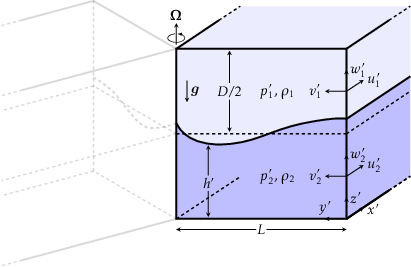
Figure 1: Schematic depiction of the rotating two-layer atmospheric model, defining the interface and relevant physical parameters.
The conversion to a countably-infinite ODE system is exact, but practical analysis and numerical integration require truncation to a finite kc. The dynamical structure, degree of sensitivity to initial conditions, and routes to chaos are fundamentally controlled by the dissipation parameter γ, proportional to the square root of the Ekman number (thus closely related to atmospheric boundary layer friction).
Integrable Limit and Hamiltonian Structure
In the inviscid (γ=0) regime, the model reduces to a Hamiltonian system—a variant of the undamped Duffing oscillator. The dynamics are constrained by a quartic potential, yielding smooth periodic orbits and homoclinic trajectories at critical energies. The amplitude remains bounded, with explicit analytic solutions for A(T) based on Jacobi elliptic functions and associated integrals.
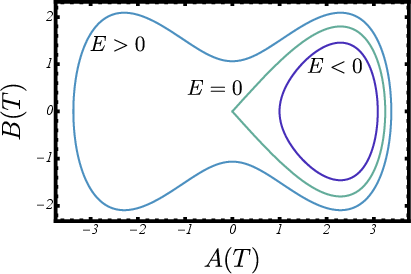
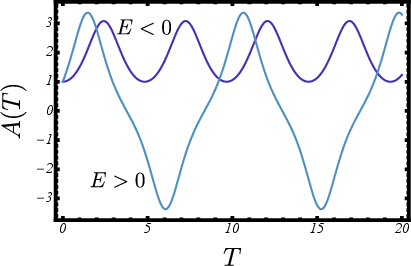
Figure 2: Phase-space trajectories of the Hamiltonian system, exemplifying periodic and homoclinic motion for different energy shells.
The phase-space features two stable equilibria and one unstable equilibrium, consistent with double-well dynamics, and the model is strictly integrable for all initial conditions.
Linear Stability and Dissipative Dynamics
Introduction of dissipation (γ>0) breaks integrability and contracts phase-space volumes, with stability characteristics determined by the eigenstructure of the Jacobian evaluated at fixed points. For the full model (limit kc→∞), the trivial point is always a saddle, and two nontrivial fixed points persist as stable nodes or foci for all γ, with their stability modulated by the magnitude of dissipation.
With truncation, particularly in the toy (minimal three-dimensional) model, a critical dissipation threshold exists below which the fixed points lose stability via Hopf bifurcation, permitting periodic and chaotic dynamics.
Nonlinear Regimes, Basins of Attraction, and Routes to Chaos
Systematic analysis of the basins of attraction reveals intricate structures, highly sensitive to both γ and initial conditions. For moderate to large Vk(T)0, the system equilibrates robustly to one of two fixed points. As Vk(T)1 decreases, regions of sensitivity proliferate and basins become fractured, with increasing prevalence of multiple attractors and boundaries exhibiting fine fractal structure.
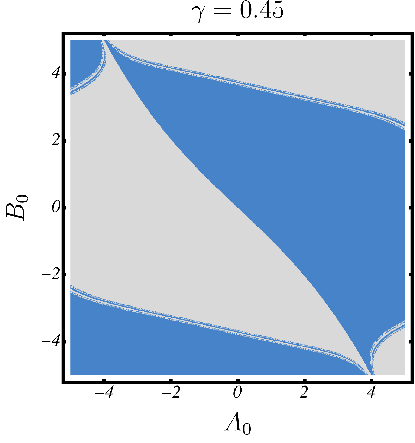
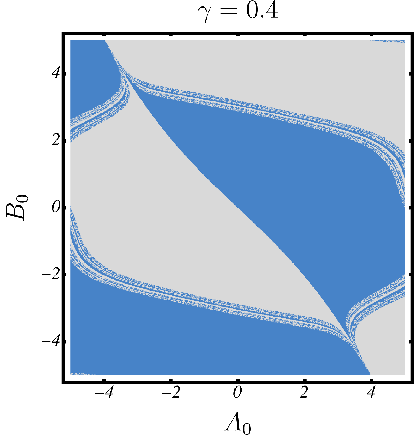
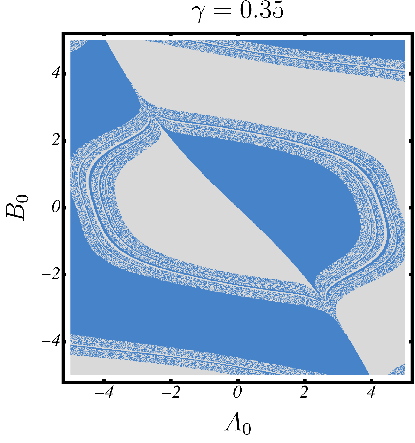
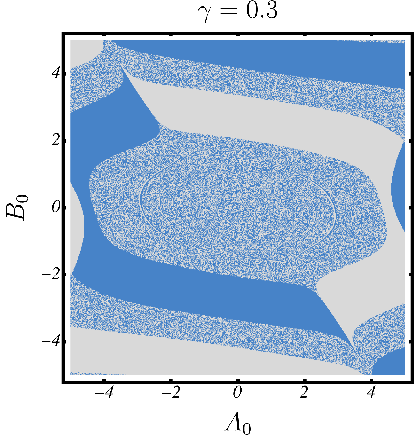
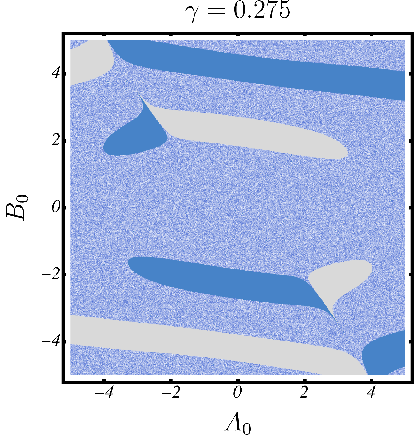
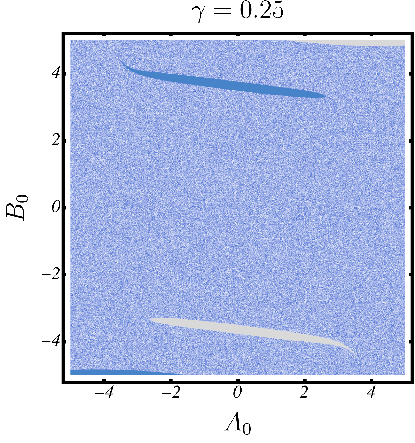

Figure 3: Basins of attraction of the toy model, illustrating dependence of final wave amplitude on initial conditions and dissipation.
Numerical experiments demonstrate both rapid transitions to equilibrium and, in the low-dissipation regime, long transients characterized by periodic, quasi-periodic, or chaotic motion.
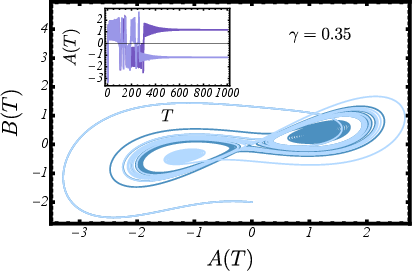
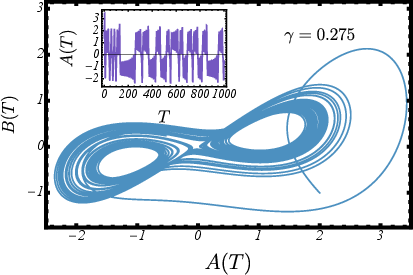
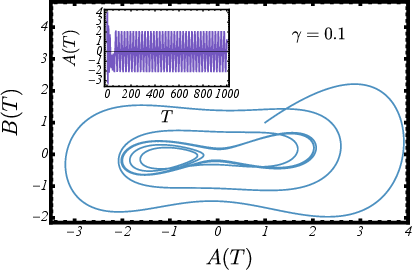
Figure 4: Representative wave amplitude trajectories for different dynamical regimes: convergence, periodicity, and chaotic wandering.
Lyapunov exponent calculations affirm deterministic chaos for specific ranges of Vk(T)2, with sharp transitions between periodic, chaotic, and equilibrium regimes. Chaos is confined to a narrow parameter window, and its onset is closely tied to period-doubling (PD) bifurcations.
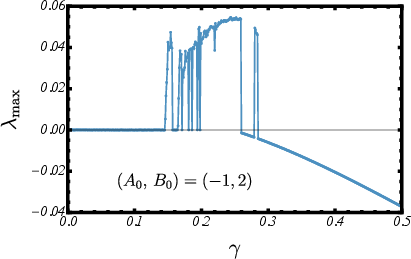
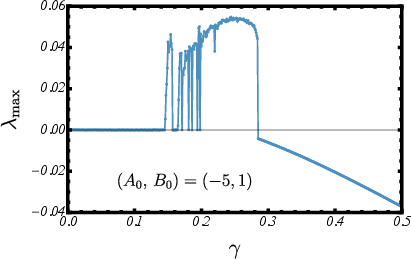
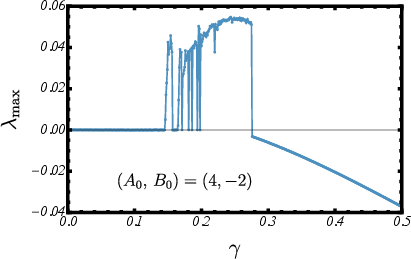
Figure 5: Maximal Lyapunov exponents as a function of Vk(T)3 and initial condition, demarcating regimes of chaos and periodicity.
Bifurcation Analysis and Continuation
Utilization of continuation software (auto-AUTO/AUTO-07p) enables systematic tracking of periodic orbits and their bifurcations as Vk(T)4 varies. The minimal model undergoes a PD cascade leading to chaos, followed by eventual stabilization via homoclinic bifurcations linking unstable periodic orbits to saddle points.
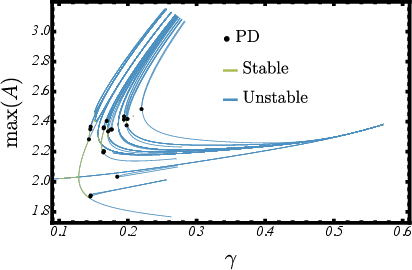
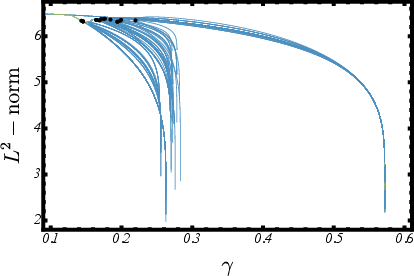
Figure 6: Bifurcation diagram for the toy model, plotting maximal amplitude and Vk(T)5 norms as Vk(T)6 varies; period-doubling and homoclinic bifurcations are annotated.
Unstable periodic orbits and homoclinic connections form the skeleton of a strange attractor in the chaotic regime, with period-doubling windows interspersed and surrounded by stable fixed points.
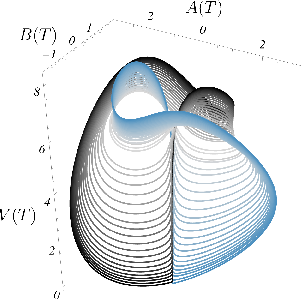
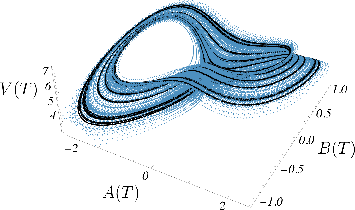
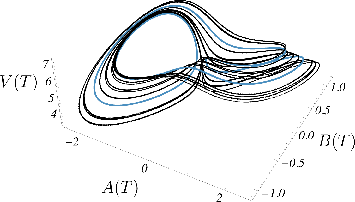
Figure 7: Example orbit continuation showing branching and emergence of homoclinic orbits in the toy model as dissipation increases.
The bifurcation structure is sensitive to model symmetry: inversion in Vk(T)7 produces mirrored dynamics due to discrete symmetry, yielding pairs of branched periodic orbits.
Connection to the Lorenz System and Structural Universality
The toy model is structurally equivalent to the Lorenz equations for specific parameter values, supporting a physically meaningful mapping. However, due to distinct scaling of the dissipation parameter, the dynamical correspondence is not exact except for particular parameter constraints. This reveals that the onset and progression of chaos—while similar to the Lorenz classical scenario—exhibits a reversed dependence on dissipation, with chaos arising at low friction and fixed points dominating at high friction.
Higher-Dimensional Truncations and Robustness
Extending to a higher number of modes (Vk(T)8, yielding a 22-dimensional ODE system), the essential features persist, with chaotic windows, PD bifurcations, and basins of attraction exhibiting even greater geometric complexity and fragmentation.
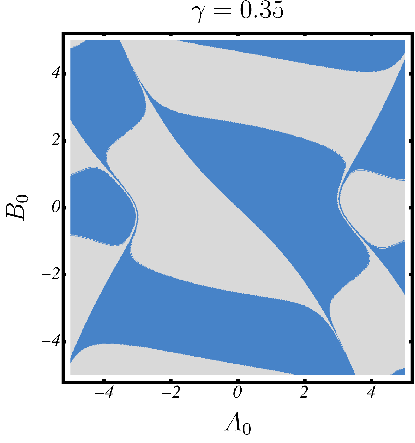
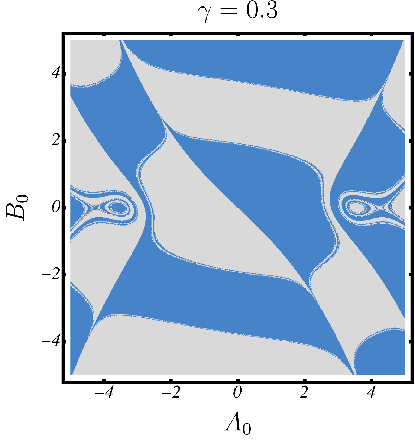
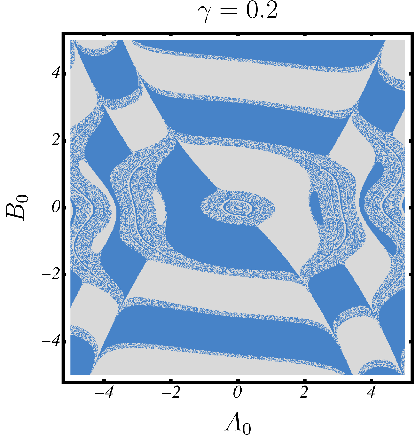
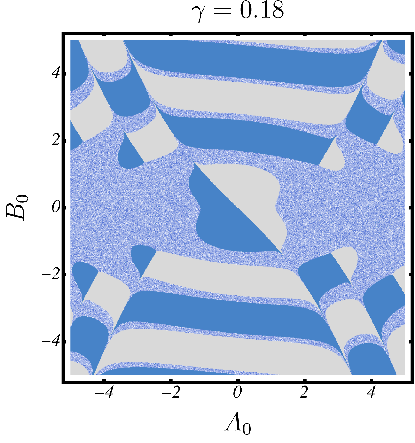
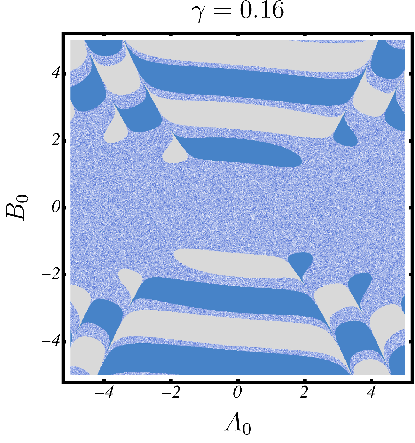
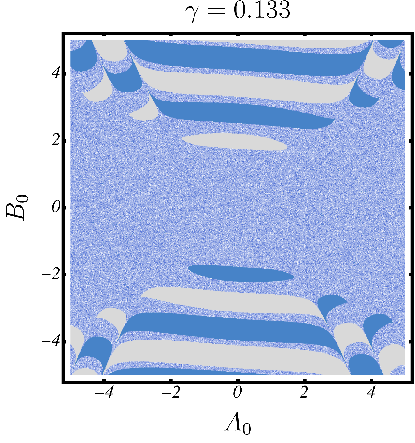

Figure 8: Basins of attraction for the 22-dimensional truncation; mosaic-like fragmentation proliferates as dissipation is decreased.
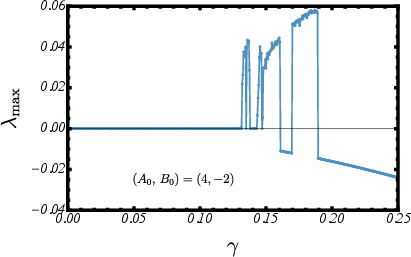
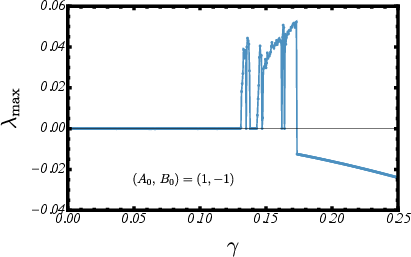
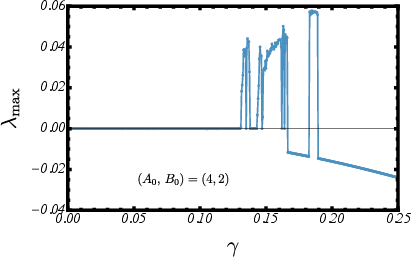
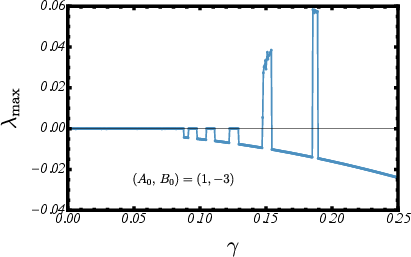
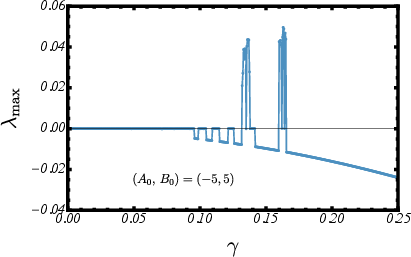
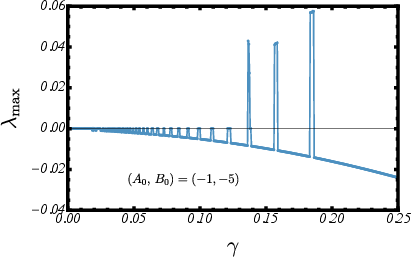
Figure 9: Maximal Lyapunov exponent plots for higher-dimensional truncation, confirming persistence of chaotic and periodic regimes.
Bifurcation diagrams and orbit continuation show that all qualitative regimes and transitions survive truncation. Convergence analyses demonstrate that dynamics is robust with respect to increased Vk(T)9, with error decaying polynomially and structural features essentially unchanged for kc0.
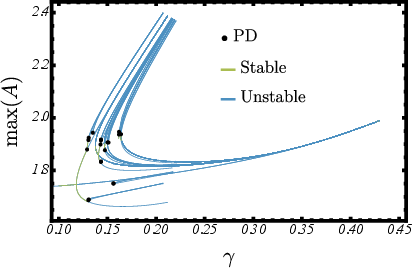
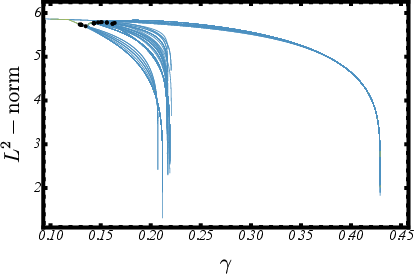
Figure 10: Bifurcation diagram for the higher-dimensional model, showing branches, period-doubling, and homoclinic bifurcations, paralleling the minimal model.
Practical and Theoretical Implications
The findings have important implications for forecasting and understanding midlatitude atmospheric dynamics in reduced-order models. The presence of multiple attractors and fractal basin boundaries indicates strong practical sensitivity to initial conditions, challenging predictability even outside chaotic regimes and making forecasting substantially harder. The structural equivalence to Lorenz-type systems suggests universality but also underlying non-universality in the details of onset and transition routes to chaos, with features such as period-doubling, homoclinic connections, and attractor fragmentation being robust to truncation and model refinement.
Theoretically, the results show that even minimal geophysical models, when analyzed using modern nonlinear tools, reveal a rich spectrum of dynamical behaviors, with chaos confined to narrow windows and strong sensitivity present even within apparently stable regimes. The increased folding and complexity of stable manifolds in higher dimensions imply additional unpredictability, as small perturbations can quickly yield divergent outcomes.
Conclusion
The paper rigorously establishes that Pedlosky's finite-amplitude baroclinic wave model, including its infinite-mode PDE representation and truncated ODE forms, possesses a diverse array of nonlinear dynamical regimes—integrable periodic motion, period-doubling cascades, deterministic chaos, coexistence of multiple attractors, and pronounced sensitivity to initial conditions. These features persist across truncation levels and parameter ranges, fundamentally modulated by the Ekman-layer-induced dissipation parameter. The structural correspondence with the Lorenz system elucidates the breadth of possible atmospheric dynamics, but also the system-specific details unique to baroclinic waves. The findings highlight both the practical obstacles in forecasting and theoretical richness in bifurcation structures, opening pathways for further investigations into the nature and roles of homoclinic orbits, attractor basins, and transition mechanisms in geophysical flows.

