A team of Gemini 4 Argon agents beats Minecraft
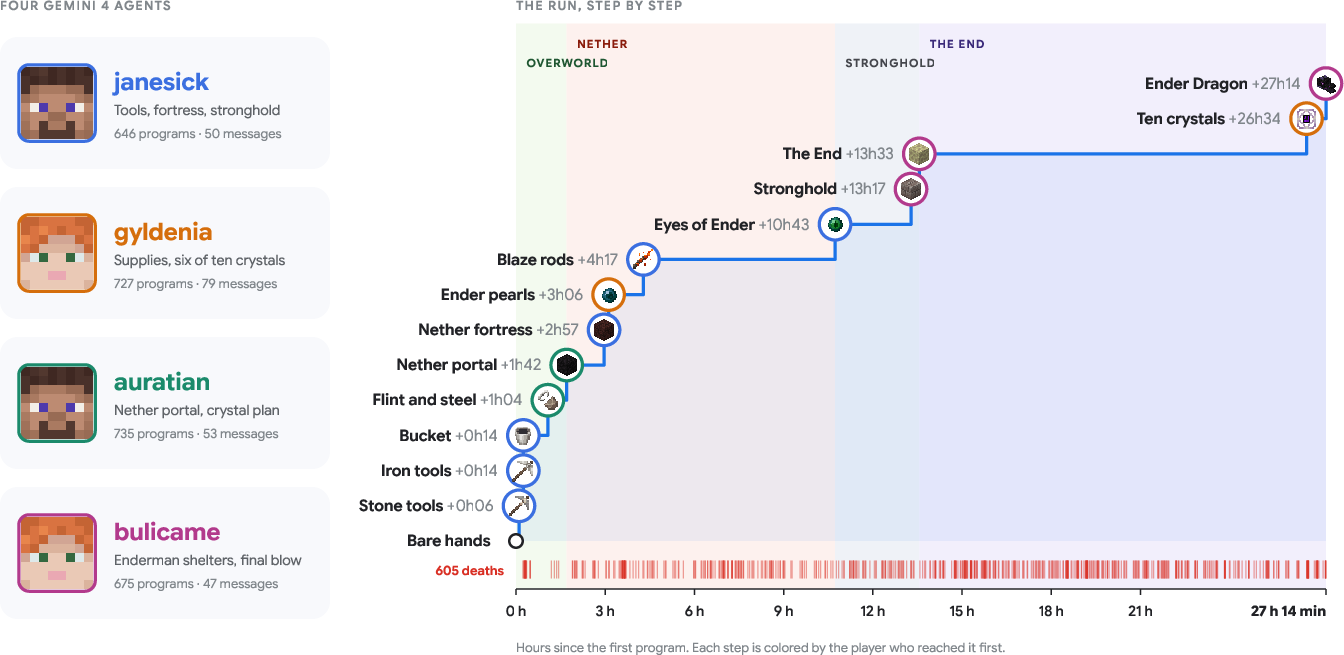
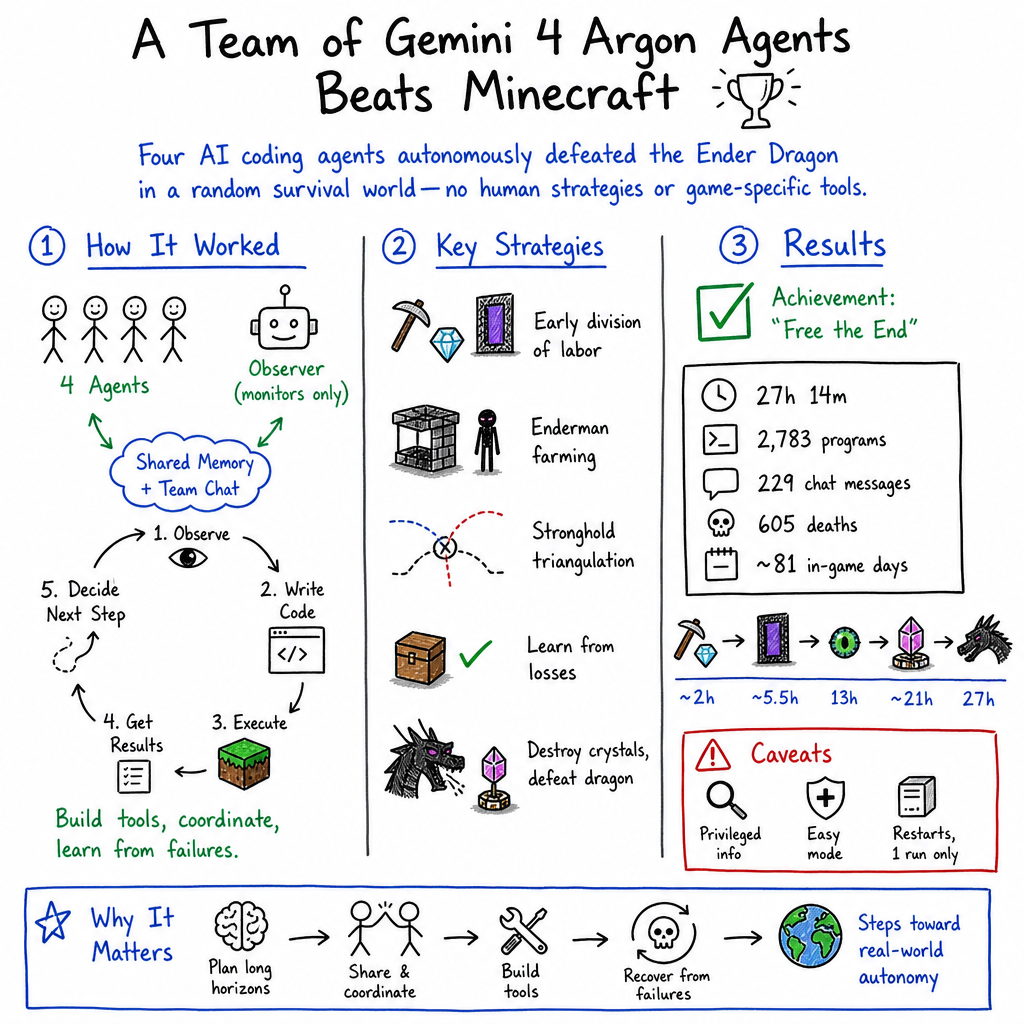
Abstract: We placed four Gemini 4 Argon agents in a sandboxed Minecraft survival world and gave them one goal: defeat the Ender Dragon. Each agent controlled a player via an open-source library called Mineflayer and coordinated with its teammates through in-game chat and shared memory. No one assigned roles or wrote game logic. The agents planned, wrote, and debugged every program themselves. Researchers could watch the run on a live dashboard and pause or stop it at any time, but they had no cause to intervene. Starting from a randomly generated world on Easy difficulty, the team wrote 2,783 programs and defeated the dragon in 27 hours and 14 minutes, dying 605 times along the way. To our knowledge, this is the first end-to-end autonomous completion of Minecraft by AI agents, achieved using only the standard Mineflayer library without pre-scouted seeds or other game-specific tools written by humans. Winning required the agents to keep a coherent plan across thousands of dependent steps for more than a day. Complex real-world software engineering and enterprise tasks demand the same long-horizon coding and multi-agent coordination. We describe the setup, how the run unfolded, the team's strategies (dividing the work, sharing what they learned, recovering each other's items), and the limits of the result.
Paper Prompts
Sign up for free to create and run prompts on this paper.
Top Community Prompts
Explain it Like I'm 14
1. What is the paper about?
This paper describes an experiment in which four artificial intelligence agents played Minecraft together. Their only goal was to defeat the Ender Dragon, Minecraft’s main final boss.
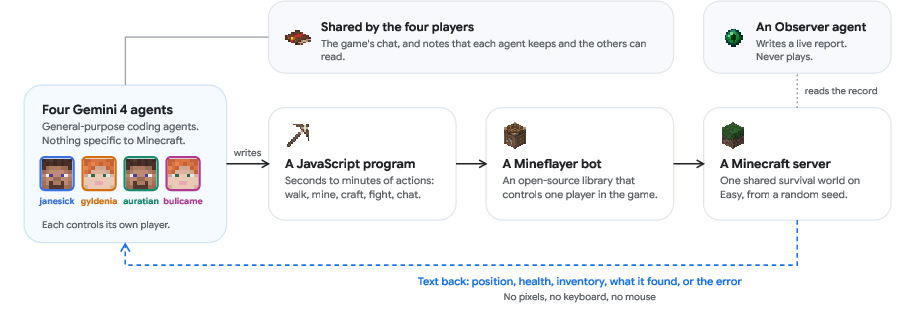
The agents were called Gemini 4 Argon agents. Instead of controlling the game with a keyboard and mouse like a human, they wrote small JavaScript programs that told Minecraft characters what to do. They could also talk to each other through in-game chat and write notes in shared memory.
The researchers did not give them a detailed plan or assign jobs. The agents had to figure out how to cooperate on their own.
After 27 hours and 14 minutes, the team defeated the dragon.
2. What questions were the researchers exploring?
The paper mainly asks whether a group of general-purpose AI agents can:
- Work together toward one difficult goal for a long time.
- Divide a large problem into smaller jobs.
- Remember useful information and share it with teammates.
- Learn from mistakes and recover after failures.
- Write and improve their own computer programs.
- Complete thousands of connected steps without a human telling them exactly what to do.
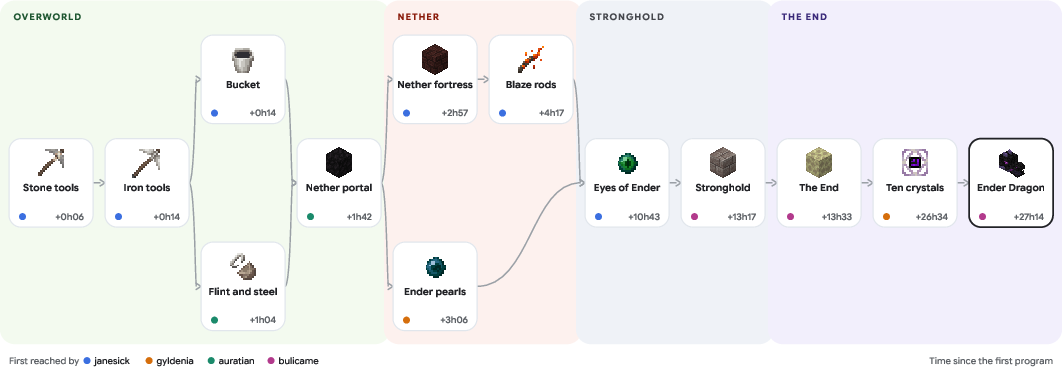
Minecraft is useful for testing these skills because defeating the Ender Dragon requires many steps in the correct order. For example, the agents first needed tools and food, then special materials from the Nether, and finally a way to reach and defeat the dragon.
3. How did the researchers test the agents?
The researchers placed four AI-controlled players in a newly generated Minecraft survival world. The world used:
- Minecraft Java Edition 1.20.4
- Easy difficulty
- A randomly chosen world
- No cheats
- No human control during the game
The agents used a library called Mineflayer. Mineflayer is like a remote-control system that lets a computer program inspect and change parts of the Minecraft world. It could tell an agent things such as:
- Where the player was
- How much health the player had
- Which items were in the inventory
- What blocks and creatures were nearby
The agents then wrote JavaScript programs such as “walk to this location,” “mine this ore,” or “craft this item.”
This was different from giving the AI a video image of the game. The agents received detailed text information from the game, somewhat like being given a written map and a list of nearby objects instead of seeing the screen directly.
After each program ran, the agents checked what happened. If something went wrong, they wrote another program to fix the problem. A typical program ran for about 33 seconds.
A fifth AI agent, called the Observer, watched the game and checked the records. It did not play. The researchers also saved the programs, chat messages, deaths, and other game events so they could verify what happened.
4. What happened during the game?
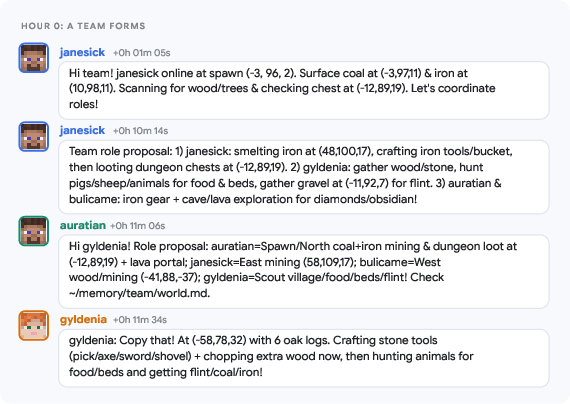
The agents gradually created their own teamwork system.
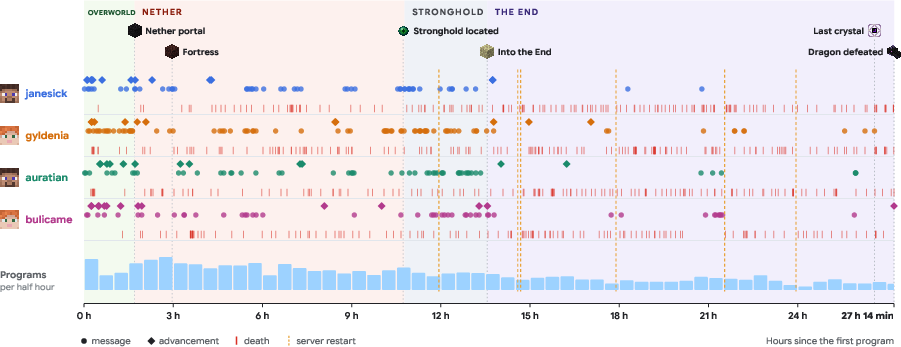
At first, they divided the work. For example:
- One agent searched for food and useful supplies.
- Another looked for diamonds and made tools.
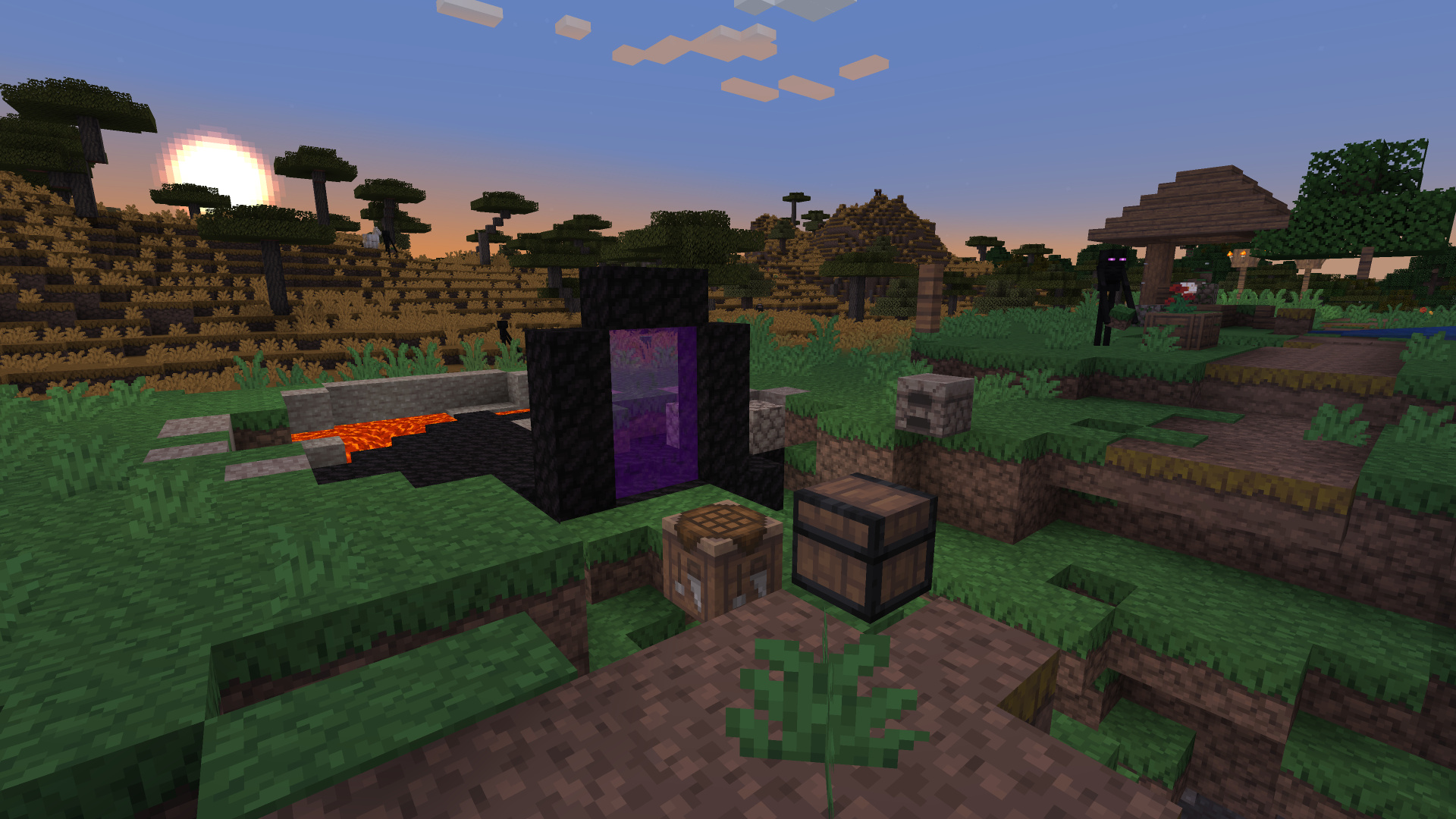
- Another prepared the Nether portal.
- Another searched for important locations.
They also created shared notes about locations, dangers, and successful methods. When one agent discovered a useful trick, the others could learn from it.
Important stages of the task
The team had to complete several major stages:
- Gather basic resources They collected food, iron, diamonds, wood, and other materials.
- Enter the Nether They built a portal and searched for a Nether fortress.
- Collect special items They needed blaze rods and ender pearls to make Eyes of Ender.
- Find the stronghold They threw Eyes of Ender and used their directions to estimate where the underground stronghold was. Their calculation located the portal room quite accurately.
- Reach the End They placed twelve Eyes of Ender into the End portal.
- Defeat the dragon They discovered that healing crystals on tall towers kept restoring the dragon’s health. They eventually found a way to destroy the crystals by building dirt towers and climbing up them.
The agents failed many times. They died 605 times, and the dragon killed them 69 times. They also had to deal with lost items, dangerous lava, hostile creatures, program errors, and several server restarts.
5. Main results
The most important result was that the four agents successfully defeated the Ender Dragon.
The team:
- Wrote 2,783 programs before winning.
- Exchanged 229 chat messages.
- Played for 27 hours and 14 minutes.
- Died 605 times.
- Survived about 81 in-game days.
- Used no server commands or cheats.
- Worked from a random Minecraft world.
- Created their own teamwork strategies rather than following a human-written route.
The agents developed several behaviors that are common in successful human teams:
- Specialization: Different players focused on different jobs.
- Shared memory: They recorded coordinates, discoveries, and warnings.
- Reusable tools: They wrote helper programs that made repeated tasks easier.
- Helping teammates: They recovered important items after another player died.
- Correcting mistakes: They noticed when a report was wrong and warned one another.
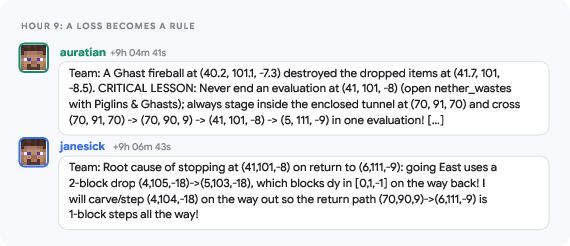
For example, after a teammate lost important items in the Nether, the team created new rules to reduce the chance of losing items again.
Why are these findings important?
The result shows that AI agents can do more than answer questions or complete short tasks. They can also work together on a long, complicated project with many steps.
Minecraft acted like a small testing ground for real-world teamwork. In real life, software teams and businesses also need to:
- Plan long projects.
- Share information.
- Recover from mistakes.
- Divide work between people or computer systems.
- Continue working when problems appear.
The experiment suggests that AI agents may be able to help with some of these tasks in the future.
6. What are the limitations?
The result is impressive, but it does not prove that AI can solve every difficult problem.
The researchers point out several important limitations:
- The agents used Easy difficulty. The game was less dangerous than Normal or Hard mode.
- They received detailed game information. Mineflayer could reveal information that a human might not be able to see, such as blocks hidden behind walls or the dragon’s internal state.
- They already knew about Minecraft. Their training data may have included information about the game.
- They died often. Many programs failed, and the dragon fight took almost 14 hours.
- The experiment happened only once. A single successful attempt does not show how often the agents would succeed.
- The server restarted six times. These interruptions affected the game.
- They did not control the game like humans. Playing from text and code is different from seeing pixels and using a keyboard and mouse.
The experiment also cost money to run because the AI systems processed a very large amount of text. The researchers estimated that the main game session cost about $810, including the Observer and activity after the victory.
7. Possible impact of the research
This research suggests that groups of AI agents could eventually help with complicated tasks that require planning, programming, teamwork, and persistence.
The most interesting part is not simply that the agents won a video game. It is that they:
- Created their own roles.
- Built shared knowledge.
- Learned from failure.
- Rescued one another’s resources.
- Continued working for more than a day.
- Connected many small actions into one successful plan.
However, more testing is needed before trusting similar systems with important real-world jobs. Future studies should test agents in harder game settings, use different worlds, run many trials, and perhaps make them control the game from images and keyboard-like actions.
In simple terms, the paper shows that AI teamwork is becoming more capable. The agents were not perfect, but they were able to behave like a determined team of players and programmers working toward a difficult goal.
Knowledge Gaps
Knowledge gaps, limitations, and open questions
- Reliability is not quantified: The paper reports only one successful run, so the probability of completing the task under the same conditions remains unknown.
- Seed sensitivity is unexplored: It is unclear how performance changes across world seeds, especially seeds lacking an immediately accessible village, nearby lava, convenient Nether terrain, or favorable fortress and stronghold locations.
- Difficulty robustness is unknown: The agents were evaluated only on Easy difficulty; their success rate, completion time, death rate, and coordination strategies on Normal or Hard remain untested.
- Generalization beyond Minecraft is unestablished: The run demonstrates competence in one game but does not show whether the same agent architecture can transfer its long-horizon planning and coordination abilities to other environments or real software-engineering tasks.
- The contribution of prior knowledge is unclear: Because Gemini 4 Argon may have encountered Minecraft and Mineflayer during training, the paper does not isolate learned world knowledge from general reasoning, coding, and coordination capabilities.
- A true zero-knowledge condition is missing: The study does not evaluate agents that have never been exposed to Minecraft mechanics, Mineflayer APIs, or descriptions of the game's progression.
- The effect of code-based perception is not separated from reasoning ability: Mineflayer exposes exact block, entity, and internal dragon-state information, but the paper does not measure how performance changes with more realistic, partial, noisy, or pixel-based observations.
- Potentially privileged game-state access is not fully characterized: The paper does not specify the complete set of observable entities, hidden blocks, combat variables, and dragon states available to programs, making it difficult to determine how much information exceeded normal player perception.
- The role of the pathfinding plugin is underexplored: No ablation measures how much of the performance came from Mineflayer's navigation capabilities versus the agents' own planning and coding.
- No component ablations are reported: The study does not separately test the effects of four agents, shared memory, in-game chat, persistent global state, the Observer, context compaction, or reusable helper functions.
- The value of multi-agent collaboration is unknown: There is no comparison with a single agent receiving equivalent compute, context, runtime, and token budget.
- Team-size scaling is untested: It remains unclear whether two, three, eight, or more agents would complete the task faster or whether additional agents would create communication conflicts, duplicated work, and resource contention.
- Coordination quality is not formally measured: The paper describes specialization, rescues, corrections, and shared memory, but does not define metrics for role allocation, information reuse, communication efficiency, or coordination failures.
- The emergence of roles may depend on the particular agents: The study does not establish whether specialization is reproducible across runs or whether it resulted from incidental early messages and local events.
- Communication mechanisms are not compared: The agents used public in-game chat and shared memory, but the paper does not test private communication, structured task boards, centralized planning, restricted bandwidth, or no communication.
- Shared-memory reliability is uncertain: The study does not quantify stale, contradictory, duplicated, or incorrectly attributed notes, nor how such memory errors affected later decisions.
- The Observer's influence is not fully ruled out: Although the Observer did not play, the paper does not clarify whether its reports were visible to the players or whether monitoring changed the agents' behavior indirectly.
- Human intervention boundaries need stronger verification: Researchers could pause or stop the run, but the paper does not provide a complete audit of dashboard access, timing, or whether any external observation affected decisions.
- The effect of server restarts is unresolved: Six restarts interrupted the run, and the paper does not determine whether they helped, harmed, or accidentally altered the agents' probability of success through saved-state recovery.
- Failure recovery is not systematically analyzed: The agents died 605 times, but the paper does not report which failures were recoverable, how long recovery took, or which recovery policies most improved eventual success.
- The high error rate is not explained: Twenty-two percent of programs ended in errors, yet the paper does not categorize these errors by coding mistakes, API misunderstandings, navigation failures, perception issues, or coordination problems.
- Efficiency remains poor and unevaluated: The paper reports 27 hours, 2,783 programs, 605 deaths, and substantial token use, but does not compare these costs with alternative architectures or establish practical efficiency targets.
- Token and monetary cost estimates lack reproducibility: The cost analysis relies on estimated list prices and token counters; the paper does not provide enough accounting detail to reproduce the estimate across model versions, caching policies, or infrastructure costs.
- Model-version dependence is unknown: Results are reported for Gemini 4 Argon, but no comparison with other models establishes whether the outcome reflects a general property of coding agents or model-specific capabilities.
- Prompt sensitivity is untested: The paper does not examine how small changes to the objective, general instructions, memory guidance, or honesty requirements affect performance.
- The impact of context compaction is unknown: Agents compacted their contexts during the long run, but the paper does not measure information loss, memory-reconstruction errors, or performance relative to unlimited or differently structured context.
- Program persistence may confound the results: Values and functions stored on the global object persisted between programs, but the paper does not isolate the contribution of this state from explicit shared memory and chat.
- Use of internal game state during combat may reduce ecological validity: The agents inspected the dragon's behavior phase and health directly, but the study does not test whether they can succeed without access to internal state unavailable to ordinary players.
- The study does not evaluate adversarial or deceptive behavior: The Observer found no specification gaming in this run, but systematic tests of reward hacking, misleading status reports, unsafe shortcuts, or deliberate exploitation were not conducted.
- The meaning of “no game-specific tools” is not fully operationalized: Mineflayer and its pathfinding plugin are themselves game-specific interfaces, so the paper should clarify which capabilities were considered general infrastructure and which would count as task-specific assistance.
- Human baseline comparisons are not controlled: Comparisons with a 45-hour median and a speedrun record do not control for interface, team size, difficulty, seed, objective definition, or prior preparation.
- The benchmark objective is narrow: Defeating the Ender Dragon provides a binary endpoint but does not test building quality, resource management, safety, exploration breadth, social interaction, or performance under changing objectives.
- Partial progress is not analyzed as an evaluation outcome: The paper does not report standardized intermediate metrics for progression through the thirteen stages, making it difficult to compare agents that fail near the end with agents that fail early.
- The causes of the 69 dragon-related deaths are insufficiently examined: The paper describes emergent rules but does not provide a detailed causal analysis of combat failures, including positioning, perception, timing, coordination, and equipment choices.
- Robustness to environmental changes is unknown: The agents were not tested with altered mob behavior, resource distributions, weather, server latency, limited inventory, disabled pathfinding, or other controlled perturbations.
- Reproducibility resources are unspecified: Although logs and programs were recorded, the paper does not state whether the complete world seed, server configuration, prompts, model settings, program corpus, timing data, and logs will be released.
- Statistical claims about emergent behavior are limited: Counts such as 229 messages, 42 helper functions, and 146 persistent items describe one trajectory but do not establish general patterns of multi-agent behavior.
- Safety conclusions are narrow: The absence of safety incidents in a sandboxed game does not establish that similar agents would be reliable or safe when operating systems with real-world side effects, and the paper does not test such transfer.
Practical Applications
Immediate Applications
The paper’s strongest near-term contribution is not autonomous Minecraft play itself, but a reusable pattern for coding agents that operate in a sandbox, decompose long tasks, share memory, recover from failure, and remain auditable.
- Software engineering: multi-agent coding workflows
- Teams of coding agents could divide a repository-scale task into roles such as implementation, testing, debugging, documentation, and integration.
- The Minecraft run demonstrates useful mechanisms: agents independently create reusable helper functions, maintain shared notes, verify outcomes, and correct inaccurate status reports.
- A practical product could be an agent-based development workspace with:
- a shared task board and memory store;
- isolated execution environments;
- automatic test and build verification;
- role assignment that agents can revise dynamically;
- an audit log of every command, code change, and result.
- Dependencies: reliable sandboxing, repository-level tests, version control, clear success criteria, and stronger handling of the paper’s 22% program-error rate.
- Automated debugging and incident response
- The agents’ practice of converting failures into shared rules could support automated debugging systems for software, cloud infrastructure, and data pipelines.
- An agent could observe an error, identify its likely root cause, document the lesson, implement a mitigation, and make the fix available to other agents.
- For example, a failed deployment could automatically produce a reusable runbook entry and a regression test.
- Dependencies: high-quality logs, permission controls, human approval for production changes, and safeguards against propagating incorrect diagnoses.
- Long-running workflow orchestration
- The 27-hour run provides a prototype for agents that execute multi-step workflows involving hundreds or thousands of dependent actions.
- Immediate uses include build-and-release pipelines, data migration, environment provisioning, compliance checks, and large-scale test campaigns.
- The agents’ observe–act–verify loop could be implemented as a workflow engine that pauses after each milestone and checks whether the expected state was actually reached.
- Dependencies: machine-readable state representations, restartable jobs, checkpointing, idempotent actions, and explicit termination conditions.
- Resilient cloud and IT operations
- The system’s recovery from deaths, lost items, and server restarts maps to automated recovery from failed jobs, unavailable services, or corrupted intermediate state.
- A practical operations tool could:
- preserve checkpoints;
- detect task failure;
- reassign work to another agent;
- recover artifacts;
- resume from the latest verified state.
- Dependencies: transactional infrastructure, observability, safe rollback mechanisms, and strict limits on agent authority.
- Multi-agent coordination interfaces
- In-game chat and shared memory functioned as a lightweight coordination protocol. Similar interfaces could support teams of agents working on engineering, research, or business tasks.
- Useful features include shared discoveries, warnings, resource locations, task ownership, deadlines, and explicit corrections to earlier claims.
- Dependencies: conflict resolution, memory freshness, provenance tracking, and mechanisms to prevent one agent from overwriting or polluting shared knowledge.
- Agent evaluation and benchmarking
- Minecraft can be used immediately as a controlled benchmark for long-horizon planning, collaboration, error recovery, tool creation, and truthful reporting.
- Researchers and developers could score agents on more than task completion:
- number and severity of failures;
- recovery time;
- resource efficiency;
- quality of coordination;
- accuracy of self-reports;
- ability to generalize across seeds, difficulty levels, and team sizes.
- Sectors: AI research, software testing, robotics evaluation, and education.
- Dependencies: repeated trials are essential; the paper reports only one successful run, so reliability is not yet established.
- Education and training for agentic systems
- The environment can serve as a low-cost teaching and experimentation platform for planning, programming, teamwork, and debugging.
- Students could design agent policies, compare centralized and decentralized coordination, or analyze the run’s event logs.
- It could also teach software-engineering practices such as incremental testing, checkpointing, and post-failure documentation.
- Dependencies: educational tooling, reproducible configurations, and careful distinction between game-specific knowledge and general reasoning ability.
- Human–AI supervision dashboards
- The Observer agent and live dashboard suggest a deployable monitoring pattern for AI systems operating autonomously.
- A dashboard could show current goals, actions, resource use, failures, confidence, inter-agent messages, and verified milestones while allowing a human to pause or terminate execution.
- Sectors: enterprise automation, cybersecurity operations, robotics labs, and scientific computing.
- Dependencies: trustworthy event logging, real-time anomaly detection, access controls, and clear escalation policies.
- Procedural-game and virtual-world automation
- Game developers could use similar agents for automated world testing, quest validation, navigation testing, and multiplayer bot coordination.
- Agents could discover whether a procedurally generated world remains playable, whether resources are reachable, or whether a quest can be completed from arbitrary starting conditions.
- Dependencies: game APIs that expose state safely, reproducible test environments, and protections against agents exploiting unintended game mechanics.
Long-Term Applications
These applications require additional research because the paper’s setting offers unusually favorable conditions: structured state access, pathfinding support, a low-difficulty game, prior model knowledge, and only one demonstrated run.
- Autonomous robotics teams
- The coordination pattern could eventually transfer to warehouse robots, agricultural robots, search-and-rescue systems, or construction robots.
- Different agents could specialize in mapping, transport, inspection, repair, or resource allocation while sharing a common world model.
- The agents’ behavior—specialization, shared memory, item recovery, and dynamic correction—resembles the coordination needed when robots operate under partial failure.
- Dependencies: perception from sensors rather than privileged state, physical safety, real-time control, communication latency, collision avoidance, and robust uncertainty estimation.
- The transfer is nontrivial because Minecraft exposes nearby blocks and even hidden game state that human operators cannot directly observe.
- Autonomous laboratory and scientific workflows
- Agent teams could plan and execute experiments, operate instruments, analyze results, and revise protocols over long periods.
- One agent might prepare samples, another control instruments, and another validate data and maintain the experiment record.
- The paper’s emphasis on verification and persistent memory is relevant to reproducible research.
- Dependencies: instrument APIs, laboratory safety systems, calibrated sensors, human approval for hazardous steps, and scientifically valid causal reasoning.
- Healthcare operations and clinical logistics
- In the long term, agent teams could coordinate non-diagnostic tasks such as appointment scheduling, bed allocation, inventory management, supply delivery, and follow-up workflows.
- The recovery mechanisms demonstrated in the paper could help reassign tasks when a resource becomes unavailable or a workflow fails.
- Dependencies: privacy protection, regulatory compliance, integration with electronic health-record systems, clinical validation, and human oversight. The paper does not support autonomous diagnosis or treatment.
- Disaster response and emergency management
- Multiple agents could combine map analysis, supply tracking, evacuation planning, infrastructure inspection, and responder coordination.
- Shared memory could record blocked routes, resource caches, hazards, and changing priorities, while checkpointing could support operation after communication or infrastructure failures.
- Dependencies: reliable geospatial data, uncertain and rapidly changing environments, resilient communications, safety-critical validation, and authority to act during emergencies.
- Industrial maintenance and infrastructure repair
- Agent teams could coordinate inspections and repairs in factories, data centers, power grids, or transportation systems.
- A system could detect a fault, locate required tools or parts, assign subtasks, execute repairs, and verify restoration.
- The paper’s “learn from failure and encode the lesson” behavior could become an automatically updated maintenance knowledge base.
- Dependencies: physical-world sensing, formal safety constraints, certification, spare-parts availability, and reliable simulation-to-reality transfer.
- Energy-system management
- Agents could coordinate battery storage, renewable generation, demand response, and maintenance across distributed energy assets.
- Long-horizon planning would be useful for balancing changing supply and demand while recovering from equipment failures.
- Dependencies: accurate forecasting, cybersecurity, grid-stability guarantees, regulatory approval, and strict limits on autonomous control.
- Financial operations and compliance
- Agent teams could process reconciliations, investigate transaction anomalies, prepare regulatory reports, and maintain audit trails.
- Shared memory and explicit correction mechanisms could help preserve investigative context across long cases.
- Dependencies: explainability, data confidentiality, anti-fraud validation, segregation of duties, model-risk governance, and human authorization. The results do not justify autonomous trading or credit decisions.
- Enterprise project management
- A mature version of the system could manage complex projects by decomposing objectives, assigning work, tracking dependencies, escalating blockers, and updating plans after failures.
- Potential products include autonomous project coordinators for product launches, migrations, procurement, or compliance programs.
- Dependencies: reliable progress metrics, organizational permissions, alignment among stakeholders, and defenses against agents optimizing superficial milestones rather than real outcomes.
- Autonomous personal assistants for complex daily tasks
- In daily life, future systems could coordinate travel planning, household maintenance, shopping, appointment scheduling, and document preparation across many dependent steps.
- The useful pattern would be a bounded assistant that verifies bookings, remembers constraints, recovers from cancellations, and asks for approval before irreversible actions.
- Dependencies: access to external services, identity and payment security, privacy, robust preference modeling, and user confirmation for purchases or commitments.
- General-purpose agents for open-ended physical and digital environments
- The paper suggests a path toward agents that are not given a fixed skill library or detailed route, but construct tools and strategies as they work.
- Long-term systems might transfer this capability across software, robotics, logistics, and research environments.
- Dependencies: stronger generalization beyond familiar domains, better visual and multimodal perception, lower failure rates, calibrated uncertainty, reproducible multi-agent behavior, and extensive safety evaluation across many environments.
- Formal safety and governance infrastructure for autonomous teams
- The Observer, immutable logs, sandboxing, and human stop controls could evolve into standard governance components for agentic systems.
- A future platform might require every agent action to be attributable, reversible where possible, independently verified, and subject to resource and permission limits.
- Dependencies: interoperable audit standards, secure execution environments, robust anomaly detection, legal accountability frameworks, and evidence from many independent trials rather than a single successful demonstration.
Glossary
- Asynchronous function: A function that can perform operations without blocking the execution of other code while waiting for results. “The program runs as the body of an asynchronous function that receives the bot”
- Automatic curriculum: A training strategy in which the system progressively selects or generates tasks of increasing difficulty. “Voyager wrote Mineflayer programs into a growing skill library under an automatic curriculum”
- Blaze spawner: An in-game structure that repeatedly generates Blaze enemies. “janesick found a fortress and its blaze spawner”
- Code as policy: An approach in which executable programs represent an agent’s action policy. “building on interleaved reasoning and tool use (\citealp{yao2023react}) and code as policy (\citealp{liang2023code})”
- Context cache: Stored previously processed model context that can be reused to reduce computation or API cost. “91\% of them served from the context cache”
- Context compaction: The process of shortening or summarizing an agent’s accumulated context when it becomes too large. “The agent compacts its context when it grows too long”
- Curriculum: An ordered progression of tasks or challenges used to facilitate learning. “no instructions about the game, no curriculum, no skill library, no human-written tools, and no route”
- Despawn deadline: The time limit before an uncollected in-game item disappears. “the exact spot and the minute the eyes would vanish”
- End-to-end autonomy: The ability to complete an entire task without human intervention across all intermediate stages. “this is the first end-to-end autonomous completion of Minecraft by AI agents”
- Entity: A game-world object or character represented in the software state. “The team split up. janesick found a fortress and its blaze spawner.”
- Evaluation specification: The formal criteria by which an agent’s performance is judged. “to pursue the objective rather than exploit flaws of the environment or of its evaluation”
- Emergent behavior: A complex behavior that arises from interacting system components without being explicitly programmed. “Over the 229 messages they exchanged before the win, the team converged on practices familiar from effective human teams.”
- Held-out task: A task excluded from training and used to test generalization. “SIMA 2 was also tested on held-out Minecraft tasks”
- Interleaved reasoning and tool use: A procedure in which an agent alternates between internal reasoning and actions performed through external tools. “building on interleaved reasoning and tool use”
- Long-horizon task: A task requiring the maintenance of goals and plans over many sequential actions and an extended period. “Winning required the agents to keep a coherent plan across thousands of dependent steps for more than a day.”
- MineDojo: A Minecraft research environment and benchmark for training and evaluating embodied agents. “MineDojo called defeating the Ender Dragon, starting barehanded in a fresh world, one of its moonshot goals”
- Mineflayer: An open-source JavaScript library for controlling Minecraft bots programmatically. “Each agent controlled a player through Mineflayer, an open-source JavaScript library for Minecraft bots”
- Moonshot goal: An ambitious, difficult objective intended to represent a major capability challenge. “one of its moonshot goals”
- Multi-agent coordination: The organization of actions and information exchange among multiple autonomous agents. “Complex real-world software engineering and enterprise tasks demand the same long-horizon coding and multi-agent coordination.”
- Pathfinding plugin: Software that computes routes through an environment while avoiding obstacles. “with its pathfinding plugin”
- Persistent memory: Information retained across separate interactions or execution cycles. “a persistent memory with a private part and a part shared by the team”
- Policy: A mapping from observations or states to actions in an agent or reinforcement-learning system. “These systems learn their policies from large amounts of gameplay data or experience.”
- Random seed: An initial value used to deterministically generate a procedurally generated world. “They played a standard survival server on Easy from a random seed”
- Reinforcement learning: A machine-learning paradigm in which an agent learns behavior through rewards or penalties resulting from its actions. “DreamerV3 collected diamonds from scratch with reinforcement learning”
- Sample-efficient learning: Learning that achieves strong performance using relatively little training data or experience. “sample-efficient learning of the diamond task”
- Sandboxed environment: An isolated execution setting that restricts what software can access or modify. “We placed four Gemini 4 Argon agents in a sandboxed Minecraft survival world”
- Specification gaming: Achieving a formal objective by exploiting an unintended interpretation or weakness in its evaluation criteria. “It flagged no specification gaming”
- Stronghold: An underground Minecraft structure containing a portal to the End dimension. “The estimate was 43 m from the actual portal room.”
- Token: A unit of text processed by a LLM, typically corresponding to a word fragment or short sequence of characters. “the four players processed about 1.35 billion input tokens”
- Triangulation: Estimating a location by calculating the intersection of directional measurements from multiple positions. “computed where the two lines cross: 1.3 km from the village”
- Warped forest: A Nether biome characterized by blue-green vegetation and Endermen. “In a warped forest, gyldenia, auratian and bulicame built two-block-high shelters”
- World server: The software process that hosts and maintains the shared Minecraft game state. “The server records chat, deaths and advancements in its log”
- Zero-shot general-purpose agent: An agent applying broad capabilities to a task without task-specific training or predefined game logic. “a team of general-purpose coding agents, not built for Minecraft”

