A simpler proof that there are no Landau--Siegel zeros
Abstract: This paper simplifies the recent OpenAI proof that there are no Landau--Siegel zeros.
Paper Prompts
Sign up for free to create and run prompts on this paper.
Explain it Like I'm 14
1. What is this paper about?
The paper studies a special kind of mathematical function called a Dirichlet -function. These functions are connected to the way prime numbers are distributed.
The paper focuses on a possible problem called a Landau–Siegel zero. This would be a real zero of an -function that lies extremely close to $1$. The paper claims to prove that such zeros cannot get too close to $1$.
In simple terms, the main claim is:
There is a fixed positive number such that a zero can never be so close to $1$ that becomes smaller than .
Here, is an integer connected to the -function. The exact meaning of is technical, but it measures the complexity of the problem.
The author’s goal is to give a simpler proof of a result that had supposedly been proved earlier.
2. What questions does the paper ask?
The paper is mainly trying to answer these questions:
- Can a real zero of a Dirichlet -function get arbitrarily close to $1$?
- If not, can we find a fixed distance that such a zero must stay away from $1$?
- Can this be shown using a simpler method than an earlier proof?
The paper’s answer is no: these zeros cannot get too close to $1$.
3. What methods does the paper use?
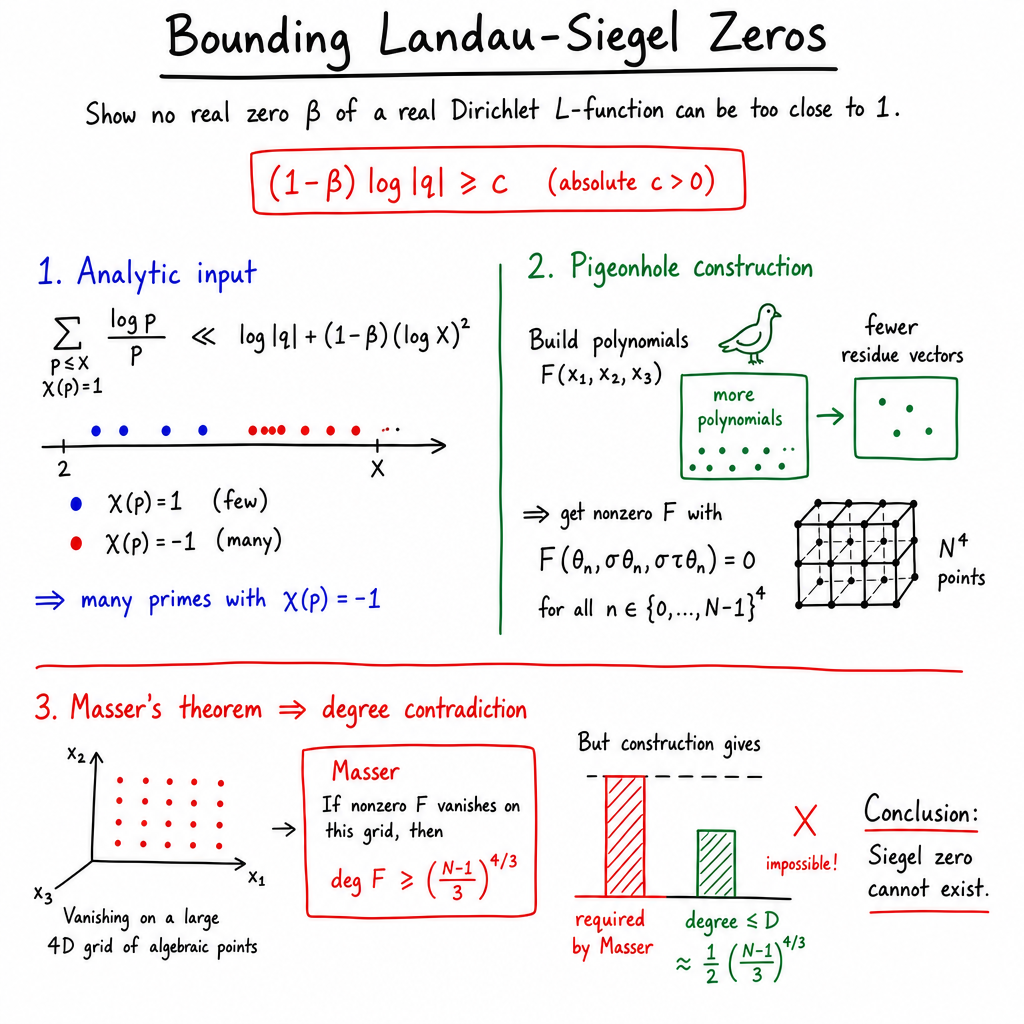
The proof combines ideas from number theory, algebra, and a counting argument.
Studying primes affected by the possible zero
The paper begins with an estimate about primes . It looks at primes for which a certain function equals $1$ or .
If a zero were extremely close to $1$, the paper shows that there would have to be a noticeable imbalance in how these primes behave. Roughly speaking, many primes would have to satisfy a particular condition.
This is an important starting point: the possible zero creates a pattern among the primes.
Moving into a larger number system
The proof then works with numbers involving
These numbers are placed inside a larger number system called a number field:
A number field is like a larger version of the ordinary rational numbers. For example, the rational numbers contain fractions such as $1/2$, while this field also contains combinations such as
The proof uses four different ways of viewing these numbers, called embeddings. These views help track how expressions change when square roots are replaced by their negatives.
Constructing a special polynomial
The central object is a polynomial in three variables. The author wants to vanish at many points of the form
where is built from four integers :
The integers range from $0$ to , so there are many such points.
The polynomial is designed to have a limited degree. “Degree” measures how complicated a polynomial is. For example, has total degree $3$.
Using primes and modular arithmetic
The author chooses many primes for which . At these primes, specially designed pieces of the polynomial become zero modulo .
Saying that an expression is zero modulo means that it is divisible by . For example,
because both numbers leave remainder $2$ when divided by $5$.
The paper uses higher powers such as as well. By making the polynomial vanish modulo many primes, the author makes its values divisible by a very large number.
The pigeonhole principle
The proof then uses the pigeonhole principle:
If there are more objects than containers, at least two objects must go into the same container.
Here, the “objects” are many different polynomials. The “containers” record what those polynomials do modulo a large number.
Because there are more polynomials than possible records, two different polynomials must behave identically modulo all the chosen primes. Subtracting them produces a nonzero polynomial whose values are divisible by a large number.
The polynomial’s values are also shown to be small. A number that is both:
- divisible by a very large number, and
- smaller than that number in absolute value,
must be zero. Therefore, actually vanishes exactly at all the selected points, not merely modulo the primes.
A theorem about polynomials
Finally, the proof uses a result by David Masser. In everyday language, this result says:
If a nonzero polynomial vanishes at a very large rectangular grid of carefully arranged points, then the polynomial must have a fairly large degree.
The paper applies this result to the points constructed earlier. It obtains the lower bound
However, the polynomial was originally constructed to have degree at most
These two facts contradict each other. The same polynomial cannot have degree both at least the larger number and at most the smaller number.
4. What are the main findings?
The main conclusion is the theorem stated at the beginning:
Real zeros of the relevant Dirichlet -functions cannot approach $1$ too closely. There is an absolute constant such that
The proof reaches this conclusion by assuming the opposite. It supposes that is extremely close to $1$ and then follows these steps:
- A very close zero would force a certain pattern among many primes.
- That pattern would provide enough primes to construct a special polynomial.
- The pigeonhole principle would produce a nonzero polynomial vanishing at many points.
- Masser’s theorem would say that such a polynomial must have high degree.
- But the polynomial was built to have low degree.
- This contradiction shows that the original zero could not have been so close to $1$.
The important idea is that the possible zero would create too much structure. That structure would force an impossible polynomial to exist.
5. Why is this important?
Landau–Siegel zeros matter because they could affect our understanding of how prime numbers are distributed. If such zeros existed extremely close to $1$, they could cause unusual irregularities in the behavior of primes.
Showing that they do not exist would mean that prime numbers behave more regularly than this worst-case possibility suggests.
The paper’s potential contribution is mainly methodological: it tries to replace a complicated part of an earlier argument with a more familiar counting idea—the pigeonhole principle. Instead of using sophisticated polynomial interpolation and determinant calculations, it finds two polynomials that behave the same way modulo many primes.
Simple overall summary
The paper argues that a number-theory object called a Landau–Siegel zero cannot exist near enough to $1$ to cause trouble.
Its proof works like this:
- Assume such a zero exists.
- Use it to find a special collection of primes.
- Use those primes to build a polynomial that vanishes at many points.
- Use the pigeonhole principle to make the polynomial.
- Use another theorem to show that the polynomial would need to be both low-degree and high-degree.
- This is impossible, so the assumed zero cannot exist.
The result, if all the arguments and cited results apply as claimed, would strengthen our understanding of prime-number patterns and provide a simpler proof of the absence of Landau–Siegel zeros.
Practical Applications
Immediate Applications
- Academic research in analytic number theory: The paper presents a potentially simpler proof strategy for excluding Landau–Siegel zeros by combining:
- a bias estimate for primes with ;
- polynomial constructions over a number field;
- the pigeonhole principle;
- congruence-based vanishing modulo many primes; and
- Masser’s lower bound for polynomial degree.
Researchers can use this framework as a template for studying other problems involving exceptional zeros, character sums, and polynomial relations among algebraic numbers. Dependency: the argument must first be independently verified, especially the asymptotic estimates and the passage from congruence vanishing to exact vanishing.
- Proof simplification and exposition: The replacement of interpolation and determinant arguments with a pigeonhole argument may provide a more accessible route for graduate courses, seminars, and expository treatments of zero-free regions of -functions. A possible educational workflow is to present the proof in stages:
- derive the prime-bias estimate;
- construct the lattice of weighted-degree polynomials;
- count coefficient vectors;
- force simultaneous congruence vanishing; and
- apply Masser’s theorem to obtain a contradiction.
Dependency: the proof must be corrected for notation and formatting issues in the manuscript, including malformed expressions involving and several apparent LaTeX or typographical errors.
- Formal verification and computer-assisted proof development: The paper’s modular structure—analytic lemma, coefficient-counting lemma, residue-counting lemma, pigeonhole lemma, and degree lower bound—could be translated into a proof assistant such as Lean, Isabelle, or Coq. The explicit rank, degree, and height estimates are suitable for formalization. Dependency: formalization would require precise statements of the number-field arithmetic, ideal divisibility, asymptotic error terms, and the exact hypotheses of Masser’s theorem.
- Research software for computational number theory: The construction suggests reusable software components for:
- enumerating weighted-degree polynomial lattices;
- computing the quantities , , and ;
- identifying primes satisfying ;
- testing Frobenius congruences in quadratic and biquadratic fields; and
- searching for low-height polynomials with prescribed modular zeros.
Such tools could support experimental investigations of Dirichlet -functions and related Diophantine problems. Dependency: these computations would test finite instances only; they would not by themselves establish the theorem or provide a practical numerical value of the absolute constant .
- Improved explicit estimates for prime distributions: If the theorem is established with effective constants, it would rule out real zeros arbitrarily close to $1$ for real primitive Dirichlet -functions. This could sharpen explicit estimates involving primes in arithmetic progressions, quadratic characters, and character sums. Dependency: the stated theorem gives existence of an absolute constant but does not, as presented, provide a numerical value or an immediately usable effective bound.
- Methodological use in algebraic and transcendence problems: The combination of a large finite grid of algebraic points with a lower bound on the degree of a vanishing polynomial may be adapted to other settings, including:
- unlikely-intersection problems;
- algebraic independence questions;
- polynomial-exponential equations; and
- lower bounds for relations among algebraic numbers.
Dependency: the relevant lattice must satisfy an analogue of the paper’s condition that its kernel is not contained in a proper rational subspace, and an appropriate Masser-type theorem must be available.
- Policy and mathematical infrastructure planning: Verified exclusion of Siegel zeros would strengthen the theoretical foundation behind explicit algorithms involving primes in arithmetic progressions, including computational prime generation and arithmetic-progression search procedures. Policymakers or research agencies could use the result to prioritize improved explicit implementations of analytic-number-theory libraries. Dependency: this is an indirect benefit; practical algorithms still require explicit constants, verified error bounds, and efficient computation of characters and -functions.
Long-Term Applications
- More reliable algorithms for primes in arithmetic progressions: A validated and effective zero-free result could improve bounds for finding primes , estimating the least such prime, and determining how large a search interval must be. Potential products include number-theory libraries that provide certified prime-search bounds for cryptographic or scientific workloads. Dependencies: effective constants are essential, and the theorem would need to be integrated with explicit versions of the prime number theorem for arithmetic progressions.
- Cryptographic parameter generation: Many cryptographic systems require primes with prescribed congruence conditions or rely on efficient generation and testing of large primes. Stronger uniform control of Dirichlet -functions could support certified estimates for the availability of suitable primes. Dependency: the result would not directly break or secure a cryptosystem. Its relevance would be indirect and would depend on whether the resulting bounds are computationally meaningful at cryptographic sizes.
- Improved computational analytic-number-theory platforms: The methods could motivate a software platform that automatically searches for auxiliary polynomials satisfying modular vanishing conditions. Such a system might combine:
- algebraic-number-field arithmetic;
- lattice-point enumeration;
- modular linear algebra;
- height optimization; and
- symbolic proof certificates.
This could be useful for discovering proofs of other zero-free results or polynomial nonvanishing statements. Dependencies: scaling is difficult because the lattice rank and polynomial degree grow rapidly; the paper’s argument is primarily asymptotic rather than an optimized algorithm.
- Extensions to broader families of -functions: The proof architecture might eventually be adapted to other families, such as:
- Hecke -functions;
- Dedekind zeta functions;
- automorphic -functions; or
- multivariable character families.
If successful, this could produce stronger uniformity results in analytic number theory and arithmetic geometry. Dependencies: these extensions require analogues of the prime-bias estimate, Frobenius congruence structure, suitable auxiliary number fields, and a degree lower-bound theorem compatible with higher-dimensional lattices.
- Explicit results in arithmetic statistics: Excluding exceptional zeros uniformly could improve error terms in the distribution of quadratic fields, class groups, splitting types, and primes represented by quadratic forms. It could also make asymptotic formulas more uniform across discriminants. Dependency: applications would require tracing the theorem through the specific explicit formulas used in each statistical problem.
- Education and automated mathematical reasoning: The proof’s use of elementary counting to replace a more sophisticated interpolation argument could inform systems designed to discover or simplify proofs. A future theorem-proving or mathematical-reasoning system might search for:
- a sufficiently large finite family of bounded-height objects;
- a smaller family of residue classes;
- a forced collision by pigeonhole; and
- a rigidity theorem ruling out the resulting object.
Dependency: this would require machine-readable libraries for algebraic number theory and reliable handling of asymptotic inequalities, rather than merely symbolic manipulation.
- Potential indirect effects on finance, engineering, and daily life: No direct application to healthcare, energy, robotics, consumer products, or ordinary daily activities follows from the paper. Any eventual effect would be indirect, through improved mathematical software, cryptographic infrastructure, or computational services that use prime-generation and arithmetic algorithms. Dependency: such effects would arise only after the mathematical result is validated, made explicit, implemented, and shown to improve existing algorithms.
- Foundational policy and research impact: If independently confirmed, the result would resolve a longstanding issue concerning exceptional real zeros and could influence research priorities in analytic number theory, explicit arithmetic computation, and formal verification. However, the manuscript itself should be treated as a research claim rather than an immediately deployable technology: its practical value depends on peer review, correction of presentation issues, verification of all technical steps, and extraction of explicit numerical constants.
Glossary
- Absolute constant: A constant independent of all variables and parameters under consideration. “There is an absolute constant ”
- Algebraic number field: A field extension of the rational numbers generated by algebraic numbers. “we work over the field ”
- Automorphism: A structure-preserving bijection from a mathematical object to itself. “Let be the automorphisms determined by”
- Chinese remainder theorem: A theorem describing simultaneous congruences modulo pairwise coprime moduli. “and the Chinese remainder theorem gives”
- Complex embedding: A field homomorphism from a number field into the complex numbers. “let denote its images under the four embeddings ”
- Conductor: The modulus associated with a Dirichlet character, measuring the smallest modulus through which it factors. “where is a fundamental discriminant”
- Congruence modulo an ideal: A relation indicating that two algebraic integers differ by an element of a specified ideal. “”
- Discriminant: An integer invariant encoding arithmetic information about a number field or quadratic form. “where is a fundamental discriminant”
- Dirichlet character: A completely multiplicative periodic arithmetic function used in analytic number theory. “every primitive nonprincipal real Dirichlet character ”
- Dirichlet -function: A complex function defined from a Dirichlet character by a Dirichlet series and analytic continuation. “every real zero of ”
- Embedding: An injective homomorphism preserving the relevant algebraic structure. “its images under the four embeddings ”
- Euler product: A factorization of a Dirichlet series into local factors indexed by primes. “For every ”
- Frobenius: An arithmetic endomorphism describing the action of raising elements to the power of a prime in a finite characteristic setting. “the action of Frobenius modulo ”
- Fundamental discriminant: A discriminant that is the discriminant of a quadratic number field. “where is a fundamental discriminant”
- Galois automorphism: An automorphism of a field extension that fixes the base field. “Let be the automorphisms determined by”
- Ideal: A subset of a ring closed under addition and multiplication by arbitrary ring elements. “modulo ”
- Interpolation: The construction of a function, often a polynomial, taking prescribed values at specified points. “replace the interpolation and determinant analysis with the pigeonhole principle”
- Lattice: A discrete additive subgroup generated by finitely many vectors. “Given a lattice ”
- Landau–Siegel zero: A hypothetical real zero of a Dirichlet -function extremely close to $1$. “A simpler proof that there are no Landau--Siegel zeros”
- Linear form: An expression formed as a linear combination of variables or algebraic quantities. “evaluating at points”
- Mertens’ estimate: An asymptotic estimate for sums or products involving primes, typically derived from the prime number theorem. “Mertens' estimate and Lemma~\ref{analytic} give”
- Norm: A multiplicative arithmetic quantity associated with an algebraic number or field element. “its norm from to would be a nonzero integer divisible by ”
- Pigeonhole principle: The principle that placing more objects than containers forces two objects into the same container. “Our main difference is to replace the interpolation and determinant analysis with the pigeonhole principle”
- Primitive character: A Dirichlet character that does not arise from a character of a smaller modulus. “every primitive nonprincipal real Dirichlet character”
- Principal character: The Dirichlet character that is one on integers coprime to its modulus and zero otherwise. “every primitive nonprincipal real Dirichlet character”
- Quadratic character: A character taking values determined by whether an integer is a quadratic residue modulo a modulus. “”
- Quadratic residue: A residue class that is the square of another residue class modulo a given modulus. “if ”
- Rank: The number of elements in a maximal linearly independent generating set of a module or lattice. “”
- Real zero: A real number at which a specified function vanishes. “every real zero of ”
- Siegel zero: A real zero of a Dirichlet -function unusually close to $1$. “Our aim is to give a conceptually simpler proof of this result.”
- Splitting field: A field extension in which a polynomial factors completely into linear factors. “The field has degree four”
- Surjective linear map: A linear map whose image is the entire target space. “Let be surjective.”
- Triangular matrix: A matrix whose entries above or below the main diagonal are all zero. “the change of basis matrix from~\eqref{eq:basis1} to~\eqref{eq:basis2} is a triangular matrix with diagonal entries one.”
- Vanishing modulo a prime: Being congruent to zero in a quotient by a prime ideal or prime modulus. “which vanishes modulo many small primes ”
- Valuation: A function measuring the exponent with which a prime divides an algebraic or integer quantity. “”
- Zero-free region: A region of the complex plane in which a specified analytic function has no zeros. “there are no Landau--Siegel zeros”