A new proof that more than $2/3$ of the zeros of the Riemann zeta function are simple and on the critical line
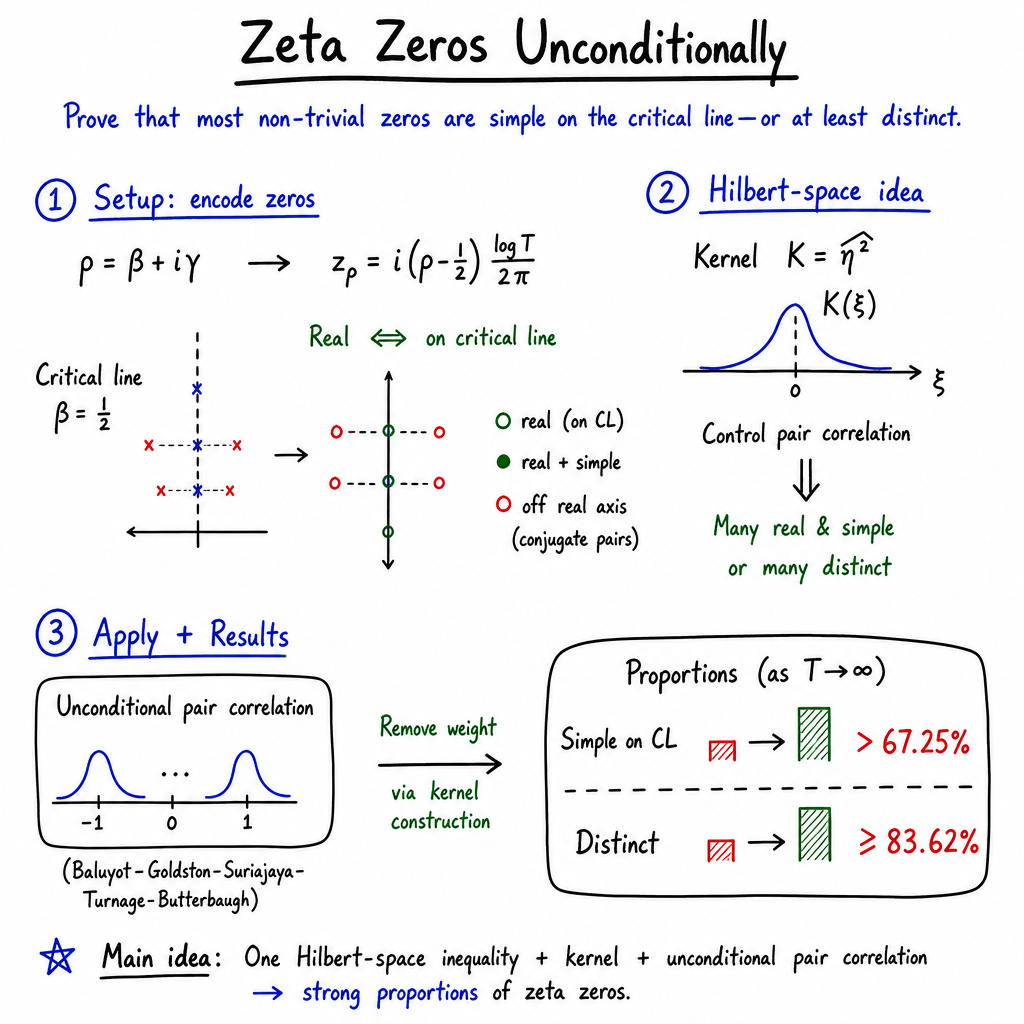
Abstract: We obtain a new, conceptually simpler, unconditional proof that more than of the non-trivial zeros of the Riemann zeta function are simple and on the critical line, and that at least of the non-trivial zeros are distinct. A proof of these results was very recently produced by an internal research version of Claude developed by Anthropic and subsequently verified by Alpöge and Furman. This argument is technically intricate, and its main mechanism is not immediately transparent. It combines several ingredients from linear algebra, including a finite-dimensional matrix representation of Weil's Hermitian form and a rank-trace inequality for Hermitian matrices, with a second moment calculation over the zeros using the explicit formula. Our new proof is shorter and proceeds by replacing the entire finite-dimensional matrix framework by a Hilbert space inequality, which allows for a direct application of Montgomery's theorem on the pair correlation of zeros of the zeta function, in the unconditional form obtained by Baluyot, Goldston, Suriajaya and Turnage-Butterbaugh.
Paper Prompts
Sign up for free to create and run prompts on this paper.
Top Community Prompts
Explain it Like I'm 14
1. What is this paper about?
This paper studies the Riemann zeta function, a complicated mathematical function closely connected to prime numbers.
The zeta function has special inputs, called zeros, where its value is equal to zero. Some of these zeros are called non-trivial zeros. Mathematicians want to understand where these zeros are located and whether some zeros are repeated.
The famous Riemann Hypothesis says that every non-trivial zero lies on a particular vertical line called the critical line:
The paper does not prove the Riemann Hypothesis. Instead, it proves that a very large proportion of the zeros have the properties predicted by the hypothesis.
Its main result is that:
- More than 67.25% of the non-trivial zeros are both simple and on the critical line.
- More than 83.62% of the zeros are distinct, meaning they are not repeated copies of the same zero.
2. What questions does the paper ask?
The paper focuses on two main questions:
- How many zeros lie on the critical line? The Riemann Hypothesis predicts that all of them do. Since this is not known, mathematicians try to prove that at least some definite percentage lie there.
- How many zeros are simple or distinct? A zero is called simple if it occurs only once. For example, if a function touches zero at one point in a normal way, that may be a simple zero. If it touches zero in a more complicated way and the same zero is counted several times, it has higher multiplicity.
The paper asks how large a guaranteed percentage of zeros can be shown to be simple and located on the critical line, without assuming the Riemann Hypothesis.
3. How did the researchers approach the problem?
The proof combines several ideas from analysis, geometry, and linear algebra. The central strategy can be understood in four stages.
Counting zeros
First, the researchers look at all non-trivial zeros whose imaginary parts are below a large number . Let represent the number of these zeros, counting repeated zeros more than once.
As becomes very large, the number of zeros grows approximately like
This formula tells the researchers how many zeros they are studying.
Turning zeros into points with symmetry
Each zero has the form
The paper transforms it into another complex number so that zeros on the critical line become real numbers. This is useful because the problem then becomes similar to this simpler question:
Given many complex points, how many of them are real and occur only once?
The zeros have an important mirror symmetry: if one zero appears, another related zero appears as its complex conjugate. The proof uses this symmetry.
Measuring how close zeros are
The researchers study how pairs of zeros are spaced. This is called pair correlation.
An everyday analogy is to imagine many people standing in a long line. Pair correlation asks:
Do the distances between pairs of people follow a particular pattern?
For zeta zeros, mathematicians use a special mathematical function called a kernel to give nearby pairs more weight than distant pairs. The kernel acts like a measuring tool or a blur filter: it summarizes how often zeros appear at particular distances from one another.
The important quantity is a sum over pairs of zeros:
The paper proves that this sum can be estimated accurately.
Replacing a large matrix with a Hilbert-space inequality
An earlier proof used a very large matrix. A matrix is a rectangular array of numbers, and the earlier argument used its rank and trace to estimate how many zeros had the desired properties.
This paper uses a different method. It replaces the large matrix calculation with an inequality in a Hilbert space.
A Hilbert space can be thought of as a very general version of ordinary space. In ordinary geometry, we measure the length of arrows and the angle between them. In a Hilbert space, the “arrows” can be functions instead of physical objects.
The researchers create functions associated with the zeros and compare them using ideas similar to measuring lengths and angles. A version of the Pythagorean theorem and Bessel’s inequality then gives a bound on how many zeros must be simple and real in the transformed picture.
This is the main conceptual improvement of the paper: it avoids constructing and analyzing a huge finite matrix.
4. What are the main findings?
The paper proves the following asymptotic results:
where counts zeros that are both simple and on the critical line.
In plain language, as we look higher and higher among the zeros, at least about 67.25% of them are guaranteed to have both properties.
The paper also proves
where counts distinct zeros. Thus, at least about 83.62% of the zeros are distinct.
These two percentages are connected by the relationship
Why are these results important?
They are important for several reasons:
- They improve what can be proved without assuming the Riemann Hypothesis.
- They show that repeated zeros cannot make up too large a portion of all zeros.
- They show that more than two-thirds of the zeros behave in the especially well-understood way of being simple and on the critical line.
- They provide a shorter and more transparent proof than the earlier matrix-based argument.
The result is still weaker than the full Riemann Hypothesis, which would say that 100% of the zeros lie on the critical line. However, proving any fixed positive proportion is difficult, and improving that proportion is a significant achievement.
5. What could this research lead to?
The research gives mathematicians a better way to study the zeros of the zeta function. Its method may help with future questions about:
- the exact locations of zeta zeros,
- how frequently zeros are repeated,
- the spacing between neighboring zeros,
- and the connection between zeta zeros and the distribution of prime numbers.
The paper also shows that complicated matrix arguments can sometimes be replaced by simpler geometric inequalities in a function space. This could make related problems easier to understand and possibly easier to solve.
Most importantly, the work moves mathematicians closer to understanding whether the Riemann Hypothesis is true. It does not settle that famous problem, but it proves that a large majority of the zeros already have the behavior the hypothesis predicts.
Knowledge Gaps
Knowledge gaps, limitations, and open questions
- Dependence on an external pair-correlation theorem: The main theorem relies essentially on Lemma 5 of Baluyot–Goldston–Suriajaya–Turnage-Butterbaugh (2024); the paper does not rederive its hypotheses, error term, or applicability in sufficient detail to make the argument self-contained.
- Insufficient treatment of the source theorem’s exact hypotheses: It remains unclear whether all regularity, support, uniformity, and height-range conditions required by the cited unconditional pair-correlation result are fully satisfied by the kernels constructed here.
- No explicit finite-height bounds: The proof establishes asymptotic liminf proportions but does not provide an explicit threshold or numerical finite- estimates beyond which the stated percentages are guaranteed.
- Error terms are not quantified uniformly in the optimization parameter: The construction fixes a kernel depending on , while the pair-correlation error is written as . The paper does not analyze how this constant grows as , so the order of the limits and cannot be made effective.
- The optimality claim is restricted to the proposed method: The statement that is optimal is supported through a cited extremal result, but the paper does not establish that no broader class of Hilbert-space inequalities, kernels, or test-function constructions can surpass the resulting bound.
- No investigation of improved input estimates: The argument uses a particular unconditional pair-correlation formula. It does not determine how stronger zero-density estimates, improved horizontal-distribution information, or sharper pair-correlation asymptotics would quantitatively improve the final proportions.
- The method does not approach the conjectural proportion: Although the paper discusses results showing that the full Pair Correlation Conjecture would imply asymptotically all zeros are simple and critical, it does not identify a path from the present unconditional estimate to proportions substantially above .
- Limited treatment of zeros near the boundary of the selected height interval: The multiset includes zeros with , whereas pair-correlation formulas and related asymptotics can be sensitive to endpoint conventions and transition ranges. The contribution of boundary effects is not separately analyzed.
- Multiplicity bookkeeping is not stress-tested in exceptional configurations: The abstract Hilbert-space proposition handles conjugation-invariant multisets, but the paper does not discuss in detail whether all possible multiplicity patterns of zeta zeros—including multiple real elements and coincident ordinates—interact correctly with the analytic weighting and limiting argument.
- The role of the complex kernel is not fully characterized: The proof avoids requiring termwise positivity of , but it does not classify which kernels or Hilbert-space factorizations permit the key inequality, nor whether alternative factorizations could yield stronger constants.
- The smoothing construction is asymptotic rather than explicit: The functions and are specified only existentially. No concrete choice is given with computable values of , derivative norms, or the associated error constants.
- The passage from the extremal nonsmooth function to smooth compactly supported kernels is not quantitatively controlled: The convergence in is asserted, but rates of convergence are not supplied. Such rates would be needed for effective optimization and numerical verification.
- Potential typographical and transcription defects obscure verification: Several displayed formulas in the supplied manuscript are malformed or missing symbols, including inequalities, summation conditions, multiplicity notation, and equation delimiters. A corrected version is needed to verify the proof rigorously and distinguish typographical errors from substantive gaps.
- The formal certificates are not independently documented: The appendix refers to Lean certificates and an external repository, but does not state the exact formalized definitions, axioms, imported results, or verification environment. It is therefore unresolved which parts are mechanically checked and which rely on unformalized assumptions.
- External AI-assisted verification is not mathematically audited in the paper: The manuscript reports certificates generated by AI systems but does not provide a human-readable correspondence between the formal code and every analytic step, leaving the scope and reliability of the formal verification unclear.
- The paper does not compare the new bound quantitatively with all competing unconditional methods: It establishes a conceptually simpler proof of the stated percentage, but does not systematically determine whether combining the Hilbert-space inequality with mollifier, density, or Levinson-type techniques could improve either the simple-critical or distinct-zero proportion.
- The distinct-zero bound is derived only as a consequence of the same second moment: The paper does not investigate whether a separate inequality tailored to multiplicities could produce a stronger lower bound than .
- Extensions to other -functions are left unexplored: The abstract proposition is formulated for arbitrary conjugation-invariant multisets, but the analytic argument is specialized to the Riemann zeta function. It remains open whether analogous unconditional results can be obtained for Dirichlet -functions, automorphic -functions, or families of -functions.
- No statistical or numerical validation is provided: The paper does not compare the kernel-based pair-correlation expression with computed zeta zeros, so it gives no empirical assessment of how sharp the inequality is at accessible heights.
Practical Applications
Immediate Applications
The paper is primarily a theoretical advance in analytic number theory. It does not provide a direct technology, medical, financial, or consumer application, nor does it establish the Riemann Hypothesis. Its immediate practical value lies in mathematical research, computational verification, and reusable proof methodology.
- Research tools for analytic number theory — academia and mathematical research
- The Hilbert-space formulation replaces a large finite-dimensional matrix construction with a direct inequality involving Fourier kernels and pair-correlation sums.
- Researchers can use this formulation as a simpler framework for studying:
- multiplicities of zeros,
- zeros lying on symmetry lines,
- pair-correlation statistics,
- analogous questions for other -functions.
- Potential tool or workflow: a reusable “kernel-design plus pair-correlation” proof template in which a researcher selects a compactly supported test function, computes its Fourier transform, and applies an explicit-formula estimate.
- Dependencies: the method requires a suitable unconditional or conditional pair-correlation theorem for the target zeta or -function.
- Improved benchmarking of numerical zeta-zero computations — software and computational mathematics
- The theorem supplies asymptotic lower bounds showing that more than of non-trivial zeros are both simple and on the critical line, while more than are distinct.
- These bounds can serve as consistency checks for large-scale numerical databases of zeros. Computed samples that substantially contradict the predicted proportions would indicate implementation, normalization, or multiplicity-detection errors.
- Potential product: validation modules for zeta-zero computation packages that compare observed zero multiplicities and critical-line occupancy with proven asymptotic lower bounds.
- Dependencies: the bounds are asymptotic as and should not be interpreted as exact finite-height guarantees without explicit error estimates.
- Formal verification of mathematical arguments — automated reasoning and proof assistants
- The appendix reports formal certificates for the key Hilbert-space proposition and the main theorem, using Lean-related tooling and an external repository.
- This demonstrates a workflow for converting advanced analytic-number-theory results into machine-checkable components:
- 1. formalize the abstract inequality,
- 2. formalize the pair-correlation input,
- 3. combine it with the Riemann–von Mangoldt asymptotic,
- 4. mechanically verify the resulting proportion bounds.
- Potential tool: libraries of formally verified lemmas for Fourier analysis, Hilbert spaces, entire functions, and explicit formulas.
- Dependencies: the formal certificate is only as strong as the correctness and formalization of its imported assumptions and underlying libraries. Independent review and reproducibility of the cited repository remain important.
- Graduate-level education in proof design — academia and education
- The paper provides a comparatively accessible example of how a complicated matrix argument can be replaced by:
- a Hilbert-space inequality,
- orthogonal decompositions,
- Bessel’s inequality,
- Fourier-transform identities,
- an analytic pair-correlation estimate.
- Potential educational workflow: use the paper in courses or seminars on analytic number theory, demonstrating how abstract functional analysis can simplify a problem traditionally presented through matrix rank and trace estimates.
- Dependencies: the argument contains technical notation and relies on substantial background in zeta functions, Fourier analysis, and asymptotic estimates.
- Systematic optimization of test functions — mathematical software
- The construction of smooth compactly supported functions approximating the Montgomery–Taylor extremal function illustrates how kernel selection controls the final numerical constant.
- Researchers can implement numerical optimization routines to search for improved admissible kernels or to test analogous extremal problems.
- Potential tool: a symbolic-numerical kernel optimizer that evaluates quantities such as
subject to support, symmetry, smoothness, and normalization constraints. - Dependencies: numerical optimization cannot by itself prove a new bound; any candidate must satisfy the analytic hypotheses and be incorporated into a rigorous pair-correlation argument.
Methodological guidance for AI-assisted mathematics — research and proof engineering
- The paper presents a concrete example in which an AI-generated argument was subsequently verified and then reformulated into a shorter human-readable proof.
- This supports a practical workflow in which AI systems are used for conjecture exploration, proof discovery, or proof compression, followed by:
- expert mathematical checking,
- formal verification,
- explicit identification of imported assumptions.
- Dependencies: AI-generated proofs may contain hidden gaps, transcription errors, or reliance on unverified claims. Human review and proof-assistant validation remain necessary.
Long-Term Applications
The following possibilities would require additional theorems, generalizations, computational development, or improved error control. They are plausible research directions rather than applications established directly by the paper.
- Generalization to other -functions — number theory, cryptography, and spectral mathematics
- The central proposition applies to finite multisets invariant under complex conjugation and is not intrinsically restricted to the Riemann zeta function.
- A suitably generalized pair-correlation theorem could allow analogous estimates for:
- Dirichlet -functions,
- automorphic -functions,
- Dedekind zeta functions,
- families associated with elliptic curves or modular forms.
- Potential outcome: rigorous estimates on simple zeros and zeros on symmetry lines for families of -functions.
- Dependencies: each family requires an appropriate functional equation, zero-counting formula, explicit formula, and pair-correlation estimate. These are currently unavailable in the required strength for many important cases.
- Sharper understanding of prime-number distributions — number theory and algorithmic prime analysis
- The paper reinforces the connection between zero correlations and the distribution of primes. Stronger information about zeta zeros can improve theoretical control over:
- primes in short intervals,
- fluctuations in prime-counting functions,
- error terms in explicit prime-counting formulas.
- Potential tools: more reliable asymptotic and interval-based estimates for prime-counting algorithms and computational experiments.
- Dependencies: the reported result concerns proportions of zeros, not their complete location. It does not by itself yield the Riemann Hypothesis or the strongest desired prime-distribution error bounds.
- Progress toward zero-multiplicity diagnostics — computational number theory
- The Hilbert-space inequality could be adapted into quantitative diagnostics for detecting clusters or repeated zeros in numerical data.
- Potential workflow: combine computed zeros with optimized kernels to estimate pair-correlation energy and flag regions that may contain unresolved multiplicities or numerical inaccuracies.
- Dependencies: numerical zeros at high height are difficult to compute and distinguish when closely spaced. Kernel-based diagnostics would need rigorous finite-height error bounds and robust numerical conditioning.
- Automated theorem discovery and formalization pipelines — AI and mathematical software
- The combination of AI-generated reasoning, human mathematical simplification, and Lean certificates suggests a future pipeline for advanced research mathematics:
- 1. an AI proposes an inequality or proof strategy;
- 2. symbolic tools test algebraic and analytic subclaims;
- 3. a proof assistant checks the formal result;
- 4. researchers inspect the assumptions and translate the proof into publishable form.
- Potential product: domain-specific systems for formal analytic number theory, including libraries for Fourier kernels, explicit formulas, and zero statistics.
- Dependencies: formalizing complex analysis, asymptotic analysis, distributions, and analytic number theory at research scale remains technically demanding.
- Improved extremal-kernel methods — optimization, harmonic analysis, and signal-processing analogies
- The paper’s use of compactly supported functions and Fourier kernels may inspire broader extremal problems in harmonic analysis, where one seeks kernels that minimize or control correlation energies.
- In an indirect engineering analogy, similar optimization principles could inform spectral-window design or interference-sensitive estimators, although the paper itself does not establish such applications.
- Dependencies: transferring the method to engineering requires a separate model connecting the mathematical quadratic form to a physical measurement or signal-processing objective.
- Stronger bounds from refined pair-correlation information — long-term analytic number theory
- If future work obtains pair-correlation estimates closer to the full Pair Correlation Conjecture, the same Hilbert-space framework could potentially yield proportions approaching of zeros that are simple and lie on the critical line.
- Potential consequence: substantially improved understanding of the structure of zeta zeros and the relationship between zero statistics and prime fluctuations.
- Dependencies: this requires major advances in unconditional pair-correlation theory. The paper’s bound is optimal for the particular Montgomery–Taylor extremal method described, so improvement may require either stronger analytic input or a fundamentally different method.
- Policy and public communication about mathematical evidence — science policy and education
- The result can be used to distinguish rigorously proven partial progress from unresolved conjectures in discussions of the Riemann Hypothesis.
- Practical use: educational and policy materials can explain that a large proven proportion of zeros lies on the critical line, while the statement that all zeros do so remains unproved.
- Dependencies: communication must preserve the distinction between asymptotic lower bounds, numerical evidence, conditional results, and a complete proof of RH.
Glossary
- Asymptotic formula: A formula describing the limiting behavior of a quantity as a parameter tends to infinity. “The classical Riemann--von Mangoldt formula gives , as .”
- Bessel’s inequality: An inequality bounding the sum of squared Fourier coefficients relative to the squared norm of a vector in an inner-product space. “Hence by Bessel's inequality we get”
- Convolution: An operation combining two functions by integrating products of shifted copies of them. “”
- Critical line: The vertical line in the complex plane, on which the Riemann hypothesis predicts all non-trivial zeta zeros lie. “all the non-trivial zeros of the Riemann zeta function lie on the critical line .”
- Critical strip: The region containing the non-trivial zeros of the Riemann zeta function. “That is, the zeros lying in the critical strip $0Re(s) 1$.”
- Entire function: A complex-valued function that is holomorphic over the whole complex plane. “Note that this is an entire function since is compactly supported.”
- Explicit formula: An identity connecting sums over prime numbers with sums over zeros of the zeta function. “with a second moment calculation over the zeros using the explicit formula.”
- Extremal problem: An optimization problem seeking the largest or smallest possible value of a mathematical quantity under specified constraints. “the same Montgomery--Taylor extremal problem”
- Fejér kernel: A nonnegative trigonometric kernel used in Fourier analysis and, here, in pair-correlation estimates. “Montgomery then computes this pair correlation sum with being the Fej”
- Functional equation: An equation relating values of a special function at transformed arguments, often providing symmetry of its zeros. “The functional equation of the zeta function implies that is a zero with the same multiplicity as .”
- Fourier transform: An integral transform expressing a function in terms of its frequency components. “For a compactly supported function we define its Fourier transform”
- Gram–Schmidt process: An algorithm that converts a linearly independent family of vectors into an orthonormal basis. “We now apply the standard Gram-Schmidt process to construct an orthonormal basis”
- Hilbert space: A complete inner-product space, possibly infinite-dimensional. “replace the entire finite-dimensional matrix framework by a Hilbert space inequality”
- Hilbert–Schmidt norm: The norm of a matrix or operator obtained by taking the square root of the sum of the squared absolute values of its entries or singular values. “the square of its Hilbert-Schmidt norm”
- Holomorphic: Complex differentiable in a neighborhood of every point in a domain. “which here and throughout we define”
- Kernel: A function used to weight or transform pairs of points, often in an integral or correlation sum. “Montgomery then computes this pair correlation sum with being the Fej”
- Lipschitz continuous: Satisfying a bound in which function differences grow no faster than a constant times the distance between inputs. “suppose that be a real-valued even function with support in , and suppose that is Lipschitz continuous at ”
- Mellin-type zeta analysis: The study of the Riemann zeta function through complex-analytic methods associated with Dirichlet series and Mellin transforms. “the distribution of prime numbers.”
- Mollification: The use of a smoothing function, called a mollifier, to make analytic estimates more tractable. “who pioneered the use of mollification in this problem”
- Multiplicity: The number of times a zero or root occurs, counted with repetition. “let be its multiplicity.”
- Multiset: A collection in which elements may occur more than once, with each occurrence retaining its multiplicity. “we will be working with multisets instead of sets of zeros.”
- Non-trivial zero: A zero of the Riemann zeta function in the critical strip, excluding the known trivial zeros at negative even integers. “Let denote a non-trivial zero of the Riemann zeta function”
- Orthonormal basis: A basis consisting of mutually orthogonal unit vectors. “construct an orthonormal basis of ”
- Pair correlation: A statistical measure of the spacing relationships between pairs of zeros. “Montgomery's theorem on the pair correlation of zeros of the zeta function”
- Parseval’s theorem: A result equating the total squared magnitude of a function with the sum of the squared magnitudes of its coefficients in an orthonormal expansion. “then by Parseval's theorem and \eqref{Eq:IntegralFz} we obtain”
- Positive proportion: A limiting fraction bounded below by a strictly positive constant. “proved in 1942 that a positive proportion of the zeros lie on the critical line.”
- Riemann hypothesis: The conjecture that every non-trivial zero of the Riemann zeta function has real part $1/2$. “The Riemann hypothesis (RH) is one of the central open problems in mathematics”
- Riemann–von Mangoldt formula: An asymptotic formula estimating the number of zeta zeros up to a given height. “The classical Riemann--von Mangoldt formula gives”
- Second moment: The average or total of the squares of values in a collection, commonly used to measure quadratic size. “both may be viewed as variants of a second-moment argument”
- Semidefinite programming: Optimization over positive semidefinite matrices subject to linear constraints. “via semidefinite programming”
- Simple zero: A zero whose multiplicity is exactly one. “more than of the non-trivial zeros of the zeta function are simple and on the critical line”
- Support: The set of points where a function is nonzero, or the closure of that set. “such that ”
- Test function: A sufficiently regular function selected to probe or weight an analytic expression. “To combine Proposition~\ref{Pro:FourierHilbert} with the pair correlation formula in Lemma~\ref{Lem:BGST}, we must remove the weight”
- Unconditional: Established without assuming an unproved hypothesis such as the Riemann hypothesis. “We obtain a new, conceptually simpler, unconditional proof”
- Zero-density hypothesis: An assumption controlling how many zeros of a zeta or -function lie in specified regions. “showed that Montgomery's $2/3$ bound for simple zeros follows from a zero-density hypothesis.”
- Zeta function: The complex function whose zeros and analytic properties encode important information about prime numbers. “the Riemann zeta function”

