On the OpenAI proof that Landau-Siegel zeros do not exist
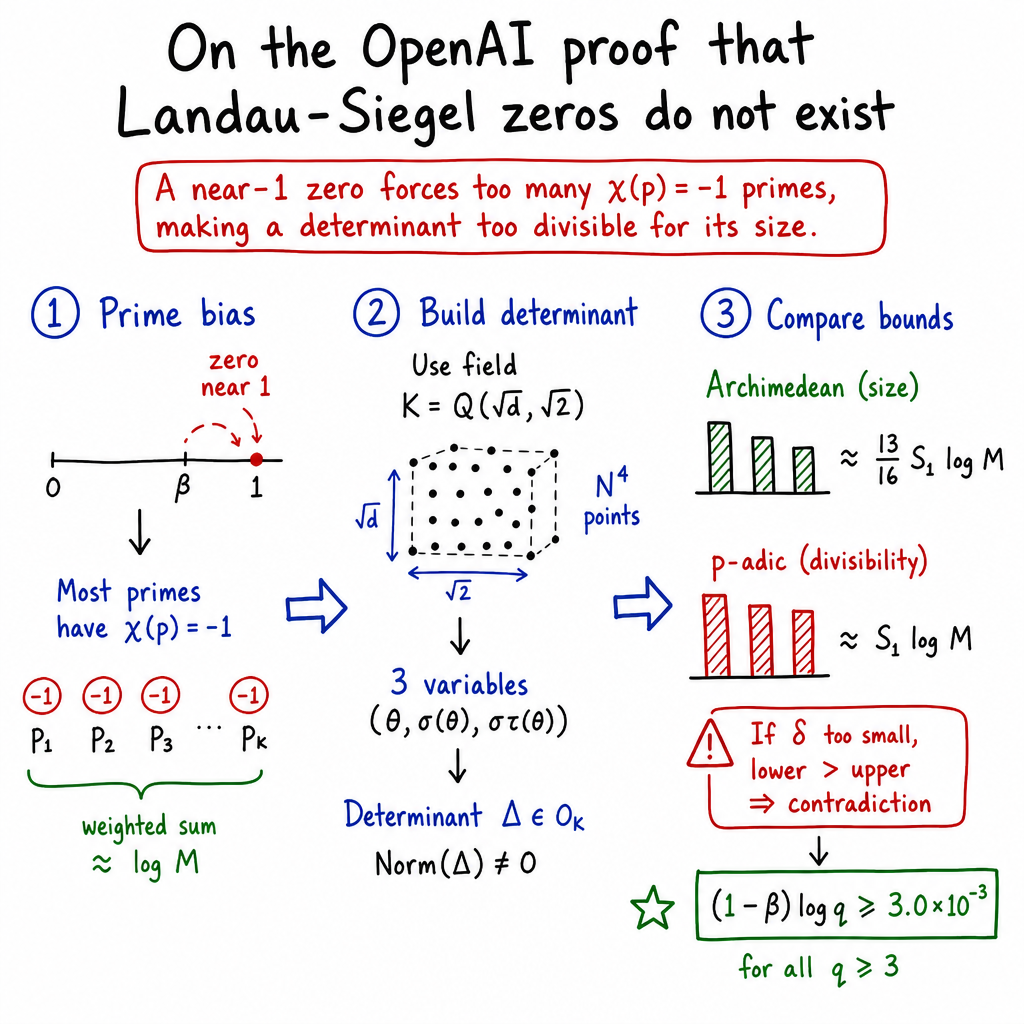
Abstract: A recent manuscript of OpenAI asserts that Landau-Siegel zeros do not exist. Here, we give a detailed account of its argument, arranged as a direct proof with explicit constants. There are absolute constants and such that, for every primitive real Dirichlet character of conductor , every real zero of satisfies , and one can take and . Combined with a recent computation of Lu, Zaman, and Zhao, this result yields the bound for every conductor . The proof is an interpolation determinant argument in the biquadratic field generated by over the quadratic field attached to . A real zero close to one forces for most primes , and the Frobenius congruence at these primes makes a certain nonzero determinant divisible by higher powers of these primes than its Archimedean size allows. The underlying ideas are those of the OpenAI manuscript. The explicit constants, and the presentation, are new.
Paper Prompts
Sign up for free to create and run prompts on this paper.
Explain it Like I'm 14
1. What is the paper about?
The paper studies a famous unsolved question in number theory: whether certain special zeros of mathematical functions called Dirichlet -functions exist.
These possible zeros are called Landau–Siegel zeros. They would be numbers very close to $1$ where an -function becomes zero. Mathematicians have tried for a long time to determine whether such zeros can actually occur.
The paper claims to prove that they do not exist. More precisely, it claims that if is one of these real zeros, then
where is an integer measuring the complexity of the -function.
In simple terms: the paper says that these zeros cannot get too close to $1$.
Important caution: The text provided is a claimed proof, not evidence that the result has been accepted by the mathematical community. The claim would require careful checking by independent experts, especially because the existence of Landau–Siegel zeros is a major open problem.
2. What questions does the paper ask?
The main research question is:
Can a real zero of a Dirichlet -function get extremely close to $1$?
The authors try to show that the answer is no. Their specific goals are to:
- Prove that there is a fixed positive distance between such a zero and $1$.
- Give actual numerical values for the constants involved.
- Show that, for sufficiently large , one can use
- Use existing computer calculations to extend this conclusion to smaller values of .
Why does this matter? If Landau–Siegel zeros existed, they could make it much harder to understand how prime numbers are spread among different patterns, such as numbers ending in particular remainders.
3. How does the paper try to prove this?
The proof combines ideas from several areas of mathematics. A useful way to picture the overall strategy is this:
- Assume that a Landau–Siegel zero exists and is very close to $1$.
- Show that this assumption forces an unusual pattern among prime numbers.
- Build a large mathematical determinant that is known to be nonzero.
- Show that the determinant must be both:
- very small when measured using ordinary absolute values, and
- very divisible by many prime numbers.
- Conclude that these two facts cannot both be true.
This is similar to showing that a number is required to be both smaller than $1$ and divisible by a large integer. That would be impossible unless the original assumption was wrong.
A. The “prime bias” idea
The paper argues that if is extremely close to $1$, then many primes must satisfy
Here, is a rule that assigns values such as $1$, , or $0$ to primes. It is a kind of mathematical coloring system.
The paper calls this a prime bias. It means that the primes would not be distributed in their usual balanced way. Instead, most of their “weight” would fall on primes with .
The authors obtain this result from an inequality involving the logarithmic derivative
This complicated expression measures how quickly the -function changes. The paper uses information about its zeros to estimate sums involving primes.
For a young-reader analogy, imagine a machine that produces a long sequence of colored balls. If the machine has a special hidden defect, the paper claims that almost all the important balls must be one particular color.
B. Building a determinant
The proof then constructs numbers inside a special number system called a biquadratic field. This field contains expressions involving
The authors form many points such as
They use powers of these numbers to form the rows of a very large matrix. The determinant of this matrix is called .
A determinant is a number that summarizes certain information about a matrix. If the determinant is nonzero, the rows and columns contain genuinely independent information.
The paper proves that is nonzero by using polynomial interpolation. This is the same basic idea as drawing a curve through selected points, except that the paper works with many variables and much more complicated points.
C. The ordinary-size estimate
The authors estimate how large can be using an inequality called Hadamard’s inequality.
Hadamard’s inequality says, roughly, that a determinant cannot be larger than the product of the lengths of its rows. Since the entries in the matrix are built from numbers of controlled size, this gives an upper bound for .
This is the paper’s “ordinary size” estimate:
The determinant cannot be too large when viewed using usual absolute values.
D. The divisibility estimate
Next, the authors study what happens modulo a prime .
For many primes with , they use a fact about the Frobenius map:
This means that raising to the th power behaves, modulo , like applying one of the field’s symmetry operations.
Using this congruence, the authors show that must be divisible by high powers of many such primes. In other words, must contain a very large factor made from primes.
This is the second estimate:
The determinant must be extremely divisible by primes.
E. Comparing the two estimates
The prime-bias result says that there are many primes of the required type. Therefore, the divisibility estimate becomes very strong.
Eventually, the paper compares:
- an upper bound on the size of , and
- a lower bound coming from the large prime factors dividing .
The authors claim that if were too small, the lower bound would exceed the upper bound. That would be impossible. Therefore, they conclude that must be at least a fixed positive number.
4. What are the main claimed findings?
The central claimed theorem is:
for every primitive real Dirichlet character of sufficiently large conductor , with the paper giving
The paper then combines this with a previous computer-assisted result for smaller conductors. It claims that the same lower bound holds for every .
The important claimed conclusion is therefore:
Landau–Siegel zeros do not exist.
If correct, this would be a major result because it would remove a long-standing obstacle in the study of primes and number fields.
The paper also emphasizes that its proof is effective. This means that it does not merely say “some positive constant exists”; it gives a numerical value for the constant.
5. Why would this matter?
Landau–Siegel zeros are important because they could affect our understanding of:
- how primes are distributed in arithmetic progressions;
- how often primes appear in different residue classes;
- estimates related to quadratic fields;
- lower bounds for class numbers, which measure how complicated certain number systems are.
If the claimed theorem were correct, mathematicians could use stronger and more reliable estimates in all these areas.
For example, it could improve results about how quickly primes appear in different patterns and could make some previously ineffective mathematical estimates fully computable.
6. Simple overall summary
The paper’s argument can be summarized like this:
- Suppose a forbidden zero lies extremely close to $1$.
- This would force many primes to behave in an unusual way.
- Use those primes to construct a special determinant.
- The determinant would have to be both small and divisible by an enormous number.
- That is impossible.
- Therefore, the zero cannot be so close to $1$.
The paper presents this as a proof that Landau–Siegel zeros do not exist and gives the explicit bound $0.003$.
However, because this is a very strong claim about a famous open problem—and because the supplied document itself describes the argument as based on an “OpenAI proof”—the result should be treated as unverified until independent mathematicians check every step. A gap in any part of the determinant, interpolation, or prime-distribution argument could invalidate the conclusion.
Practical Applications
Immediate Applications
The paper’s central claim is a theoretical bound excluding Landau–Siegel zeros, with explicit constants, but the excerpt does not by itself establish that the proof has been independently validated. Accordingly, the applications below should be understood as conditional on the theorem and its constants being correct.
- Analytic number theory: improved effective estimates for primes in arithmetic progressions Sector: Academia, computational number theory, cryptography-adjacent number theory Category: Immediate Application A verified lower bound of the form
would make certain estimates involving Dirichlet -functions effective with an explicit constant. Researchers could incorporate the bound into algorithms and proofs concerning: - the distribution of primes in residue classes; - explicit versions of the prime number theorem for arithmetic progressions; - bounds on exceptional characters; - effective zero-free regions near . Dependencies: The result must survive independent verification, including the interpolation determinant construction, the -adic divisibility argument, and the numerical constant extraction.
- More reliable explicit bounds in computational prime-search algorithms
- certified bounds for the first prime ;
- interval-search routines with provable stopping thresholds;
- libraries for explicit estimates involving .
- Dependencies: The theoretical bound must be translated into concrete ranges of and implemented with careful treatment of small conductors and imprimitive characters.
- Effective lower bounds for quadratic class numbers
- certified searches for quadratic fields with prescribed class-number properties;
- explicit estimates for regulators and units;
- computational studies of quadratic field families.
- Dependencies: The relationship between the zero-free estimate and the relevant class-number formula must be made explicit. Additional analytic estimates may be needed for sharp numerical bounds.
- Benchmarking and verification of automated mathematical proofs
- checking AI-generated research proofs;
- testing theorem-proving systems on analytic number theory;
- evaluating whether a model distinguishes plausible arguments from verified arguments;
- building proof-audit workflows that track dependencies between lemmas.
- The dependency diagram and separation into analytic, algebraic, geometric, and determinant components are particularly suitable for machine-assisted checking.
- Dependencies: A formal verification system would need libraries for Dirichlet -functions, algebraic number fields, determinants, valuations, and explicit numerical inequalities.
- Reusable interpolation-determinant techniques
- auxiliary-polynomial constructions;
- transcendence and Diophantine approximation arguments;
- rank estimates for structured evaluation matrices;
- symbolic algorithms for selecting independent polynomial features.
- Dependencies: The specific interpolation result depends on rational linear independence of coordinates and the stated dimension inequalities. Its transfer to other settings would require checking these hypotheses.
- Explicit computational experiments on exceptional characters
- enumerates primitive real Dirichlet characters;
- computes or bounds real zeros of ;
- checks the claimed small-conductor range;
- tests the determinant construction for moderate and .
- This would provide an independent computational audit, even if it could not replace a proof for all conductors.
- Dependencies: Reliable high-precision evaluation of -functions, certified zero isolation, and independent implementations of the relevant arithmetic routines.
Long-Term Applications
- A fully effective theory of primes in arithmetic progressions
- explicit least-prime-in-progression bounds;
- effective versions of Linnik-type theorems;
- improved estimates for primes represented by quadratic forms;
- stronger uniformity across moduli.
- Dependencies: Further optimization of , treatment of all relevant character types, and integration with explicit zero-density estimates and zero-free regions.
- Improved algorithms for arithmetic progressions and residue-class sampling
- cryptographic key-generation workflows;
- prime generation for algebraic algorithms;
- randomized testing of modular arithmetic systems;
- distributed searches for primes with prescribed residues.
- Dependencies: The bound would need to be converted into practical parameter ranges rather than merely asymptotic or very large-conductor statements. Security applications would also require conservative margins and empirical validation.
- Stronger explicit estimates for quadratic class groups and regulators
- estimating class-group sizes;
- certifying lower bounds for class numbers;
- studying narrow class groups;
- analyzing families of real and imaginary quadratic fields.
- Such tools could be incorporated into computer algebra systems for certified arithmetic in number fields.
- Dependencies: Effective use of class-number formulas, regulator estimates, and efficient algorithms for handling large discriminants.
- Generalized determinant methods for other -functions
- Hecke -functions;
- Artin -functions;
- automorphic -functions;
- zero-repulsion and exceptional-zero problems in higher-degree extensions.
- Dependencies: Suitable algebraic integral models, controllable Frobenius actions, interpolation spaces with favorable dimension growth, and explicit bounds on all conjugates.
- Automated proof-auditing pipelines for advanced mathematics
- unsupported transitions;
- incorrect uses of asymptotic estimates;
- hidden dependence of constants;
- invalid divisibility or integrality claims;
- gaps between an asymptotic argument and an explicit theorem.
- Dependencies: Formalization of substantial analytic-number-theory libraries and reliable mechanisms for detecting subtle errors in long proofs.
- New algorithms for structured interpolation and determinant optimization
- interpolation on algebraic lattices;
- structured polynomial feature selection;
- rank testing for tensor-product evaluation matrices;
- determinant maximization under degree constraints;
- algebraic coding constructions.
- Dependencies: The method would need to be generalized beyond the special four-dimensional lattice and three-variable projection used here. Numerical stability would also be a major issue in non-exact implementations.
- Policy and research-integrity standards for AI-generated mathematical results
- disclosure of AI involvement;
- machine-readable proof dependencies;
- reproducible computational checks;
- separate verification of headline constants;
- clear distinction between conjectural, conditionally established, and independently verified results.
- Dependencies: Broad adoption by journals, availability of verification artifacts, and agreement on standards for authorship, accountability, and reproducibility.
- Daily-life applications are indirect rather than direct Sector: Daily life Category: Long-Term Application The result is too specialized to produce an immediate consumer-facing product. Any eventual effect would be indirect, through improved mathematical software, cryptographic infrastructure, certified computation, or educational material on proof verification. Dependencies: Successful translation of the theorem into usable algorithms and practical software, plus independent confirmation that the claimed result is correct.
Glossary
- Archimedean bound: An estimate involving the usual absolute value on a number field embedded in the complex numbers. “The Archimedean bound.”
- Biquadratic field: A degree-four number field obtained by adjoining two independent square roots. “The proof is an interpolation determinant argument in the biquadratic field generated by over the quadratic field attached to .”
- Carathéodory’s theorem: A convex-geometric result stating that points in the convex hull of a set in a -dimensional affine space can be represented using at most points. “By Carathéodory's theorem applied in that space, every point of $\conv(\cS\cap\cG_{h})=\cG_{h}$ is a convex combination of at most four points.”
- Conductor: The smallest modulus associated with a Dirichlet character, measuring its arithmetic complexity. “Let be a primitive real Dirichlet character of conductor .”
- Convex hull: The smallest convex set containing a given set of points. “with $\conv(\cS)$ its convex hull.”
- Dirichlet character: A completely multiplicative periodic arithmetic function used to encode residue-class information. “Let be a primitive real Dirichlet character of conductor .”
- Dirichlet -function: A complex analytic function defined from a Dirichlet character by a generalization of the Riemann zeta function. “every real zero of satisfies”
- Discriminant: An integer invariant associated with an algebraic number field or quadratic form. “for a fundamental discriminant with ”
- Euclidean norm: The standard length function on a real or complex vector space. “$\|x\|\defeq(x\dotpx)^{1/2}$”
- Frobenius congruence: A congruence describing the action of the Frobenius endomorphism modulo a prime. “Then $\theta^p\equiv g_p(\theta)\bmod{p\,\cO}\qquad(\theta\in\cO).$”
- Frobenius endomorphism: The map sending an element of a ring of characteristic to its th power. “The ring $\cO/p\,\cO$ has characteristic , so its Frobenius endomorphism is a ring homomorphism”
- Fundamental discriminant: A discriminant that corresponds to the ring of integers of a quadratic field and parametrizes primitive quadratic characters. “for a fundamental discriminant with ”
- Galois group: The group of field automorphisms fixing the base field. “with Galois group $\Gal(K/\Q)=\{1,\sigma,\tau,\sigma\tau\}$”
- Hadamard’s inequality: An inequality bounding a determinant by the product of the Euclidean norms of its rows or columns. “Hadamard's inequality, applied to each conjugate of , gives”
- Interpolation determinant: A determinant formed from evaluations of functions, used to establish algebraic independence or divisibility properties. “It is an interpolation determinant argument of a kind familiar from transcendence theory”
- Kronecker symbol: A generalization of the Legendre symbol defining a quadratic Dirichlet character. “A primitive real character of conductor is the Kronecker symbol”
- Landau–Siegel zero: A hypothetical real zero of a Dirichlet -function unusually close to $1$. “A zero of this kind is called a Landau--Siegel zero.”
- Legendre symbol: A function indicating whether an integer is a quadratic residue modulo an odd prime. “$\chi(p)=#1{d}{p}\quad\text{(Legendre symbol) for every odd prime$p$.}$”
- Logarithmic derivative: The derivative of a function divided by the function itself, often used to study its zeros. “We begin with the classical bound for the logarithmic derivative of ”
- Mertens’ theorem: A theorem describing the asymptotic behavior of sums involving primes, including . “By the explicit form of Mertens' theorem”
- Norm: The product of all Galois conjugates of an algebraic number, yielding an element of the base field. “Thus, $\Nm(\Delta)$ is a nonzero integer.”
- Partial fraction formula: A representation of a meromorphic function as a sum of terms associated with its poles or zeros. “The classical partial fraction formula”
- -adic bound: An estimate based on divisibility by powers of a prime . “The -adic bound.”
- Primitive character: A Dirichlet character that does not arise by inducing a character of a smaller modulus. “for every primitive real Dirichlet character of conductor ”
- Prime bias: The tendency, forced by a zero near one, for a character to take the value at unusually many primes. “A zero with small forces for most primes .”
- Quadratic field: A number field obtained by adjoining the square root of a nonsquare rational number. “Let $\Q(\sqrt{d}\,)$ be the quadratic field attached to ”
- Real zero: A zero of a complex-valued function lying on the real axis. “every real zero of ”
- Siegel’s theorem: An ineffective lower-bound result for values of Dirichlet -functions near . “Siegel~\cite{Sie} proved that $L(1,\chi)\gg_\eps q^{-\eps}$”
- Supporting face: A face of a convex body on which a linear functional achieves its maximum. “Step 3: a supporting face and a distinguished point .”
- Transcendence theory: The study of algebraic and transcendental numbers, including methods for proving that numbers are not algebraic. “It is an interpolation determinant argument of a kind familiar from transcendence theory”
- Unipotent matrix: A matrix whose eigenvalues are all equal to one; a lower triangular unipotent matrix has ones on its diagonal. “with some lower triangular matrix that has ones on the diagonal (in other words, a lower unipotent matrix).”