Complete or Sparse: A Tale of Two Identifiabilities
Abstract: Understanding when neural networks learn interpretable representations is central to mechanistic interpretability. We study this through identifiability: when can supervised learning recover the true latent variables underlying the data? We introduce two data generating processes distinguished by their causal direction where either labels cause latents (generative) or latents cause labels (discriminative). When the representation has at least as many dimensions as the latent space, we prove that the optimal encoders are linear in the latents. Conversely, when dimensions are insufficient, identifiability generically fails and encoders become nonlinear. We then show that additional constraints yield recovery of individual latent variables, not just linear mixtures. In the generative setting, non-negative activations and energy efficiency force each neuron to encode exactly one latent, providing a precise account of selective grandmother cell-like responses. In the discriminative setting, when latents are sparse and the true measurement matrix satisfies the spark condition, the learned encoder inherits compressed sensing structure, enabling sparse dictionary learning to perfectly recover individual latents. This constitutes, to our knowledge, the first identifiability result for undercomplete nonlinear independent component analysis. Our framework unifies nonlinear ICA, compressed sensing, and neural network interpretability, delineating exactly when representations transition from nonlinear distortions to linear representations and, under additional constraints or steps, to clean, axis-aligned codes. Theoretical predictions are validated on synthetic benchmarks and on activations drawn from vision models, LLMs, and macaque inferotemporal cortex.
Paper Prompts
Sign up for free to create and run prompts on this paper.
Top Community Prompts
Explain it Like I'm 14
1. What is the paper about?
This paper asks a big question about neural networks and brains:
When does a neuron represent one clear idea, and when does it represent a mixture of several ideas?
For example, one neuron might respond mostly to dogs, while another might respond to a mixture such as dogs, wheels, and the color red. A neuron with one clear meaning is called monosemantic. A neuron representing several mixed ideas is called polysemantic.
The authors study this using a mathematical idea called identifiability. Identifiability means asking whether a learning system can recover the hidden features that originally produced the data.
The paper’s main message is:
- If a neural network has enough neurons, it can recover the important hidden features in a mostly organized way.
- If it has too few neurons, it must squeeze information together, often creating complicated or mixed representations.
- Extra rules, such as non-negative neuron activity or sparse data, can help individual neurons line up with individual concepts.
2. What questions did the researchers ask?
The paper focuses on several related questions:
- Can supervised learning recover the hidden features behind data? For example, can a network discover hidden properties such as shape, color, or object type?
- What happens when the network has enough neurons? Does it recover the hidden features in a simple form, or does it twist them into something difficult to understand?
- What happens when the network has too few neurons? Does the network have to create nonlinear and mixed representations?
- What extra conditions make neurons individually interpretable?
The authors investigate conditions such as:
- neurons only producing non-negative activity;
- using as little total activity or “energy” as possible;
- hidden features being sparse, meaning that only a few are active at a time.
- Can these ideas explain real neurons and modern AI systems? The authors compare their predictions with vision models, LLMs, and neurons in monkey visual cortex.
3. How did they study the problem?
A simple model of hidden features
The researchers imagine that data are produced in two steps:
- There are hidden variables, written as . These might represent concepts such as “has wheels” or “is a cat.”
- A complicated transformation turns these hidden variables into the visible input, written as .
The neural network receives and learns an internal representation, written as . It then uses this representation to predict a label, such as the name of an object.
The transformation from hidden variables to input is allowed to be nonlinear. In everyday language, this means the input may be a complicated, distorted version of the original information—like a scrambled message.
Two ways the data can be produced
The paper studies two different situations.
Generative setting: labels help create the features
In this setting, the class comes first, and the hidden features are then produced from it.
For example:
Someone decides to draw the number “3,” and then creates an image with the shapes needed to make a 3.
The authors model the hidden features as:
- non-negative, meaning they cannot be below zero;
- sparse, meaning only a few features are strongly active at once.
Discriminative setting: features determine the label
Here, the hidden features come first, and the label is chosen afterward.
For example:
An image contains certain features, and a person looks at those features to decide whether it shows a cat or a dog.
In this setting, the authors focus especially on hidden features that are sparse.
Measuring whether the network predicts correctly
The network predicts class probabilities, such as:
- 80% cat
- 15% fox
- 5% dog
The researchers train it using cross-entropy loss, a standard way to measure how far the network’s predictions are from the correct probabilities. It is similar to giving the network a penalty when it is confidently wrong.
They then use mathematical proofs and computer experiments to study the best possible network.
Important technical ideas in simple language
- Latent variables: hidden features that explain the data.
- Linear transformation: mixing features together using addition and multiplication. For example, one neuron might represent “2 × color + shape.”
- Nonlinear transformation: a more complicated twisting or distortion of information.
- Capacity: how many useful dimensions or neurons the network has.
- Overcomplete or sufficient capacity: the network has at least as many important neurons as hidden features.
- Undercomplete capacity: the network has fewer neurons than important hidden features.
- Compressed sensing: recovering a large hidden message from a smaller measurement, when only a few parts of the message are active.
- Sparse dictionary learning: finding a collection of hidden features that can explain data using only a few features at a time.
4. What did they find?
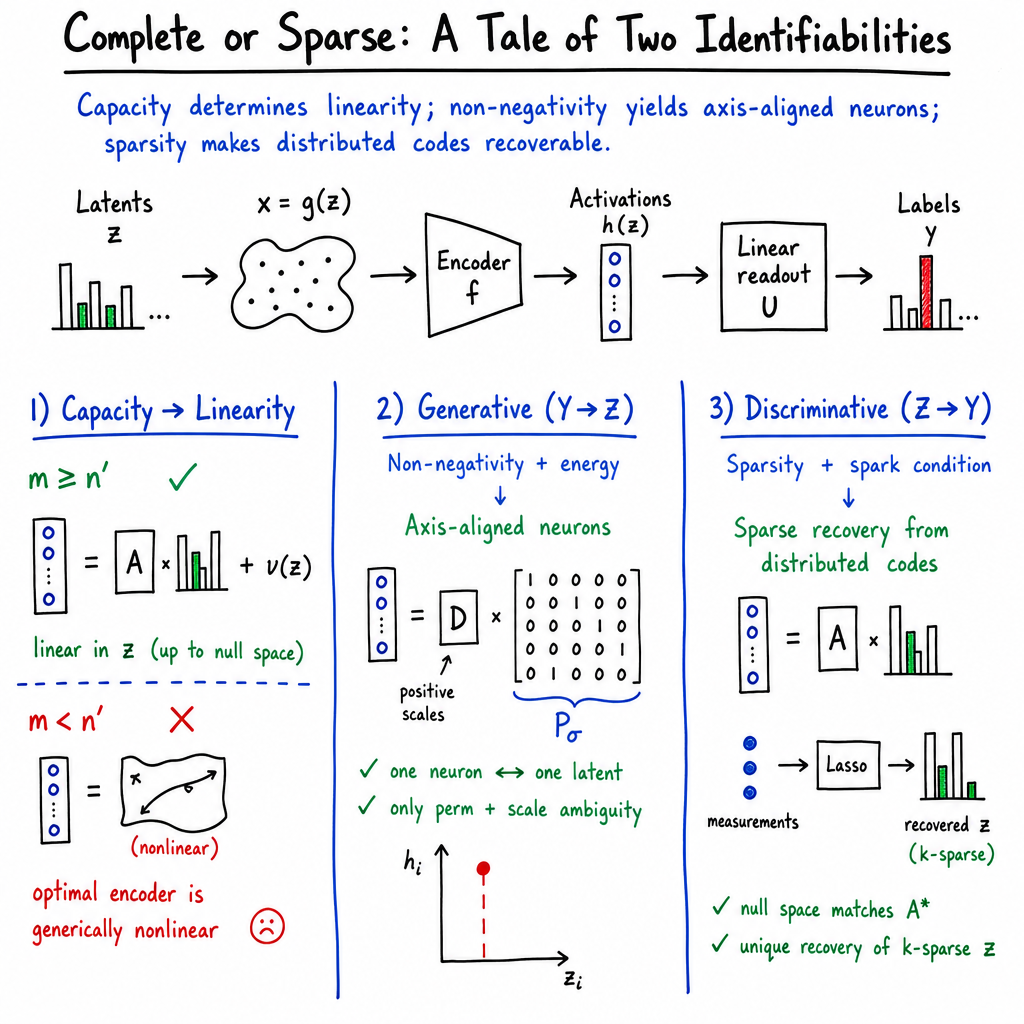
Finding 1: Enough neurons usually lead to a linear representation
When the network has at least as many neurons as the important hidden dimensions, the part of its representation used for classification must be linear in the hidden variables.
This does not necessarily mean that each neuron represents exactly one feature. Instead, the network may mix the features together.
For example, suppose the true hidden features are:
- shape
- color
- size
The network might learn neurons representing:
- shape + color
- color − size
- shape + size
The information is still present, but it is mixed across neurons.
This explains why a network can perform well while its individual neurons remain difficult to interpret.
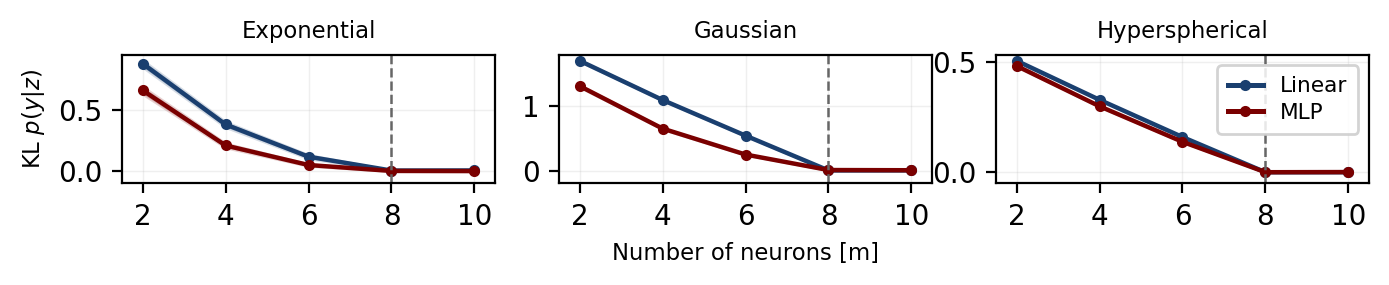
Finding 2: Too few neurons force nonlinear distortions
If the network has fewer neurons than the important hidden dimensions, it cannot preserve all the information in a simple linear form.
The authors prove that the best solution is generally nonlinear. In other words, the network must bend, compress, or distort the hidden information to fit it into a smaller space.
The experiments found a clear change at the point where the number of neurons became equal to the effective number of hidden dimensions:
| Network capacity | Expected representation |
|---|---|
| Enough neurons | Mostly linear recovery of the hidden features |
| Too few neurons | Nonlinear and less identifiable representation |
This is similar to trying to store a long message in a very small notebook. You may need abbreviations, complicated codes, or summaries that are hard for someone else to decode.
Finding 3: Non-negative activity and efficiency can create single-concept neurons
In the generative setting, the authors add three important conditions:
- the network has exactly enough neurons;
- neuron activity cannot be negative;
- the network is encouraged to use as little activity or energy as possible.
Under these conditions, the mathematical optimum is a scaled permutation of the original features. In simpler terms:
- each neuron lines up with one hidden variable;
- the order of the neurons may change;
- each neuron may use a different positive scale.
For example, one neuron might represent “redness,” another “roundness,” and another “large size,” instead of each neuron mixing all three.
This gives a possible explanation for so-called grandmother cells, neurons that respond strongly to a particular object or concept.
Finding 4: Sparse features can be recovered even from compressed representations
In the discriminative setting, the network may not represent every hidden feature directly. Instead, it may create a smaller mixture of them.
The authors show that if:
- only a small number of hidden features are active at once; and
- the network’s measurements preserve enough information,
then the original features can still be recovered using sparse decoding.
This is the idea behind compressed sensing. Imagine taking a small number of carefully designed measurements of a picture that contains only a few bright stars. Even though the measurements are compressed, the locations of the stars can be reconstructed.
This result helps explain why sparse autoencoders can often find meaningful features inside neural-network activations. The original neuron activations may be mixtures, but a sparse autoencoder can separate the mixture into clearer concepts.
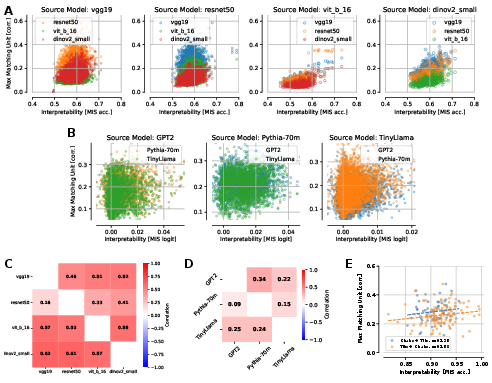
Finding 5: Clearer neurons tend to match across systems
The researchers also tested real systems:
- vision models trained on ImageNet;
- LLMs;
- neurons from macaque monkey visual cortex.
They measured how interpretable each neuron was and whether a similar neuron could be found in another model or brain.
Their results showed a general pattern:
The more clearly a neuron represented one concept, the more likely another system had a neuron with a similar response.
The pattern was strongest in vision models, weaker in LLMs, and suggestive—but less statistically certain—in the monkey data.
5. Why are these findings important?
The paper connects several observations that can seem contradictory:
- Some neurons appear to represent one clear concept.
- Other neurons represent several concepts at once.
- Sparse autoencoders can sometimes separate mixed representations into understandable features.
- Neural networks and brains may use distributed representations when they have limited space.
The authors argue that these are not necessarily competing explanations. They may happen under different conditions.
A useful summary is:
| Situation | Likely result |
|---|---|
| Enough neurons, but no special constraints | Hidden features are recovered as mixtures |
| Too few neurons | Information is compressed through nonlinear distortions |
| Non-negative activity plus energy efficiency | Individual neurons can match individual features |
| Sparse hidden features plus suitable measurements | Sparse methods can recover the original features |
6. What could this mean for AI and neuroscience?
For artificial intelligence, the research suggests that interpretability depends not only on how large a model is, but also on:
- how many neurons are available;
- how information is distributed;
- whether the model uses sparse activity;
- whether the representation is constrained to be non-negative;
- whether tools such as sparse autoencoders are used.
This could help researchers understand why some AI neurons have clear meanings while others are polysemantic.
For neuroscience, the theory offers a possible explanation for why some brain neurons respond selectively to particular objects or ideas. Individual “grandmother cells” might arise naturally when sparse, non-negative, energy-efficient coding is useful.
However, the authors also emphasize that their theory is simplified. Real brains and datasets do not perfectly satisfy the assumptions. For example, real features may be negative, classes may not be equally common, and the hidden data-generating process may not be truly sparse.
Conclusion
The paper argues that the way a neural network represents information depends strongly on the relationship between:
- the number of important hidden features;
- the number of available neurons;
- the structure of the data; and
- the rules placed on neuron activity.
With enough capacity, a network can recover hidden information in a fairly organized way. With too little capacity, it must compress and distort that information. Under special conditions—especially sparsity and non-negative activity—individual neurons can become aligned with individual concepts.
The main practical lesson is that interpretable neurons do not happen by accident alone. They are more likely when the data are sparse and the network’s design encourages simple, efficient representations. This could lead to better tools for understanding AI models and may also shed light on how biological brains organize information.
Knowledge Gaps
Knowledge gaps, limitations, and open questions
- The theoretical results are established only for highly idealized classification settings with an exactly log-linear conditional distribution ; it remains unclear whether the identifiability and axis-alignment conclusions hold for nonlinear label mechanisms, regression, generative modeling, or multitask objectives.
- The proposed generative model assumes conditionally independent, non-negative exponential latent variables; the effects of correlated latents, heavy-tailed distributions, discrete variables, bounded variables, signed variables, and manifold-valued latents are not characterized.
- The axis-alignment theorem depends critically on equal conditional entropy across classes, but the paper provides no quantitative theory describing how deviations from this assumption affect alignment, neuron mixing, or identifiability.
- The claim that moderate entropy violations merely “blur” axis alignment is based on preliminary simulations rather than a systematic characterization of the alignment error as a function of entropy heterogeneity.
- The role of the uniform class prior is only discussed through an offset argument; the effects of severe class imbalance on global optima, optimization dynamics, and practical axis alignment remain unresolved.
- The energy objective is represented by minimizing expected squared activation magnitude, but the equivalence between this mathematical regularizer and biological energy efficiency, weight decay, or commonly used neural-network training objectives is not established.
- It is unclear whether axis alignment persists under alternative energy costs, such as activation sparsity, metabolic costs, L1 penalties, firing-rate constraints, or costs applied to weights rather than activations.
- The axis-alignment theorem assumes exact capacity ; the behavior with mild overcapacity, undercapacity, dead units, or dynamically varying capacity is not theoretically resolved.
- The theorem does not establish uniqueness of the scaling factors or predict their values; the interaction between scaling indeterminacy, normalization layers, regularization, and downstream readouts remains unexplored.
- Extra representation dimensions are theoretically unconstrained by the classification loss in the overcomplete regime, but the paper does not determine what practical training dynamics, regularization, initialization, or architecture will make these dimensions linear, nonlinear, meaningful, or unused.
- The “generic nonlinearity” result for does not quantify how much nonlinear distortion is required, how it depends on the degree of undercompleteness, or which nonlinear encoder structures achieve the optimum.
- The undercomplete theorem relies on strong support assumptions, including a distribution with nonempty interior and intersections between candidate null spaces and the support; its applicability to sparse, discrete, low-dimensional, or manifold-supported data is unclear.
- The paper does not characterize the global optimum or identifiability structure in the transition regime near , beyond empirical evidence of a phase transition.
- The results assume unlimited data and global optimization, whereas the effects of finite samples, stochastic optimization, model misspecification, and local minima are not analyzed.
- The compressed-sensing theorem requires the true measurement matrix to satisfy the spark-$2k$ condition, but spark is difficult to verify and is substantially stronger or less practical than common restricted-isometry, incoherence, or mutual-coherence assumptions; robustness under weaker conditions is unstudied.
- The theorem guarantees equality of null spaces, but it does not establish recovery of the measurement matrix itself, including its scale, basis, conditioning, or row-space geometry beyond the null space.
- Exact sparse recovery is proved only for noiseless measurements and exactly -sparse latents; robustness to measurement noise, approximate sparsity, dense weak features, distribution shift, and estimation error is left unresolved.
- The analysis assumes that every latent vector is uniformly bounded in sparsity by ; it does not address realistic sparsity distributions in which the number of active features varies across examples.
- The paper does not determine whether unsupervised sparse dictionary learning can reliably recover the latent dictionary under the stated assumptions, despite presenting this as an explanation for sparse autoencoders.
- The gap between the theorem’s supervised sparse recovery procedure and practical sparse autoencoders is not formally bridged: practical SAEs use learned dictionaries, reconstruction losses, sparsity penalties, finite-width decoders, and optimization heuristics that differ from the theorem’s setting.
- The empirical unsupervised recovery results decline as sparsity increases, but the paper does not explain this degradation theoretically or identify the sample, dictionary, or optimization thresholds governing successful recovery.
- The identifiability analysis treats the encoder as an arbitrary continuous function and does not establish whether standard architectures—ReLU MLPs, convolutional networks, transformers, normalization layers, or residual networks—can represent or attain the stated global optima.
- The assumption that the nonlinear mixing function is invertible excludes information loss, nuisance variables, stochastic observation processes, occlusion, and non-injective sensory mappings common in natural data.
- The causal distinction between and is imposed through synthetic data-generating processes, but the paper does not provide a method for identifying or validating the causal direction in real datasets.
- It remains unclear whether the proposed conclusions depend on the causal direction itself or primarily on the different latent distributions and supervision structures chosen for the two settings.
- The connection between axis-aligned latent variables and “grandmother cells” is indirect: the theory predicts alignment with abstract latent coordinates, but it does not show that those coordinates correspond to semantic concepts, invariant objects, or biologically meaningful variables.
- The real-data experiments use MIS as a proxy for latent disentanglement, but MIS is itself an interpretability metric and may correlate with MMU through shared selectivity, frequency, variance, or neuron-quality effects rather than identifiability.
- The cross-model and cross-brain analyses are correlational and do not establish that disentanglement causes cross-system feature preservation.
- The biological validation is limited to two macaques, a small number of recorded neurons, and one visual cortical region; generalization across animals, cortical areas, tasks, behavioral states, and recording technologies remains unknown.
- The reported macaque correlations are weak and statistically nonsignificant in the presented directions, so the evidence for cross-animal preservation is inconclusive.
- The model comparisons involve a small set of vision and LLMs and do not test how architecture, training objective, model scale, data overlap, fine-tuning, or layer depth affect the proposed relationship between interpretability and cross-system matching.
- The experiments use synthetic benchmarks with ten random seeds and near-perfect optimization outcomes, but uncertainty from dataset size, hyperparameter selection, initialization, and repeated training failures is not comprehensively assessed.
- The paper does not provide scaling experiments that test whether the theoretical regime survives as the latent dimension, number of classes, network width, dataset size, or sparsity level grows to realistic values.
- The robustness of the results to violations of conditional independence and exponential conditionals is reported only qualitatively; no general theorem specifies which distributional perturbations preserve identifiability.
- The framework does not address temporal structure, contextual dependence, sequential data, or nonstationarity, despite the relevance of temporal nonlinear ICA to neural and language representations.
- The theory focuses on population cross-entropy minimizers and does not explain how finite regularization, early stopping, batch normalization, dropout, residual connections, or optimizer choice select among the many equivalent minimizers.
- The paper leaves open whether the proposed identifiability mechanisms improve behavioral performance, causal faithfulness, feature steering, robustness, or interpretability of downstream computations.
- The claim that sufficient capacity plus sparsity leads to clean latent recovery under distribution shift is untested; recovery may fail when the latent support, sparsity level, class distribution, or measurement matrix changes at test time.
- The paper does not study latent variables that are hierarchically related, compositional, entangled by causal interactions, or active only conditionally, all of which may violate the assumed independent-coordinate structure.
- It remains unresolved whether a single model can simultaneously exhibit axis-aligned neurons for some features and compressed, polysemantic representations for others under heterogeneous latent distributions and nonuniform feature frequencies.
Practical Applications
Immediate Applications
- Mechanistic interpretability of language and vision models — Software/AI safety
- Apply sparse autoencoders or sparse dictionary-learning pipelines to intermediate activations in LLMs, vision models, and multimodal systems.
- Use the recovered sparse features to label model concepts, detect polysemantic neurons, trace feature-to-output pathways, and inspect whether safety-relevant concepts are represented.
- A practical workflow is: collect activations → train an overcomplete sparse dictionary → solve sparse codes for new activations → rank features by selectivity and causal effect → validate by feature ablation or activation steering.
- Dependency: Reliable recovery requires sufficiently sparse underlying features, adequate activation data, and a measurement matrix with compressed-sensing-like properties. High feature overlap, distribution shift, or dense representations can reduce recovery quality.
- Automated neuron and feature matching across models — AI auditing and model comparison
- Use interpretability scores such as monosemanticity or selective-response metrics to prioritize neurons likely to have counterparts in another model.
- Match units or sparse features across model versions, architectures, training checkpoints, or independently trained systems to identify shared representations.
- This could support regression testing: if a model update removes or changes a feature associated with factuality, toxicity, visual recognition, or instruction following, the change can be flagged.
- Dependency: Cross-model matching assumes comparable inputs and sufficiently aligned semantic features. The reported correlations are empirical associations, not guarantees of functional equivalence.
- Capacity planning for interpretable representations — Machine-learning engineering
- Estimate the effective latent dimension , then choose representation width accordingly:
- If , a linear and potentially interpretable representation is theoretically attainable.
- If , expect nonlinear compression and reduced identifiability.
- This provides a design diagnostic for bottleneck layers, embedding dimensions, sparse autoencoders, and representation-learning systems.
- Dependency: The effective dimension must be estimated from the task and data; raw input dimension is not necessarily the relevant quantity. The threshold is derived under idealized population-loss assumptions and may not precisely predict finite-data behavior.
- Improved sparse-autoencoder training and evaluation — Software tooling
- Combine sparse penalties, non-negative activations, weight decay, and validation against reconstruction or prediction performance when decomposing neural activations.
- Evaluate learned features using both:
- linear alignment, which detects recovery up to arbitrary mixing; and
- axis-alignment or monosemanticity metrics, which test whether individual features correspond to individual latent concepts.
- This avoids treating low reconstruction error alone as evidence of interpretable or disentangled features.
- Dependency: Non-negativity is especially important for the paper’s axis-alignment result. Signed or highly dense latent variables may require alternative identifiability criteria.
- Compressed sensing for sparse signal decoding — Signal processing and neuroscience
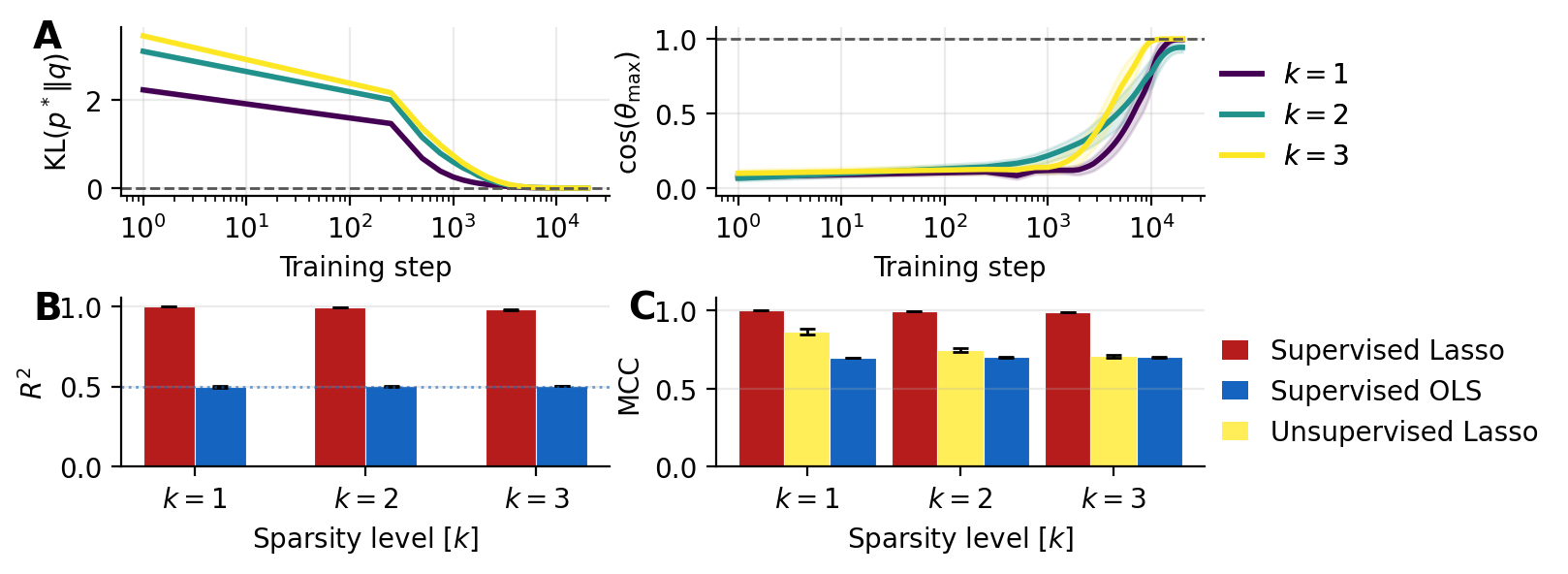
- When a high-dimensional signal is sparse, recover the original latent vector from a lower-dimensional neural or computational representation using Lasso or related sparse solvers.
- Potential uses include decoding sparse visual features from cortical recordings, reconstructing sparse sensor states, and interpreting compressed activations in neural networks.
- A deployable workflow is to learn or estimate a measurement matrix, verify sparse-recovery conditions empirically, and decode with Lasso rather than ordinary least squares.
- Dependency: Recovery depends strongly on sparsity level , measurement quality, noise, and matrix geometry. Ordinary least squares cannot generally recover components that are invisible in the compressed projection.
- Interpretability-aware model diagnostics — Industry and research operations
- Use the paper’s regime distinction to diagnose why a model exhibits monosemantic units, mixed selectivity, or nonlinear bottleneck behavior.
- For example, teams can inspect whether observed polysemanticity results from:
- insufficient representation capacity;
- superposition of sparse features;
- absence of non-negativity or sparsity constraints; or
- genuinely distributed task structure.
- This can guide decisions about widening a layer, adding a sparse dictionary, changing activation functions, or applying feature-level regularization.
- Dependency: These diagnoses are hypotheses unless supported by intervention experiments; correlations between interpretability and representation similarity do not establish causality.
- Neuroscience data analysis — Academic and biomedical research
- Analyze neural population recordings with non-negative factorization, sparse coding, and cross-subject matching to identify selective neuronal responses and shared latent features.
- The framework provides a principled comparison between single-neuron coding and distributed population coding rather than assuming that one is universally more efficient.
- It may help prioritize neurons for targeted electrophysiology, imaging follow-up, or causal stimulation experiments.
- Dependency: Biological neural responses may be signed, noisy, recurrent, and manifold-valued, violating the paper’s exponential non-negative latent assumptions. The reported macaque correlations are modest and should not be interpreted as proof of one-to-one biological feature correspondence.
- Educational tools for representation learning — Education and academia
- Build teaching demonstrations showing the transition at :
- train linear and nonlinear encoders at different bottleneck widths;
- compare classification loss and latent recovery;
- impose ReLU and energy penalties;
- visualize mixed versus axis-aligned representations.
- Such tools can make identifiability, nonlinear ICA, superposition, and compressed sensing concrete for courses in machine learning, neuroscience, and information theory.
- Dependency: Synthetic demonstrations may make the theoretical effects appear cleaner than they are in real datasets.
Long-Term Applications
- Interpretable and controllable AI systems — AI safety and enterprise software
- Develop model architectures that deliberately allocate sufficient capacity for task-relevant latent factors and regularize representations toward sparse, non-negative, or otherwise identifiable codes.
- A mature system could expose a feature API in which each latent direction has a human-readable description, confidence estimate, causal influence score, and intervention mechanism.
- Applications include debugging, compliance review, bias analysis, and controlled editing of model behavior.
- Dependencies: Real-world latent variables may be signed, hierarchical, correlated, nonstationary, or non-sparse. Further work is needed to connect statistical identifiability with causal faithfulness and robust human interpretation.
- Feature-level monitoring for deployed foundation models — AI governance
- Construct monitoring systems that track interpretable features across model versions and deployment environments.
- Alerts could identify the emergence of unsafe concepts, changes in refusal-related features, loss of domain knowledge, or representation drift under distribution shift.
- Cross-model matching could support standardized “feature cards” analogous to model cards, documenting which internal features are preserved across releases.
- Dependencies: Feature identities may be unstable under reparameterization, fine-tuning, quantization, or adversarial inputs. Monitoring must therefore include causal interventions and robustness tests rather than relying only on correlation-based matching.
- Adaptive architecture selection and compression — Edge AI and robotics
- Use estimates of effective latent dimension and sparsity to choose between:
- wider linear representations;
- nonlinear bottlenecks;
- sparse overcomplete dictionaries; or
- compressed-sensing decoders.
- In embedded robotics, autonomous sensing, or edge devices, sparse latent codes could reduce communication, storage, and inference costs while preserving recoverable information.
- Dependencies: Energy efficiency in the paper is represented mainly through activation norms or weight decay, which may not correspond directly to hardware energy. Hardware-aware training and noise-tolerant sparse recovery remain necessary.
- Sparse and interpretable medical decoding — Healthcare and neurotechnology
- Apply the framework to neural prostheses, brain–computer interfaces, medical imaging, and physiological sensing where clinically meaningful signals may be sparse.
- Potential products include decoders that reconstruct interpretable motor, sensory, or pathological features from fewer electrodes or compressed measurements.
- Axis-aligned or sparse features could make clinical models easier to inspect and calibrate.
- Dependencies: Clinical data are subject-specific, noisy, temporally dependent, and often nonstationary. Safety-critical deployment requires prospective validation, uncertainty quantification, privacy protection, and evidence that recovered features correspond to clinically meaningful variables.
- Cross-species and cross-subject neural representation atlases — Neuroscience
- Build atlases that match selective neural features across animals, individuals, brain areas, or recording sessions.
- The paper’s prediction suggests that highly disentangled units may be more consistently matched across systems, potentially assisting studies of visual concepts, object categories, or sensory invariances.
- Dependencies: Neural correspondence may reflect shared stimulus statistics rather than shared biological mechanisms. Larger datasets, longitudinal recordings, anatomical alignment, and causal validation are required.
- Theory-guided unsupervised discovery of scientific factors — Science and engineering
- Use sparse dictionary learning to discover latent factors in high-dimensional datasets such as climate observations, molecular measurements, industrial sensors, or financial time series.
- The capacity and identifiability framework could help distinguish recoverable factors from artifacts created by an undercomplete nonlinear bottleneck.
- Dependencies: The paper’s guarantees concern supervised classification with a specific log-linear structure. Applying them to continuous prediction, temporal dynamics, causal inference, or correlated latent variables requires new theory.
- Policy and standards for interpretable AI evaluation — Regulation and public-sector procurement
- Establish evaluation standards that separately report:
- task performance;
- representation capacity relative to effective task dimension;
- linear recoverability;
- sparse or axis-aligned recoverability;
- stability across models and datasets; and
- causal usefulness of identified features.
- Procurement frameworks could require evidence that claimed explanations survive feature ablation, distribution shifts, and model updates.
- Dependencies: No single disentanglement score guarantees fairness, truthfulness, or causal validity. Standards must avoid equating monosemanticity with overall model safety.
- Biologically plausible efficient neural hardware — Neuromorphic computing
- Translate the non-negative, sparse, and energy-constrained regime into neuromorphic architectures using spiking or non-negative units.
- Such systems could seek selective, low-energy representations in sensory processing, robotics, and event-based vision.
- Dependencies: The theoretical axis-alignment result assumes exact capacity, specific latent support, and a particular statistical objective. Hardware noise, recurrence, timing, and signed synaptic effects may substantially alter the predicted behavior.
Glossary
- Ablation: An experiment that removes or changes a component to test its effect. “We also conduct ablation tests to assess the robustness of our results to violations of these assumptions.”
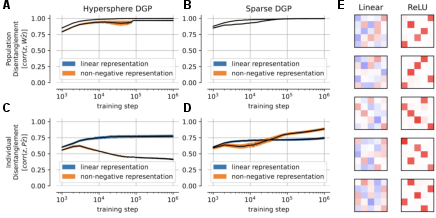
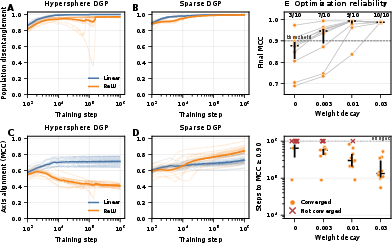
- Axis alignment: A representation in which individual dimensions correspond directly to individual latent variables. “Axis alignment tells a different story (bottom panels): the combination of a sparse DGP and a non-negative output layer converges (albeit slowly) to an axis-aligned neural representation”
- Bayes’ rule: A theorem for computing conditional probabilities by reversing the direction of conditioning. “With a uniform prior , Bayes' rule gives the posterior in the form of \eqref{eq:true_posterior}”
- Bottleneck: A dimensionality limitation that restricts the information a representation can encode. “The encoder must distort the geometry.”
- Causal direction: The assumed direction in which one set of variables generates or influences another. “The difference between our two DGPs will be the causal direction between these: either generative or discriminative .”
- Compressed sensing: A framework for recovering sparse signals from a smaller number of linear measurements. “This ensures all -sparse latents remain distinguishable after projection, making compressed sensing recovery possible”
- Conditional entropy: The uncertainty remaining in one random variable given another. “We assume constant conditional entropy across classes”
- Cross-entropy loss: A loss function measuring the discrepancy between true and predicted probability distributions. “Training minimizes the cross-entropy loss”
- Data Generating Process (DGP): A probabilistic specification describing how observed data are produced. “We propose a sparse Data Generating Process (DGP)”
- Discriminative setting: A modeling setup in which latent variables generate or determine labels. “In this setting, we draw a latent first from some prior , and then draw a label conditioned on that latent.”
- Disentanglement: The separation of distinct underlying factors into independently interpretable representation components. “Disentanglement is assessed with two metrics.”
- Dictionary learning: The process of learning basis elements that represent data as sparse combinations. “The learned encoder inherits compressed sensing structure, enabling sparse dictionary learning to perfectly recover individual latents.”
- Effective dimensionality: The number of dimensions relevant to the predictive relationship, here defined by a matrix rank. “The effective dimensionality $n' = \rank(W^*)$ will play a central role in our analysis.”
- Energy constraint: A restriction or objective favoring representations with low activation magnitude. “An energy constraint favors small activations”
- Exponential conditional distribution: A probability distribution whose density decreases exponentially with a variable. “giving factorized exponential conditionals”
- Factorized distribution: A distribution expressed as a product of independent or conditionally independent component distributions. “giving factorized exponential conditionals”
- Full-capacity regime: A setting in which the representation has at least as many dimensions as the effective latent space. “We begin with the full–capacity setting ()”
- Generative setting: A modeling setup in which labels are generated before and influence latent variables. “In this setting, we draw a label first, then a latent conditioned on that label.”
- Identifiability: The property that a model’s underlying variables or parameters can be uniquely recovered from observations, subject to specified ambiguities. “Understanding when neural networks learn interpretable representations is central to mechanistic interpretability.”
- Independent Component Analysis (ICA): A method for recovering statistically independent latent sources from observed mixtures. “Recent theoretical advances in identifiability theory, particularly nonlinear Independent Component Analysis (ICA)”
- Invertible function: A function with a unique inverse, so each output corresponds to exactly one input. “The latent variables are transformed into inputs by an invertible nonlinear function”
- Latent variable: An unobserved variable inferred from observed data. “We assume latent variables that are -dimensional”
- Log-linear model: A model in which the logarithms of probabilities or odds depend linearly on input variables. “We assume the true relationship between latents and labels is captured by a log-linear model”
- Logit: An unnormalized score used as input to a softmax or related probability transformation. “Softmax logits are invariant to a common row shift”
- Mechanistic interpretability: The study of how individual components of neural networks implement computations. “Understanding when neural networks learn interpretable representations is central to mechanistic interpretability.”
- Mixed selectivity: Neural or model responses that encode multiple features or variables simultaneously. “This means that they exhibit what is called mixed selectivity”
- Monosemanticity: The property of a unit representing one interpretable feature or concept. “The existence of these highly interpretable individual neurons is surprising”
- Non-negative matrix factorization: A factorization of a matrix into components constrained to contain no negative entries. “Sparse coding and non-negative matrix factorization”
- Nonlinear Independent Component Analysis: Independent component analysis in which the observed data are generated through nonlinear transformations of latent sources. “Recent theoretical advances in identifiability theory, particularly nonlinear Independent Component Analysis (ICA)”
- Null space: The set of vectors mapped to zero by a linear transformation. “The term captures the degrees of freedom in the dimensions orthogonal to the readout.”
- Overcomplete representation: A representation with more dimensions or components than the underlying latent space. “We derive identifiability results for both the overcomplete ()”
- Polysemanticity: The representation of multiple unrelated features by one neuron or unit. “or, polysemanticity in mechanistic interpretability of AI research.”
- Row space: The vector space spanned by the rows of a matrix. “so rank equals the dimension of the row space.”
- Selective response: A response of a neuron or unit to a particular feature or concept. “neurons that selectively respond to highly specific concepts”
- Softmax: A function converting a vector of scores into a probability distribution. “$p(y|z) = \softmax(W^* z)$”
- Sparse autoencoder: An autoencoder designed to produce representations in which most activations are zero or near zero. “This offers a principled explanation for the success of sparse autoencoders”
- Sparse coding: Representing data using only a small number of active basis elements. “Sparse coding and non-negative matrix factorization”
- Spark condition: A compressed-sensing condition requiring that no nonzero sufficiently sparse vector lies in a measurement matrix’s null space. “ satisfies the spark-2 condition: no nonzero $2k$-sparse vector lies in $\Ker(A^*)$.”
- Superposition: The encoding of multiple features along overlapping, non-orthogonal directions in a representation space. “features in deep networks may be represented in superposition”
- Undercomplete representation: A representation with fewer dimensions than the latent space or effective input structure. “Conversely, we prove that in the undercomplete setting (), the global optimum of the cross-entropy loss is generically nonlinear”
- Variance normalization: A procedure that fixes or standardizes the variance of activations. “a fixed within-class population variance (e.g., variance normalization)”

